Table of Contents
- A Summer Day That Changed a Continent: The Pan-European Picnic of 1989
- Iron Curtain’s Tight Grip: Europe Divided Since 1945
- Winds of Change in 1989: A Continent on the Brink
- Hungary’s Reformers and the Idea of an Open Border
- The Vision Behind the Picnic: Otto von Habsburg’s Dream
- Sopron’s Quiet Village: Setting the Stage for History
- August 19th, 1989: The Day the Border Opened
- The Pan-European Picnic Unfolds: Families, Soldiers, and Refugees
- East German Refugees’ Journey to Freedom
- Cold War Tensions and Silent Triumphs
- The Unexpected Mass Exodus: A Human Wave Over the Fence
- Behind the Scenes: Diplomacy and Hesitation in the Background
- The Impact on the German Democratic Republic
- The Fall of the Berlin Wall: A Domino Effect Begins
- Hungary’s Bold Steps toward Democracy and European Integration
- Personal Stories: Voices of Those Who Crossed
- The Picnic’s Legacy in European Unity and Memory
- Reflecting on Human Courage Amid Political Upheaval
- Pan-European Picnic Commemorations Today
- The Symbolism of Borderless Europe: Still Relevant?
1. A Summer Day That Changed a Continent: The Pan-European Picnic of 1989
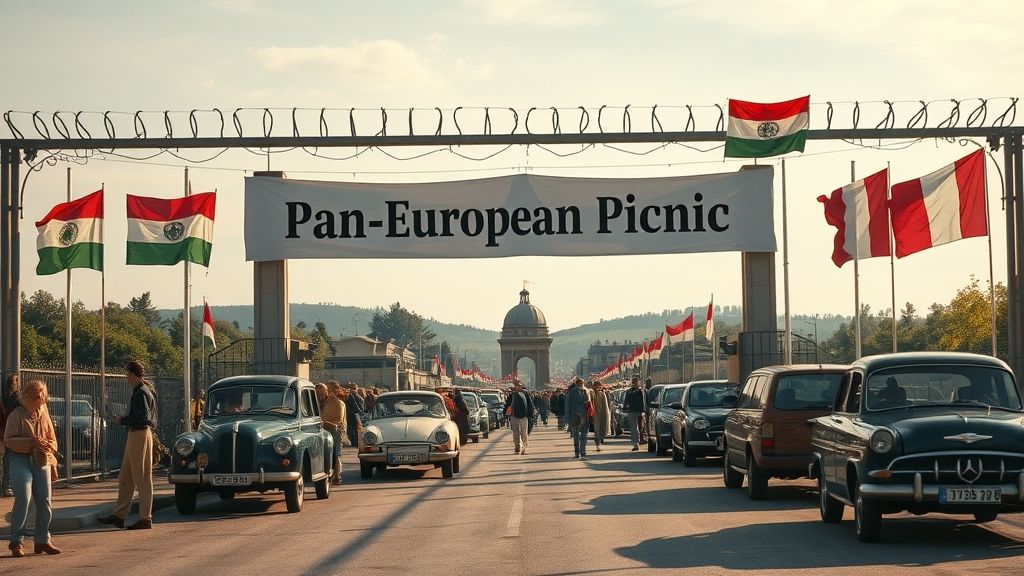
The morning sun rose gently over the small town of Sopron in western Hungary on August 19, 1989. Birds chirped, the scent of freshly cut grass lingered in the air, and families prepared for what seemed like a simple community event — a Pan-European Picnic meant to promote dialogue and unity across a divided continent. But beneath this pastoral scene, tectonic plates of history were shifting. On this day, behind the guise of a picnic, a crack appeared in the Iron Curtain. This event would echo across Europe, accelerating the collapse of communist regimes and ushering in a new era of freedom and unity.
Imagine the nervous excitement, the mix of hope and uncertainty filling the air as families and officials gathered near the border fence separating East and West, on a line that had divided not just Germany, but a continent, for over four decades. That summer day would surprise many. It was not just a celebration but a cautiously orchestrated political experiment that unexpectedly sparked a mass exodus — hundreds of East Germans seized the moment and slipped through the temporarily lifted border controls, fleeing the oppressive world behind the Iron Curtain toward a future unknown yet craved.
This was no ordinary picnic; it symbolized a turning point — a human moment of freedom that, for the first time in generations, cracked open the dam of division that had bled Europe dry with ideological coldness.
2. Iron Curtain’s Tight Grip: Europe Divided Since 1945
To understand the magnitude of the Pan-European Picnic’s ripples, one must travel back to the bitter aftermath of World War II. Europe had been shattered by conflict, its landscapes scarred and its peoples divided. The victorious Allies — the United States, Great Britain, France, and the Soviet Union — carved the continent into spheres of influence.
The Soviet Union’s sphere stretched across Eastern Europe, where authoritarian communist regimes were installed, shackled by Moscow’s demands. The Iron Curtain, as Winston Churchill famously dubbed it in 1946, sliced through countries, cities, families — a physical and ideological barrier epitomized by guarded fences, minefields, watchtowers, and barbed wire.
In this starkly divided world, Hungary found itself trapped in the Eastern Bloc, ruled by a socialist government under Soviet influence. Borders here were fortified with unforgiving strictness, and crossing from East to West was tantamount to defection. Escape was perilous, often deadly; yet beneath this repression thrived an undercurrent of resistance and longing for freedom.
3. Winds of Change in 1989: A Continent on the Brink
By the late 1980s, the Soviet grip was loosening. Mikhail Gorbachev’s reforms — perestroika and glasnost — introduced political openness and economic restructuring, but they also sparked aspirations for change far beyond the Kremlin’s visions.
Across Central and Eastern Europe, opposition movements, intellectuals, and reform-minded politicians felt the stirrings of historic change. The Soviet Union’s waning influence stirred hope but also uncertainty.
In Hungary, in particular, the winds blew with new vigor. A reformist faction within the Communist Party began cautiously to open the country, adopting policies that hinted at eventual democratization and greater ties with the West.
This was the fraught backdrop for an event that started small but would become a symbol of continental transformation.
4. Hungary’s Reformers and the Idea of an Open Border
The seeds of the Pan-European Picnic sprouted in Hungary’s emerging reformist circles. By 1988, it was clear that Hungary was pivoting away from rigid Stalinist policies toward more open, liberal pathways.
The Hungarian Democratic Forum and other groups pushed for human rights improvements and closer cooperation with Western Europe. Border regions, especially near Austria, became areas of symbolic and practical significance, representing potential gateways between two worlds.
Within the government, figures like Imre Pozsgay and Miklós Németh advocated gradual reforms, cautiously testing the limits of the Soviet system while supporting Hungary's slow opening.
But opening the border entirely remained unthinkable without triggering crises. It is here that the Pan-European Picnic took root — as a political and cultural gambit designed to probe those boundaries.
5. The Vision Behind the Picnic: Otto von Habsburg’s Dream
Integral to this moment was Otto von Habsburg, the eldest son of the last Austro-Hungarian emperor and a European Parliament member with a vision of a continent reunited.
For decades, Habsburg had championed the idea of a free, politically integrated Europe transcending the Cold War’s artificial divides.
Together with Hungarian reformers and Austrian activists, he helped conceive the Pan-European Picnic — an event intended as a peaceful demonstration of reconciliation, openness, and dialogue. It would celebrate Europe’s shared cultural heritage and symbolize a desire to tear down fences, both literal and metaphorical.
Although officially framed as a temporary opening of the border for a few hours, the picnic carried profound subtext: a call for unity and freedom, a subtle challenge to Soviet-imposed restrictions.
6. Sopron’s Quiet Village: Setting the Stage for History
Sopron, often called “the most loyal town” due to its vote to join Austria in 1921, sat on Hungary’s western frontier, directly adjacent to the Iron Curtain.
The town’s idyllic landscapes, rolling hills, and serene forests seemed an unlikely theater for a Cold War breakthrough.
On August 19, 1989, thousands gathered in and around the border crossing point near Sopron, including locals, Hungarian and Austrian officials, peace activists, and media from across Europe.
The border fence, reinforced with razor wire and minefields on the Hungarian side, was ceremonially opened for a brief window — an unprecedented move that combined festive speeches, nationalist hymns, and shadowy apprehensions.
This gathering was charged with hopeful tension — a delicate dance between celebration and silent defiance.
7. August 19th, 1989: The Day the Border Opened
As the picnic commenced, speakers extolled the ideals of peace, cooperation, and European unity. Crowds mingled, children played, and families picnicked close to a border fence that, for decades, had been a symbol of separation.
Yet behind the scenes, East Germans — increasingly desperate to escape their repressive state — quietly crossed into Hungary, exploiting the brief window when border controls were relaxed.
Some were early arrivals, parkouring through forests, while others waited anxiously for the official opening. When the socialist border guards lowered the barriers for the event, the floodgates opened — figuratively and literally.
As Hungarian border guards refrained from enforcing usual restrictions strictly, about 600 East Germans slipped through, heading toward Austria and then West Germany, their steps trembling with hope and fear.
8. The Pan-European Picnic Unfolds: Families, Soldiers, and Refugees
The event became part festival, part human drama, part political experiment.
Refugees mingled with picnickers, soldiers stood by silently, perhaps unsure whether to intervene. The moment was a rare mix of peacefulness laced with profound tension.
For the East Germans, it was nothing less than a flight toward freedom — leaving behind tightly controlled lives of surveillance and limited rights to an uncertain, open future.
Locals recalled how strangers shared food and spontaneous camaraderie blossomed, blending celebration with the poignant drama of escape.
Yet, this was no forced march or upheaval; it was a hopeful moment born from decades of quiet resistance and political opening.
9. East German Refugees’ Journey to Freedom
East Germany’s citizens had endured decades of dictatorship under the Socialist Unity Party (SED), with the Berlin Wall a stark reminder of what awaited those who tried to flee.
In 1989, hundreds of thousands sought ways to leave, many trapped in a system that denied basic freedoms and economic opportunities.
Hungary’s gradual border liberalization provided a new escape route. The Pan-European Picnic became a de facto breach, empowering refugees to cross from Hungary to Austria and onward to West Germany.
The journey was perilous yet filled with astonishing determination and hope. Refugees faced hostile weather, uncertain allies, and the constant threat of capture but were driven by dreams of freedom that no totalitarian regime could suppress.
10. Cold War Tensions and Silent Triumphs
Despite the risk of provoking the Soviet Union, Hungarian authorities allowed the border opening, reflecting growing cracks in Eastern Bloc unity.
While Western governments observed cautiously, the event was largely peaceful, with no immediate armed conflicts.
Domestically, however, reaction was mixed. Hardliners in Hungary and the USSR voiced concern, yet reformists pressed forward, sensing that the seemingly small breach symbolized something greater.
The Pan-European Picnic illuminated the interplay between diplomacy, citizen courage, and bureaucratic hesitation — a complex weave common in Cold War diplomacy.
11. The Unexpected Mass Exodus: A Human Wave Over the Fence
The flow of refugees during the picnic surprised many — what had been envisioned as symbolic détente turned into a mass movement.
Those 600 refugees were only the beginning; in the weeks that followed, thousands more East Germans crossed Hungary’s borders, abetted by the tacit acceptance of Hungarian officials.
This human tide challenged both Soviet authority and the legitimacy of the East German regime, fueling internal crises and accelerating calls for reform.
It was a vivid reminder that political walls cannot restrain the universal human quest for liberty indefinitely.
12. Behind the Scenes: Diplomacy and Hesitation in the Background
While the picnic drew public attention, secret negotiations and diplomatic undercurrents played crucial roles.
Hungarian reformers carefully balanced Soviet expectations with domestic pressures, crafting a path toward opening without triggering a harsh crackdown.
Meanwhile, Austrian diplomats and European Parliament members, including Otto von Habsburg, pressed for symbolic acts that could pave the way to political change.
Moscow watched cautiously but chose restraint, signaling its declining ability or willingness to enforce strict control over Eastern Europe.
13. The Impact on the German Democratic Republic
The Pan-European Picnic became a powerful catalyst within East Germany.
News of the picnic and subsequent border crossings ignited unrest within the GDR, undermining the legitimacy of the SED regime.
Citizens staged protests; embassies became overcrowded with refugees seeking asylum.
The East German government found itself increasingly isolated and powerless to stop the exodus.
This pressure culminated in the fall of the Berlin Wall on November 9, 1989 — a historic event with roots that trace back, in part, to the picnic’s symbolic and practical dismantling of border controls.
14. The Fall of the Berlin Wall: A Domino Effect Begins
When the Berlin Wall fell, it was not an isolated incident but the climax of a series of events and pressures that had been building all year.
The Pan-European Picnic stands as one of the early sparks in this cascade, signifying the vulnerability of Cold War borders.
Its success emboldened movements across Eastern Europe, from Poland’s Solidarity to Czechoslovakia’s Velvet Revolution.
The picnic’s small act of opening a gate foreshadowed the sweeping political and cultural transformations that would redefine Europe.
15. Hungary’s Bold Steps toward Democracy and European Integration
Following the picnic and the border opening, Hungary accelerated reforms, leading to its first free elections in 1990 and the dissolution of single-party rule.
Its bold policy choices helped pave the way for its integration into Western political and economic structures, including NATO and the European Union.
The picnic became a symbol of the country’s pivotal role in bridging East and West and its commitment to democracy.
16. Personal Stories: Voices of Those Who Crossed
Behind the historical narrative lie countless individual stories of courage and longing.
One refugee, Anke, recounted how she and her family waited anxiously near the border, clutching each other as the fence opened for those decisive minutes.
For her, the picnic was a “miracle moment, where hope burst free after years in shadows.”
Others spoke of uncertain futures yet overwhelming joy, of strangers who became helpers, and of the bittersweet feeling of leaving home behind.
These personal accounts humanize an event often told in dry diplomatic terms, reminding us of the lived realities behind history.
17. The Picnic’s Legacy in European Unity and Memory
Today, the Pan-European Picnic is commemorated annually near Sopron, drawing visitors and dignitaries who honor its role in European history.
It stands as a testament to the power of peaceful protest, human solidarity, and the will to bridge divisions.
The event’s symbolism transcends its immediate context, reminding successive generations that openness and dialogue can overcome even the most entrenched barriers.
18. Reflecting on Human Courage Amid Political Upheaval
The picnic’s story is not just about political change but about human resilience and courage.
Ordinary people, from border guards hesitant to enforce orders, to refugees risking everything for freedom, to activists organizing an idea, all played a role.
Their bravery and humanity illuminate the broader lessons of history — that change often arises from small moments of collective daring.
19. Pan-European Picnic Commemorations Today
Each year, the region near Sopron holds ceremonies marking the picnic’s anniversary.
Speeches invoke its memory to inspire contemporary discussions on borders, migration, and European identity.
Educational programs ensure that younger generations understand the picnic’s significance, nurturing awareness of freedom not as a given, but as a hard-won achievement.
20. The Symbolism of Borderless Europe: Still Relevant?
Decades later, the Pan-European Picnic’s message resonates amid ongoing debates on border policies, migration, and European unity.
It challenges current and future generations to remember that walls are often temporary, but human bonds and aspirations for freedom endure.
As Europe continues to grapple with its complex identity, Sopron’s picnic stands as a beacon — a reminder that peaceful openings can pave the way for lasting transformation.
Conclusion
The Pan-European Picnic of August 19, 1989, might have begun as a modest local event — a picnic. Yet, what unfolded that summer day was one of the quiet revolutions in modern history. It revealed how ordinary moments, suffused with extraordinary courage, can fracture mighty walls erected by fear and oppression. This picnic was not just a breach of barbed wire; it was a powerful symbol of hope, humanity, and Europe’s unyielding longing for freedom.
In the end, it showed that borders are not merely lines on a map but human stories — stories of families divided, of dreams deferred, and ultimately, of freedom reclaimed. From Sopron’s fields to the fall of the Berlin Wall, the Pan-European Picnic stands as a testament: that when people dare to imagine and act for a better world, history bends toward liberty.
FAQs
Q1: What was the Pan-European Picnic?
A1: The Pan-European Picnic was a peaceful political event held on August 19, 1989, near Sopron, Hungary, where the border between Hungary and Austria was temporarily opened, leading to the escape of hundreds of East Germans from the Eastern Bloc.
Q2: Why was the Pan-European Picnic significant in 1989?
A2: It was one of the first breaches of the Iron Curtain, symbolizing the weakening of Soviet control over Eastern Europe and helping trigger a chain reaction that culminated in the fall of the Berlin Wall and the end of communist regimes.
Q3: Who organized the Pan-European Picnic?
A3: The event was co-organized by Hungarian reformers and Austrian peace activists, with significant involvement from Otto von Habsburg, a European Parliament member and advocate for European unity.
Q4: How did East Germans use the picnic to escape?
A4: East Germans gathered near the Hungarian border, and when border controls were relaxed during the picnic, about 600 slipped through to Austria and then West Germany, escaping the GDR’s oppressive regime.
Q5: What was the impact of the picnic on the Cold War?
A5: The picnic demonstrated the declining power of Eastern Bloc governments, encouraged mass emigration, embarrassed authoritarian regimes, and hastened political changes across Eastern Europe.
Q6: How is the Pan-European Picnic remembered today?
A6: It is commemorated annually near Sopron and celebrated as a symbol of peaceful revolt, European unity, and the triumph of human courage over division.
Q7: Did the Soviet Union intervene during the picnic?
A7: No direct intervention occurred; the Soviet Union chose restraint despite the potential threat to its influence, reflecting the broader reforms and weakening authority under Gorbachev.
Q8: What lessons does the Pan-European Picnic offer for today?
A8: It reminds us of the power of grassroots activism, the importance of humane policies toward migration and borders, and the enduring human desire for freedom and unity.