Table of Contents
- The Frosty Dawn of December 1989: Setting the Stage in Valletta
- Cold War Tensions at Their Zenith: A World on Edge
- The Architects of Change: George H.W. Bush and Mikhail Gorbachev
- Malta as the Unexpected Venue: Symbolism and Strategy
- The Day Before the Summit: Hints of Historic Dialogue
- The Malta Summit Unfolds: Dialogue Between Giants
- From Strategic Ambiguity to Cooperative Intentions
- Key Conversations: Nuclear Arms, Europe, and the Future Order
- The Role of Smaller Powers: Malta’s Diplomatic Debut
- Immediate Reactions: Media, Public, and Political Responses
- The Summit’s Quiet Revolution: No New Formal Treaty, Yet a Monumental Shift
- The Waning Shadow of the Iron Curtain: Prelude to Collapse
- The American Perspective: Containment to Engagement
- The Soviet Reforms: Perestroika and Glasnost in Action
- The Summit and Its Echoes in Eastern Europe
- How Malta Chronicle Changed Perceptions of Diplomacy
- The Human Element: Leaders, Advisors, and the Weight of History
- Economic and Military Implications for the Superpowers
- Cultural Ripples: Cinema, Literature, and the Cold War Narrative
- The Legacy of the Malta Summit in Post-Cold War Europe
- Lessons in Diplomacy: Negotiation Without Grandstanding
- The Summit’s Place in the Timeline of Global Peace Efforts
- Reflections from Historians and Political Scientists
- The Modern Resonance: Cold War Lessons for Today’s World
- Concluding Thoughts: When Words Became Bridges
The Frosty Dawn of December 1989: Setting the Stage in Valletta
On a biting day in early December 1989, the air over Valletta—the sunlit capital of Malta, nestled between azure Mediterranean waves—held a sense of expectant silence unlike any other. The air was crisp and carried with it the subtle hum of a world on the cusp of transformation. The usual hum of tourists was replaced by the hushed gatherings of aides, security personnel, and journalists whose flashbulbs intermittently brightened the ornate facades of baroque buildings.
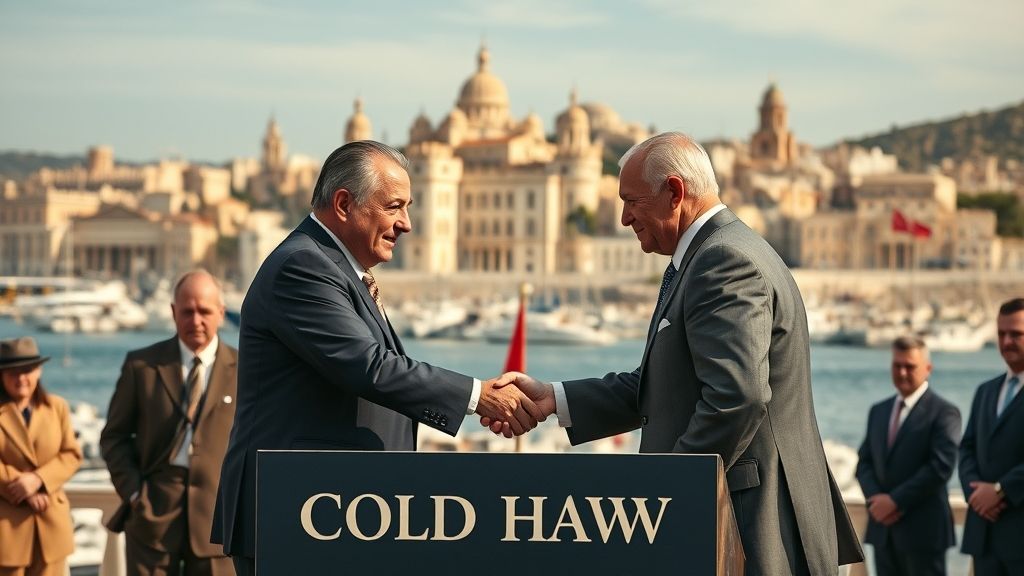
Two figures stood poised to meet, not as adversaries, but as men burdened and inspired by the tides of history pulling at their nations and the world at large: U.S. President George H.W. Bush and Soviet General Secretary Mikhail Gorbachev. Their meeting here, an unassuming Mediterranean isle more noted for its ancient knights and cathedrals than for geopolitics, was about to send tentative but electrifying signals announcing the beginning of the Cold War’s end.
Yet the Malta Summit would not be marked by grand declarations or immediate treaty signings. Instead, it epitomized a subtle but profound diplomatic breakthrough—a thaw in the decades-long freeze between East and West.
Cold War Tensions at Their Zenith: A World on Edge
By late 1989, the tapestry of global politics was in flux. The Cold War, that long standoff born from the ashes of World War II, had gripped the globe in geopolitical tension for over four decades. The world was painted in black and white — capitalist West versus communist East, democracy pitted against authoritarian control, individual freedoms countered by ideological loyalty.
Yet beneath the surface simmered cracks. The Soviet Union was strained economically and politically, its satellite states stirring with unrest and demands for reform. Across the Atlantic, the United States was at a relative peak of confidence, its economy booming, though cautious in the face of the unpredictable Soviet reforms. The Cuban Missile Crisis, Vietnam, and the arms race seemed like distant memories, but nuclear arsenals still cast long shadows.
The Berlin Wall, that grim symbol of division, stood precariously—and would fall less than three weeks after the Malta Summit. Eastern Europe pulsed with revolutionary energy as the Soviet grip weakened. Yet there remained an abiding mistrust born from decades of espionage, propaganda, and ideological conflict.
The Architects of Change: George H.W. Bush and Mikhail Gorbachev
President George Herbert Walker Bush had inherited the Cold War legacy from Ronald Reagan but promised a different style: pragmatic, cautious, and temperate. The elder Bush was, in many respects, a Cold War warrior turned measured statesman. His experiences as a young naval pilot in WWII and as CIA director informed a deep understanding of both the stakes and the mechanisms of international diplomacy.
Mikhail Gorbachev was, without question, the most significant Soviet leader since Stalin’s death. Ascending to power in 1985, he injected the USSR with doctrines of glasnost (openness) and perestroika (restructuring), aiming to revitalize communism by introducing limited freedoms and economic reforms. Gorbachev’s vision extended beyond the Soviet borders, signaling a willingness to reduce Cold War hostilities. Yet his reforms were controversial at home and abroad, his legacy painfully entwined with the eventual dissolution of his nation.
Together, these two leaders came to Valletta carrying the weight of history and hope—a delicate experiment in diplomacy that could chart a new course for global peace.
Malta as the Unexpected Venue: Symbolism and Strategy
Selecting Malta as the summit locale was no accident. A small, strategically placed island with a history as a naval hub and crossroads between East and West, Malta symbolized neutrality, mediation, and connection. As a non-aligned state during the Cold War, its choice signaled a departure from the usual venues steeped in the ideological divide.
Malta’s warm Mediterranean climate and neutral standing created an environment conducive to informal, candid discussions away from the rigid posturing inherent in capitals like Washington or Moscow. The silence of the harbor, juxtaposed with the bubbling tension of the superpowers’ ambitions, made Malta an ideal resting point for history in the making.
The Day Before the Summit: Hints of Historic Dialogue
December 1, 1989, was a day of quiet nervous anticipation. Delegations arrived and mingled amid whispered exchanges. Behind the scenes, aides pored over briefing documents, freshly drawn proposals, and counterpoints. While public optimism seeped through press releases, the gravity of the meeting was unmistakable.
These were men—and their entourages—fully aware that while no grand treaty was scheduled, every word spoken would ripple into decades to come. As twilight draped the limestone city in golden hues, a shared understanding permeated the air: this was no ordinary diplomatic meeting.
The Malta Summit Unfolds: Dialogue Between Giants
On December 2nd, the summit commenced. Unlike typical Cold War encounters marked by declarations and ultimatums, Valletta witnessed what many describe as a conversational meeting. The talks were modest in tone but monumental in implication.
The core agenda touched upon arms control, the situation in Eastern Europe, and avenues for future cooperation. Both leaders expressed mutual respect, a far cry from the animosity of previous decades. The meeting was a gesture as much as a policy statement: a visible thaw, a deliberate step toward reconciliation.
From Strategic Ambiguity to Cooperative Intentions
Throughout their exchanges, Bush and Gorbachev demonstrated an evolving approach to their superpower roles. The summit marked a transition from strategic ambiguity—where mutual suspicion fostered uncertainty—to a tentative embrace of cooperative intentions.
No immediate resolutions on nuclear reductions emerged, but there was a tacit admission that the arms race imposed unsustainable risks on humanity. Both parties recognized that dialogue must replace confrontation, setting the stage for later formal treaties like START (Strategic Arms Reduction Treaty).
Key Conversations: Nuclear Arms, Europe, and the Future Order
The summit dialogues focused heavily on nuclear arms control, reflective of Cold War fears. While no signature treaties were finalized, the willingness to discuss limitations on intercontinental ballistic missiles and nuclear warheads was momentous.
Eastern Europe's rapidly shifting political landscape was another core topic. Gorbachev acknowledged the winds of change blowing through Warsaw Pact countries, while Bush expressed cautious optimism. This represented a tacit acceptance of national self-determination—a pivot away from the rigid Soviet sphere of influence.
Additionally, the two leaders touched upon the post-Cold War world order—the possibilities of arms reduction, increased economic cooperation, and the future of NATO and the Warsaw Pact. These were early blueprints for the transformation soon to unfold.
The Role of Smaller Powers: Malta’s Diplomatic Debut
Malta seized the spotlight unusual for a small nation, its diplomacy thrust into the global limelight. Hosting the summit not only enhanced Malta’s international standing but also underscored the potential power of smaller states to facilitate dialogue amid colossal conflicts.
Maltese officials adeptly balanced protocol and pragmatism, setting an example for how neutral ground can nurture fragile peace efforts. This small island’s role embodied the possibility that global change often begins in the margins.
Immediate Reactions: Media, Public, and Political Responses
The media quickly crowned the Malta Summit as a harbinger of peace. Headlines worldwide spoke of “The End of the Cold War” even as cautious voices urged restraint. Public opinion leaned toward hope, eager for the sword to be laid down.
Politicians, particularly in Western Europe and the United States, lauded the summit’s spirit, viewing it as a vindication of years-long diplomatic patience. Meanwhile, some hardliners in the USSR expressed concern, seeing the openness as vulnerability.
The Summit’s Quiet Revolution: No New Formal Treaty, Yet a Monumental Shift
Perhaps the most striking aspect of the Malta Summit was its subtlety. No grand treaty, no dramatic handshake caught on newsreels dominated headlines. Instead, it represented a breakthrough in mindset—a collective acknowledgment that confrontation was no longer inevitable.
This quiet revolution paved the way for the formal end of the Cold War. Analysts today consider Malta the moment when the psychological barricades between superpowers started to crumble definitively.
The Waning Shadow of the Iron Curtain: Prelude to Collapse
Within weeks, the Berlin Wall was opened; the Eastern Bloc's communist regimes began to crumble. The summit’s timing was providential. Though not the direct cause, Malta was emblematic of the global shift loosening authoritarian grips and restoring individual freedoms.
The summit served as a diplomatic prelude to the rapid unravelling of Soviet control over Eastern Europe, a process impossible without mutual understanding at the highest level.
The American Perspective: Containment to Engagement
For the United States, the Malta Summit reflected a remarkable pivot in Cold War strategy. The longstanding doctrine of containment—aimed at halting communism—gave way toward engagement and managed transition.
President Bush’s cautious but clear signals of reducing hostile rhetoric and exploring collaboration were strategic masterstrokes. They balanced firmness with diplomacy, encouraging reform without igniting backlash.
The Soviet Reforms: Perestroika and Glasnost in Action
Gorbachev’s presence at Malta was itself a public embodiment of his reformist ideals. His willingness to engage earnestly with the West, to accept criticisms and negotiate, contrasted sharply with past Soviet leaders’ isolationism.
Perestroika and glasnost found their international expressions in the summit’s openness. Nonetheless, Gorbachev’s challenges back home threatened to undermine his efforts as conservative elements resisted change.
The Summit and Its Echoes in Eastern Europe
Eastern European countries—then weaving the complex tapestry of liberation from Soviet dominance—watched Malta keenly. The summit signaled that the superpowers might permit these nations to chart their destinies without fear of military intervention.
This hope was tangible: leaders in Poland, Hungary, and Czechoslovakia accelerated reforms, while masses demanded freedoms long denied. Malta was thus a diplomatic accelerant for revolutionary change.
How Malta Chronicle Changed Perceptions of Diplomacy
The Malta Summit reshaped notions of diplomacy beyond treaties and protocols. It demonstrated that dialogues—rooted in respect and patience—could deflate decades of hostility.
Historians regard Malta as a turning point where diplomacy embraced subtlety, patience, and realism. It inspired renewed faith in negotiation as a tool for peace.
The Human Element: Leaders, Advisors, and the Weight of History
Behind the summit’s polished veneer were deeply human stories: a cautious Bush balancing domestic politics, a visionary Gorbachev wrestling with internal opposition, advisors scrambling to prepare documents, translators bridging languages—and the palpable tension of men knowing they were scripting history’s next chapter.
The intensity of those exchanges, the weight of responsibility on shoulders aged by decades of conflict, adds a poignant dimension to Malta’s sunny shores.
Economic and Military Implications for the Superpowers
The summit signaled an impending reduction in Cold War expenditures. The arms race, costing trillions globally, strained both economies. Malta posed the question: could superpowers redirect resources toward domestic needs and global development?
How decisions taken in Malta impacted military strategies and budgets would become clearer in the years following, influencing the defense posture of both Washington and Moscow.
Cultural Ripples: Cinema, Literature, and the Cold War Narrative
The Malta Summit also penetrated popular culture. It inspired a wave of films, books, and documentaries exploring themes of détente, the human cost of division, and the possibilities of peace.
Writers and directors seized upon Malta’s symbolism—the meeting of East and West in a sun-drenched neutral ground—to tell stories not just of politics but of hope and reconciliation.
The Legacy of the Malta Summit in Post-Cold War Europe
In the decades since, Malta’s 1989 summit stands as a testament to transformative diplomacy. It marked a transition point from bipolar antagonism to multipolar engagement.
The summit’s legacy is visible in expanded NATO cooperation, European integration, and the relative absence of direct superpower conflicts since. It remains a beacon of possibility when adversaries choose conversation over confrontation.
Lessons in Diplomacy: Negotiation Without Grandstanding
Perhaps the most enduring lesson is that negotiation often succeeds not through spectacle but subtlety. The Malta Summit teaches patience, respect for sovereignty, and readiness to listen.
In today’s fractured world, these lessons resonate strongly, reminding leaders that history’s most profound turns are born in dialogue, sometimes quietly, sometimes at an unexpected place on a small island.
The Summit’s Place in the Timeline of Global Peace Efforts
While overshadowed in public memory by events like the fall of the Berlin Wall, the Malta Summit is a cornerstone in peace diplomacy. It bridged Reagan’s confrontational legacy and Clinton’s post-Cold War optimism.
Recognizing its place enriches our understanding of how superpower rivalry gracefully exited center stage—not through sudden collapse, but calculated conversations.
Reflections from Historians and Political Scientists
Scholars universally acknowledge Malta’s significance. As historian John Lewis Gaddis summarized, “Malta was less a summit and more a recognition: that we were on the same side of history.”
Such reflections underscore that the Cold War’s end was not an accident but a complex process involving courage, strategy, and the willingness to step into the unknown.
The Modern Resonance: Cold War Lessons for Today’s World
Looking across a quarter century later, the Malta Summit’s spirit echoes in contemporary diplomatic challenges: nuclear disarmament talks, East-West tensions, and the quest for peace in conflict zones.
Its example encourages today’s leaders to pursue dialogue with humility and an eye toward long-term human security.
Conclusion
The Malta Summit of December 1989 was not an explosive headline event. It lacked dramatic agreements or symbolic handshakes at the summit’s close. Instead, it was a quiet but decisive turning point—a moment when two formidable adversaries recognized that rivalry must give way to dialogue.
Bathed in Mediterranean light, this summit represented the beginning of the Cold War’s twilight. It sowed seeds of hope, signaling the world was ready to exit the shadow of nuclear fear and ideological division. Presidents Bush and Gorbachev emerge not as mere politicians, but as architects of peace, styled by history’s crucible.
Malta reminds us that peace does not always roar. Sometimes, it whispers in conversation, faith, and the courage to begin anew.
FAQs
1. Why was Malta chosen as the venue for the summit?
Malta’s neutral status, strategic Mediterranean position, and reputation as an impartial actor made it an ideal location for informal dialogue between superpowers seeking to thaw relations without the spectacle and pressure of major capitals.
2. What were the main outcomes of the Malta Summit?
Though it produced no formal treaties, the summit marked a significant improvement in U.S.-Soviet relations, setting the tone for arms reduction talks and acknowledging the shifting political landscape in Eastern Europe.
3. How did the Malta Summit influence the fall of the Berlin Wall?
While not directly causing it, the summit’s spirit of cooperation and mutual restraint contributed to the broader environment allowing Eastern European revolutions to proceed peacefully, culminating in the Berlin Wall’s fall weeks later.
4. In what ways did Gorbachev's policies shape the summit?
Gorbachev’s reformist agenda, embracing glasnost and perestroika, fostered openness that was reflected in his candid and cooperative approach during the summit, signaling the USSR’s willingness to engage differently with the West.
5. How was the summit received domestically in the U.S. and USSR?
Public and political reactions were generally optimistic in the U.S., seen as a step toward ending the Cold War. In the USSR, conservatives were apprehensive, fearing loss of Soviet influence, while reformists viewed it as hopeful progress.
6. Did the Malta Summit end the Cold War?
No single event ended the Cold War, but Malta symbolized a key diplomatic turning point that helped ease tensions and paved the way for subsequent events that collectively marked the Cold War’s end.
7. What lessons does the Malta Summit offer for modern diplomacy?
It highlights the power of dialogue, patience, mutual respect, and the choice of neutral venues, encouraging contemporary statesmen to pursue diplomacy quietly and thoughtfully rather than through grandstanding.
8. How has Malta commemorated the summit?
Malta recognizes the summit as one of its most significant diplomatic moments, occasionally hosting conferences and memorial events reflecting on its role as a bridge between superpowers.