Table of Contents
- A Winter Morning Like No Other: The Soviet Union’s Final Dawn
- The Soviet Union: A Colossus on Shaky Ground
- Roots of Dissolution: Ideological Strain and Economic Collapse
- Gorbachev’s Reforms: Perestroika and Glasnost as Double-Edged Swords
- The Rise of Nationalism and the Fracturing Republics
- The Baltic States’ Courageous Quest for Independence
- August Coup of 1991: The Turning Point of Fate
- Boris Yeltsin’s Defiant Stand: Symbol of a New Russia
- The Belavezha Accords: Redrawing the Map of Eurasia
- The Formal Declaration: December 26, 1991, The USSR Ceases to Exist
- Immediate Aftermath: A World Transformed Overnight
- Political Earthquake: New States and Power Vacuums
- Economic Turmoil and the Struggle for Stability
- The Human Cost: Lives Upended by History’s Tide
- Cultural and Ideological Legacy: Soviet Memory in Transition
- Global Repercussions: From Bipolarity to Unipolarity
- Western Reactions: Triumph, Hesitation, and Strategic Calculations
- Russia’s New Path: Challenges of Post-Soviet Identity
- The Commonwealth of Independent States: Cooperation or Mirage?
- Reflections from Former Soviets: Pride, Regret, and Hope
- The Dissolution in Historical Perspective: End of an Era, Birth of Another
- Artifacts of an Empire: Monuments, Museums, and Memories
- Lessons Learned: What the Soviet Collapse Teaches Today
- The Dissolution’s Place in the 20th-Century Global Narrative
A Winter Morning Like No Other: The Soviet Union’s Final Dawn
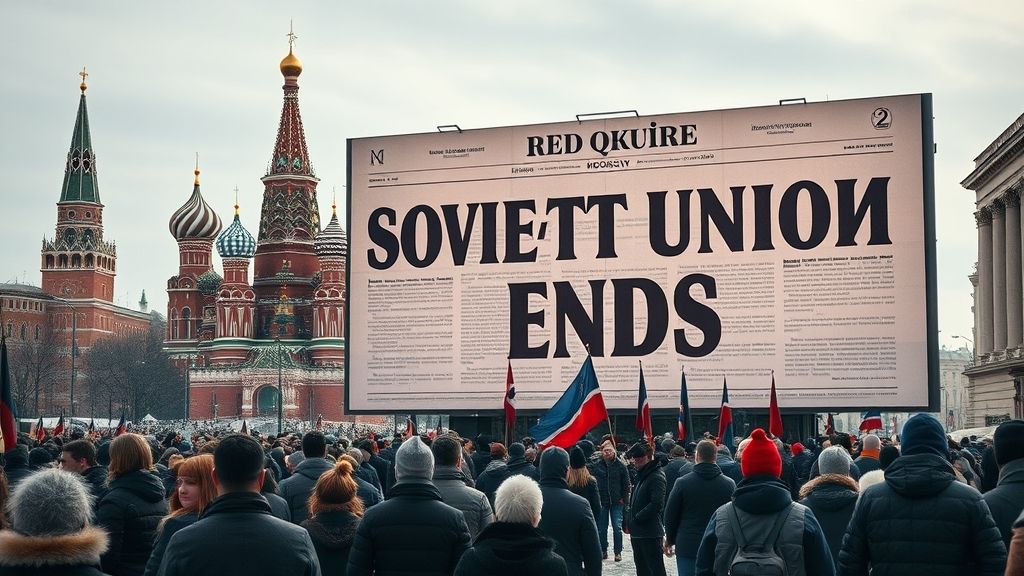
December 26, 1991. The icy Moscow winter dawn crept over the crumbling skyline—the familiar silhouettes of Stalinist skyscrapers, the looming Kremlin walls, the gray stretch of Red Square. But that morning was etched in history not by the chill in the air, but by an announcement that shattered a superpower, ending an era that had dominated global affairs for nearly seventy years. The Soviet Union, the sprawling communist state that had risen from the ashes of revolution and two world wars, simply ceased to exist.
To ordinary Muscovites, people across the vast Soviet territories—stretching from the cold tundras of Siberia to the sunny shores of the Black Sea—this day was bewildering, surreal. News spread swiftly: Mikhail Gorbachev had resigned, handing powers to Boris Yeltsin; the Soviet flag had been lowered, replaced by the Russian tricolor; and the USSR was no more.
It was more than a political event. It was an emotional rupture—a living experiment in governance, ideology, and identity came to an abrupt and irrevocable end. For some, it was relief and hope. For others, bitter loss and uncertainty. And for the world, it was a seismic shift, an inflection point that rewrote international relations and the very meaning of modern statehood.
The Soviet Union: A Colossus on Shaky Ground
At its height, the Soviet Union was a juggernaut—one of the two superpowers, a beacon of communist ideology, and a crucible of innovation, fear, hope, and repression. Crafted from the Bolshevik Revolution of 1917, the USSR grew into a federation of fifteen republics, governed with an iron fist from Moscow.
Yet beneath its enormity lay simmering contradictions. Centralized control clashed with cultural diversity; economic plans struggled under bureaucratic bloat; secret police shadowed everyday life. By the late 1980s, even the most loyal party members felt the structural fragility. Outwardly powerful yet inwardly brittle, the Soviet Union was trapped between the past’s weight and an uncertain future.
Roots of Dissolution: Ideological Strain and Economic Collapse
The roots of the Soviet collapse reach deep into decades-long stresses. The ideological rigidity imposed by Stalin and his successors stifled innovation. The Cold War arms race drained resources. But perhaps most damaging was the failing command economy. Agriculture sputtered; factories produced low-quality goods; consumer shortages became routine.
Behind the grand slogans—“Workers of the world, unite!”—lay corruption, inefficiency, and despair. The Soviet citizen increasingly questioned the legitimacy of the system. The dignity promised by communism contrasted sharply with daily hardships and political repression.
Gorbachev’s Reforms: Perestroika and Glasnost as Double-Edged Swords
Entering into the picture in 1985 was Mikhail Gorbachev, a reformist yearning to revitalize the Soviet project. His twin strategies, perestroika (restructuring) and glasnost (openness), were bold attempts to breathe new life into the moribund system.
Yet these reforms unleashed forces that would destabilize rather than stabilize. Transparency revealed uncomfortable truths. Calls for democracy emboldened dissidents. And the loosening of control did not succeed in reviving the stagnant economy. Instead, it loosened the Party’s grip on power and intensified republican nationalist movements.
The Rise of Nationalism and the Fracturing Republics
Throughout the USSR’s vast expanse lay unique national identities and centuries-old historical memories suppressed under Soviet federalism. With glasnost, these fires ignited. Baltic republics such as Lithuania, Latvia, and Estonia swiftly asserted sovereignty, triggering domino effects.
Ukraine, Georgia, Armenia, and others followed suit, asserting language rights, rewriting histories, and demanding control over their resources and governance. Moscow’s central authority waned as ethnic and national pride surged, exposing the fragile union that had barely held together diverse peoples under a single banner.
The Baltic States’ Courageous Quest for Independence
The Baltic republics’ dramatic reassertion of independence became symbolically powerful and strategically significant. In the late 1980s, “singing revolutions” filled the streets of Tallinn, Riga, and Vilnius with hope and resistance.
Despite Soviet crackdowns, the peaceful protests demanding freedom galvanized international attention. By 1990, Lithuania was the first to declare independence, directly challenging Soviet authority. Moscow’s attempts at suppression only intensified desires for sovereignty, making the Baltic states a catalyst for wider disintegration.
August Coup of 1991: The Turning Point of Fate
Perhaps the most dramatic episode before the dissolution was the August coup. In mid-August 1991, conservative hardliners within the Communist Party, alarmed by Gorbachev’s weakening control and the prospect of further disintegration, staged a failed coup to seize power.
The world watched in stunned silence as tanks rolled into Moscow and the city held its breath. Boris Yeltsin, newly elected president of the Russian Federation, defiantly climbed onto a tank outside the parliament, rallying citizens and military against the coup leaders.
This failure fatally weakened the Communist Party’s control and became a pivotal moment accelerating dissolution. Gorbachev, sidelined, was effectively powerless. The USSR’s fate was sealed.
Boris Yeltsin’s Defiant Stand: Symbol of a New Russia
Yeltsin’s bold opposition to the coup transformed him overnight into a symbol of resistance and change. His image—hard hat in hand atop an armored vehicle—captured the imagination of Russians and the world.
Yet beneath the heroism lay complexity: Yeltsin was an imperfect leader, a figure of contradictions, sometimes erratic, often pragmatic, struggling with the vast challenges ahead. His rise presaged Russia’s future as the Soviet colossus’s heir apparent, though not without enormous growing pains.
The Belavezha Accords: Redrawing the Map of Eurasia
In December 1991, leaders from Russia, Ukraine, and Belarus met in the Belavezha Forest, deep in Belarus, and shook hands on a historic agreement. The Belavezha Accords declared the Soviet Union dissolved and established the Commonwealth of Independent States (CIS), a loose association of former republics.
This unexpected pact effectively ended Moscow’s claim as the USSR’s government. It was a decisive moment—legal, political, and emotional—that formalized the breakup and set the stage for new national sovereignty.
The Formal Declaration: December 26, 1991, The USSR Ceases to Exist
On the morning of December 26, the Supreme Soviet—the Soviet Union’s highest governing body—formally voted to dissolve the USSR. Gorbachev addressed the nation one last time, his voice tinged with resignation and melancholy.
The red flag, flown for decades above Kremlin towers, was lowered, replaced by the Russian tricolor. With this symbolic gesture, a superpower folded quietly into history books, marking an epochal conclusion to an extraordinary but tumultuous political experiment.
Immediate Aftermath: A World Transformed Overnight
The consequences were immediate and profound. Suddenly, fifteen independent states stood on the global stage, many fragile and economically debilitated. Old alliances shattered; new diplomatic challenges emerged. Former Cold War enemies now had to negotiate a new normal.
The Americans proclaimed victory, analysts debated implications, and the global security landscape pivoted dramatically. The bipolar world—characterized by U.S. versus USSR—vanished almost overnight.
Political Earthquake: New States and Power Vacuums
Inside the former Soviet space, power vacuums emerged with dramatic effects. Some republics fell into ethnic conflict; borders became flashpoints; new governments struggled to establish legitimacy.
Russia, the largest and heir to the Soviet nuclear arsenal, faced overwhelming challenges: domestic instability, wavering central authority, and an identity crisis between Soviet legacy and the new reality.
Economic Turmoil and the Struggle for Stability
The Soviet planned economy collapsed, plunging millions into hardship. Hyperinflation, unemployment, and poverty surged as the transition to market capitalism unfolded unevenly.
Industrial networks fragmented; energy supplies fluctuated. While some seized entrepreneurial opportunities, many suffered loss of pensions, basic services, and dignity. The upheaval was both material and spiritual, testing the resilience of societies.
The Human Cost: Lives Upended by History’s Tide
Beyond geopolitics and economic data, millions of lives bore the brunt of dissolution. Families separated by new borders, ethnic tensions ignited, old grievances revived.
For many, the collapse brought hope—freedom, democracy, new possibilities. For others, disorientation, fear, and nostalgia for a lost Soviet identity. The psychological scars of witnessing the sudden implosion of the familiar were profound and enduring.
Cultural and Ideological Legacy: Soviet Memory in Transition
In the decades since, societies in former USSR territories have wrestled with Soviet memory. Museums, monuments, literature, and public discourse reflect conflicted views—pride in scientific achievements and social justice ideals; horror at repression and lost freedoms.
This contested memory shapes contemporary politics and identities, an ongoing dialogue between past and present.
Global Repercussions: From Bipolarity to Unipolarity
The Soviet dissolution reshaped global order. The Cold War’s ideological confrontation ended, ushering in a unipolar moment dominated by the United States.
New security architectures appeared. NATO expanded eastward; the United Nations recalibrated. Yet new tensions and uncertainties remained, seeded in the experiences and aftermath of the Soviet collapse.
Western Reactions: Triumph, Hesitation, and Strategic Calculations
Western leaders greeted the Soviet collapse with mixed feelings—optimism tempered by caution. While it signaled the “end of history” for liberal democracies, it also introduced unpredictability.
Some policymakers embraced a rapid expansion of influence; others feared instability and nuclear proliferation. The West’s engagement with Russia and former Soviet republics shaped subsequent decades’ diplomacy.
Russia’s New Path: Challenges of Post-Soviet Identity
For Russia, the Soviet collapse was a brutal identity shock. Stripped of superpower status yet burdened by imperial legacy, the country struggled to redefine itself politically, economically, and culturally.
The 1990s were marked by upheaval—chaotic markets, political turbulence, and quests for national renewal. The shadow of the Soviet past loomed large but could not contain the aspirations of a new Russian state.
The Commonwealth of Independent States: Cooperation or Mirage?
The CIS formed as a mechanism to manage the post-Soviet transition. However, it was more a loose federation than a confederation, lacking real power or unity.
While it offered forums for dialogue, disputes and competing national interests limited its effectiveness. The CIS remains a symbol of connection and separation intertwined.
Reflections from Former Soviets: Pride, Regret, and Hope
Voices from across the former USSR reveal a spectrum of feelings. Older generations often express regret or nostalgia; younger ones embrace new freedoms but struggle with instability.
This mosaic reflects the complex legacy of the Soviet state—a paradoxical blend of repression and achievement, loss and opportunity.
The Dissolution in Historical Perspective: End of an Era, Birth of Another
In retrospect, the dissolution was neither sudden nor inevitable. It was the culmination of decades of political, economic, and social pressures converging with individual agency and historical contingencies.
This moment closed a chapter in 20th-century history, but gave birth to new national narratives, global dynamics, and ongoing debates about sovereignty, governance, and identity.
Artifacts of an Empire: Monuments, Museums, and Memories
Today, physical reminders of the Soviet era endure—from statues and architecture to archives and personal memorabilia. These artifacts serve as anchors for memory and tools for education.
They challenge societies to confront history honestly, acknowledging triumphs and atrocities alike, ensuring that the story of the Soviet Union remains alive yet critically engaged.
Lessons Learned: What the Soviet Collapse Teaches Today
Looking back, the Soviet collapse offers lessons about the vulnerabilities of centralized power, the dangers of ideological rigidity, and the liberating yet chaotic potential of reform.
It underscores the essential human element in historical change—the hopes, fears, and actions of millions caught in sweeping transformations.
The Dissolution’s Place in the 20th-Century Global Narrative
The Soviet Union’s end marked the close of one of the defining dramas of the 20th century. Alongside the World Wars, decolonization, and civil rights movements, it reshaped the global order.
Its aftermath continues to influence politics, societies, and collective memories around the world.
Conclusion
The dissolution of the Soviet Union was neither a swift accident nor an isolated event—it was a deeply human story of rising aspirations, competing visions, and the relentless tides of history. The cold December morning of 1991 marked the close of a grand but troubled experiment, one that shaped the lives of hundreds of millions and defined a century’s struggle for power and identity.
Yet even as the great red banner was lowered, the echoes of the Soviet past persist—in the politics, cultures, and dreams of Eurasia and beyond. History rarely offers neat endings. Instead, it challenges us to understand the complexity of change: how nations and peoples fracture, rebuild, and move forward in the eternal quest for meaning and belonging.
FAQs
Q1: What were the main causes of the Soviet Union’s dissolution?
The collapse resulted from a mix of economic stagnation, political rigidity, nationalist movements, and failures of Gorbachev’s reforms, alongside the weakening ideological cohesion of the communist system.
Q2: Who were the key figures in the USSR’s final days?
Mikhail Gorbachev, the last president seeking reform; Boris Yeltsin, the Russian leader who resisted the August coup; and the signatories of the Belavezha Accords played crucial roles.
Q3: How did the August 1991 coup impact the dissolution?
The failed coup discredited hardliner Communists, empowered Yeltsin, and accelerated fragmentation, making the Soviet Union’s end inevitable within months.
Q4: What happened to Soviet nuclear weapons after the dissolution?
Nuclear arsenals were inherited mainly by Russia, with Ukraine, Belarus, and Kazakhstan giving up their Soviet-era weapons in exchange for security guarantees.
Q5: How did the dissolution affect ordinary people?
Millions faced economic hardship, identity crises, and sometimes ethnic conflict. Freedom came with uncertainty and instability in daily life.
Q6: What is the Commonwealth of Independent States (CIS)?
A loose association of most former Soviet republics created to manage post-Soviet cooperation, though it lacks real political power.
Q7: How is the Soviet past remembered today?
Memory varies widely: pride in achievements, mourning of lost unity, critical reassessment of repression, and ongoing debates about historical legacy.
Q8: Did the Soviet Union’s collapse end the Cold War?
Yes, it ended the bipolar Cold War structure, transitioning the world to a unipolar moment dominated by the United States.