Table of Contents
- April 6, 1992: Sarajevo Awakens to War
- The Fragile Peace of Yugoslavia’s Breakup
- Ethnic Fault Lines and Political Faults
- The Siege of Sarajevo Begins
- International Indifference and Early Diplomatic Efforts
- The Role of Nationalism and Propaganda
- Massacres and Civilian Suffering
- The United Nations’ Peacekeeping Trials
- The Weaponization of the City
- Sarajevo’s Cultural Defiance amid Ruins
- The Impact on Bosnia’s Multiethnic Communities
- Voices from the Frontline: Soldiers and Civilians
- The Sarajevo Tunnel: Lifeline Under Siege
- Shifting Alliances and the Regional Stakes
- The War’s Toll: Numbers, Refugees, and Destruction
- International Intervention and the Dayton Accords Prelude
- Media Coverage and the Battle for Global Attention
- Lessons on Ethnic Conflict and International Law
- Memory, Monuments, and the Postwar Landscape
- Conclusion: Sarajevo’s War in Our Collective Consciousness
- FAQs
- External Resource
- Internal Link
1. April 6, 1992: Sarajevo Awakens to War
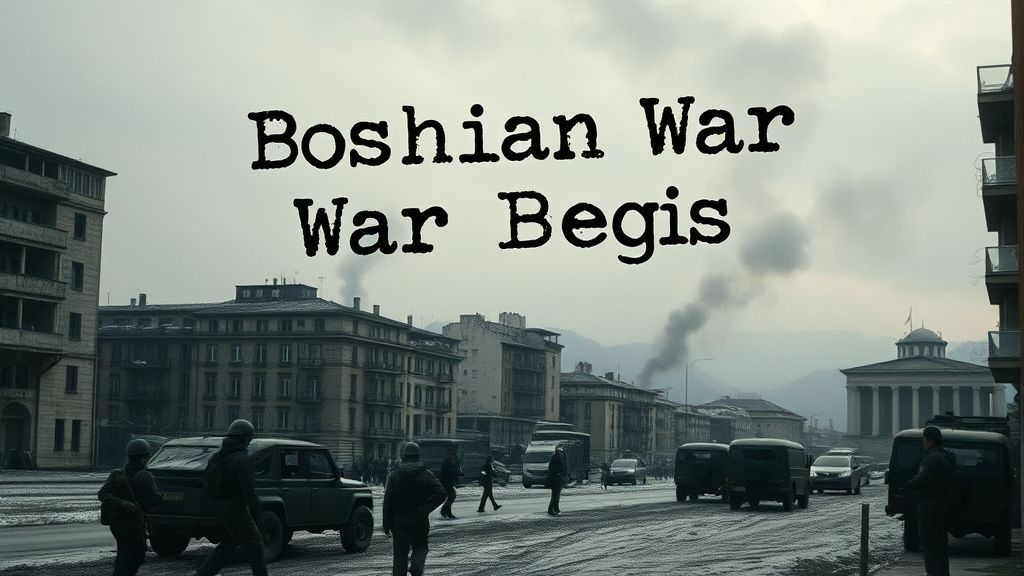
The morning of April 6, 1992, dawned grey and heavy over Sarajevo, the capital of Bosnia and Herzegovina—a city celebrated for its blend of East and West, where mosques, churches, and synagogues had stood side by side for centuries. But that day marked an inflection point, the rupture of a fragile peace that had tethered together the diverse factions of Yugoslavia for decades.
At dawn, distant gunfire cracked with unnerving sharpness, echoing across the hills that cradle the city. Sniper bullets found their marks in quiet neighborhoods, and shells began to rain on civilian quarters. What had been political tensions now turned into a brutal reality—the Bosnian War had begun in earnest. Sarajevo, once a symbol of multicultural coexistence, was about to suffer the longest siege in modern warfare and become the epicenter of one of the most tragic conflicts of the late 20th century.
This was not just a battle for territory; it was a war that cut deep into identities, loyalties, and histories, fracturing a society into lines of blood and despair.
2. The Fragile Peace of Yugoslavia’s Breakup
To understand the eruption of war in Sarajevo, one must look back at the implosion of the Socialist Federal Republic of Yugoslavia, a state held together by the delicate weave of ethnicities—Serbs, Croats, Bosniaks, Slovenians, Macedonians, and Montenegrins. The death of Josip Broz Tito in 1980 unraveled the political glue, exposing simmering nationalist ambitions.
Throughout the late 1980s, as communism receded in Eastern Europe, nationalist leaders sharpened ethnic distinctions for political gain. Bosnia and Herzegovina, a republic within Yugoslavia with no majority ethnic group, found itself caught in the storm. The election of nationalist parties advocating ethnic supremacy clashed with moderates yearning for a multiethnic Yugoslavia or peaceful independence.
The 1990 elections brought to power parties representing the three main ethnic groups separately: the Serbs who largely aligned with the Serbian Democratic Party led by Radovan Karadžić, the Croat Democratic Union, and the Bosnian Muslim-led Party of Democratic Action. This fractured political landscape sowed distrust and the groundwork for violence.
3. Ethnic Fault Lines and Political Faults
Bosnia and Herzegovina’s ethnic mosaic was intricate. Bosniaks (Bosnian Muslims) made up about 44%, Serbs 31%, and Croats 17%. But populations were interwoven, often living as neighbors for generations. However, decades of propaganda, historical grievances, and rising nationalism ignited ethnic suspicions.
The Serbian leadership conceived “Greater Serbia,” aiming to unify Serb-populated territories. Ethnic Serb militias, like the notorious paramilitary “White Eagles” and “Arkan’s Tigers,” mobilized. Meanwhile, Bosniaks and Croats organized their defenses, but lacked comparable military capacity. The fragmented political environment undermined peaceful resolution, while rival paramilitary and militia groups set cities, including Sarajevo, on a collision course.
4. The Siege of Sarajevo Begins
With Bosnia's formal declaration of independence on March 3, 1992, held in a referendum boycotted by many Serbs, armed conflict was inevitable. On April 6, the Bosnian Serb Army (VRS), backed by the Yugoslav People's Army (JNA) and supported by Serb paramilitaries, launched attacks around Sarajevo.
The siege effectively began with the surrounding of the city by Serb forces positioned on the surrounding hills. From these vantage points, they used artillery, snipers, and tanks to bombard the city relentlessly for nearly four years. The people of Sarajevo, numbering over 400,000, found themselves trapped—a modern city turned open-air prison.
The brutality was unprecedented. Chronic shortages of food, water, electricity, and medical supplies combined with constant danger from shelling and sniper fire transformed daily life into a struggle for survival.
5. International Indifference and Early Diplomatic Efforts
The world watched with a mixture of shock, confusion, and initial passivity. The United Nations moved quickly to impose arms embargoes and called for peace, but their efforts were hampered by the complexities on the ground. The arms embargo notably disadvantaged the Bosniaks, who were poorly armed compared to Serb forces.
Diplomatic talks, such as the Vance-Owen Plan in 1993, attempted to partition Bosnia into ethnic cantons, but few parties genuinely desired compromise. International actors were reluctant or slow to deploy robust peacekeeping or enforcement measures, encapsulating the tragic failure to prevent mass atrocities.
6. The Role of Nationalism and Propaganda
Propaganda machines fueled fear and hatred. Media outlets broadcast inflammatory rhetoric, dehumanizing “the other” and justifying atrocities as existential defense. Nationalist leaders’ speeches became rallying cries for ethnic cleansing—a euphemism that masked systematic campaigns to forcibly remove communities based on ethnicity.
The manipulation of historical narratives created impossible divides: friends and neighbors transformed overnight into enemies.
7. Massacres and Civilian Suffering
The siege was punctuated by gruesome massacres. One of the most harrowing was the Markale marketplace shelling in 1994, where dozens of civilians were killed, provoking outrage but little action. Equally tragic were the ethnic cleansings in towns like Prijedor and Srebrenica, where systemic executions and deportations began earning international condemnation.
The human cost defies numbers: over 100,000 killed in the entire war, including approximately 40,000 civilians. Countless more were wounded, traumatized, or displaced.
8. The United Nations’ Peacekeeping Trials
UN peacekeepers, deployed under the "UNPROFOR" mission, were tasked with humanitarian aid and protection of safe zones. However, their mandate was limited, and they were ill-equipped to stop aggression.
Episodes such as the fall of Srebrenica in 1995, a declared “safe area,” exposed tragic failures of international protection. The massacre of over 8,000 Bosniak men and boys by Bosnian Serb forces shocked the world and tarnished the UN’s legacy.
9. The Weaponization of the City
Sarajevo became a weapon itself: snipers strategically positioned on rooftops and hills reduced the entire urban landscape to a tactical battleground. Daily errands turned perilous, with “sniper alleys” where any exposed step risked death.
The city’s infrastructure crumbled — hospitals bombed, utilities cut. Yet, life persisted underground: makeshift schools and theaters continued behind rubble, a defiant assertion of humanity amidst horror.
10. Sarajevo’s Cultural Defiance amid Ruins
Despite the siege, Sarajevo preserved its cultural heartbeat. The Sarajevo Film Festival, founded in the mid-1990s during the siege, was a beacon of hope. Musicians performed in basements; artists painted the visible scars as testimony.
The city's diverse cultural heritage, from Ottoman-era mosques to Austro-Hungarian architecture, stood battered but unbroken—a living symbol of resilience.
11. The Impact on Bosnia’s Multiethnic Communities
The war’s most tragic consequence was the irrevocable division of Bosnia’s societies. Mixed neighborhoods emptied, multiculturalism shattered. Ethnic homogenization, through violence or forced migration, redrew demographic lines.
Communities torn apart by the conflict would face years of distrust and trauma, challenging the possibility of reconciliation.
12. Voices from the Frontline: Soldiers and Civilians
Personal testimonies from civilians paint a visceral image: families huddling in basements during bombardments, children playing amidst ruins, elderly struggling with food shortages. Soldiers, often conscripts, grappled with loyalty and survival.
These human stories reveal the war’s complexity beyond geopolitics — a tapestry of fear, courage, abject suffering, and indomitable hope.
13. The Sarajevo Tunnel: Lifeline Under Siege
In 1993, as Sarajevo’s connection to the rest of Bosnia was severed, civilians and military alike relied on the Sarajevo Tunnel. Dug under the airport runway, it became a secret artery bringing in humanitarian aid, weapons, and hope.
This tunnel is emblematic of human ingenuity amid desperation and remains a powerful symbol of survival.
14. Shifting Alliances and the Regional Stakes
The Bosnian War was not isolated. Neighboring Croatia and Serbia had vested interests and complex involvements, sometimes fighting alongside or against Bosnian factions.
Croatian-Bosniak alliances formed but later fractured. Serbia, under Slobodan Milošević, provided political and military support for Serb forces but was also pressured internationally to engage diplomatically.
This regional chessboard added layers of complexity, prolonging the conflict and hindering peace.
15. The War’s Toll: Numbers, Refugees, and Destruction
By war’s end in late 1995, Bosnia’s population suffered immense losses: tens of thousands killed, up to two million displaced, shattered infrastructure, and devastated economy.
Entire towns lay in ruins, and the psychological scars—on survivors and subsequent generations—remain profound. The war reshaped the Balkans physically and demographically.
16. International Intervention and the Dayton Accords Prelude
Intense international pressure and NATO air strikes in 1995 changed the war's dynamics. The homicidal stalemate in Sarajevo and elsewhere compelled combatants to come to the negotiating table.
The Dayton Peace Accords, signed in December 1995 in Ohio, USA, ended active hostilities and established Bosnia and Herzegovina as a federal state divided into two entities, a fragile framework tested ever since.
17. Media Coverage and the Battle for Global Attention
Sarajevo’s siege became one of the first conflicts extensively covered by international media in real time. Graphic images and reports stirred global conscience but also testified to the limits of external action.
Journalists risked snipers’ bullets, becoming witnesses and sometimes participants in the narrative of war and survival.
18. Lessons on Ethnic Conflict and International Law
The Bosnian War highlighted challenges for international law: genocide was committed, peacekeeping was constrained, and accountability was initially elusive.
The International Criminal Tribunal for the former Yugoslavia (ICTY) later prosecuted war crimes, a landmark for international justice but a process fraught with political difficulties.
19. Memory, Monuments, and the Postwar Landscape
Years after the war, Sarajevo and Bosnia grapple with memory politics—commemorating victims, confronting denial, and rebuilding coexistence.
Memorials dot the cityscape. The scars of war remain visible, reminding all who pass of the fragility of peace and the cost of ethnic hatred.
Conclusion
The beginning of the Bosnian War in Sarajevo on April 6, 1992, was the eruption of deep-seated tensions, identity struggles, and political fractures accumulated over decades. Sarajevo's siege remains emblematic of human suffering, resilience, and the dizzying complexities of ethnic conflict in a globalizing yet divided world.
As shells rained over the city for almost four years, the spirit of Sarajevo’s people endured; art blossomed in basements, children played amid rubble, and communities fought to maintain their humanity against dehumanizing violence. The horrors of war etched enduring lessons for international diplomacy, justice, and memory.
Today, Sarajevo stands as a testament—wounded but unbowed—challenging us never to forget that peace, fragile and hard-won, remains our most precious possession.
FAQs
Q1: What were the primary causes of the Bosnian War?
A1: The collapse of Yugoslavia, rising nationalist politics, ethnic tensions, and competing territorial claims led to the war. Bosnia's declaration of independence triggered the armed conflict amidst unresolved ethnic divisions.
Q2: Why was Sarajevo targeted for siege?
A2: Sarajevo, as Bosnia’s capital and symbol of multiethnic coexistence, was strategically and symbolically important. Encircled by Serb forces, the siege aimed to break the city’s will and control the region.
Q3: How did civilians survive during the siege?
A3: Through resourcefulness—including use of underground shelters, smuggling via the Sarajevo Tunnel, and communal support—civilians endured extreme hardship despite constant danger and scarcity.
Q4: What role did the international community play?
A4: Initially hesitant, the international community imposed arms embargoes, deployed peacekeepers, and eventually NATO intervened with air strikes. However, early efforts were criticized as inadequate in preventing atrocities.
Q5: What was the significance of the Dayton Accords?
A5: The Dayton Peace Accords formally ended active combat in 1995, creating a framework for Bosnia’s political structure and attempting to reconcile divided communities, though many challenges remain.
Q6: Are there still repercussions of the war today?
A6: Yes, ethnic divisions persist politically and socially. The war’s legacy influences regional relations, justice efforts, and reconciliation initiatives in Bosnia and the Balkans.
Q7: How is the Bosnian War remembered in Sarajevo?
A7: Through museums, memorials, public commemorations, and cultural expressions emphasizing remembrance, resilience, and calls for peace.
Q8: What was the impact of media coverage during the siege?
A8: Media brought global attention to Sarajevo’s plight, influencing public opinion and eventually policy decisions, though it also revealed limits of international response.