Table of Contents
- The Fateful Summer of 1995: Srebrenica on the Brink
- A Safe Haven Turned Into a Death Trap
- Roots of the Conflict: The Breakup of Yugoslavia and Ethnic Tensions
- Bosnia’s Patchwork: Ethnic Divides and the Struggle for Identity
- The United Nations’ Role and the "Safe Area" Declaration
- Life in Srebrenica Before the Massacre: Fear, Hope, and Uncertainty
- The Siege Tightens: Military Movements and Diplomatic Failures
- July 11, 1995: The Beginning of the Massacre
- The Systematic Execution: A Horror Unfolds in the Forest and Fields
- The Role of Ratko Mladić and the Bosnian Serb Forces
- The International Community’s Response: Shock, Delay, and Denial
- Survivors’ Stories: Testimonies of Loss, Escape, and Survival
- The Aftermath: Mass Graves and the Search for Justice
- War Crimes Trials: The International Criminal Tribunal for the Former Yugoslavia
- The Impact on Bosnia and Herzegovina’s Fragile Peace
- Memory and Remembrance: Museums, Monuments, and Education
- Srebrenica in Global Consciousness: Lessons for Humanity
- Reflections on Genocide: The Definition and Recognition
- Political Controversies and Denial Movements
- The Continuing Legacy: Healing, Reconciliation, and Warning Signs
- Conclusion: From Tragedy to Resilience
- FAQs
- External Resource
- Internal Link
The Fateful Summer of 1995: Srebrenica on the Brink
On the morning of July 11, 1995, the dawn broke over a quiet town nestled in the eastern bosom of Bosnia and Herzegovina. Srebrenica, once a humble industrial town surrounded by dense forests and rolling hills, held the fragile hopes of thousands displaced by war. Yet, underneath the fragile calm, dread hung thick in the air. The promise that the United Nations had made in declaring this enclave a “safe area” seemed increasingly hollow. What was to come would soon etch one of the darkest chapters in modern European history — a genocide that would shock the world and alter forever the meaning of human cruelty.
But the massacre did not erupt from nowhere. It was born of decades of nationalism, ethnic hatred, and political collapse. The Slovenian and Croatian declarations of independence from Yugoslavia in the early 1990s ignited simmering tensions across the region. Bosnia and Herzegovina’s multiethnic fabric was rent apart by brutal warfare, with Serbs, Croats, and Bosniaks caught in a deadly struggle for territory and survival.
Srebrenica, designated a UN “safe area” in 1993, was a symbol of international hope and failure alike. Yet, by July 1995, this refuge would sadly become synonymous with mass murder — an attempted ethnic cleansing that sought to erase a community from the map.
A Safe Haven Turned Into a Death Trap
In the months leading to July 1995, Srebrenica was a besieged town. Around 25,000 refugees, mostly Bosniak civilians, sought shelter within its limits. UN peacekeepers, poorly armed and grossly undermanned, were tasked with protecting them — a half-hearted shield against mounting aggression.
The United Nations Protection Force (UNPROFOR), headquartered under Dutch command, was ill-equipped to prevent the looming tragedy. When Bosnian Serb military forces launched a decisive offensive, the enclave fell in a matter of days. The supposed “safe area” was overrun with terrifying efficiency.
The Bosnian Serb army, under General Ratko Mladić, systematically separated men and boys from the women, who were deported or sent on to other territories. Over the course of several days, approximately 8,000 Bosniak males were rounded up and executed in a grim act of genocide — the worst atrocity on European soil since the Holocaust.
Roots of the Conflict: The Breakup of Yugoslavia and Ethnic Tensions
To unearth why Srebrenica became a stage for such horror, we must turn back to the tangled dissolution of the Socialist Federal Republic of Yugoslavia.
Throughout the 20th century, Yugoslavia had been a mosaic of diverse ethnic groups: Serbs, Croats, Slovenes, Bosniaks, Macedonians, and Albanians. While Tito’s iron grip maintained uneasy peace for decades, the veil of unity thinned rapidly after his death in 1980. The early 1990s saw nationalist leaders weaponizing ethnic identity to consolidate power and territorial claims.
Bosnia and Herzegovina, a republic with nearly equal Muslim (Bosniak), Serb Orthodox Christian, and Croat Catholic populations, found itself caught in the crossfire. In 1992, a referendum on independence triggered armed conflict as Serb forces, supported by neighboring Serbia and the Yugoslav People’s Army, attempted to carve out “ethnically pure” territories.
The war that followed was marked by siege, massacres, and ethnic cleansing, setting the stage for the Srebrenica tragedy.
Bosnia’s Patchwork: Ethnic Divides and the Struggle for Identity
Bosnia’s demographics were a living patchwork. The coexistence that had been the bedrock of its culture unraveled beneath the pressure of extreme nationalism.
While Bosniaks identified primarily as Muslims culturally rather than religiously, Serbs and Croats pursued visions of a Greater Serbia or Croatia, often through violent means.
Srebrenica, located deep within contested territory, was primarily Bosniak but surrounded by Serb-held lands. The town became a borderline — physically and symbolically — between war camps.
The siege of Srebrenica was an attempt not only to take land but to annihilate an entire identity. The infamous phrase "ethnic cleansing" brutally encapsulated the strategy.
The United Nations’ Role and the "Safe Area" Declaration
In 1993, the UN declared Srebrenica, alongside several other enclaves, a “safe area.” Meant to be demilitarized and protected by peacekeepers, this designation was meant to create pockets where civilians could shelter.
Yet, this well-intentioned ideal faltered on the ground. UNPROFOR forces were lightly armed observers, a mere fraction of the firepower wielded by hardened militias.
Dutch battalion troops manned the enclave but had no real means to defend it against a determined assault. Air support requests were often delayed or withheld due to the complexities of UN mandates and political hesitations.
This failure would have harrowing consequences.
Life in Srebrenica Before the Massacre: Fear, Hope, and Uncertainty
Despite the siege, life in Srebrenica before July 1995 was a mixture of desperation and resilience.
Civilians lived in constant fear of shelling and starvation but tried to preserve some semblance of normality with schools, markets, and medical clinics operating under harrowing conditions.
The community held onto hope that peacekeepers would fulfill their promises. But as the Serb siege tightened, food shortages worsened and psychological strain deepened.
In intimate portraits recorded in survivor testimonies, we hear stories of families torn apart, last embraces before men were taken away, and quiet courage amidst despair.
The Siege Tightens: Military Movements and Diplomatic Failures
By mid-1995, General Ratko Mladić and the Bosnian Serb army had amassed overwhelming force around Srebrenica.
The Bosnian Serbs aimed to fulfill their horrific ambition of ethnic cleansing by crushing the enclave.
Simultaneous diplomatic efforts by the UN and Western powers were feeble. Despite pleas from local commanders and mounting evidence of impending disaster, international intervention remained hesitant.
When the assault came, it did so with overwhelming force — artillery bombardments and infantry advances crushed the defenders.
July 11, 1995: The Beginning of the Massacre
July 11 marked the fall of Srebrenica after nearly a week of relentless attacks.
As the enclave's defenses crumbled, thousands of Bosniak civilians and soldiers attempted to flee through nearby forests toward Bosnian government-held territory.
Many were caught in this desperate exodus; others were captured.
What followed was organized mass murder, meticulously planned and executed by Bosnian Serb forces.
The precision and scale of these killings stunned observers, revealing a calculated genocidal campaign rather than sporadic war violence.
The Systematic Execution: A Horror Unfolds in the Forest and Fields
Over the next several days, Bosnian Serb soldiers separated men and boys from their families.
They were transported to remote sites — warehouses, fields, and mines — where they were executed en masse.
Mass graves were hastily dug to conceal this genocide. The victims, often blindfolded and hands tied, were shot point-blank, many in cold blood.
Witness accounts reveal the chilling efficiency, the silence broken only by gunfire, and the sorrow of families left behind.
The Role of Ratko Mladić and the Bosnian Serb Forces
Central to the atrocity was General Ratko Mladić, commander of the Bosnian Serb army.
Mladić’s strategy of ethnic cleansing was part of a broader campaign to create a “Greater Serbia” free of Bosniak presence.
He was later indicted for war crimes and genocide by the International Criminal Tribunal for the former Yugoslavia (ICTY).
Mladić’s leadership and orders were pivotal in orchestrating the massacre, which remains an indelible stain on history.
The International Community’s Response: Shock, Delay, and Denial
The world reacted with horror once news of the massacre emerged.
Yet, initial international responses were slow and fragmented.
United Nations officials admitted to failures, with Dutch peacekeepers expressing anguish over their impotence.
The massacre exposed deep shortcomings in safe area policies and the limitations of peacekeeping under ambiguous mandates.
It also forced a global reckoning on how to respond to genocide in real time.
Survivors’ Stories: Testimonies of Loss, Escape, and Survival
Amid the statistics, individual stories illuminate the human cost.
Survivors recount narrow escapes, the trauma of losing entire families, and their lives forever altered.
Women who fled describe the crushing pain of separation; children orphaned by systematic cruelty reflect the enduring scars.
These testimonies form a vital archive — ensuring memory, bearing witness, and asserting humanity’s refusal to forget.
The Aftermath: Mass Graves and the Search for Justice
In the massacre’s wake, Bosnian authorities and international organizations undertook painstaking work to locate mass graves.
Exhumations revealed the scale of the genocide and provided evidence for tribunals.
Families clung to hope for justice, even as many victims remain missing to this day.
The painstaking recovery efforts symbolize a commitment to truth amid overwhelming grief.
War Crimes Trials: The International Criminal Tribunal for the Former Yugoslavia
The ICTY, established in 1993, prosecuted those responsible for atrocities committed during the Yugoslav wars.
It tried key figures including Ratko Mladić and Radovan Karadžić, sentencing them for genocide, crimes against humanity, and war crimes.
These trials represented landmark moments in international law, affirming accountability for crimes that once seemed beyond reach.
The Impact on Bosnia and Herzegovina’s Fragile Peace
Srebrenica’s massacre scarred the already fractured society of Bosnia and Herzegovina.
The 1995 Dayton Peace Agreement ended active warfare but left a country divided along ethnic lines — a political architecture born of violence.
Rebuilding trust proved arduous, with interethnic relations strained by trauma and politicization.
Understanding Srebrenica’s impact is essential to grasping Bosnia’s continuing struggle for reconciliation.
Memory and Remembrance: Museums, Monuments, and Education
Decades later, Srebrenica stands as a solemn symbol.
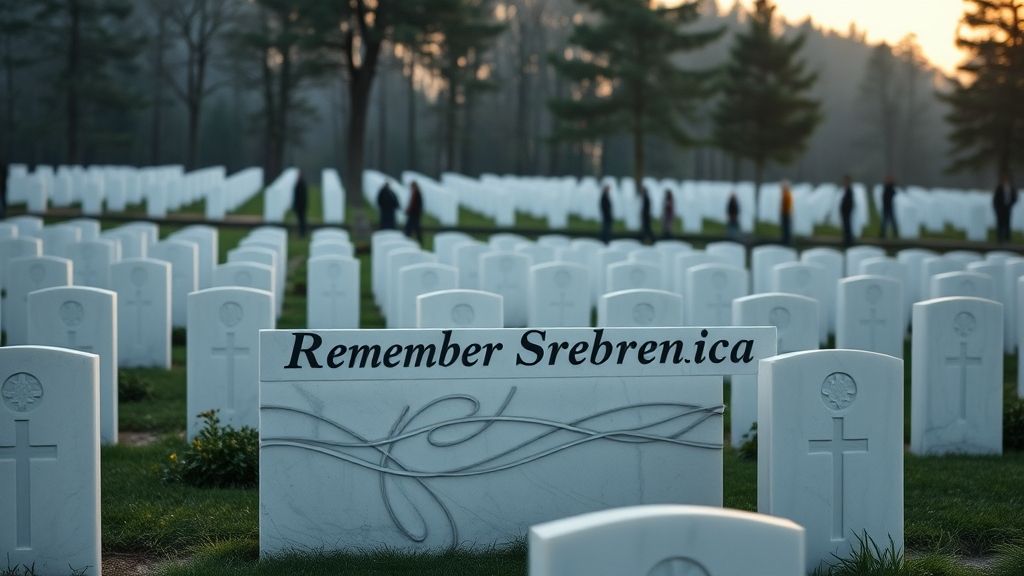
Memorial sites, cemeteries, and museums honor the victims and educate the world.
Annual commemorations gather survivors, refugees, and dignitaries alike, fostering grief but also hope for peace.
Teaching this history is an act of preservation against denial and erasure — a pact with futures to remember.
Srebrenica in Global Consciousness: Lessons for Humanity
Srebrenica captured global attention as a grim reminder of genocide’s persistence.
It challenged notions that modernity and international organizations could prevent mass murder.
The event galvanized policymakers, scholars, and activists to advocate for stronger mechanisms against atrocities.
From Rwanda to Darfur, echoes of Srebrenica inform humanitarian interventions and genocide prevention today.
Reflections on Genocide: The Definition and Recognition
The massacre became a key case in defining genocide legally and morally.
The systematic killing, intent to destroy a people, and targeting of men and boys fulfilled UN Convention criteria.
Recognition of Srebrenica as genocide was initially contentious but now widely accepted by courts and historians.
This clarity shapes global discourse on human rights and interventions.
Political Controversies and Denial Movements
Despite overwhelming evidence, denial and revisionism persist.
In some Serbian political circles, Srebrenica’s massacre is minimized or dismissed.
These narratives fuel ongoing ethnic divisions and jeopardize reconciliation.
Confronting denial remains a crucial challenge for educators, governments, and civil societies.
The Continuing Legacy: Healing, Reconciliation, and Warning Signs
More than two decades later, Bosnia grapples with the trauma.
Healing is uneven — some communities engage in dialogue, while others retreat into suspicion.
The Srebrenica massacre serves as a warning — humanity must continually confront hatred and violence before they escalate.
Its legacy is both a remembrance of sorrow and a call to vigilance.
Conclusion
The massacre at Srebrenica is a profoundly tragic testament to the capacity for human cruelty, borne from a crucible of nationalist hatred, war, and political paralysis. Yet, beyond the grievous loss of over 8,000 lives, it stands as a powerful symbol of resilience, memory, and the enduring quest for justice. The tale of Srebrenica compels the world never to forget the consequences of silence and inaction.
As survivors rebuild broken lives, as courts seek accountability, and as memorials rise from mass graves, the story speaks across borders and generations. It asks us all to recognize the fragile threads of peace, to listen deeply to human suffering, and to strive tirelessly to prevent such horrors again.
Srebrenica's shadow is long, but in remembrance lies both reckoning and hope — that from the darkest past can emerge a commitment to a more humane future.
FAQs
Q1: What caused the Srebrenica massacre?
The massacre was the result of ethnic nationalism, the breakup of Yugoslavia, and wartime strategies of ethnic cleansing by Bosnian Serb forces seeking to establish Serb-dominated territories.
Q2: How many people were killed during the Srebrenica massacre?
Approximately 8,000 Bosniak men and boys were systematically executed in July 1995.
Q3: Who was responsible for the massacre?
The Bosnian Serb army, led by General Ratko Mladić, orchestrated the massacre. Commanders and political leaders involved have been convicted of genocide and war crimes.
Q4: What was the role of the United Nations during the massacre?
The UN had declared Srebrenica a “safe area,” but its peacekeepers were under-equipped and unable to prevent the fall or subsequent killings.
Q5: How has Srebrenica been remembered internationally?
Through memorials, museums, annual commemorations, and international legal proceedings, Srebrenica has become a symbol of genocide prevention and the need for global vigilance.
Q6: Is the massacre recognized as genocide?
Yes, international courts and the United Nations recognize the Srebrenica massacre as genocide.
Q7: Are there still disputes about what happened in Srebrenica?
Despite overwhelming evidence, denial and revisionism persist, particularly in certain political groups in the Balkans.
Q8: How has the massacre affected Bosnia and Herzegovina today?
It has left deep wounds affecting ethnic relations, political structures, and national reconciliation efforts, which remain fragile.