Table of Contents
- A Dawn Shrouded in Fog: The Morning of June 14, 1800
- The Stakes of the Napoleonic Wars in Italy
- The Road to Marengo: Preceding Maneuvers and Strategies
- Two Armies, One Battlefield: The Forces at Play
- Napoleon’s Gambit: Bold Risk in Uncertain Terrain
- The Opening Clash: Austrians Advance with Confidence
- French Defensive Lines Under Pressure
- The Turning Tide: Desaix’s Timely Arrival
- The Decisive Counterattack: Breaking the Austrian Will
- A Battlefield Transformed: Aftermath of the Fighting
- The Human Cost: Stories from the Frontline
- Political Reverberations in Europe’s Power Balance
- Military Innovations and Tactics Revealed
- Napoleon’s Reputation Cemented: From General to Emperor
- The Myth and Memory of Marengo in French Culture
- Austrians in Retreat: Loss and Lessons for the Habsburg Empire
- Historiographical Debates: Was Marengo a True Victory or a Narrow Escape?
- Marengo’s Legacy in Napoleonic Warfare Doctrine
- Commemorations and Monuments: Remembering the Battle
- Conclusion: An Epochal Clash that Shaped Modern Europe
- FAQs about the Battle of Marengo
- External Resource
- Internal Link
1. A Dawn Shrouded in Fog: The Morning of June 14, 1800
In the pale light of a humid June morning, the fields near the small town of Marengo, just south of Alessandria in northern Italy, lay cloaked in mist. The air was heavy with anticipation and the metallic scent of impending violence. Soldiers stirred in campfires that struggled against the chill, their breath visible in the stillness, while officers poured over maps by the flickering flame of lanterns. It was June 14, 1800 — a day that would etch itself into history, shaping the fate of France and Europe alike.
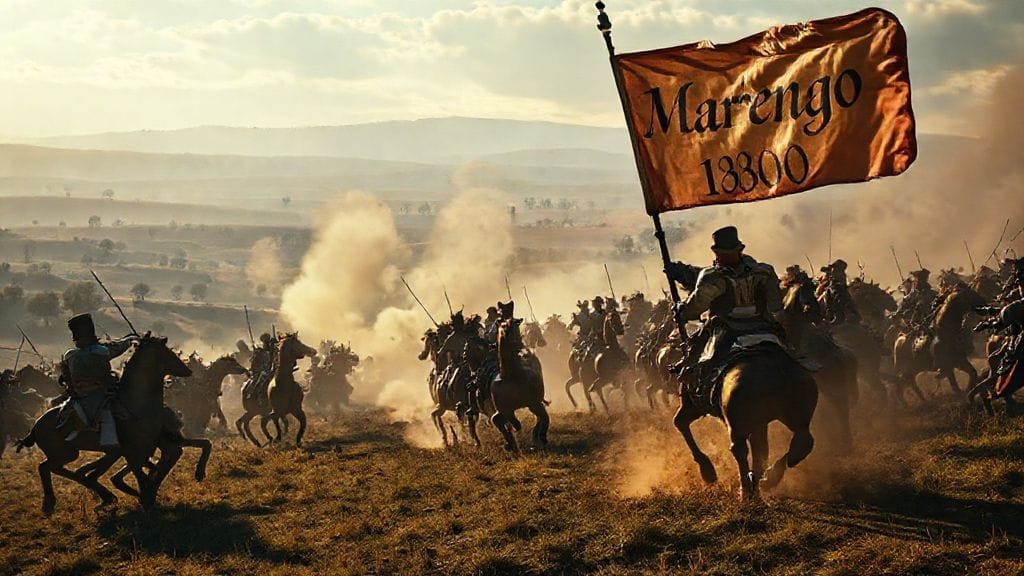
Napoleon Bonaparte, a man who at thirty was already ascending to the helm of Europe’s turbulent political seas, faced a formidable Austrian army under Field Marshal Michael von Melas. The contest was more than a fight for territory; it was a duel for survival, dominance, and influence in a continent still reeling from revolution and war. As the first cannonballs shattered the morning stillness, the Battle of Marengo commenced, an event whose drama, chaos, and ultimate outcome still capture the imagination centuries later.
2. The Stakes of the Napoleonic Wars in Italy
The year 1800 found Europe in the throes of the French Revolutionary Wars, a series of violent upheavals contesting monarchies and republican ideals. Italy, fragmented and ruled by various powers, was a key theater. For Napoleon, then First Consul of the French Republic, securing northern Italy was critical for consolidating power and spreading revolutionary principles.
The Austrian Habsburgs, guardians of the old order, aimed to reverse French gains and protect their Italian domains. The Italian peninsula was more than a prize; it was a strategic chessboard whose control signified greater influence over the balance of power. Both France and Austria recognized that the outcome near Marengo could tip the scales irrevocably — making the stakes colossal.
3. The Road to Marengo: Preceding Maneuvers and Strategies
Before the battle, a tense game of strategic positioning unfolded. Napoleon had executed a daring crossing of the Alps in May 1800, an audacious move that caught Austrian commanders off guard. This feat demonstrated the audacity and genius that had begun to define him.
Melancholy reports of Austrian forces steadily regrouping around Alessandria challenged Napoleon to act fast. While Austrian ranks grew in size and confidence, Napoleon sought to divide and conquer, striking decisively before Melas could solidify his positions. Both sides moved meticulously, scouts probing, feints employed — a prelude charged with secrets lying beneath the summer dawn.
4. Two Armies, One Battlefield: The Forces at Play
The French Army of the Reserve under Napoleon comprised roughly 28,000 men, a disciplined, motivated force seasoned by Italy's campaigns. Their tactics revolved around flexibility, rapid movement, and inspired leadership.
Opposing them, the Austrians fielded approximately 30,000 soldiers under Melas, bolstered by tradition, scale, and organized infantry squares. Their confidence was shaken by earlier setbacks but bolstered by the hope of crushing the French in one decisive blow.
This was not merely a contest of numbers but of wills, training, morale, and vision. Both commanders shaped their troops with personality; Napoleon’s magnetic leadership inspiring loyalty and courage, Melas’s experience instilling a sense of order and imperial might.
5. Napoleon’s Gambit: Bold Risk in Uncertain Terrain
Napoleon bet heavily on the element of surprise and his battlefield agility. The fog lent concealment yet brought uncertainty. His plan was complex: hold defensive positions initially while waiting for reinforcements, then launch a potent counteroffensive.
This was a study in calculated risk — Napoleon’s judgment of timing and terrain would be tested. His private thoughts likely mixed caution with ambition; he understood that victory here could fast-track his ascendancy to undisputed power, while defeat might condemn his fragile political position.
6. The Opening Clash: Austrians Advance with Confidence
As the fog lifted, Austrian troops advanced aggressively, pushing French forces back through a series of fierce engagements. The French were pressed hard; for hours, the Austrians appeared dominant, seizing key positions and disrupting French lines.
The battle’s early tempo was defined by artillery barrages and frenetic skirmishes in the steep, rolling landscape — the Palardon farmstead, the village of Marengo itself, and the orchards became deadly nodes of combat. The atmosphere was chaotic: musket fire echoed, men surged forward, and officers shouted orders amid the din.
7. French Defensive Lines Under Pressure
French soldiers held their ground with remarkable resilience. Though under heavy pressure, formations like the grenadiers and chasseurs maneuvered expertly. Napoleon’s presence was palpable; his staff rode between units, boosting morale and adjusting plans dynamically.
Yet the tide seemed to be turning against the French. Units faltered, lines wavered, and some feared collapse. Even Napoleon contemplated the possibility of defeat, his famed resolve tested to the limit.
8. The Turning Tide: Desaix’s Timely Arrival
Just as the dusk began to darken the battlefield, reinforcements arrived under General Louis Desaix. Desaix had been trailing the army, and his unexpected entry brought renewed strength and hope.
With calm decisiveness, Desaix's troops moved to stabilize the faltering French right flank. His legendary cry, “There is the victory!” (supposedly uttered on the field), symbolized a turning point. His presence reinvigorated French efforts and set the stage for a fierce counterattack.
9. The Decisive Counterattack: Breaking the Austrian Will
Seizing the initiative, French forces launched a coordinated assault. Infantry columns struck with renewed vigor, supported by fresh artillery barrages. The battle’s momentum shifted dramatically as the Austrians, caught off guard, began withdrawing.
What followed was a blistering push that shattered Austrian morale. Ultimately, Field Marshal Melas was forced to order a retreat, suffering severe casualties. The French victory was hard-earned — a testament to leadership, timing, and tenacity.
10. A Battlefield Transformed: Aftermath of the Fighting
When the smoke cleared, Marengo was a scene of devastation mixed with triumph. Fields bore the scars of cannonballs and musket fire; bodies of friend and foe mingled in silent witness to violent conflict.
French forces suffered approximately 7,700 casualties, the Austrians nearly 12,000. Despite heavy losses, the French secured control of northern Italy, shifting the strategic landscape irrevocably. Commanders and common soldiers alike grappled with exhaustion, grief, and relief.
11. The Human Cost: Stories from the Frontline
Beyond the grand strategic narrative lay personal stories — the young conscript who fired his first shot, the medic tending to shattered limbs, the tragic family of peasants caught between both armies.
Letters and memoirs collected later reveal a panoply of emotions: fear, courage, despair, hope. One soldier recalled, “The roar was endless, men screaming, horses falling… yet we stood, because we trusted in the man who led us.”
This brilliant yet brutal clash symbolized the furious reality of war — intertwined with suffering and a poignant humanity.
12. Political Reverberations in Europe’s Power Balance
The victory at Marengo resonated far beyond the Italian plains. It secured French dominance in northern Italy, forcing Austria to negotiate the Treaty of Lunéville in 1801, effectively recognizing French territorial gains.
More broadly, the battle elevated Napoleon's stature, setting him firmly on the path from General to Emperor. European monarchies took note: the old order faced a dynamic revolutionary force reshaping traditional hierarchies.
13. Military Innovations and Tactics Revealed
Marengo showcased key Napoleonic tactics — rapid troop movements, use of artillery in mobile support roles, flexible lines adapting to battlefield realities.
The French army exemplified the power of a corps system, allowing for greater autonomy and quicker responses. Desaix’s intervention illuminated the critical importance of reserves and timing.
Lessons extracted from Marengo influenced military doctrine across Europe for decades, heralding a modern era of warfare.
14. Napoleon’s Reputation Cemented: From General to Emperor
With Marengo triumph, Napoleon transformed from a talented general into the symbol of French destiny. His political opponents grudgingly recognized his skill.
Public celebrations in Paris hailed “Le Grand Capitaine,” the great captain who had pulled victory from near defeat. This prestige propelled him to consolidate power, culminating in his coronation as Emperor in 1804.
Marengo was not only a battlefield success but a crucial chapter in Napoleon’s meteoric rise.
15. The Myth and Memory of Marengo in French Culture
Marengo entered French cultural memory as a symbol of resilience and genius. Paintings, poems, and commemorations immortalized the day.
Napoleon’s horse, Marengo, became legendary, a living emblem of the battle’s glory. Streets, fountains, and monuments across France bear its name.
This memory sustained national pride through later upheavals and remains a touchstone in French historical identity.
16. Austrians in Retreat: Loss and Lessons for the Habsburg Empire
For Austria, Marengo was a sobering defeat. The loss forced military reforms and a reassessment of conventional tactics against the agile French model.
Politically, it undermined Habsburg influence in Italy, stoking internal pressures. However, the empire harnessed these lessons, which contributed to future resistance during the Napoleonic Wars.
The battlefield’s wounds ran deep – challenging pride and tradition.
17. Historiographical Debates: Was Marengo a True Victory or a Narrow Escape?
Historians have long debated the nature of Marengo’s outcome. Some argue it was a narrow escape for the French rather than a decisive victory, given the hour-long Austrian dominance and potential catastrophe.
Others emphasize Napoleon’s leadership and Desaix’s intervention as decisive turning points, underscoring the victory’s legitimacy and strategic import.
This nuanced view reflects the complexities of warfare itself — where fortune, timing, and decision-making intertwine unpredictably.
18. Marengo’s Legacy in Napoleonic Warfare Doctrine
Marengo became a case study in military academies worldwide. It highlighted combined arms tactics, the importance of intelligence and reconnaissance, and leadership charisma.
Napoleon’s innovations at Marengo influenced the conduct of campaigns well into the 19th century, shaping how armies balanced aggression and defense.
This enduring legacy confirms the battle’s historical significance beyond its immediate outcome.
19. Commemorations and Monuments: Remembering the Battle
Today, the site near Alessandria hosts museums and annual events honoring the Battle of Marengo. The Marengo Memorial and multiple plaques invite visitors to contemplate this pivotal moment.
These commemorations blend solemn respect with national pride, connecting contemporary generations with their turbulent past.
They stand as reminders of sacrifice, strategy, and the human capacity to both destroy and endure.
20. Conclusion: An Epochal Clash that Shaped Modern Europe
The Battle of Marengo was more than a clash of armies; it was a fulcrum on which the destiny of nations pivoted. Fog and fire mingled on the plains of Italy, crafting a narrative of courage, calculation, and unforeseen salvation.
Through sheer force of will and the crucible of battle, Napoleon forged an indelible legacy — a step that reshaped Europe’s political map and echoed across centuries. Marengo embodies the drama of history: unpredictable, tragic, and ultimately transformative.
FAQs about the Battle of Marengo
Q1: What caused the Battle of Marengo?
The battle resulted from the ongoing struggle between Revolutionary France and the Austrian Habsburgs for control over northern Italy during the War of the Second Coalition. Napoleon sought to solidify French influence by swiftly striking Austrian forces regrouping near Alessandria.
Q2: Who were the key commanders at Marengo?
Napoleon Bonaparte led the French forces, supported critically by General Louis Desaix. The Austrian army was commanded by Field Marshal Michael von Melas.
Q3: How significant was Desaix’s role in the battle?
Desaix’s arrival late in the afternoon was pivotal. His fresh troops helped stabilize the French lines and execute a decisive counterattack that turned potential defeat into victory.
Q4: What were the casualties?
French casualties numbered around 7,700, while Austrian losses were approximately 12,000. Both sides endured heavy physical and psychological tolls.
Q5: How did Marengo affect Napoleon’s political standing?
The victory significantly bolstered Napoleon’s reputation, enabling him to consolidate power in France and solidify his path to become Emperor.
Q6: What military tactics did Marengo highlight?
The battle showcased rapid troop movements, effective use of artillery, flexible defensive and offensive coordination, and the importance of reserves.
Q7: How is Marengo remembered today?
Marengo is commemorated through monuments, museums, and cultural references, celebrating its historical and symbolic importance in French and European history.
Q8: Did Marengo have lasting effects on European geopolitics?
Yes, it shifted power balances, weakened Austrian influence in Italy, led to subsequent peace treaties favoring France, and influenced military doctrines across Europe.