Table of Contents
- The Quiet Dawn at Lunéville: February 9, 1801
- Europe on the Edge: Setting the Stage for Peace
- The French Revolutionary Wars: A Backdrop of Chaos and Change
- The Directors in Decline and the Rise of a New Actor
- Austria and France: Foes Entangled in a Continental Struggle
- The Road to Lunéville: Negotiations Amidst War Fatigue
- The Treaty Takes Shape: Terms Forged by Power and Pragmatism
- The Map of Europe Redrawn: Territorial Adjustments and Sovereignty
- The Collapse of the Holy Roman Empire Looms
- Napoleon’s Grand Design and Austria’s Concessions
- The Human Toll Behind the Inked Signatures
- Immediate Aftershocks: Political Reverberations and Reactions
- The Treaty in the Context of the Revolutionary Wars’ End
- Repercussions for Britain and Other European Powers
- The Legacy of Lunéville: From Temporary Peace to Lasting Change
- Historical Reflections: Lessons from the Treaty of Lunéville
- Conclusion: Peace Carved from the Ruins of War
- FAQs: Clarifying the Treaty’s Impact and Significance
- External Resource
- Internal Link
The Quiet Dawn at Lunéville: February 9, 1801
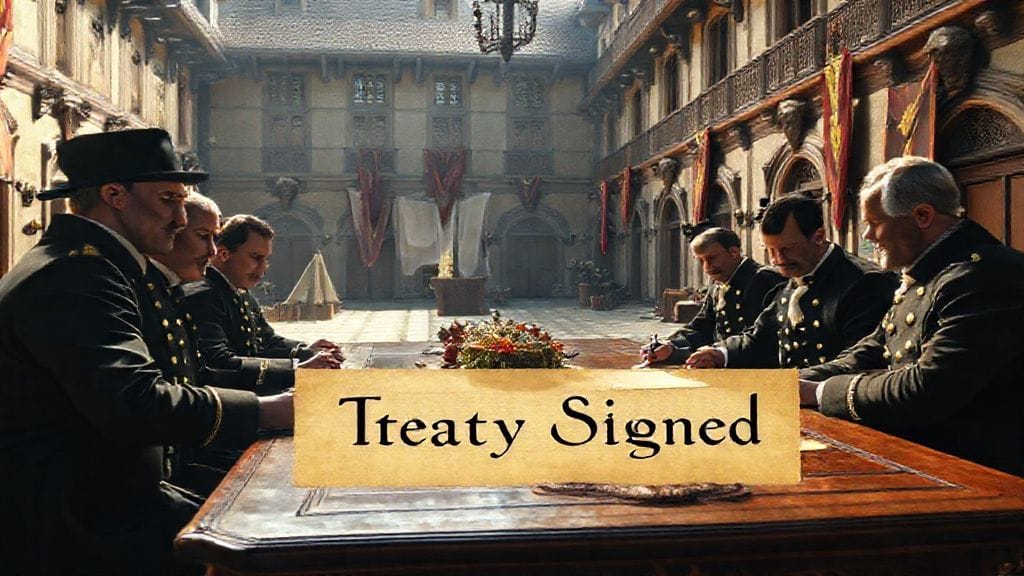
On a chilly February morning in 1801, as winter’s gray fingers still clung to the French countryside, the small town of Lunéville witnessed an event that would ripple across Europe’s fractured landscape. Within a modest yet stately building, representatives of the French Republic and the Austrian Empire gathered to affix their seals on a document that promised to end years of bloody conflict: the Treaty of Lunéville. Unlike the thunderous battles that had punctuated the French Revolutionary Wars, here was peace negotiated quietly, amidst hushed exchanges and careful diplomacy. Yet beneath the calm surface, the treaty heralded a profound reshaping of European order—one steeped in both hope and uncertainty.
The treaty was more than just parchment and signatures; it was the culmination of exhaustion, ambition, and a pragmatic desire for stability. The echoes of cannonfire and the mournful cries of countless soldiers still surrounded the continent, but for now, a fragile silence fell. As the ink dried, so did one chapter in the long saga of revolutionary upheaval and imperial rivalry. This moment at Lunéville was a pause—a breath drawn deep by a Europe desperate for respite, even if the turmoil was far from over.
Europe on the Edge: Setting the Stage for Peace
By the dawn of the 19th century, Europe stood at a crossroads. The revolutionary fervor that had erupted in France in 1789 had, over the preceding decade, transformed the continent. Monarchies trembled; alliances shifted like shifting sands under a turbulent sky. The French Republic sought to export its ideals of liberty and equality by the force of arms—a mission that ignited fierce resistance and prolonged conflict.
France’s neighbors, especially Austria, the Habsburg powerhouse, found themselves dragged reluctantly into a grinding war of attrition. For years, battle lines shifted back and forth from the Rhine to Italy, leaving shattered communities and bleeding armies in their wake. While France offered the promise of new order, many across Europe viewed the Revolution as a menace to their traditional structures. Yet the tide was turning. War had drained treasuries and stamina, kingdoms were weary, and the idea of negotiated peace gained traction. The Treaty of Lunéville would become a critical waypoint in this turbulent journey toward a precarious balance.
The French Revolutionary Wars: A Backdrop of Chaos and Change
The French Revolutionary Wars were not merely battles over territory; they were the combustion of conflicting ideologies. Starting in 1792, revolutionary France faced a coalition of European monarchies fearful of contagion. The series of wars that unfolded were brutal and transformative. At stake was nothing less than Europe’s future political landscape.
France’s army, initially chaotic, was forged into an instrument of revolutionary zeal and innovative tactics under generals whose names would become legends—Napoleon Bonaparte chief among them. Austria, meanwhile, oscillated between desperation and resolve, its leadership committed to curbing the Republic’s influence but also wary of endless war. The conflict saw stunning French victories interspersed with costly setbacks, each shifting the strategic calculus for both sides. The Treaty of Lunéville emerged as an attempt to codify a ceasefire, shaped by this decade-long agonizing duel.
The Directors in Decline and the Rise of a New Actor
By 1800, the French government under the Directory was floundering amidst internal divisions and external pressures. Military successes abroad had saved the revolution for the moment, but political stability eluded Paris. Enter General Napoleon Bonaparte—a figure whose meteoric rise embodied both the possibilities and contradictions of revolutionary France.
Napoleon’s return from the Egyptian campaign and his remarkable Italian victories commanded attention. In November 1799, he staged a coup d’état, ending the Directory and inaugurating the Consulate, effectively installing himself as First Consul with near-dictatorial power. His diplomatic and military prowess set the tone for the upcoming peace negotiations. For Austria, dealing with this new power was both a challenge and an imperative.
Austria and France: Foes Entangled in a Continental Struggle
Austria, under the Habsburg Emperor Francis II, was a reluctant warrior. The empire was vast but stretched thin, its resources committed across multiple fronts. The relentless warfare against France imposed not just military strains but also economic hardship and internal unease within the multi-ethnic realm.
Yet Austria was determined to defend its territories and maintain its influence in the volatile Germanic regions. This fierce rivalry underscored the stakes at Lunéville. Both sides were aware that a resolution was necessary but fraught with compromises. Austria’s negotiators approached the table mindful of the empire’s vulnerabilities, seeking to preserve as much of its legacy as possible amid the changing tides.
The Road to Lunéville: Negotiations Amidst War Fatigue
Peace talks were hardly straightforward. Prior to Lunéville, preliminary efforts in places like Campo Formio in 1797 had partially settled terms but failed to bring lasting harmony. By 1800, with renewed hostilities flaring, neither side held decisive advantage.
The Battle of Marengo in June 1800—Napoleon’s striking victory over Austrian forces—altered the balance, compelling the Habsburgs toward negotiation. War-weariness permeated political corridors, while the looming threat of further conflict compelled pragmatic compromises.
The choice of Lunéville, a modest town near Nancy in eastern France, for these negotiations was itself symbolic: far from the grandeur of imperial courts, it reflected the unvarnished reality of exhausted powers seeking shelter in dialogue.
The Treaty Takes Shape: Terms Forged by Power and Pragmatism
Signed on February 9, 1801, the Treaty of Lunéville was essentially a reaffirmation and extension of the earlier Treaty of Campo Formio but with more comprehensive terms. It decreed the formal recognition of French territorial gains achieved during the conflict, particularly on the left bank of the Rhine River—a significant alteration to the map of Central Europe.
Austria acknowledged the French annexations of the Austrian Netherlands (roughly modern Belgium) and much of the Rhineland, while compensations were arranged for Habsburg losses through secularizations and territorial redistributions within the Holy Roman Empire. Mediterranean and Italian interests were also adjusted, with France securing influence in key regions.
The treaty sought to synchronize a fragile peace, yet it carried the seeds of future discord by redrawing borders without regard to ethnic or cultural sensibilities, fettering an already fragile peace.
The Map of Europe Redrawn: Territorial Adjustments and Sovereignty
The Treaty of Lunéville signaled a profound territorial transformation. France’s borders pushed beyond their 1792 limits, consolidating the Revolution’s expansionist ambitions. The left bank of the Rhine, a vital strategic frontier, passed under French control, dramatically shifting power in Western Europe.
Austria, meanwhile, began compensating its princes for lost lands with territories in Germany and Italy—moves that further destabilized the complex patchwork of the Holy Roman Empire. The treaty essentially marked a decisive step toward the dissolution of this centuries-old institution, heralding a new era dominated by rising nation-states and centralized authority.
This redrawing created tensions too, as displaced rulers and populations grappled with new political realities, sowing seeds for future nationalist and dynastic conflicts.
The Collapse of the Holy Roman Empire Looms
Though not officially dissolved until 1806, the Holy Roman Empire was fatally weakened by the Treaty of Lunéville. The treaty’s reallocation of territories and sovereign rights undermined the Empire’s coherence.
The emperor’s diminished control and the increased power of German princes—rearranged and compensated by French-driven territorial changes—tilted the balance. The treaty was a catalyst in the Empire’s terminal decline, which would soon give way to the Confederation of the Rhine under Napoleon’s aegis.
It was the end of a medieval order struggling to survive in a world reshaped by revolution and modern diplomacy.
Napoleon’s Grand Design and Austria’s Concessions
Napoleon’s victory at Marengo and his diplomatic ascendancy at Lunéville were steps in a broader strategy to establish French dominance in Europe. The treaty’s terms reflected Napoleon’s skillful balancing of military might and pragmatic statesmanship, acknowledging Austria’s need for compensation while securing France’s gains.
Austria’s concessions, though painful, were tempered by political realities and a desire to avoid further devastating war. For Napoleon, the treaty was not merely peace but a platform for future expansion, enabling him to consolidate power domestically and abroad.
The Human Toll Behind the Inked Signatures
Beyond political calculations and territorial exchanges were the lives forever altered by conflict. Thousands of soldiers had perished, families destroyed, and communities uprooted.
Veterans returned to changed homelands; refugees crossed uncertain borders. The treaty’s lines—invisible to many ordinary Europeans—dictated new allegiances and identities. In rural towns and bustling cities alike, the aftershocks of revolution and war remained palpable, reminding all that peace was not just paperwork but a complex, ongoing process of healing.
Immediate Aftershocks: Political Reverberations and Reactions
The Treaty of Lunéville was met with a mixture of relief and suspicion across Europe. In France, it bolstered the new Consulate and Napoleon’s legitimacy, appearing as a triumph of diplomacy backed by military prowess.
Austria’s court and military leadership mourned lost prestige but recognized the necessity of peace. Other powers watched warily, aware that the treaty might only be a reprieve rather than a permanent settlement.
In Britain, excluded from these talks and still fighting France, the treaty was viewed through a lens of mistrust, sowing seeds for continued confrontation.
The Treaty in the Context of the Revolutionary Wars’ End
Though the treaty marked the virtual end of the War of the Second Coalition, it was part of a series of agreements that culminated in a fragile European peace. Its significance lies in the acknowledgment of revolutionary France’s altered status and the new balance of power that would dominate the Napoleonic era.
Lunéville effectively closed one chapter of continental upheaval, opening another defined by empire building and ultimately, the Napoleonic Wars that followed.
Repercussions for Britain and Other European Powers
Britain, the persistent adversary of Revolutionary France, had not been a party to the Treaty of Lunéville and remained embroiled in conflict. The treaty strained alliances and marked the beginning of realigning partnerships.
Russia, Prussia, and other monarchies contemplated their position in a reshaped Europe, where France’s aggressive diplomacy challenged the old order. For many, Lunéville was a warning: stability required more than signed treaties—it demanded a new vision for the continent.
The Legacy of Lunéville: From Temporary Peace to Lasting Change
Though intended as a peace treaty, Lunéville’s effects were complex and far-reaching. It underscored the limits of diplomacy in the face of ideological and strategic contradictions.
The treaty’s territorial rearrangements presaged the downfall of the Holy Roman Empire and foreshadowed Europe’s transformation into a battleground of nationalism and empire. It strengthened Napoleon’s hand, laying groundwork for the subsequent expansion and imperial ambitions that would reignite conflict.
Nevertheless, it also demonstrated how war and peace were intertwined in the revolutionary age—fragile moments of accord amid relentless upheaval.
Historical Reflections: Lessons from the Treaty of Lunéville
Looking back, the Treaty of Lunéville reveals much about diplomacy under duress, the interplay of military force and negotiation, and the limits of peace settlements imposed by victors.
It is a case study in the cost of revolution and war, the reshuffling of power, and the eroding of old regimes. Moreover, it hints at the enduring human cost beneath geopolitical chess games, the uncertainty faced by populations caught between imperial ambitions and nationalist currents.
Conclusion
The Treaty of Lunéville stands as both a symbol and a substance of a transformative era in European history. Signed quietly in a provincial French town, it represented exhaustion and pragmatism, victory and concession, hope and foreboding. It was a moment when weary powers agreed to redraw borders and renegotiate sovereignty, yet the peace it forged was fragile, built upon fresh tensions and unresolved grievances.
For Napoleon, Lunéville was a stepping stone on his path to unrivaled influence; for Austria, a reluctant acceptance of changed fortunes; for Europe, a signpost of the end of an age. The treaty reminds us how peace is often the interlude between conflicts, a delicate pause that demands vigilance, vision, and an understanding of history’s human dimension.
From the ink-stained pages, one hears the echo of countless voices—generals and diplomats, monarchs and soldiers, citizens and refugees—each stitching their stories into the complex fabric of Europe’s destiny. The legacy of Lunéville is not simply in the treaties but in the enduring quest for balance amid the storms of change.
FAQs
Q1: What prompted the Treaty of Lunéville in 1801?
A1: The treaty was prompted by prolonged warfare between revolutionary France and the Austrian-led Second Coalition. Exhaustion, military defeats of Austria, and Napoleon’s victories made peace negotiations necessary.
Q2: How did the Treaty of Lunéville affect the map of Europe?
A2: It confirmed French annexations, especially on the left bank of the Rhine, and mandated territorial compensations for Austria, thereby accelerating the decline of the Holy Roman Empire and rearranging Central Europe.
Q3: What role did Napoleon play in the treaty discussions?
A3: Though not personally present at Lunéville, Napoleon’s military successes and political maneuvers shaped France’s negotiating position, making the treaty an instrument of his broader strategy for European dominance.
Q4: Did the treaty bring lasting peace?
A4: The treaty brought a temporary peace and formalized the end of the War of the Second Coalition but did not prevent further Napoleonic Wars, which would follow shortly after.
Q5: How did other European powers react to the treaty?
A5: Britain and other coalition members not party to the treaty viewed it with suspicion and remained opposed to French expansion, leading to ongoing conflict until the Treaty of Amiens in 1802.
Q6: What was the significance of the treaty for the Holy Roman Empire?
A6: The treaty accelerated the empire's fragmentation by redistributing territories and weakening imperial authority, setting the stage for its ultimate dissolution in 1806.
Q7: How is the Treaty of Lunéville remembered today?
A7: It is remembered as a pivotal diplomatic moment marking the transition from revolutionary wars to Napoleonic consolidation, often studied for its impact on European geopolitics.
Q8: Were there notable human stories affected by the treaty?
A8: Yes, the treaty’s territorial changes displaced populations, shifted loyalties, and affected soldiers and civilians who had endured years of upheaval, making peace both a relief and a challenge.