Table of Contents
- The Dawn of a New Era: Paris, December 2, 1804
- From Revolutionary General to Emperor: The Rise of Napoleon Bonaparte
- France on the Brink: The Political Landscape Before the Coronation
- The Power of Symbolism: Why the Coronation Mattered
- Preparations and Intrigue: Setting the Stage at Notre-Dame
- The Ceremony Begins: A City Holding Its Breath
- Napoleon’s Crowning Moment: Seizing the Crown from the Pope
- Joséphine’s Coronation: The Empress in the Spotlight
- Reactions Across Paris: Awe, Dread, and Acclamation
- Europe Watches Closely: Diplomats and Monarchs Respond
- Napoleon’s Vision of Empire: Ideology Behind the Pageantry
- The Role of Religion: The Pope and the Politics of Legitimacy
- The Military Display and the Spectacle of Power
- The Public and the Press: Creating a Legend
- Symbolism and Propaganda: Crafting the Image of an Emperor
- The Immediate Aftermath: Consolidation of Authority
- From Republic to Empire: The Shift in French Identity
- The Coronation as a Prelude to War and Expansion
- The Legacy of December 2, 1804, in French History
- The Myth of Napoleon: How the Coronation Forged a Legend
- Conclusion
- Frequently Asked Questions
- External Resource
- Internal Link
1. The Dawn of a New Era: Paris, December 2, 1804
The morning of December 2, 1804, broke over Paris with a muted chill wrapping the ancient stones of Notre-Dame. But inside the cathedral's soaring Gothic vaults, history unfurled itself with grandeur and solemnity. Banners fluttered in the icy wind, marble gleamed under flickering candlelight, and a crowd of dignitaries, clergy, and soldiers held their collective breath. At the heart of it all stood Napoleon Bonaparte — a man whose meteoric rise from provincial obscurity to the pinnacle of power was about to culminate in a ceremony that would stun Europe and rewrite the narrative of France.
The air was thick not only with incense but with anticipation, pride, and unease. This was no ordinary day; it was an epoch-defining moment where the ideals of the Revolution appeared to diverge sharply into the establishment of a new monarchy, albeit under a man born of revolutionary fire. Paris was the stage, Notre-Dame the theater, and Napoleon's coronation—the performance that would seal his destiny—was about to begin.
2. From Revolutionary General to Emperor: The Rise of Napoleon Bonaparte
Napoleon Bonaparte’s journey to the throne was extraordinary and emblematic of the whirlwind that was post-revolutionary France. Born in 1769 on the island of Corsica shortly after its annexation by France, he embodied the spirit of ambition and adaptation. Early on, his military talents burst forth during the chaos of the French Revolution, where the old aristocracy fell, and meritocracy briefly ruled. His victories in Italy and suppression of internal revolts painted him as a savior of the Republic.
Yet, for all his revolutionary credentials, Napoleon embodied a paradox: a man who declared himself the champion of republican ideals while nurturing imperial ambitions. The 1799 coup d'état of 18 Brumaire transformed him from general to First Consul, effectively making him France’s ruler, but it was clear to many that this was only a stepping stone. By 1804, with domestic stability fragilized and European monarchies edging toward war, Napoleon felt the need to legitimize and cement his rule in a way that transcended the fragile principles of republicanism.
3. France on the Brink: The Political Landscape Before the Coronation
France in 1804 was a nation grappling with monumental contradictions. The Revolution had drained the monarchy of power but failed to resolve the deeper tensions of governance, economy, and identity. The Directory government had fallen to corruption and inefficiency, and Napoleon’s rise had reasserted order but at a cost: many saw in him a new form of autocracy. The revolution’s ideals—liberty, equality, fraternity—had been violently tested, and now the question loomed: what form would France’s future take?
International tensions soared. The old monarchies of Europe viewed the French state with hostility, distrust, and fear. The Coalition powers bristled at Napoleon's military campaigns and despotic tendencies. Within France’s borders lay a delicate balance between revolutionary fervor and nostalgia for the ancien régime. For Napoleon, the coronation was a bold gamble—a unifying spectacle designed to rally nationalism, consolidate power, and send a message that the new France was both unstoppable and legitimate.
4. The Power of Symbolism: Why the Coronation Mattered
One must understand that the coronation of Napoleon was not mere pomp or ritual—it was a carefully choreographed political act laden with layered symbolism. Unlike the Bourbon kings who inherited their crowns by divine right, Napoleon sought to create a new kind of sovereignty: one that blended revolution, religion, and empire.
The very choice of Notre-Dame Cathedral—a sacred site resonating with centuries of French monarchy—was itself a statement bridging past and present. The presence of Pope Pius VII was intended to lend religious legitimacy to Napoleon’s reign, yet the ceremony’s unique twist—Napoleon crowning himself—reflected his insistence on being master of his own destiny. This act shattered traditional protocol and symbolized a new order where authority emanated not simply from God, but from personal merit and popular sovereignty.
5. Preparations and Intrigue: Setting the Stage at Notre-Dame
Weeks before December 2, Paris buzzed with activity. Streets were cleared, façades adorned with imperial eagles, and Notre-Dame transformed into a royal chapel. The event was not only a religious ceremony but also a political theater.
Napoleon’s aides meticulously arranged every detail. Invitations were sent to foreign dignitaries, generals, senators, and courtiers. The Pope’s arrival, the military parades, the distribution of lavish gifts—all contributed to the narrative of a new order. Behind the scenes, palace factions debated the implications; monarchists bristled at the abandonment of traditional kingship, while Bonapartists saw this as the triumph of France’s new destiny.
Rumors abounded of Napoleon’s plan to crown himself, a provocative act that unsettled even the Pontiff. This tension electrified the preparations, underscored by the very real possibility that history’s course would hinge on a few decisive moments inside Notre-Dame’s vaulted nave.
6. The Ceremony Begins: A City Holding Its Breath
On the dawn of December 2, the city awoke to the grand procession making its way to Notre-Dame. Crowds lined the boulevards, soldiers marched in gleaming uniforms, joined by clerics in resplendent vestments. The bell tower tolled solemnly, calling the faithful and the curious alike to witness the birth of an empire.
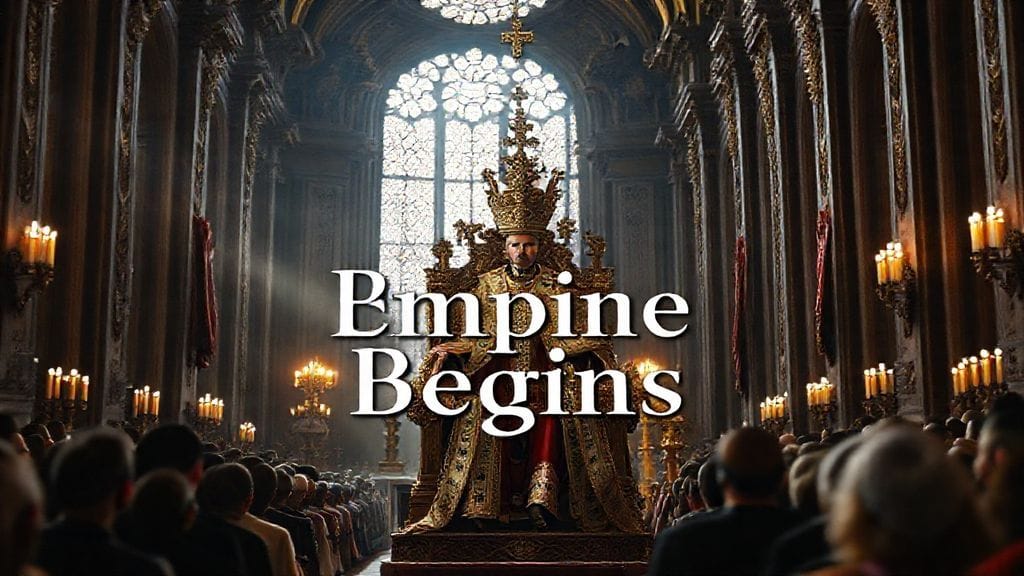
Inside the cathedral, oil lamps cast flickering shadows across the assembled throng. The air was thick with incense and whispered prayer. Nobles, generals, politicians, and clergy settled into their places, faces marked by anticipation or apprehension. At the center stood Napoleon, calm, resolute, clad in robes befitting an emperor, yet scrutinized by all.
The Mass began, voices of the choir soaring, while every eye watched for the moment of transformation—when the general, the First Consul, would become Emperor of the French.
7. Napoleon’s Crowning Moment: Seizing the Crown from the Pope
The defining moment stunned all who witnessed it. As Pope Pius VII raised the crown—an ornate golden laurel wreath symbolic of imperial power—he expected to place it upon Napoleon’s head in the traditional gesture of divine investiture. Instead, Napoleon reached up, took the crown from the Pope’s hands, and placed it himself upon his own brow.
The cathedral fell into stunned silence before erupting into cheers. It was a masterstroke—a vivid spectacle of self-determination and authority. This act sent a clear message: Napoleon alone ordained his rule. The gesture positioned him not as a vassal of the Church, but as the supreme arbiter of France’s destiny.
The symbolism rippled immediately across Europe, unsettling monarchs who now faced a revolutionary figure transformed into a self-styled emperor, unbound by ancient traditions but steeped in new imperial ambitions.
8. Joséphine’s Coronation: The Empress in the Spotlight
Shortly after crowning himself, Napoleon turned to Joséphine de Beauharnais, his beloved wife, and placed the crown upon her head. The relatively humble Corsican general and the elegant empress-to-be embodied contrasting yet intertwined stories: the self-made sovereign and the cultivated aristocrat.
Joséphine’s coronation was more than ceremonial—it reinforced the new imperial family’s place at the heart of French political and social life. Yet their relationship, marked by affection but strained by political necessity, would echo the complex intertwining of personal ambition and public spectacle that characterized Napoleon’s reign.
9. Reactions Across Paris: Awe, Dread, and Acclamation
Outside Notre-Dame, the reaction was mixed. For many Parisians, the coronation was a moment of immense pride—a sign of France’s strength and unity after years of turmoil. The city’s streets roared with acclamation; bonfires and celebrations illuminated the winter night.
Yet whispers of unease traveled through salons and taverns alike. Some viewed Napoleon’s assumption of imperial power as a betrayal of republican values—a reversion to monarchy in Revolutionary disguise. Intellectuals debated the implications, workers sensed the tightening grip of authority, and rural France watched from a distance, uncertain how this new emperor would affect their lives.
10. Europe Watches Closely: Diplomats and Monarchs Respond
Europe’s reaction was a complex blend of anxiety and cautious curiosity. Monarchies such as Austria, Prussia, and Russia viewed the coronation with suspicion, seeing it as a provocative act threatening the old balance of power.
The British, while treating Napoleon with disdain, finally recognized the significance of the new regime. Diplomatic envoy dispatches bubbled with analysis, speculation, and strategic calculations. Warsaw, Vienna, and St Petersburg debated how to respond to a France that was no longer a republic but an empire bent on domination.
Napoleon’s coronation thus not only reshaped France internally but sent unmistakable ripples through the European political landscape—a challenge that would soon erupt into war.
11. Napoleon’s Vision of Empire: Ideology Behind the Pageantry
Napoleon envisioned an empire that was neither wholly revolutionary nor reactionary but a hybrid—a modern state ruled by law, military strength, and meritocracy, yet cloaked in the symbols of monarchy. The coronation was the public embodiment of this vision.
His reforms in law, most notably the Napoleonic Code, sought to standardize justice and administration. The empire was to bring order after revolutionary chaos, a unification of diverse French peoples under a common destiny. But this was an empire reliant on conquest, constant vigilance, and the charismatic authority of its leader.
The coronation was thus not just an event but an opening act in the story of a ruler destined to remake Europe in his image.
12. The Role of Religion: The Pope and the Politics of Legitimacy
Religion played a paradoxical role during the coronation. The Catholic Church, severely weakened by revolutionary upheaval, sought to reclaim influence through papal participation. Pope Pius VII’s presence symbolized an endorsement that could placate devout subjects and foreign powers alike.
Yet Napoleon’s act of crowning himself indicated the limits of ecclesiastical authority over his reign. The Church gained ritual prominence, but the event underscored a shifting balance where political sovereignty overruled spiritual sanction.
This uneasy alliance between throne and altar continued to define the complex relationship between Napoleon and the Catholic Church throughout his reign.
13. The Military Display and the Spectacle of Power
Napoleon’s coronation was as much a military event as a religious one. Processions of elite troops, cavalry maneuvers, and martial music punctuated the ceremony, reminding all that this emperor was, first and foremost, a soldier-king.
The military spectacle served multiple purposes: intimidating rivals, inspiring the French people, and asserting the legitimacy of a regime born through conquest. The cultivated image of Napoleon as the invincible general-turned-emperor was central to the enduring mythos the ceremony spawned.
14. The Public and the Press: Creating a Legend
The role of the public and the press in shaping the coronation’s image was crucial. Pamphlets, engravings, and paintings immortalized the event, spreading its symbolism far beyond Paris. Artists like Jacques-Louis David captured moments frozen in time: the self-crowning, the radiant Joséphine, the grandeur of the cathedral.
For ordinary citizens, the spectacle became a story to tell and retell, solidifying Napoleon as the embodiment of French glory and a new status quo. The press carefully choreographed narratives praised order, strength, and renewal—tones that helped cement support and quell dissent.
15. Symbolism and Propaganda: Crafting the Image of an Emperor
From costume to choreography, every detail of the coronation was designed to craft a powerful visual narrative. The imperial robes stitched with golden bees, the fleur-de-lis motifs, the laurel wreath borrowed from Roman tradition—all evoked themes of legitimacy, prosperity, and historical destiny.
This deliberate use of symbols transformed the event into a form of propaganda, presenting Napoleon not just as a man but as an idea: the righteous ruler chosen by history, law, and personal genius. The coronation thereby became a cornerstone of the Bonapartist myth.
16. The Immediate Aftermath: Consolidation of Authority
In the weeks following the coronation, Napoleon capitalized on the momentum to strengthen his political hold. New laws, appointments, and military campaigns reinforced the empire’s foundations. His image as Emperor became inseparable from France itself, enabling him to quell internal opposition and rally resources for further expansion.
The coronation, in essence, was not a ceremonial endpoint but the opening gambit of a reign that would reshape France and Europe for decades.
17. From Republic to Empire: The Shift in French Identity
Napoleon’s coronation marked the definitive end of France’s revolutionary republican experiment, steering the nation toward imperial rule. This shift redefined French identity: from citizens of a republic to subjects of an empire, united under a symbolic figure whose authority blended tradition and modernity.
This transformation provoked complex responses: pride in restored order, frustration among republicans, and anticipation of both opportunity and conflict. It was a rebirth, but one shadowed by questions about the soul of the nation.
18. The Coronation as a Prelude to War and Expansion
Within months, Napoleon’s empire was at war again. The coronation was not only a domestic spectacle but a prelude to broader ambitions. Coalitions formed, armies marched, and the struggle for European dominance intensified.
The ceremony energized both supporters and foes; it declared France’s intention to dominate geopolitics through military might and political innovation. Thus, the crowning of Napoleon was inseparable from the wars that would define his reign and Europe’s future.
19. The Legacy of December 2, 1804, in French History
Over two centuries later, Napoleon’s coronation remains a powerful symbol of ambition, revolution, and the complexities of power. It marks the moment a figure of extraordinary talent ascended to canonical status—forever inscribed in history books, art, and collective memory.
The event encapsulates the contradictions of the era: revolutionary ideals entwined with autocratic reality, allegiance to the past coupled with a vision of modern empire. December 2 stands as an enduring testament to the transformative power of ritual, leadership, and spectacle.
20. The Myth of Napoleon: How the Coronation Forged a Legend
The coronation shaped one of history’s enduring legends. Napoleon emerges neither simply as a conqueror nor a tyrant, but as a self-made emperor whose reign transitioned France from chaos to order, from republic to empire.
Through a single, magnificent day, he claimed not only a crown but the narrative of a nation, wrapping himself in mythic proportions. The legacy of this act stretches beyond France, inspiring and cautioning those who seek to rewrite the destinies of nations.
Conclusion
December 2, 1804, was more than a day of ritual—it was a moment when history’s threads converged to weave a new tapestry. Napoleon Bonaparte, once the revolutionary general, stood crowned as Emperor, embodying both the promises and betrayals of the French Revolution. His self-coronation was a bold assertion of individual will and a symbolic break with the past, leaving an indelible mark on France and the world.
This ceremony was a powerful reminder of how symbolism, power, and human ambition intertwine to shape history. Behind the gold and grandeur lay a man determined to forge an empire, a nation poised at the crossroads of revolution and tradition, and a continent bracing for the storms to come.
Frequently Asked Questions
1. Why did Napoleon crown himself instead of accepting the Pope’s crown?
Napoleon’s self-crowning was a deliberate assertion of his authority, signaling that his power was self-derived and not granted by the Church. It symbolized his independence from religious authority and emphasized his role as the supreme arbiter of his own destiny.
2. What role did the Catholic Church play in the coronation?
Pope Pius VII’s presence lent religious legitimacy and continuity with French tradition. However, the ceremony reflected a complex relationship where Napoleon upheld certain religious rituals but maintained political supremacy over the Church.
3. How did the French population react to Napoleon’s coronation?
Reactions were mixed; many Parisians celebrated with enthusiasm and pride, seeing the event as a restoration of national glory. Others, particularly republicans, saw it as a betrayal of revolutionary ideals. The event inspired both hope and apprehension.
4. How did other European powers respond to the coronation?
Monarchies viewed the coronation with suspicion and concern, interpreting it as a challenge to the established balance of power. It accelerated diplomatic tensions that soon led to renewed conflict and coalitions against France.
5. What was the significance of the location, Notre-Dame Cathedral?
Notre-Dame was a symbol of French royal tradition and Catholic heritage. Using the cathedral linked Napoleon’s regime with the historical monarchy, lending a sense of continuity and grandeur to his new empire.
6. Did the coronation help Napoleon consolidate power?
Absolutely. The ceremony was a powerful political act that reinforced Napoleon’s authority, unified the nation under his rule, and enhanced his legitimacy both domestically and internationally.
7. How did the coronation influence Napoleon’s subsequent military campaigns?
The imperial stature elevated by the coronation emboldened Napoleon’s ambitions, providing political capital and national support to pursue expansive wars across Europe aimed at securing and expanding his empire.
8. How is the coronation remembered in historical memory today?
It is viewed as a defining moment that marked the end of revolutionary France and the birth of the Napoleonic Empire. Represented in iconic paintings and literature, it remains a powerful symbol of ambition and the complexities of power.