Table of Contents
- The Dawn of October 21, 1805: A Day Poised on the Edge of History
- Europe on Fire: The Napoleonic Wars and the Struggle for Supremacy
- The Stakes at Sea: Control of the British Isles and the Continental Blockade
- The Commanders’ Mantles: Admiral Nelson and Admiral Villeneuve Face Off
- The Gathering Storm: The Franco-Spanish Fleet Sets Sail
- British Naval Doctrine and the Revolutionary Spirit of Nelson
- The Approaching Armada: Maneuvers off Cape Trafalgar
- The Clash Begins: Breaking the Line and Shattering Formations
- Fires, Smoke, and Thunder: The Heat of Battle on the Open Sea
- Nelson’s Final Charge: Heroism and Sacrifice in the Eye of the Storm
- The Wounded Giant: The French and Spanish Fleets Crumble
- A Nation’s Cry: Britain’s Reaction to Nelson’s Death and Victory
- The Immediate Aftermath: Rescue, Loss, and the Toll of War
- Naval Supremacy Secured: Britain’s Command of the Oceans
- The Strategic Impact: Napoleon’s Continental Ambitions Thwarted
- Cultural Echoes: Trafalgar in Art, Literature, and National Memory
- The Evolution of Naval Warfare Post-Trafalgar
- Remembering Trafalgar: Monuments, Ceremonies, and the Legacy of Valor
- Lessons from the Battle: Leadership, Innovation, and the Human Cost
- The Global Reverberations: How Trafalgar Shaped 19th Century Geopolitics
- Conclusion: Trafalgar’s Enduring Resonance in History’s Great Narrative
- FAQs: Unraveling the Mysteries and Myths of Trafalgar
- External Resource: Link to the Wikipedia Portal on the Battle of Trafalgar
- Internal Link: Visit History Sphere for More Immersive Historical Narratives
1. The Dawn of October 21, 1805: A Day Poised on the Edge of History
The chill of early autumn wrapped tightly around the jagged cliffs near Cape Trafalgar as the first light spilled across the restless Atlantic waves. At sea, a tense hush hung over two colossal fleets poised for a clash that would echo through centuries. On this razor-thin morning, 27 British ships faced an armada of 33 combined French and Spanish vessels, each captain aware that what unfolded today would decisively sway the fate of empires.
The salt-tinged air vibrated with anticipation and dread. Thousands of sailors—men hardened by endless ocean voyages yet inexperienced in the grim ballet of battle—gripped their riggings and squinted towards the horizon. Smoke curled faintly from distant masts. Cannon crews stood ready, hearts pounding beneath scarred uniforms coated in the brine of months at sea.
Aboard HMS Victory, Admiral Horatio Nelson stood radiating calm determination, his famous eye patch giving him the air of a man who had faced death before and emerged reborn in steel and spirit. His hand steadied the telescope as he surveyed the enemy lines. “England expects that every man will do his duty,” the famous signal would soon ripple through his fleet, emboldening men to do what seemed impossible.
This was no mere naval encounter: it was a crucible of will and ambition, where tides of metal and courage would test the limits of strategy and sacrifice.
2. Europe on Fire: The Napoleonic Wars and the Struggle for Supremacy
The Battle of Trafalgar unfolded against the tempestuous backdrop of the Napoleonic Wars—a sprawling, bloody contest that reshaped Europe’s political map. By 1805, Napoleon Bonaparte, the French emperor, had carved out an empire stretching across much of the continent. His ambitions, however, extended beyond land, seeking to strangle Britain’s economy and weaken its global influence.
Naval supremacy was the iron wall guarding the British Isles from invasion. The Royal Navy—steeped in tradition and innovation—stood as the last bulwark against Napoleon’s Continental System, an economic blockade intended to isolate Britain and force its surrender by choking trade.
Spain, once a proud maritime power, was by then a reluctant ally cobbled to France through dynastic marriages and diplomatic pressure. Its fleet, though formidable, suffered from decay and inconsistent leadership. Together, the French and Spanish hoped to combine naval might sufficient to challenge and break Britain’s hold on the seas.
Yet, challenges abounded within the alliance: mistrust, language barriers, and contrasting naval doctrines complicated the cohesion of their forces. Each captain carried a burden heavier than their guns—a burden of national pride and the looming shadow of defeat.
3. The Stakes at Sea: Control of the British Isles and the Continental Blockade
Control of the seas was not simply a question of flag-waving and pride—it was existential for Britain. The island nation’s survival depended on uninterrupted trade routes for food, raw materials, and the wealth that fueled its industrial revolution.
Napoleon’s Continental Blockade sought to sever these lifelines. His plan was bold: assemble a fleet strong enough to evade or shatter the British navy, allowing an invasion force to cross the English Channel and end British independence once and for all.
Meanwhile, the British sought to pre-empt this nightmare. Naval intelligence, captured dispatches, and coded signals painted a picture fraught with danger and urgency. The Admiralty knew that failure at sea would shortcut the war’s timeline dramatically in favor of France.
Thus, Trafalgar was not merely a battle but the pivot upon which the fate of the British Isles—and perhaps all Europe—would turn.
4. The Commanders’ Mantles: Admiral Nelson and Admiral Villeneuve Face Off
Two figures tower over the story of Trafalgar, emblematic of contrasting destinies and leadership styles: Vice-Admiral Horatio Nelson for Britain, and Vice-Admiral Pierre-Charles Villeneuve for the Franco-Spanish alliance.
Nelson, scarred physically and mentally by previous battles, was beloved by his men. His aggressive tactics, unorthodox maneuvers, and uncanny ability to inspire loyalty birthed myths of near-superhuman leadership. He sailed with a palpable intensity: “No captain can do very wrong if he places his ship alongside that of the enemy,” he famously declared.
In contrast, Villeneuve’s reputation was more mixed. His fleet had suffered defeats and criticism, and Napoleon himself doubted his resolve. Villeneuve faced pressure to unite the French and Spanish forces coherently, but he could never shake the weight of strategic indecision or the nagging fear of disaster.
Their encounter was not only a meeting of fleets but a confrontation between bold vision and hesitant command.
5. The Gathering Storm: The Franco-Spanish Fleet Sets Sail
Throughout the summer and early autumn of 1805, the French and Spanish fleets struggled to consolidate forces in Cádiz and Toulon. Stormy seas and British blockades hampered movements, but the combined fleet finally set sail on October 19, attempting to elude Nelson’s pursuing ships.
This ⚓ “great escape” was fraught with tactical risk; the winds and currents off southern Spain are notoriously fickle. Yet Villeneuve was determined: these ships were the spearhead of Napoleon’s planned channel crossing.
Behind them loomed a restless British fleet, shadowing every move with ruthless patience. Nelson’s ships were smaller but swifter, their crews battle-hardened and hungry for confrontation.
The stage was set for a storm whose violence would alter naval history forever.
6. British Naval Doctrine and the Revolutionary Spirit of Nelson
The Royal Navy’s principles diverged sharply from those of the traditional line-of-battle tactics embraced by their adversaries. Nelson championed audacity over rigid formations, valuing initiative and the element of surprise.
He organized his fleet into two columns aimed deliberately at “breaking the line” of the enemy’s battle formation—a maneuver that risked exposing parts of British ships to devastating broadsides but promised chaotic close combat where British gunnery and seamanship excelled.
Beneath Nelson’s leadership was a complex web of signals and codes, honed over years to communicate fluidly amidst smoke and confusion. His famous signal before battle—“England expects that every man will do his duty”—stirred pride and steel nerves, weaving a psychological tapestry as potent as any cannonade.
This innovative doctrine would be tested mercilessly off Cape Trafalgar.
7. The Approaching Armada: Maneuvers off Cape Trafalgar
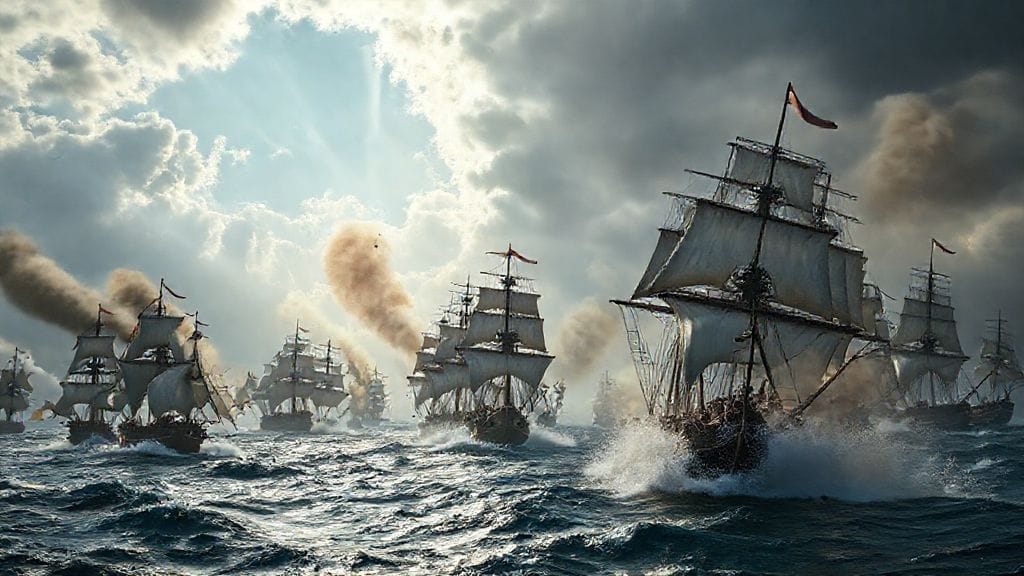
By mid-morning on the 21st, the two fleets closed with a tension rivaling any earthly theater. The British columns sliced through the offshore breeze, their colors snapping defiantly. Opposing them, the Franco-Spanish line braced, flags fluttering amid the anticipation of hellfire and iron.
The sea churned with the movement of 60,000 men, horses, guns, and sails—each vessel a universe of noise and human ambition. Captains shouted orders over the roar of waves, crewmen readied powder charges, and nerves strained taut in the moments before history’s great crescendo.
It was a ballet of chaos, the turns and tacks of hundreds of ships playing out in a dangerous chess game where a single misstep meant annihilation.
8. The Clash Begins: Breaking the Line and Shattering Formations
Nelson’s two-column attack was as daring as it was devastating. The moment British ships pierced the enemy line’s coherence, order gave way to confusion. Cannon fire exploded from every side, sending plumes of smoke and wreckage into the sky.
This breaking of the line nullified the conventional advantage of the enemy’s concentrated broadsides and forced brutal close-range fighting. British sailors boarded enemy vessels in bloody hand-to-hand combat, their training and ferocity turning the tide.
The shouting of officers, the pounding drums, and the staccato of muskets painted an apocalyptic scene unfolding under a storm of iron.
9. Fires, Smoke, and Thunder: The Heat of Battle on the Open Sea
Ship after ship became engulfed in flames, rigging shattered, and decks slick with blood and seawater. The cries of the wounded mingled with the relentless peal of guns. Exploding munitions sent shrapnel into the thick, suffocating fog of smoke.
Despite grievous losses, the British maintained relentless pressure. Their gunners found rhythms honed in decades of war; their commanders coordinated close combat with surgical precision. Throughout the inferno, Nelson’s flagship, HMS Victory, stood at the center, a beacon of resistance and resolve.
Yet the cost was grievous. Sailors and officers alike paid the ultimate price in this crucible of fire and steel.
10. Nelson’s Final Charge: Heroism and Sacrifice in the Eye of the Storm
Tragically, Nelson himself was mortally wounded during the battle—a musket ball tore through his left shoulder, and the admiral was carried below deck as victory unfolded above.
Despite his grievous injury, Nelson’s calm and stoic presence inspired those around him in his final hours. His last words reportedly urged the continuation of the fight, his mind fixed on ensuring triumph even at the cost of his life.
News of his death was a hammer blow to Britain, but it also immortalized his legend and galvanized the nation’s resolve. Nelson became not just a general but a symbol of sacrifice and national identity.
11. The Wounded Giant: The French and Spanish Fleets Crumble
By nightfall, the combined Franco-Spanish fleet was shattered. Eighteen ships were captured or destroyed; the rest limped back to port, broken in spirit and capacity.
Villeneuve himself was taken prisoner, his career and hopes dashed against the rocks of Trafalgar’s furious waves. Spain’s maritime power was effectively crippled, its fleet no longer a threat to British supremacy.
This rout not only ended the immediate naval threat to Britain but shattered Napoleon’s dreams of invasion indefinitely.
12. A Nation’s Cry: Britain’s Reaction to Nelson’s Death and Victory
Across Britain, news of the victory was tempered by sorrow. Nelson’s sacrifice became a rallying point, a narrative entwining national pride with a profound sense of loss.
Public celebrations erupted alongside solemn memorials. Poets and painters immortalized the event, blending fact and myth. Admiral Nelson was lionized as the savior of the nation and embodying the virtues of courage and patriotism.
Trafalgar Day became an annual occasion to remember sacrifice and resilience. The battle entered British collective consciousness as a twilight moment where freedom was secured through blood and bravery.
13. The Immediate Aftermath: Rescue, Loss, and the Toll of War
The wounded were tended and ships salvaged under difficult conditions. Maritime surgeons worked feverishly to save lives amid the wreckage. Yet the human toll was staggering—nearly 5,000 casualties from both sides, including hundreds killed outright or lost at sea.
Beyond the physical wounds, survivors carried psychological scars that would haunt them for years. The battle exposed the brutal realities of naval warfare—the thin line between glory and tragedy.
14. Naval Supremacy Secured: Britain’s Command of the Oceans
With the enemy fleet crippled, Britain’s maritime dominance became uncontested for over a century. This supremacy allowed British trade and colonial expansion to flourish unimpeded, laying foundations for the country’s global empire.
Trafalgar guaranteed the “Rule of the Waves,” securing lines of communication and influence from the Caribbean to the Indian Ocean. The Royal Navy’s role as a global policing force was cemented, shaping the modern world order.
15. The Strategic Impact: Napoleon’s Continental Ambitions Thwarted
The defeat forced Napoleon to abandon plans for invading Britain, redirecting his energies to land campaigns. This shift altered the strategic balance in Europe, prolonging the conflict but changing its nature fundamentally.
Without naval superiority, France's ability to challenge Britain globally was severely diminished. Trade blockades, colonial expeditions, and power projection hinged increasingly on continental victories rather than maritime force.
Trafalgar marked the effective end of French and Spanish naval threats for decades.
16. Cultural Echoes: Trafalgar in Art, Literature, and National Memory
The battle inspired a wave of creative expression: epic poems, paintings by J.M.W. Turner and others, and countless stories told in taverns and drawing rooms alike.
Trafalgar became a symbol of British resilience, heroism, and the sacred duty of service. Monuments such as Nelson’s Column in London rose to enshrine memory in stone, while songs and tales passed down generations.
This cultural legacy forged a national mythology interwoven inseparably with British identity.
17. The Evolution of Naval Warfare Post-Trafalgar
Trafalgar also signaled a turning point in naval tactics and technology. The triumph of breaking the line emboldened commanders to favor flexible, aggressive formation strategies.
New ship designs, gunnery techniques, and signaling methods were developed to capitalize on the lessons learned. The battle underscored the importance of morale and leadership above sheer numbers, reshaping navies globally.
18. Remembering Trafalgar: Monuments, Ceremonies, and the Legacy of Valor
Annually, thousands gather to mark Trafalgar Day, reflecting on sacrifice and service. Naval academies study the battle as a cornerstone of strategy and leadership.
Statues, plaques, and museums preserve artifacts and stories, connecting modern audiences to the tumultuous sea battles of 1805. Trafalgar’s legacy remains a touchstone for courage tested under fire.
19. Lessons from the Battle: Leadership, Innovation, and the Human Cost
Trafalgar teaches the profound impact of visionary leadership, the willingness to embrace risk, and the unity forged in adversity.
Yet it also reminds us of the human toll—the shattered families, lost lives, and wounded bodies beneath the glory. It is a balanced tapestry of valor and tragedy, innovation and sacrifice.
20. The Global Reverberations: How Trafalgar Shaped 19th Century Geopolitics
Beyond Europe, Trafalgar affected colonial dynamics, trade routes, and naval doctrines worldwide. British influence expanded, while French ambitions were checked.
New alliances formed, and rivalries intensified against this changed backdrop of maritime power. The echoes of Trafalgar shaped diplomacy and conflict throughout the 19th century.
21. Conclusion: Trafalgar’s Enduring Resonance in History’s Great Narrative
More than two centuries after the guns fell silent off Cape Trafalgar, the battle endures as a defining moment of courage, strategy, and national identity. It captures the human drama of war: fear and hope intertwined on the high seas.
Nelson’s legacy and the undying spirit of those who fought resonate still, inviting us to reflect on leadership, sacrifice, and the tides of history that shape our world.
Conclusion
The Battle of Trafalgar was more than an epic naval engagement; it was a fulcrum of history where courage met strategy under the bleak clouds of war. Admiral Nelson’s vision and bravery turned the tide against formidable odds, securing Britain’s command of the seas for generations. Yet Trafalgar also echoes with the human cost—men who fought and died amid smoking decks and shattered rigging, heroes who shaped the fate of nations at the edge of a precipice.
This battle remains a powerful testament to the complexities of leadership, the unpredictable nature of war, and the enduring spirit of those who sail into the storm to defend ideals greater than themselves. In remembering Trafalgar, we honor not just a victory, but the human heart beating at history’s turbulent core.
FAQs
1. Why was the Battle of Trafalgar so important in the Napoleonic Wars?
Trafalgar decisively established British naval supremacy, preventing Napoleon’s planned invasion of Britain and ensuring control of the seas, which was crucial for trade and colonial defense.
2. Who was Admiral Horatio Nelson, and why is he famous?
Nelson was the British admiral who led the Royal Navy to victory at Trafalgar. Known for his daring tactics and charismatic leadership, he became a national hero, dying aboard HMS Victory during the battle.
3. What tactics did Nelson use to win the battle?
Nelson employed the innovative tactic of breaking the enemy’s line with two columns, disrupting their formations and enabling close-quarters combat where British gunnery and training proved superior.
4. What were the main weaknesses of the Franco-Spanish fleet?
The alliance suffered from poor coordination, less experienced crews, and differing naval doctrines, which limited their ability to respond effectively to Nelson’s aggressive tactics.
5. How did the battle impact European geopolitics?
By securing naval supremacy, Britain maintained control of its empire and trade routes, forcing Napoleon to focus on land campaigns and altering the course of the broader conflict.
6. How is Trafalgar commemorated today?
Trafalgar Day is commemorated annually in Britain with ceremonies, naval traditions, and public remembrance. Monuments like Nelson’s Column in London commemorate the battle and its heroes.
7. What was the human cost of the battle?
Approximately 5,000 men were killed, wounded, or missing, making it one of the deadliest naval battles of the era with significant losses on both sides.
8. Did Trafalgar change naval warfare tactics permanently?
Yes, the success of breaking the enemy line encouraged more flexible, aggressive tactics in naval combat and influenced ship design and training in subsequent decades.