Table of Contents
- The Storm Gathers: Europe on the Brink, 1806
- Napoleon’s Vision of Continental Domination
- The Berlin Decree: Architecture of Economic Warfare
- The Mechanics of the Continental System: A Blockade Unlike Any Other
- Britain’s Naval Supremacy and the Limitations of a Land-based Embargo
- Enforcement Across Europe: Compliance, Resistance, and Corruption
- The Role of Neutral Nations Caught in the Crossfire
- Economic Reverberations: Winners, Losers, and the Shifting Trade Landscape
- The British Response: Smuggling, Diplomacy, and the Orders in Council
- The Continental System and the Peninsular War: When Economics Meets Guerrilla Warfare
- Russia’s Growing Discontent and the Seeds of Defiance
- The System’s Impact on French Industry and the Illusion of Self-Sufficiency
- Global Echoes: How the Continental System Influenced Colonial Economies
- The Collapse of the Continental System: The Aftermath of Napoleon’s Invasion of Russia
- Legacy of the Berlin Decree: Economic Warfare in Modern Memory
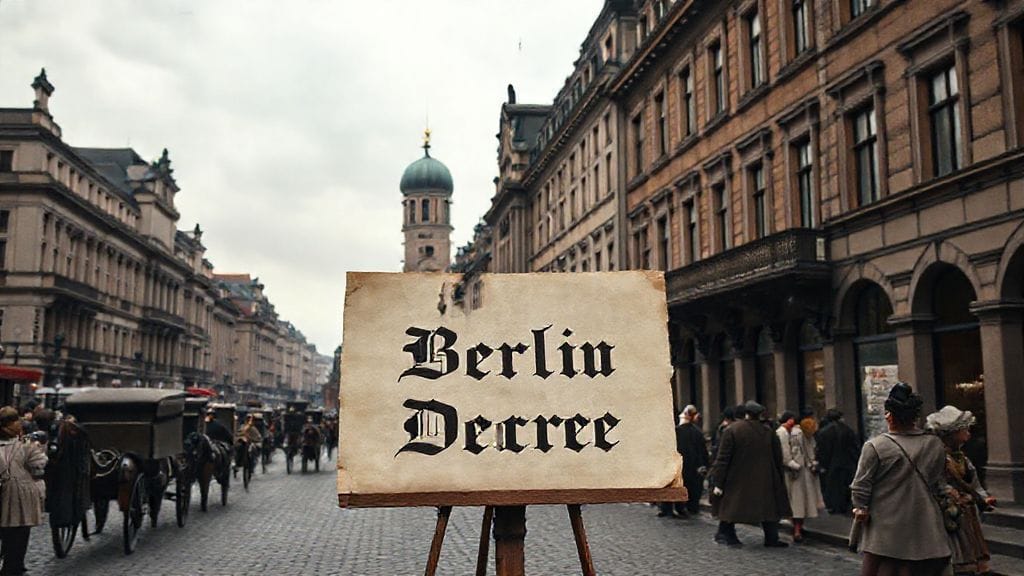
In the chill of a bleak November dawn in 1806, the cobblestoned streets of Berlin were awash with a tension that seemed to thicken the cold Prussian air. Under gloomy skies, the towering palaces bore witness to a decree that would ripple across continents and decades. It was the Berlin Decree, a proclamation issued by Napoleon Bonaparte on the 21st of November, 1806, signaling the birth of the infamous Continental System—a grand economic strategy crafted to strangle Britain’s thriving maritime empire without firing a shot at sea.
Napoleon stood as one of history’s most enigmatic commanders, blending military genius with political audacity. Yet, beyond the dramatic battles and sweeping conquests, lay an economic chess game of unparalleled scale. The Berlin Decree was more than a mere piece of legislation; it was a declaration of total war against British trade, a blockade crafted to reshape Europe’s economic map and bind the continent under French hegemony.
But what did it mean to declare an economic war from a city that once trembled under the shadow of Prussian power? How did this decree reflect the grand ambitions—and palpable paranoia—of one man convinced that Britain was the invisible hand strangling his empire’s rise? This tale, rife with intrigue, defiance, and unintended consequences, unfolds not only on the battlegrounds of Europe but also in the ports, markets, and merchant ships caught in the continental storm.
The Storm Gathers: Europe on the Brink, 1806
By late 1806, Europe was convulsed by the seismic upheavals provoked by the meteoric rise of Napoleon Bonaparte. The Holy Roman Empire had dissolved, its centuries-old structures shattered at the Battle of Austerlitz the previous year, and Prussia was still reeling from its catastrophic defeat at Jena and Auerstedt in October 1806. The old order trembled as Napoleon’s Grande Armée marched unopposed across the continent.
Britain, unyielding and unassailable naval giant, stood as the enduring thorn in Napoleon’s side. Though the French emperor had conquered Europe by land with unparalleled swiftness, the British Isles remained stubbornly out of reach. Channel seas, patrolled by the Royal Navy, barred any hopes of invasion.
Napoleon’s strategy grew clearer: if he could not crush Britain with armies, he would attempt to suffocate her economy. The spirit of this new warfare was articulated in the Berlin Decree, a legal straitjacket designed to isolate Britain, choke her commerce, and force her into submission without another shot across the Channel.
Napoleon’s Vision of Continental Domination
The Continental System was born from the mind of a man who believed that wealth and power were inseparable. Napoleon was convinced that British prosperity depended on its trade dominance, its industrial prowess fueled by global commerce, and its capacity to finance endless wars abroad.
To Napoleon, the key battlefield was economic: by cutting Britain off from its key continental markets, he could deprive it of raw materials, cripple its industry, and spark internal unrest. France and her allies must enforce a strict embargo on British goods, making the continent a fortress of economic self-sufficiency.
Yet this vision was bound by contradictions. France’s own industrial base was comparatively weak, and the economies of allies and occupied territories were intertwined with trade routes that the Continental System sought to disrupt. Still, the Berlin Decree was the opening gambit in what Napoleon hoped would be his most decisive campaign.
The Berlin Decree: Architecture of Economic Warfare
Officially promulgated on November 21, 1806, the Berlin Decree declared the British Isles “in a state of blockade,” forbidding any trade or communication with the British. It ordered that all British goods found on the continent be seized and that no British ships be allowed into European ports under French control.
The terms were sweeping and ambitious. The decree attempted to cut off British goods, ships, and financial instruments—essentially severing Britain’s arteries of trade. The economic blockade was to extend through allied states, client kingdoms, and occupied territories, imposing uniform commercial warfare.
Napoleon’s words, though declarative, quickly came under tension with political realities. How enforceable was such a blockade when vast coastlines and porous borders awaited eager smugglers and a determined Britain?
The Mechanics of the Continental System: A Blockade Unlike Any Other
Unlike a naval blockade, where an enemy fleet physically prevents entry and exit from ports, the Continental System relied on diplomatic decrees and land-based enforcement. This approach was unprecedented due to Europe’s geographic complexity, the numerous political entities involved, and the sheer volume of trade to police.
Customs officers along the Rhine, the Baltic shores, and the Mediterranean coast found themselves tasked with detecting British goods and preventing their passage. Territories like the Kingdom of Italy, the Confederation of the Rhine, and even neutral states were compelled to comply or risk French military intervention.
However, this mechanism was inherently fragile. Smuggling intensified, corruption thrived, and local populations often sympathized with British trade. In this dance of surveillance and subterfuge, the Continental System became as much a psychological war as an economic one.
Britain’s Naval Supremacy and the Limitations of a Land-based Embargo
From the wooden decks of the Royal Navy, the Continental System looked like an elaborate dream doomed to failure. Britain’s dominance at sea made any French attempt at a naval blockade futile. Instead, Britain harnessed its maritime strength to trade with the rest of the globe, circumventing continental restrictions.
British merchants employed an array of strategies: rerouting goods through neutral ports, creating dummy companies, and exploiting the inconsistent enforcement by local authorities. The Orders in Council, Britain's countermeasures, aimed to blockade French-controlled Europe in return, escalating economic warfare.
The British government’s response illustrated a key paradox: while the Continental System aimed to isolate Britain, it instead intensified Britain’s resolve and ingenuity, catalyzing new trade routes and alliances elsewhere.
Enforcement Across Europe: Compliance, Resistance, and Corruption
Across the patchwork of Napoleonic Europe, the Continental System’s enforcement was a patchwork quilt of uneven compliance. France’s allies, often reluctantly, imposed embargoes on British trade, but resentment simmered.
Denmark, Spain, and the Confederation of the Rhine played complex roles as both enforcers and offenders at different points. Many merchants found covert ways to bypass restrictions, leveraging bribery and local complicity. Corruption became an open secret despite reprisals.
In Spain, for instance, the embargo inflamed nationalist sentiments, contributing indirectly to the explosive Peninsular War. In Prussia, once stripped of its independence, the decree was a bitter pill that further alienated the population.
The Role of Neutral Nations Caught in the Crossfire
Countries not formally involved in the conflict, such as Sweden, the Ottoman Empire, and especially the United States, found themselves squeezed by the Continental System and Britain’s counterblockades. Neutral shipping became a battleground.
The United States’ trade interests were deeply entangled, caught between Napoleon’s decrees and British naval control. This tension partially contributed to the War of 1812, highlighting the global significance of European economic policies.
Neutral nations often faced seizure of their ships or cargo, diplomatic pressure, and shifting alliances, underscoring that this economic warfare transcended Europe’s borders.
Economic Reverberations: Winners, Losers, and the Shifting Trade Landscape
The ripple effects of the Berlin Decree were profound and complex. While the system aimed to bring Britain to her knees, it also inflicted pain on continental economies. Textile producers in France and allied states struggled to replace British imports; shortages and inflation hit urban centers.
Conversely, some sectors found opportunity. French industries cautiously expanded to meet demand, and certain port cities adapted to new trade patterns. Yet the general effect was economic disruption, not dominance.
Britain’s global colonies and maritime trade networks softened the blow, but continental Europe felt the strain deeply, exacerbating social tensions that would later contribute to resistance against French rule.
The British Response: Smuggling, Diplomacy, and the Orders in Council
Britain’s answer to Napoleon’s blockade was the Orders in Council of 1807, decrees intended to block neutral ships trading with French-controlled ports. This tit-for-tat blockade escalated tensions dramatically.
Smuggling escalated through the English Channel and along the European coasts. British merchants developed clandestine routes, bribed customs officials, and used third-party flags to disguise their trade.
This interplay underscored the paradox of economic warfare: the more Napoleon tried to isolate Britain, the more inventive British commerce became, knitting tighter global networks while sowing resentment across Europe.
The Continental System and the Peninsular War: When Economics Meets Guerrilla Warfare
The Continental System inadvertently helped ignite one of the most brutal conflicts of the Napoleonic era—the Peninsular War (1808–1814). Spain and Portugal, vital transit points for British trade, became battlegrounds as the embargo clashed against entrenched local interests.
The embargo created widespread hardship, alienating the Spanish elite and peasantry alike. British forces, working with Spanish guerrillas, exploited these fractures to wage asymmetrical warfare that drained Napoleon’s resources and morale.
The Peninsular War became a living symbol of the Continental System’s limits and the resilience of national identities under foreign rule.
Russia’s Growing Discontent and the Seeds of Defiance
Russia was initially a reluctant participant in the Continental System, constrained by political pragmatism rather than ideological zeal. Tsar Alexander I recognized the high cost of cutting off British trade, vital to Russia’s economy.
By 1810, cracks appeared as Russia began to flout the embargo, resuming trade with Britain. This defiance was a pivotal moment, undermining the system’s coherence and foreshadowing the breakdown of Napoleon’s alliance with Russia.
This rupture would culminate in the catastrophic 1812 invasion of Russia—an event that marked the beginning of the end for Napoleon’s empire and the Continental System.
The System’s Impact on French Industry and the Illusion of Self-Sufficiency
Napoleon dreamed that the blockade would stimulate continental manufacturing and end Europe’s historic dependence on British goods. Some industries did expand—textiles, ironworks, and weaponry—but the overall result was more complex.
French industry was insufficiently developed to replace the wide range of British imports. The embargo caused shortages of raw materials like cotton and coal, limiting production capacity.
Moreover, consumer dissatisfaction grew. The French economy, strained under constant warfare and the blockade itself, found it difficult to achieve the self-sufficiency Napoleon envisioned.
Global Echoes: How the Continental System Influenced Colonial Economies
While the immediate skirmishes of the Continental System played out across Europe, its reverberations reached far-flung colonies. British colonial economies adapted, expanding sugar, tobacco, and cotton exports to compensate for lost European markets.
French colonies, such as those in the Caribbean, suffered isolation and shortages, weakening French global influence.
The Continental System inadvertently accelerated shifts in global trade, contributing to the reshaping of colonial economies and foreshadowing the rise of new economic powers.
The Collapse of the Continental System: The Aftermath of Napoleon’s Invasion of Russia
The 1812 invasion of Russia was a strategic and logistical nightmare. As Russian forces retreated, they scorched the earth, denying the French army supplies and forcing a harrowing withdrawal in the brutal winter.
This failure fractured the Continental System’s fragile web. With Russia breaking embargo and other states following suit, the blockade effectively collapsed.
The ensuing coalition wars toppled Napoleon, restored trade flows, and marked the failure of economic blockade as a tool to force Britain’s hand. The Continental System became a cautionary tale of overreach and the limits of economic warfare.
Legacy of the Berlin Decree: Economic Warfare in Modern Memory
The Continental System remains one of history’s earliest large-scale attempts at economic warfare. It is a landmark illustrating how trade and war intertwine, how commerce can become a weapon of statecraft, and how geopolitics strain economic ambitions.
Napoleon’s blockade failed to destroy Britain but transformed the continent in profound ways—politically, economically, and socially.
Modern historians view the Berlin Decree as a bold, if flawed, experiment in economic coercion, paving the way for later embargoes, sanctions, and blockades in the centuries to come.
Conclusion
The Berlin Decree of November 1806 was a moment where the pulse of history shifted from swords clashing on battlefields to tariffs, embargoes, and blockades shaking global economies. It unveiled Napoleon’s ruthless genius and his blind spots—the desire to bend an entire continent to his will through economic constraint, and the underestimation of geography, local interests, and human ingenuity.
This decree crafted a war without canon shots but with deep and lasting scars. The Continental System, despite its failure, reshaped Europe’s economic and political terrain. It revealed the limits of power, the resilience of trade, and the enduring complexity of warfare in a connected world.
In the story of the Berlin Decree, we see the intertwining of ambition, resistance, and unintended consequence—a drama as relevant today as it was more than two centuries ago.
FAQs
Q1: What exactly was the Berlin Decree and why was it issued?
A1: The Berlin Decree, issued by Napoleon on November 21, 1806, initiated the Continental System—a blockade designed to cut off British trade with Europe to weaken Britain economically as part of Napoleon’s strategy to dominate the continent without a full-scale naval invasion.
Q2: How did the Continental System affect European countries under French control?
A2: The blockade disrupted traditional trade routes, causing economic hardship, shortages, and inflation. While some industries grew, many regions experienced resentment and resistance, contributing to political instability and conflicts such as the Peninsular War.
Q3: Why was the Continental System ultimately ineffective against Britain?
A3: Britain’s naval supremacy allowed it to continue global trade through neutral countries and colonies. Smuggling, bribery, and diplomatic countermeasures undermined the embargo, and many European states failed to enforce the system consistently.
Q4: What role did neutral countries play in the blockade’s enforcement?
A4: Neutral countries, notably the United States and parts of Scandinavia, were caught between the Continental System and British counter-blockades, leading to diplomatic tensions and incidents that sometimes escalated into conflict, such as the War of 1812.
Q5: How did the Berlin Decree influence Napoleon’s relationship with Russia?
A5: Russia initially complied but grew increasingly dissatisfied due to economic harm from the embargo and conflicting interests, eventually violating the system. This breakdown contributed directly to the deteriorating Franco-Russian alliance and Napoleon’s disastrous 1812 invasion.
Q6: Did the Continental System have any long-term economic impacts?
A6: Yes, it highlighted the interconnectedness of European and global economies, accelerated industrial development in some regions, and set a precedent for economic warfare. The embargo’s failure reinforced the limits of economic sanctions lacking full international cooperation.
Q7: Can the Berlin Decree be considered one of the first modern economic sanctions?
A7: Absolutely. The decree represents one of the earliest large-scale attempts to use legal and economic means to achieve military and political objectives on a continental scale.
Q8: How is the Continental System viewed by historians today?
A8: Historians often see it as a bold but flawed strategy that underestimated the complexity of enforcing such a vast embargo and the resilience of Britain's naval power and trade networks.