Table of Contents
- A Watershed Moment on the Niemen River: The Setting of the Treaty of Tilsit
- Europe in the Shadow of Napoleon: Prelude to Confrontation
- The Ulm and Austerlitz Campaigns: Foundations for Tilsit
- After Jena and Auerstedt: Prussia’s Crushing Defeat
- The Road to Friedland: Napoleon’s Quest to Obliterate Russian Resistance
- The Battle of Friedland: Decisive Victory and Russian Desperation
- Diplomacy on the Memel: The Arrival at Tilsit
- Napoleon and Alexander I: Two Emperors, Two Visions
- The Signing of the Treaty: A New European Order Drafted on a Floating Royal Barge
- The Terms Imposed on Prussia: Humiliation and Territorial Losses
- The Franco-Russian Agreement: An Uneasy Alliance Through Marriage and War
- The Continental System: Napoleon’s Economic Weapon Against Britain
- The Birth of the Duchy of Warsaw and Reshuffling of Central Europe
- The Fate of the Kingdom of Westphalia and Other Napoleonic Client States
- Reactions Across Europe: From London to Vienna
- The Treaty’s Impact on Russian Strategy and Romanian Politics
- The Seeds of Future Conflict: The Fragility of the Franco-Russian Alliance
- Napoleon’s Vision of European Hegemony and the Costs Thereof
- The Legacy in Prussia: Nationalism and Military Reform After Tilsit
- Echoes of Tilsit in Later Diplomatic History: From Congress of Vienna to World Wars
- Conclusion: The Treaty of Tilsit as a Moment of Illusory Peace
- FAQs: Understanding the Treaty’s Causes, Consequences, and Characters
- External Resource
- Internal Link
1. A Watershed Moment on the Niemen River: The Setting of the Treaty of Tilsit
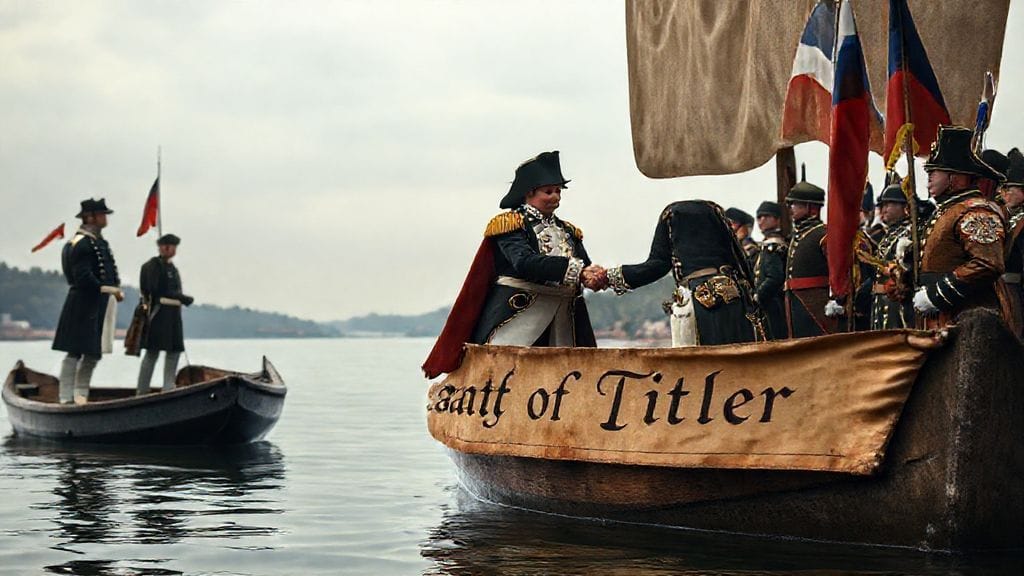
July 7, 1807. On the placid waters of the Niemen River, two great leaders met to draw the map of Europe anew. The sun blazed over the small Prussian town of Tilsit—today Sovetsk—nestling on the border between Prussia and Russia. Yet, beneath the serene sky, tension crackled like an electric storm. After a cascade of brutal battles and relentless pursuit, Napoleon Bonaparte and Tsar Alexander I, once enemies, now sat face to face on a barge turned floating throne. It was not merely a negotiation; it was a dramatic orchestration, a parley of giants that remolded the continent’s destiny. History remembers this moment as the signing of the Treaty of Tilsit, a moment where pride, power, and political calculation collided with profound consequences.
The story of the Treaty of Tilsit is far more than ink on parchment—it is the saga of ambition, defeat, and fragile peace that reshaped Europe during one of the darkest passages of the Napoleonic Wars.
2. Europe in the Shadow of Napoleon: Prelude to Confrontation
At the dawn of the 19th century, Europe was a continent convulsed by revolutionary fervor and imperial ambition. France, under the revolutionary torch and subsequently under Napoleon’s iron fist, had unsettled the old order—the ancien régime that had dominated for centuries. Monarchies feared the spread of ideas about liberty, equality, and fraternity, but also the unstoppable rise of a French emperor whose military genius seemed boundless.
The continent’s power balance teetered precariously. Britain held the seas, Austria clung to its gothic realms in Central Europe, Russia was an immense giant awakening to its role, and Prussia, historically powerful yet recently eclipsed, sought to remain relevant amid shifting alliances.
Napoleon’s campaign of expansion, shaped by victories at Marengo, Hohenlinden, and ultimately Austerlitz in 1805—the famous "Battle of the Three Emperors"—had decisively altered the landscape. Austria humbled and the Holy Roman Empire dissolved, leaving Prussia and Russia as the remaining bulwarks against French domination in the east.
Yet, Napoleon’s eyes were on broader horizons: to subjugate the fragmented German states and challenge Russia’s influence. The stage for confrontation had been set.
3. The Ulm and Austerlitz Campaigns: Foundations for Tilsit
The campaigns of 1805 showcased the brilliance of Napoleon’s strategy. With unmatched speed and surprise, the French army surrounded and captured an Austrian force at Ulm, then decisively crushed the combined Russo-Austrian armies at Austerlitz. The Holy Roman Empire dissolved into the Confederation of the Rhine, aligning German states under French influence.
Prussia, watching nervously, remained ambivalent but wary. Its court oscillated between neutrality and hostility. Napoleon’s aggression stirred unease, while Russia’s oscillating policies complicated allegiances. The fragile peace was a mirage.
4. After Jena and Auerstedt: Prussia’s Crushing Defeat
In October 1806, the fragile balance shattered. Prussia, under King Frederick William III and its seasoned generals, gambled on confronting Napoleon to rescue its prestige and halt French expansion. However, the twin battles of Jena and Auerstedt were catastrophic disasters for the Prussian army.
Napoleon’s forces outmaneuvered and annihilated the once-feared Prussian military. The humiliating defeat shattered Prussia’s illusions of power. Cities fell rapidly, and the French occupied Berlin by late October. This crushing blow left the path open for Napoleon’s campaign against Russia, but also set the tone of humiliation that would linger.
5. The Road to Friedland: Napoleon’s Quest to Obliterate Russian Resistance
Having reduced Prussia to submission, Napoleon turned east to confront Tsar Alexander I’s forces. The campaign was neither swift nor easy. The vastness of Russia’s territory and the resilience of its army stretched French supply lines and morale.
Yet the climactic engagement came on June 14, 1807, at the Battle of Friedland. Here, Napoleon’s tactical genius shone brilliantly, decimating the Russian army and forcing Alexander to reconsider his options. The loss was staggering, and the Tsar faced the stark reality of continuing a war that could imperil his empire’s very survival.
6. The Battle of Friedland: Decisive Victory and Russian Desperation
Friedland was not only a military triumph but a turning point in Napoleonic diplomacy. Napoleon’s forces attacked the Russians positioned near the Alle River. Despite fierce resistance, the French artillery and infantry unleashed relentless pressure, inflicting severe casualties and forcing Alexander’s army to retreat in disarray.
This defeat left Russia exposed, with its western frontier vulnerable and its political will shaken. The Tsar, pragmatic though proud, chose negotiation over ruin. The battle’s significance was immense: it ended the Fourth Coalition and ushered a hiatus in hostilities between France and Russia.
7. Diplomacy on the Memel: The Arrival at Tilsit
Amid the aftermath of Friedland’s carnage, preparations commenced for a diplomatic summit in the town of Tilsit, perched along the Niemen’s banks. Napoleon arrived surrounded by his marshals and aides, an aura of invincibility accompanying him. Alexander appeared cautious but regal, accompanied by his own court and advisors.
The negotiations took place aboard two barges anchored mid-river—a symbolic choice underscoring neutrality yet hinting at the fragile balance of power. Here, in this confined space, destinies intertwined; empires’ futures were decided not by sword but by ink and oath.
8. Napoleon and Alexander I: Two Emperors, Two Visions
Napoleon, dynamic and youthful despite his coronation years earlier, saw himself as the unifier and modernizer of Europe, destined to impose a continental order that would secure peace through domination. Alexander, sophisticated and enigmatic, sought to preserve Russia’s influence and prestige without plunging further into catastrophic wars.
Their conversations were a blend of political calculation, subtle flattery, and veiled threats. Shared interests—especially opposition to Britain—created the ground for an uneasy détente. Yet, mutual distrust simmered beneath the surface.
9. The Signing of the Treaty: A New European Order Drafted on a Floating Royal Barge
On July 7, 1807, the Treaty of Tilsit was signed. The ceremony, both grand and surreal, symbolized the unpredictable alliance between the two emperors. The treaty comprised two distinct agreements: one between France and Russia, the other between France and Prussia.
Napoleon dictated harsh terms to a humiliated Prussia, stripping it of half its territory, while cautiously cloaking his understanding with Russia through marriage alliances and promises of cooperation. It was a moment of transformation, delineating spheres of influence and redrawing maps with authoritarian strokes.
10. The Terms Imposed on Prussia: Humiliation and Territorial Losses
Prussia bore the brunt of Napoleon’s wrath. The treaty reduced its territory drastically, ceding lands to create the new Kingdom of Westphalia under Napoleon’s brother Jérôme, and the Duchy of Warsaw, resurrecting a Polish state under French influence.
These territorial amputations were a catastrophic blow to Prussia’s power and pride. Moreover, the occupation of key cities and a heavy indemnity imposed draconian conditions. The Prussian monarchy faced not only physical losses but an existential crisis—its sovereignty undermined, its future precarious.
11. The Franco-Russian Agreement: An Uneasy Alliance Through Marriage and War
Between France and Russia, the terms were less severe but no less consequential. Alexander agreed to join the Continental System, Napoleon’s economic blockade against Britain, effectively turning Russia into an economic ally. A dynastic marriage between Napoleon’s sister, Caroline Bonaparte, and the Russian governor of Warsaw was arranged to seal goodwill.
Yet the alliance was fragile, born of necessity rather than trust. Both sides harbored ambitions that would later unravel this uneasy concord.
12. The Continental System: Napoleon’s Economic Weapon Against Britain
One of the treaty’s critical outcomes was Russia’s reluctant commitment to the Continental System, a large-scale embargo designed to strangle Britain’s economy by closing European ports to British goods. This ambitious economic warfare aimed to isolate Britain and force it into submission.
However, enforcing the blockade was fraught with difficulty, as smuggling and economic self-interest often undermined the system. For Russia, the policy proved costly, contributing to growing tensions with France.
13. The Birth of the Duchy of Warsaw and Reshuffling of Central Europe
Perhaps the most resounding geopolitical shift was the resurrection of a Polish entity: the Duchy of Warsaw. Carved from Prussian lands, this new client state served as a beacon of hope for Poles longing for independence after decades of partitions.
Napoleon portrayed the duchy as a protector of Polish aspirations. Yet, it also served French strategic aims, acting as a buffer and a tool against Prussia and Russia alike.
14. The Fate of the Kingdom of Westphalia and Other Napoleonic Client States
To solidify his influence, Napoleon fashioned several client kingdoms from the dismantled Prussian territories, notably the Kingdom of Westphalia under Jérôme Bonaparte. These states were laboratories of Napoleonic codes and reforms but remained heavily dependent on French military power and political oversight.
These satellite realms symbolized both modernization and domination—a paradox that defined much of Napoleon’s European strategy.
15. Reactions Across Europe: From London to Vienna
The news of the Treaty of Tilsit rippled across capitals. London recoiled at the new Franco-Russian understanding, deepening its determination to resist. Austria, humbled recently but wary of Napoleon’s expanding reach, observed with a mixture of relief and apprehension.
The European order, already shaken by revolutions and wars, now faced a precarious peace—one issued not by equal powers but by the victor pressing terms.
16. The Treaty’s Impact on Russian Strategy and Romanian Politics
By aligning with France, Russia entered a tangled web of strategic dilemmas. The treaty promised time to rebuild its forces but demanded harsh economic concessions.
In Eastern Europe, especially in regions like the Romanian principalities under Ottoman suzerainty but Russian influence, the treaty’s reverberations shaped political alignments and military postures, feeding into the larger Great Power rivalry.
17. The Seeds of Future Conflict: The Fragility of the Franco-Russian Alliance
Despite its initial appearance as a breakthrough, the Tilsit alliance was riddled with fragility. Russia chafed under the Continental System; Napoleon’s constant expansionism bred suspicion; and mutual ambitions could not be suppressed indefinitely.
Within years, ideological and strategic differences reignited hostilities, culminating in the catastrophic invasion of Russia in 1812.
18. Napoleon’s Vision of European Hegemony and the Costs Thereof
Tilsit exemplified Napoleon’s dream of a France-dominated Europe—a vision that blended reform with coercion, modernity with autocracy.
Yet, the costs were immense: relentless wars, nationalist backlash, and the distortion of diplomacy. The Treaty encapsulated both the glory and the hubris of Napoleonic Europe.
19. The Legacy in Prussia: Nationalism and Military Reform After Tilsit
For Prussia, Tilsit was a profound humiliation but also a catalyst for reform. The loss awakened nationalist sentiment and sparked a military and administrative overhaul under the likes of Stein and Scharnhorst.
These reforms laid the groundwork for Prussia’s resurgence and eventual leadership in German unification decades later.
20. Echoes of Tilsit in Later Diplomatic History: From Congress of Vienna to World Wars
The Treaty’s redrawing of borders and alliances resonated far beyond 1807. At the Congress of Vienna in 1815, Europe sought to remedy the Napoleonic upheavals, but patterns of alliance, rivalry, and nationalism planted at Tilsit shaped later conflicts.
Even into the 20th century, echoes of these territorial arrangements and rivalries influenced the causes and conduct of world wars.
21. Conclusion: The Treaty of Tilsit as a Moment of Illusory Peace
The Treaty of Tilsit emerged as a dramatic tableau of power, a moment when the ambitions of two emperors briefly aligned to reshape Europe. Yet, beneath its surface, it was a fragile peace—one born of exhaustion rather than true reconciliation.
It demonstrated both the heights of Napoleonic diplomacy and the limits of imposed order in a continent riven by aspiration and resistance. The treaty’s legacy is a testament to the complexity of forging peace from war and the enduring human costs that followed.
Conclusion
The summer of 1807 on the Niemen River was a pivotal junction in European history—a moment when the fates of empires hinged on a few hours of diplomatic maneuvering aboard a modest barge. The Treaty of Tilsit, signed between two towering figures—Napoleon Bonaparte and Alexander I—was far more than a ceasefire; it was a declaration of new ambitions, new borders, and new enmities.
Yet as history has taught us, the uneasy peace forged there was but a prologue. The accord shaped not only the immediate futures of Prussia and Russia but also the broader continental struggle for dominance, liberty, and survival. The treaty reminds us that the balance of power is a delicate dance, one where the pursuit of victory often sows the seeds of the next conflict. Through the lens of Tilsit, we glimpse the eternal interplay of war, diplomacy, pride, and the human yearning for order amidst chaos.
FAQs
Q1: What were the main causes leading to the Treaty of Tilsit?
The treaty arose after a series of military defeats for Prussia and Russia at the hands of Napoleon’s forces, notably the Battle of Friedland. Exhausted and seeking to avoid further ruin, Tsar Alexander I agreed to negotiate peace with Napoleon, while Prussia, severely weakened after Jena and Auerstedt, was compelled to accept harsh terms.
Q2: Who were the key figures involved in the Treaty of Tilsit?
The principal actors were Emperor Napoleon Bonaparte of France and Emperor Alexander I of Russia. Prussia was represented indirectly as it had suffered defeat and was forced to abide by terms dictated largely by Napoleon.
Q3: How did the treaty affect Prussia’s territorial integrity?
Prussia lost about half its territory, including lands used to create the Kingdom of Westphalia and the Duchy of Warsaw. This territorial dismemberment significantly weakened Prussia politically, militarily, and economically.
Q4: What was the Continental System and what was its significance?
The Continental System was Napoleon’s economic blockade aimed at isolating Britain by closing European ports to British goods. Russia’s reluctant participation marked a shift in its economic and diplomatic policies, although enforcement was problematic and contributed to tensions with France.
Q5: Why was the Franco-Russian alliance fragile after Tilsit?
Despite the treaty, deep mutual distrust persisted. Russia suffered economic hardship under the blockade, and Napoleon’s expansionist policies threatened Russian interests. These conflicting ambitions made the peace temporary and ultimately led to renewed conflict.
Q6: How did the Treaty of Tilsit influence future European diplomacy?
The treaty realigned powers and borders, setting a precedent of enforced peace by military dominance rather than peaceful consensus. These arrangements influenced the Congress of Vienna and subsequent 19th-century European politics, feeding tensions that erupted in future wars.
Q7: What role did the treaty play in the rise of Polish nationalism?
By creating the Duchy of Warsaw, the treaty rekindled Polish hopes for self-determination after partitions by Russia, Prussia, and Austria. Although a client state under French influence, it became a symbol of Polish national revival.
Q8: In what ways did the Treaty of Tilsit impact military reforms in Prussia?
The crushing defeat and territorial loss pushed Prussia to reorganize and modernize its military, administration, and society. Reformers introduced changes that laid the foundation for Prussia’s resurgence and its future role in German unification.