Table of Contents
- The Dawn of a Tumultuous Era: Europe on the Brink of Transformation
- Prelude to Diplomacy: The Napoleonic Wars and the Road to Schönbrunn
- Austria’s Crucible: Defeat and Determination before the Treaty
- Vienna in October 1809: A City Hosting the Fate of Empires
- The Negotiating Table: Characters and Stakes at Schönbrunn Palace
- Signing the Treaty: The Day of October 14, 1809
- The Terms Laid Bare: Territorial Losses and Strategic Concessions
- Beyond the Pen: Immediate Reactions Across Europe
- The Personal Toll: Emperor Francis I and Napoleon’s Complex Rivalry
- Redrawing the Map: The Impact on Central Europe’s Geography
- The Aftermath in Austria: Political Upheaval and National Identity
- Ripples Through the German States and the Habsburg Monarchy
- Economic Shocks and Social Strains Post-Schönbrunn
- Cultural Reflections: Art, Music, and Literature in a Time of Tumult
- The Treaty of Schönbrunn in Napoleonic Strategy
- Seeds of Resistance: How the Treaty Fueled Future Nationalism
- Lessons from Diplomacy: The Art and Limits of Forced Peace
- Conclusion: The Treaty’s Enduring Place in European Memory
- FAQs: Understanding the Treaty of Schönbrunn
- External Resource
- Internal Link
The Dawn of a Tumultuous Era: Europe on the Brink of Transformation
October 14, 1809. The sky above Vienna was heavy with the chill of early autumn, a somber pall settling over the city like a veil over a once-proud heart. Within the ornate halls of Schönbrunn Palace, the glitter of imperial splendour masked an intense drama — Europe’s fate hinged on the outcome of a treaty that would shatter kingdoms, redraw borders, and forever alter the course of empires. The Treaty of Schönbrunn, signed on that crisp autumn day, bore the weight of defeat but also the promise of renewal, a complex covenant born not of equality but of survival.
One can almost hear the faint echoes of heavy footsteps along the polished marble floors, the quiet rustle of silken robes, the stifled murmurs of emissaries burdened with the impossible task of negotiating peace under the shadow of Napoleon’s dominance. The treaty was more than paper—it was a testament to the reshaping of Europe amid war, ambition, and the relentless march of history.
Prelude to Diplomacy: The Napoleonic Wars and the Road to Schönbrunn
The early years of the 19th century saw Europe convulsed in the fires of the Napoleonic Wars. After the French Revolution’s seismic upheaval, Napoleon Bonaparte rose as an emblem of military genius and political transformation. His grand vision of a reorganized Europe under French hegemony brought both innovations and relentless conflict.
Austria, under Emperor Francis I, found itself locked in a bitter struggle with the French Empire. The War of the Fifth Coalition in 1809 was a desperate attempt by Austria, joined by Britain, to resist Napoleon’s expanding influence. Yet, despite brave efforts on numerous battlefields—Wagram being the decisive and brutal encounter—Austrian forces were overwhelmed.
The war had drained the resources of the Habsburg Monarchy and exposed the limits of traditional imperial power. As summer waned into autumn, the call for peace grew urgent—not because Austria had achieved victory, but because the reality of further war threatened annihilation.
Austria’s Crucible: Defeat and Determination before the Treaty
Before the imposing gates of Vienna, the aura of defeat was undeniable. The city had narrowly escaped capture earlier that year, yet its spirit remained unbroken. Emperor Francis I faced a calamity that would shake the foundations of his empire. The heavy losses on the battlefield translated into political vulnerability, forcing the Austrian government to consider terms dictated by a now omnipotent French Emperor.
But Austria was not ready to surrender its identity. The corridors of power buzzed with deliberations, as ministers and generals grappled with humiliating concessions and the challenge of preserving sovereignty. The Habsburgs knew that what was signed at Schönbrunn would shape the destiny of their dynasty for generations.
Vienna in October 1809: A City Hosting the Fate of Empires
Vienna had never been merely a backdrop to history; it was a protagonist in its own right. The imperial capital, renowned for its baroque elegance and cultural vibrancy, was now the stage for an uneasy peace. The war had transformed its streets—troops marched amid the grand facades; the air was thick with tension and whispered rumors of inevitable surrender.
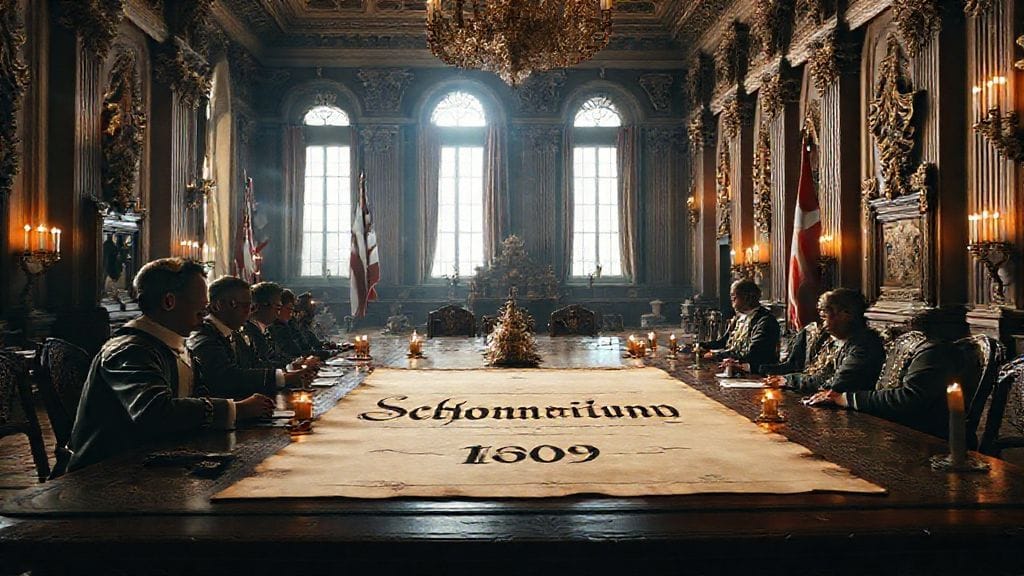
Schönbrunn Palace, the former summer residence of the Habsburgs, became the venue where history was inked. The grand rooms, rich with frescoes and gilded ornament, witnessed a scene far grimmer than their opulence promised. Napoleon’s envoys arrived alongside Austrian delegates, their expressions masks of calculated resolve or resigned pragmatism.
The Negotiating Table: Characters and Stakes at Schönbrunn Palace
The treaty’s architects were formidable figures steeped in the harsh realities of their age. On the Austrian side, the Chancellor Klemens von Metternich embodied cautious conservatism, advocating for preservation through compromise. He understood that Austria’s survival depended on deft diplomacy as much as military might.
Facing him was Napoleon’s representative, skilled in diplomacy yet uncompromising in demands. The French Emperor himself refrained from attending, confident in his generals’ ability to impose his will, but his shadow loomed large.
The negotiations were grueling. Each clause bore the weight of lost lives and sacrificed lands. Metternich's acumen would later earn him a reputation as a master diplomat, but for now, he worked to salvage what could be saved from the ruins.
Signing the Treaty: The Day of October 14, 1809
The day of the signing was drenched in heavy symbolism. As quills scratched signatures onto the parchment, the balance of power tilted irrevocably. The Treaty of Schönbrunn formalized Austria’s capitulation but also drew a new Europe, carved with harsh lines by French ambition.
Witnesses observed the solemnity mixed with despair and resignation. The grand halls, so often a site of celebration and triumph, now echoed with the silence of a diminished empire facing a precarious future.
The Terms Laid Bare: Territorial Losses and Strategic Concessions
The treaty’s articles stripped Austria of significant territories. The Duchy of Salzburg was ceded to Bavaria, while other lands, including parts of Galicia and Carinthia, were surrendered or reorganized. Notably, the Illyrian Provinces passed to France, consolidating Napoleon’s hold on the Adriatic coast.
Economic reparations further burdened Austria’s already strained treasury. Military restrictions were also imposed to weaken potential rebellions. This was no mere treaty; it was a profound reshaping of sovereignty and a bitter pill for a proud empire.
Beyond the Pen: Immediate Reactions Across Europe
News of the treaty reverberated swiftly across the continent. Allies and adversaries alike recognized the new status quo. Britain, still at war with France, found both encouragement and concern in Austria’s submission. It underscored French dominance, yet proved that resistance was still possible, even if costly.
Within the empire, reactions ranged from outrage to quiet acceptance. Nobles lamented their losses, peasants braced for the hardships manifesting from new rulers. For many Europeans, the Treaty of Schönbrunn was a stark reminder of the fragility of nations in the Napoleonic order.
The Personal Toll: Emperor Francis I and Napoleon’s Complex Rivalry
The treaty was also a story of two men—Francis I and Napoleon—locked in a dance of power and enmity. Francis, burdened with the legacy of Habsburg rule, had to navigate a humiliating peace while preserving dynastic honor.
Napoleon, in contrast, reveled in victory but was no stranger to the paradoxes of empire. His respect for certain traditions clashed with his ruthless pragmatism. The treaty was a demonstration of dominance but also a fragile accord that foreshadowed further conflict.
Redrawing the Map: The Impact on Central Europe’s Geography
Central Europe’s political landscape was irrevocably altered. The rearrangement of territories around the Danube, the Balkans, and German states had long-term consequences for national borders and ethnic compositions. The Habsburgs’ reduced sphere of influence created a vacuum soon contested by rising nationalist movements and shifting alliances.
This cartographic upheaval ignited tensions that would persist beyond Napoleon’s reign, ultimately contributing to the nationalist ferment that shaped the 19th century.
The Aftermath in Austria: Political Upheaval and National Identity
Austria grappled with internal challenges following the treaty. Military defeat and territorial losses shook confidence in leadership. Yet, the crisis also birthed a renewed sense of Austrian nationalism, as intellectuals and politicians sought to redefine the empire's identity.
Metternich’s conservative order aimed to suppress revolutionary currents, striving to maintain imperial cohesion. However, the seeds of modernization and reform were quietly sown in the fertile soil of adversity.
Ripples Through the German States and the Habsburg Monarchy
The treaty’s implications extended into the web of German principalities under Habsburg influence. The weakening of Austria emboldened rival powers such as Prussia and Bavaria, altering the balance within the complex German Confederation.
Simultaneously, nationalist ideas began to challenge the old order, foreshadowing the eventual unification movements. Schönbrunn thus marks a chapter in the slow unraveling and reconfiguration of Central Europe's political tapestry.
Economic Shocks and Social Strains Post-Schönbrunn
Economic consequences were severe. Loss of resource-rich regions, war reparations, and trade disruptions exacerbated Austria’s fiscal distress. The burden fell unevenly on different social classes, with peasants and urban workers often suffering the most.
Inflation and increased taxation fueled social discontent, yet the government’s tight control limited open rebellion. This uneasy calm masked simmering tensions within the empire’s diverse populations.
Cultural Reflections: Art, Music, and Literature in a Time of Tumult
Despite political turmoil, Austria's cultural scene remained vibrant. In the shadow of defeat, figures like Beethoven and Schubert channeled the era’s contradictions into their art. Music became a refuge and a form of subtle resistance.
Writers and intellectuals wrestled with themes of identity, loss, and hope—mirroring the broader societal quest for meaning amid upheaval. Schönbrunn’s legacy is thus not only political but deeply human, echoing through cultural expressions.
The Treaty of Schönbrunn in Napoleonic Strategy
For Napoleon, the treaty was a strategic jewel, securing his southeastern flank and enabling further campaigns into Eastern Europe and beyond. It underscored his mastery of combining military might with diplomatic coercion.
Yet, Napoleon’s overreach sowed the seeds of eventual resistance, as conquered peoples and disgruntled rulers coalesced against French domination. Schönbrunn, while a high point, was also a prelude to the fragmentation of the Napoleonic Empire.
Seeds of Resistance: How the Treaty Fueled Future Nationalism
By redrawing borders and imposing foreign rule, the treaty inadvertently galvanized nationalist sentiments across affected regions. The loss of ancestral lands and imperial pride stirred movements that sought to reclaim autonomy and rights.
These currents would come to the fore in the revolutions of 1848 and later unification efforts, highlighting the unintended consequences of imposed peace.
Lessons from Diplomacy: The Art and Limits of Forced Peace
The Treaty of Schönbrunn reveals the intricate balance between power and diplomacy. It exemplifies how treaties imposed under duress can cement short-term gains but fail to guarantee lasting peace.
Metternich’s later efforts to stabilize Europe at the Congress of Vienna reflected hard-earned lessons about compromise, balance of power, and the dangers of unchecked ambition.
Conclusion
The Treaty of Schönbrunn, signed on October 14, 1809, remains a poignant symbol of an age defined by conquest and resilience. It was not merely a document but a crossroads where empires faltered and the modern European order began to take shape. Austria’s humiliating defeat unveiled the vulnerabilities of traditional monarchies confronting a new era of warfare and nationalism.
Yet within this chapter of loss, there lay also the threads of renewal. The treaty’s aftermath compelled reflection, adaptation, and the emergence of ideas that would reshape nations. It reminds us that history’s great dramas are not only about winning or losing but also about enduring and transforming.
Ultimately, Schönbrunn stands as a testament to the human capacity to negotiate survival amid sweeping forces, where the echo of inked signatures reverberates far beyond the walls that witnessed their creation.
FAQs
Q1: What caused the Treaty of Schönbrunn to be signed?
The treaty followed Austria’s defeat in the War of the Fifth Coalition against Napoleon’s France. Austria’s losses, coupled with economic exhaustion and military pressure, forced Emperor Francis I to seek peace under harsh terms.
Q2: Who were the main negotiators of the treaty?
Austria was chiefly represented by Chancellor Klemens von Metternich, while Napoleon’s government sent experienced diplomats to enforce the Emperor’s will. Napoleon himself did not attend but was the ultimate authority behind the treaty.
Q3: What were the major territorial changes imposed by the treaty?
Austria ceded Salzburg and other regions to Bavaria, lost parts of Galician and Carinthian territory, and the Illyrian Provinces were annexed by France. These losses weakened Austria’s influence in Central Europe.
Q4: How did the treaty affect Austria internally?
It triggered political upheaval, economic hardship, and a reassessment of national identity. Metternich’s conservative policies sought to maintain order, but nationalist and reformist sentiments gained traction.
Q5: What was Napoleon’s strategic interest in the treaty?
Securing Austria’s submission consolidated his southeastern European flank, facilitated control over important territories, and strengthened France’s position before further campaigns.
Q6: How did the treaty influence later European history?
It contributed to the reshaping of borders and political alliances, fueling nationalist movements that challenged the old monarchies. The treaty’s consequences echoed in the revolutions and unifications of the 19th century.
Q7: Why is the Treaty of Schönbrunn important in the Napoleonic Wars?
It marked a significant victory for Napoleon, highlighting his dominance after the War of the Fifth Coalition. Yet, it also exposed the limits of his power and set the stage for his eventual downfall.
Q8: How is the treaty remembered today?
Often overshadowed by other Napoleonic events, it remains a critical episode illustrating diplomacy, defeat, and survival in a turbulent era. It is studied as a landmark in European history and Austria’s national story.