Table of Contents
- The Dawn After Defeat: Paris, June 1815
- The Rise and Fall of an Emperor: A Brief Recap
- Europe in Turmoil: The Napoleonic Wars Revisited
- The Hundred Days: Napoleon’s Shocking Comeback
- Waterloo: The Final Clash of Titans
- The Morning After Waterloo: Chaos and Despair
- The Road to Abdication: Pressure Mounts in Paris
- The Imperial Household in Crisis: Allies and Betrayals
- June 22, 1815: The Abdication in the Tuileries
- Immediate Reactions: Paris and Beyond
- The Role of the Chamber of Deputies and Political Factions
- The Bourbon Restoration: Louis XVIII Returns
- The Fate of Napoleon: Exile to Saint Helena
- The Impact on French Society and National Identity
- Europe’s Reshaped Political Landscape
- Memory and Myth: Napoleon’s Legacy Through the Ages
- The Cultural Reverberations: Art, Literature, and Memory
- The Abdication in Historical Debate: Heroism or Hubris?
- Lasting Lessons: Power, Ambition, and the Fragility of Empires
- Conclusion: The End of an Era and the Birth of Modern Europe
- FAQs: Understanding Napoleon’s Second Abdication
- External Resource
- Internal Link
The Dawn After Defeat: Paris, June 1815
The streets of Paris lay thick with tension, a strange mixture of hope shattered and uncertainty looming. On a gray summer morning, June 22, 1815, a city still echoing with the thunder of cannon fire and the sobering news from Waterloo faced a turning point. The sun struggled to pierce a heavy sky as couriers raced through the cobbled streets, bearing word of a decision that would shake the very foundations of France and reverberate throughout Europe: Napoleon Bonaparte had abdicated—again.
This was no ordinary day. The once-mighty emperor, whose name had echoed with both fear and admiration across the continent for over a decade, was relinquishing power for a second time. In the grand salons and the shadowed alleyways alike, whispers ran like wildfire. What did this mean for France? For Europe? For the man who had seemingly conquered history itself?
The atmosphere was electric but somber. The city, still vibrant with art, culture, and revolutionary spirit, now faced the dusk of an era. The political elites convened hastily, each maneuvering for advantage amid the imperial vacuum. Soldiers marched silently past, wearied yet alert, their allegiance uncertain. And the people—common folk, shopkeepers, and nobles—stood bewildered, caught between relief and despair. The empire, a testament to genius and relentless ambition, was crumbling at last.
But this was mere prelude to the profound transformations that would follow. Napoleon’s second abdication was not just an ending; it was a watershed moment that shaped the modern European order, rewritten in the blood, hopes, and fears of 1815.
The Rise and Fall of an Emperor: A Brief Recap
To comprehend the gravity of June 22, 1815, one must understand the man who created such seismic ripples in history. Born in Corsica in 1769, Napoleon Bonaparte had ascended from obscurity to glory with breathtaking speed. A military prodigy, his campaigns from Italy to Egypt cemented his legend. The Revolution had fractured France but he stitched it back together—first as Consul, then Emperor in 1804.
Napoleon’s reign was marked by sweeping reforms: the Napoleonic Code reshaped law; the administrative apparatus was centralized; secular education and meritocracy were advanced. Yet his incessant wars exhausted France and soaked Europe in blood. The Continental System sought to choke Britain economically but backfired.
In 1812, the Siberian nightmare of the Russian campaign turned the tide against him. Coalition forces regrouped, and by 1814 Paris had fallen once. Forced to abdicate, Napoleon was exiled to Elba. But his Cuban resolve remained unshaken.
Europe in Turmoil: The Napoleonic Wars Revisited
Europe in the early 19th century was a roiling cauldron of alliances, rivalries, and revolutions. The French Revolution had ignited a chain reaction that unsettled monarchies across the continent. Monarchs feared Jacobinism as much as Napoleon’s military genius.
Coalitions formed and fell in succession: Britain, Austria, Prussia, Russia, and others combined efforts to curtail French expansion. The Napoleonic Wars, spanning more than a decade, reshaped borders, toppled dynasties, and introduced new militaristic doctrines.
Yet the power vacuum left by the French Revolution and Napoleonic upheaval made political compromise fragile. When Napoleon escaped Elba in February 1815, embarking on the Hundred Days, Europe was gripped by a mix of dread and resolve: the old order must be restored.
The Hundred Days: Napoleon’s Shocking Comeback
Few historical episodes brim with such dramatic flair as the Hundred Days. From the moment Napoleon landed on the shores of France in March 1815, the political landscape convulsed. Supporters flocked to his banner; King Louis XVIII fled Paris.
Napoleon’s charisma and strategic genius once again rallied troops and populace alike. He promised stability, glory, and renewal. Yet his return was precarious. The allied powers mobilized a swift response, preparing for the ultimate showdown.
That period saw frantic diplomacy interlaced with military preparations, setting the stage for a decisive confrontation that would finalize Napoleon’s fate.
Waterloo: The Final Clash of Titans
On June 18, 1815, near the rugged Belgian village of Waterloo, history witnessed the clash that decided Europe’s destiny. Napoleon’s army met the combined forces of the Duke of Wellington’s British troops and Gebhard Leberecht von Blücher’s Prussian army.
Though the battle waged fiercely and Napoleon initially pressed hard, miscalculations, delayed attacks, and stubborn opposition spelled doom. The arrival of Prussian reinforcements tilted the scales. After hours of carnage amid rain-soaked fields, the French army crumbled.
Waterloo was more than a military defeat; it was the symbolic death knell of Napoleonic dreams. The emperor’s aura of invincibility shattered—his empire unraveling before the world’s eyes.
The Morning After Waterloo: Chaos and Despair
News of the defeat trudged slowly to Paris, but the impact was immediate. Military commanders were reluctant to accept the loss; morale plummeted. The French people braced for uncertain days.
Napoleon himself was caught in a whirlwind of defeat and defiance. Instead of surrendering outright, he tried to negotiate terms, seeking a way to preserve some vestige of power. But his options dwindled fast.
Political factions jostled for influence. The Chamber of Deputies grew restive, the aristocracy cautious, and the military fractured. Paris, once the heart of an empire, simmered with anxiety as looming exile became inevitable.
The Road to Abdication: Pressure Mounts in Paris
Between Waterloo and June 22, the days raced with crises. Rue by rue, chamber by chamber, the machinery of power creaked under tremendous strain.
On one hand, some urged the emperor to muster new resistance or even move the capital. On the other, pragmatic voices called for abdication to avoid further bloodshed and chaos.
Foreign powers issued stark warnings. The allied armies were converging, ready for march on Paris. Diplomats whispered of restoring the Bourbon monarchy and punishing the French revolutionary legacy.
Napoleon’s inner circle was divided. Loyalty clashed with realism. Ultimately, the emperor recognized that another campaign would be both futile and destructive.
The Imperial Household in Crisis: Allies and Betrayals
Behind palace walls, the drama unfolded in intimate detail. Napoleon’s closest aides—Marshal Ney, General Drouot, and his brothers Joseph and Lucien Bonaparte—were torn between loyalty and survival.
Some called for honorable resistance; others plotted expedient capitulation. Secret meetings and tense confrontations answered the questions of power and legacy.
It was a study in human frailty amid political catastrophe. The emperor’s solitude deepened as trusted allies adopted divergent fates—some prepared to face exile beside him, others turned to negotiate with the returning Bourbons.
June 22, 1815: The Abdication in the Tuileries
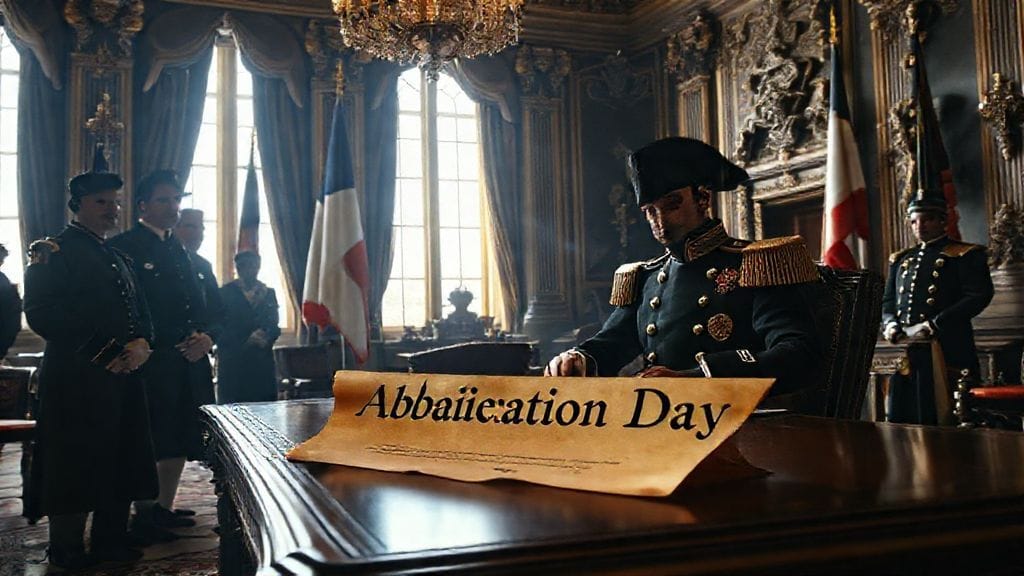
At last, on June 22, the inevitable unfolded within the gilded chambers of the Tuileries Palace. Napoleon, pale but resolute, signed the document relinquishing his throne in favor of his son, Napoleon II—a symbolic gesture without practical power.
Witnesses described the scene as somber, almost surreal. The grandeur of the imperial court dimmed under the weight of defeat. Officials and courtiers bowed to the new political reality, some in silence, others with thinly veiled relief.
Napoleon’s words carried the tragic dignity of a fallen titan: "France, the army in the field were my only family… France has been my life.” Yet destiny was unyielding. The empire had ended.
Immediate Reactions: Paris and Beyond
News of the abdication rippled swiftly. Parisians took to streets, their expressions mixed—relief from war-weariness mingled with uncertainty about the future.
Royalists celebrated cautiously, while Bonapartists mourned quietly, readying themselves for exile or resistance. The Deputy Chamber convened hastily, debating the new order amid fragile peace.
Across Europe, diplomats pondered the restoration of monarchies and the geopolitical balance. The age of revolutionary wars seemed, at last, to be over.
The Role of the Chamber of Deputies and Political Factions
The Chamber of Deputies played a pivotal role in this transition. It was a fragmented body representing monarchy sympathizers, liberal constitutionalists, and lingering Bonapartists.
Discussions swirled around legitimacy, governance, and peace. Some deputies pressed for immediate reinstatement of Louis XVIII, arguing that only a stable monarchy could heal France. Others hoped for a constitutional monarchy that could balance revolutionary gains with royal authority.
In the smoke of abdication, political intrigue and factionalism surged—demonstrating the fragile nature of France’s post-Napoleonic identity.
The Bourbon Restoration: Louis XVIII Returns
With the emperor’s abdication confirmed, the path was cleared for the Bourbon’s second restoration. Louis XVIII, who had fled to Ghent during Napoleon’s Hundred Days, was swiftly escorted back.
His ascendance was cautious. Though monarchists rejoiced, many French citizens remained ambivalent. Louis XVIII attempted to govern with pragmatism—preserving some Revolutionary reforms but also reinstating royal prerogatives.
This era marked both renewal and repression, setting the tone for the post-Napoleonic order in France.
The Fate of Napoleon: Exile to Saint Helena
Although abdicated, Napoleon’s story was far from over. After initial hopes of asylum or return, the allied powers resolved to isolate the former emperor permanently.
He was shipped to the remote island of Saint Helena in the South Atlantic, a place chosen deliberately for its isolation. From 1815 until his death in 1821, Napoleon lived in exile—his health fading, yet his legend growing.
Saint Helena became a prison and a crucible for myth-making, the final chapter of a man who had reshaped Europe by sheer will and genius.
The Impact on French Society and National Identity
Napoleon’s second abdication struck deep chords in French society. For a nation that had oscillated between monarchy, republic, and empire within decades, this moment crystallized the contradictions of identity.
The emperor was both a hero who modernized the nation and a tyrant who dragged France into ruinous wars. His reforms endured in law, education, and administration, while memories of glory clashed with wounds of loss.
French nationalism was thus refashioned—not erased—but layered with ambiguity. The Bonapartist spirit lived on, underlying future political movements.
Europe’s Reshaped Political Landscape
Beyond France, the abdication signaled a seismic shift in Europe’s balance of power. The Congress of Vienna, convening since 1814, sought to impose a "Concert of Europe" to prevent future upheavals.
Territorial adjustments were made: the Netherlands united with Belgium, Prussia expanded, and Austria reclaimed influence. Monarchies, bruised but restored, aimed to create a durable peace.
Yet beneath this order lingered seeds of nationalism and liberalism, destined to challenge the old regimes in decades to come.
Memory and Myth: Napoleon’s Legacy Through the Ages
Napoleon’s final abdication did not diminish his influence; if anything, it added layers to the mythology surrounding him. In France and beyond, he became a symbol of ambition, genius, and tragic downfall.
Writers, politicians, and historians wrestled with his legacy—some lionizing him as a hero of the Enlightenment and modern statecraft; others condemning him as a warmonger.
The image of the fallen emperor, signing his abdication with dignity amidst ruin, remains one of history’s most evocative moments—a story retold in countless books, films, and monuments.
The Cultural Reverberations: Art, Literature, and Memory
Artists and authors found inexhaustible inspiration in the drama of 1815. Romantic painters depicted Napoleon with grandeur and pathos; poets echoed his tragic heroism.
The abdication scene, the Battle of Waterloo, and his exile became motifs symbolizing the rise and fall of power, the fragility of human endeavor. Museums, theaters, and later, cinemas, kept the memory alive.
This cultural response underscored how history and myth intertwine, shaping collective memory as much as facts.
The Abdication in Historical Debate: Heroism or Hubris?
Scholars have long debated the nature of Napoleon’s second abdication. Was it an act of heroic self-sacrifice to spare France more bloodshed? Or the ultimate failure of hubris, a final capitulation after relentless ambition?
Some argue it was pragmatic realism—recognition of an untenable position. Others see tragedy: the fall of a man who refused to yield until the very end.
What remains undeniable is the human complexity, the mixture of courage, pride, and mortality that defined the event.
Lasting Lessons: Power, Ambition, and the Fragility of Empires
Napoleon’s 1815 abdication offers timeless lessons. It illustrates how empires, even those built by genius and ferocity, can rapidly unravel amid changing tides.
Ambition, while a driving force, must be tempered by reality. The political, military, and social forces that built the Napoleonic Empire could not withstand the coalition of Europe’s old powers.
Moreover, it testifies to the costs of war and the importance of balance—a lesson echoed in diplomatic efforts well into modern times.
Conclusion: The End of an Era and the Birth of Modern Europe
June 22, 1815, was more than a date on the calendar; it was a fulcrum upon which history pivoted. The second abdication of Napoleon Bonaparte marked the definitive end of one of the most turbulent and transformative eras Europe had known.
From the rubble of empire emerged a new order, cautious but hopeful, wary but ambitious. France and Europe would never be the same—politically, culturally, or ideologically.
Yet Napoleon’s spirit lingered, a reminder that history is shaped by individuals who dare to dream and the collective forces that shape their destiny. His last act of abdication was not merely a surrender—it was the closing chapter of a saga that continues to captivate the human imagination.
FAQs
1. Why did Napoleon abdicate a second time in June 1815?
Napoleon abdicated after his decisive military defeat at the Battle of Waterloo, which made further resistance unsustainable. Pressure from the French political elites, the advancing allied armies, and the untenable military situation compelled him to relinquish power a second time.
2. What role did the Chamber of Deputies play during the abdication?
The Chamber of Deputies negotiated the political transition after Napoleon's defeat. The assembly was divided but largely supported the restoration of the Bourbon monarchy to stabilize France and avoid further conflict.
3. How did the French public react to Napoleon’s second abdication?
Reactions were mixed. Some Parisians felt relief at the prospect of peace, others mourned the end of Napoleon’s rule. Bonapartists viewed the abdication as a tragic loss, while royalists cautiously cheered the return of the monarchy.
4. What happened to Napoleon after his second abdication?
Napoleon was exiled by the allied powers to Saint Helena, a remote island in the South Atlantic, where he spent the remainder of his life until his death in 1821.
5. How did Napoleon’s second abdication affect Europe’s political landscape?
It paved the way for the Congress of Vienna to finalize a new European order, restoring monarchies, reshaping borders, and seeking a balance of power intended to prevent future widespread conflicts.
6. Was Napoleon’s abdication voluntary or forced?
While Napoleon signed the abdication willingly, it was under immense military, political, and diplomatic pressure, making it effectively forced by circumstances.
7. How is Napoleon’s legacy viewed today in relation to his abdication?
Napoleon’s legacy remains complex—he is hailed as a military genius and reformer, but also criticized for aggressive wars. His abdication symbolizes both the limits of ambition and the price of empire-building.
8. What symbolic meaning did Napoleon’s attempt to abdicate in favor of his son have?
Abdicating in favor of his son Napoleon II was a symbolic gesture to maintain the Bonaparte dynasty, but it had little practical effect, as the political and military realities rendered any such succession moot.