Table of Contents
- The Chilling Aftermath of Waterloo: Paris in the Shadow of Defeat
- The Stakes Are Immense: Europe on the Brink of Transformation
- From the Congress of Vienna to the Second Treaty of Paris: The Preceding Drama
- The Bourbon Restoration: A Monarch’s Return Amidst Chaos
- Enter the Great Powers: Britain, Austria, Russia, and Prussia Take the Stage
- Napoleon’s Last Stand: How Defeat Paved the Way for Diplomacy
- The Negotiation Chambers: Paris as a Diplomatic Battlefield
- The Terms Unveiled: Punishments, Boundaries, and Reparations
- France’s Territorial Fate: Loss, Retraction, and Contested Borders
- Military Restrictions: The Siege of France’s Martial Pride
- Economic Burdens: Reparations and the Weight of Defeat
- The Impact on French Society: Pride, Resentment, and Reconstruction
- Europe’s Fragile Peace: The Concert of Europe Begins to Take Shape
- The Treaty’s Legacy: Seeds of Stability or Future Discord?
- Reflections from Key Figures: Voices from the Treaty’s Hallways
- Popular Sentiment in France and Abroad: Nationalism and Reaction
- The Second Treaty in the Shadow of the First: A Comparative Perspective
- Long-term Consequences: Borders, Alliances, and Power Shifts
- The Role of the Treaty in the Fall of Napoleonic Dreams
- How the Second Treaty of Paris Shaped Modern Europe
- Conclusion: A Peace Bought at a Price and a New Dawn for the Continent
- FAQs: Unveiling the Complexities of the 1815 Treaty
- External Resources: Further Reading and Reference
- Internal Link: Explore More on History Sphere
The Chilling Aftermath of Waterloo: Paris in the Shadow of Defeat
The sun rose on Paris in the bleak November of 1815, its golden rays hardly piercing the heavy fog of uncertainty that hung over the city. Just months earlier, the world had witnessed the final dramatic downfall of Napoleon Bonaparte at Waterloo—a battle whose echo shattered empires and dreams alike. The cobbled streets, once vibrant with revolutionary zeal and imperial grandeur, now hummed with whispers of despair, and the looming question: what would become of France now?
Paris was a city on edge. The cheers that had once toasted Napoleon’s return during the Hundred Days had faded into silence, replaced by the grim realization that France must submit once again to the will of Europe’s great powers. The Second Treaty of Paris was imminent—a treaty not only sealing the fate of the defeated French Empire but reshaping the very map of Europe.
As diplomats convened, the emotional unspooling of a continent began, wrapped in equal parts hope for peace and dread of punishment. The grand halls of Paris buzzed with intrigue and tension; what seemed like the end of a catastrophe was, in truth, the beginning of a new chapter.
The Stakes Are Immense: Europe on the Brink of Transformation
This moment in 1815 was German at the crossroads of history. The Napoleonic Wars had upended centuries of dynastic rule, sowed republican ideas, and unleashed nationalist fervor. The European powers—Britain, Austria, Prussia, and Russia—stood determined to restore order, but none underestimated the volatility of a continent scarred by war and revolution.
The stakes were high: should France be crushed entirely, risking long-term resentment and future rebellion? Or should the victorious Allies seek a balance between punishment and reconciliation, stabilizing a Europe weary of bloodshed? Each choice would echo for decades to come.
In the aftermath of Napoleon’s dramatic return from exile on Elba, the Hundred Days shattered the fragile post-war peace established by the Congress of Vienna only months prior. Now, with the Grand Army defeated again, the great powers reconvened to rewrite France’s role and safeguard their own interests.
From the Congress of Vienna to the Second Treaty of Paris: The Preceding Drama
The Congress of Vienna, convened in late 1814, had been a monumental effort to create a new European order after years of Napoleonic upheaval. Chaired by the Austrian statesman Prince Metternich, the Congress sought to restore monarchies, redraw boundaries, and establish a “balance of power” that would prevent any single state from dominating the continent anew.
Yet, the outbreak of the Hundred Days in March 1815 rendered much of this work precarious. Napoleon’s audacious return from Elba upended months of painstaking diplomacy. The Allies rapidly reassembled their forces, culminating in the decisive Battle of Waterloo in June 1815.
With Napoleon defeated at last and exiled to Saint Helena, the urgent task was to consolidate peace and finalize the political arrangements that would restrain France and reassure neighbors.
The Bourbon Restoration: A Monarch’s Return Amidst Chaos
Louis XVIII’s ascent to the throne in 1814 marked the restoration of the Bourbon monarchy after years of revolutionary experimentation and imperial reign. Yet his rule was fraught with challenges—180 years of revolution and empire had transformed French society and ideology dramatically.
His return to the Tuileries Palace was initially celebrated by royalists, but Republicans, Bonapartists, and liberals harbored resentment, creating a fissured society. The Hundred Days had further weakened Louis’s precarious legitimacy.
Thus, the Second Treaty of Paris would not only define territorial borders but also the political and ideological rehabilitation—or suppression—of France itself.
Enter the Great Powers: Britain, Austria, Russia, and Prussia Take the Stage
Four great powers dominated the negotiation table. Britain, under the firm leadership of Lord Castlereagh, sought to maintain its naval and colonial supremacy. Austria, the architect of the Congress of Vienna, aimed to reinforce conservative order. Prussia, after its pivotal role in Napoleon’s defeat, wanted security guarantees on its western frontier. Russia, empowered by vast resources, feared revolutionary contagion and sought influence over Eastern Europe.
For each, France was both a threat and a pawn. The treaty became a chessboard upon which their strategic aims interlocked and collided.
Napoleon’s Last Stand: How Defeat Paved the Way for Diplomacy
Napoleon’s defeat at Waterloo on June 18, 1815, was not just a military disaster but the death knell for his political dreams. His legendary charisma and genius had been unable to overcome the united front of the Allies, exhausted armies, and shifting loyalties.
As he fled to Paris and subsequently abdicated, the void of leadership intensified calls for renewed peace. The Allies’ victory provided them leverage, but the memory of the Grande Armée’s sweeping conquests tempered demands with caution.
The Negotiation Chambers: Paris as a Diplomatic Battlefield
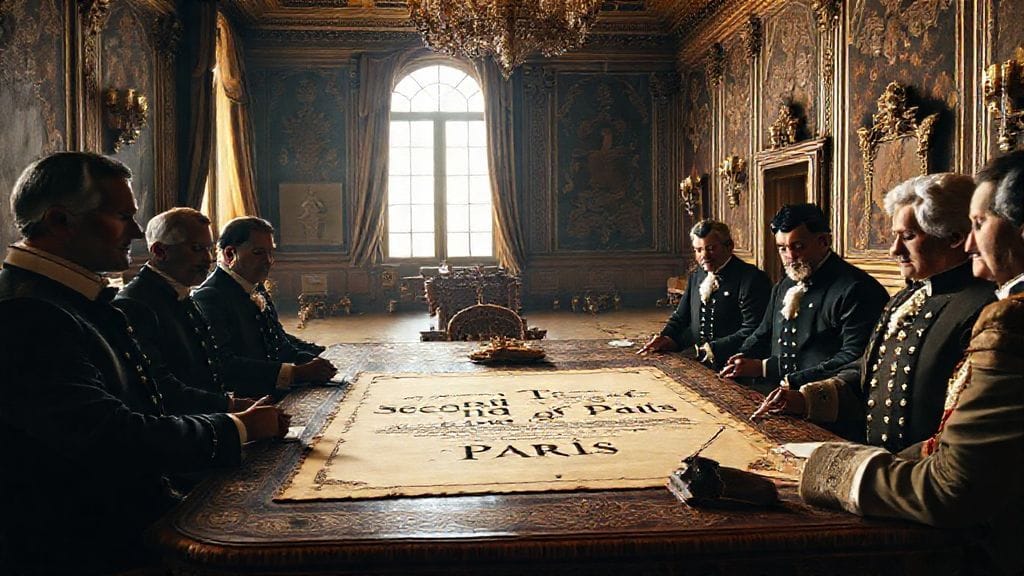
Paris became once more the heart of European diplomacy, hide-and-seek of power behind gilded doors. Representatives worked tirelessly to craft a treaty balancing justice and pragmatism.
Negotiations extended through autumn, under the watchful eyes of Parisians who observed rumors and protests alike. Behind closed doors, personalities clashed—Metternich’s conservative rigidity versus Castlereagh’s diplomatic finesse—and every clause was weighed under the heavy gravity of recent bloodshed.
The Terms Unveiled: Punishments, Boundaries, and Reparations
On November 20, 1815, the Second Treaty of Paris was signed, imposing harsher terms than those of 1814. France was to revert to its 1790 borders—a significant rollback from Napoleon’s gains. The loss of territories such as Belgium and Luxembourg struck both symbolic and strategic blows.
The treaty ordered France to pay a colossal indemnity of 700 million francs and accept an army of occupation—up to 150,000 troops stationed for five years—to ensure compliance.
These terms aimed to restrain France while avoiding the total dismantling feared to trigger unrest.
France’s Territorial Fate: Loss, Retraction, and Contested Borders
For France, the treaty marked a humiliating reversal. The annexations and satellite states of the Napoleonic period vanished almost overnight. The Rhineland was fortified, Belgium detached to form part of the new Kingdom of the Netherlands, and the Saar region was returned to German states.
The redefinition stirred nationalist unease, a potent seed for future conflicts, but the immediate effect was the geographic and political shrinking of France in Europe’s new order.
Military Restrictions: The Siege of France’s Martial Pride
To prevent any resurgence of French militarism, the Allies imposed strict military restrictions. The French army was limited to 100,000 men, conscription was curtailed, and fortresses were to be controlled by occupation forces.
For a nation whose identity had been so closely entwined with its martial prowess and revolutionary valor, these restrictions cut deeply into the national psyche.
Economic Burdens: Reparations and the Weight of Defeat
The financial reparations extracted from France were immense. The 700 million franc indemnity strained an economy already weakened by years of warfare and blockade.
This reparative burden influenced French fiscal policy and social conditions for years, feeding grievances and economic hardships. The crushing payments were a tangible reminder of defeat and subjugation.
The Impact on French Society: Pride, Resentment, and Reconstruction
The treaty’s consequences rippled beyond borders and armies. French society, fractured by revolution and imperial ventures, grappled with loss of status and wounded pride.
Attempts at political reconciliation under Louis XVIII struggled against lingering Bonapartist loyalties and liberal dreams. Yet, rebuilding began—economically and culturally—with a collective memory of both glory and humiliation shaping identity.
Europe’s Fragile Peace: The Concert of Europe Begins to Take Shape
The Second Treaty of Paris symbolized the birth of a cooperative European order known as the Concert of Europe. The great powers, despite rivalries, pledged to maintain peace through diplomacy and collective security.
Although uneasy and often self-serving, this framework prevented large-scale wars for decades, a remarkable respite after years of almost ceaseless conflict.
The Treaty’s Legacy: Seeds of Stability or Future Discord?
Was the treaty a genuine path to lasting peace or merely a temporary bandage on a continent’s deep wounds? Opinions remain divided. It undoubtedly curtailed French ambitions for a time but sowed undercurrents of resentment and nationalism.
The Great Powers’ cooperative system, while innovative, depended heavily on mutual trust—something often in short supply. The shadows of 1815 would linger, influencing revolutions, alliances, and eventually the world wars of the next century.
Reflections from Key Figures: Voices from the Treaty’s Hallways
Prince Metternich later described the treaty as “a delicate balance between retribution and mercy.” Lord Castlereagh saw it as necessary to “curb the pride of France while securing peace.”
Conversely, French deputies decried it as “a humiliation that stings the soul,” while common citizens grumbled about foreign troops marching their streets.
Such voices illustrate the human emotions interwoven with diplomatic language.
Popular Sentiment in France and Abroad: Nationalism and Reaction
Across France, the treaty was both a comfort and a grievance. Some welcomed the return to stability and monarchic order; others mourned the loss of national prestige and the ideals that Napoleon’s rule had inspired.
In other countries, the treaty was hailed as the restoration of lawful order but also viewed warily as a fragile compromise amid unresolved tensions.
The Second Treaty in the Shadow of the First: A Comparative Perspective
Unlike the more lenient First Treaty of Paris in 1814, the second imposed stricter conditions, reflecting the Allies’ loss of patience with France’s resurgence during the Hundred Days.
This shift underscored the precariousness of peace and the hardening attitudes toward France’s place in Europe.
Long-term Consequences: Borders, Alliances, and Power Shifts
The reshaping of borders influenced the rise of national movements, especially in the German and Italian regions. The Treaty reinforced the Holy Alliance but also marked the beginning of a new diplomatic era.
France, while diminished, remained a key player; the settlement did not permanently exclude it from European affairs but set strict boundaries on its ambitions.
The Role of the Treaty in the Fall of Napoleonic Dreams
By extinguishing the possibility of further French expansion and exile, the treaty closed the chapter on Napoleonic aspirations. Though heroic in legend, the Empire’s fall was definitive.
Napoleon’s exile to Saint Helena, far from Europe’s center, symbolized the end of an era and the tragic costs of ambition.
How the Second Treaty of Paris Shaped Modern Europe
The treaty laid the groundwork for a cautious 19th-century peace that would allow industrialization, nation-state formation, and colonial expansion to proceed largely undisturbed.
Its legacy is nuanced: both a blueprint for diplomacy and a reminder of the limits of power and vengeance.
Conclusion
In the wintry dusk of November 20, 1815, the signing of the Second Treaty of Paris closed one tumultuous chapter and opened another. It was a peace forged from blood, sacrifice, and reluctant compromise—a balm that soothed, yet left scars.
This treaty marked not just the end of Napoleonic wars but also the birth of a new European consciousness, a tentative alliance between powers wary of each other’s ambitions but united in their desire to prevent another continent-wide conflagration.
France emerged humbled but still vital; Europe entered an era where diplomacy tried to tame the ghosts of revolution and empire. The Second Treaty of Paris teaches us that peace, however costly, is the foundation upon which nations rebuild—and it is never guaranteed.
FAQs
1. Why was there a need for a Second Treaty of Paris in 1815?
Because Napoleon's return during the Hundred Days invalidated the peace settled by the First Treaty of Paris (1814), a new treaty was necessary to solidify France's defeat and establish a lasting settlement.
2. How did the Second Treaty of Paris differ from the First?
The second treaty imposed harsher penalties: France lost more territory, faced larger reparations, and had to accept military occupation forces, reflecting the Allies' increased mistrust after Napoleon's brief resurgence.
3. What were the main territorial changes imposed on France?
France was reduced to its 1790 borders, losing Belgium and Luxembourg, while regions like the Rhineland were ceded to neighboring states or set under allied influence.
4. Who were the major powers involved in drafting the treaty?
Britain, Austria, Russia, and Prussia coordinated the terms, each aiming to protect their interests while punishing France.
5. What was the impact of the treaty on French society and politics?
The treaty damaged French pride and economy but also forced political stabilization under the Bourbon monarchy, which faced opposition from Bonapartists and liberals.
6. Did the Second Treaty of Paris guarantee lasting peace in Europe?
While it ushered in the Concert of Europe—a diplomatic framework that prevented major wars for decades—tensions and nationalist sentiments persisted, eventually leading to conflicts later in the century.
7. How is the Second Treaty of Paris viewed by historians today?
Historians see it as a necessary but imperfect compromise that balanced retribution with the need for European stability, a foundational moment in modern diplomatic history.
8. Where can I learn more about the Second Treaty of Paris?
Comprehensive information is available on its Wikipedia page, offering detailed historical context and analysis.