Table of Contents
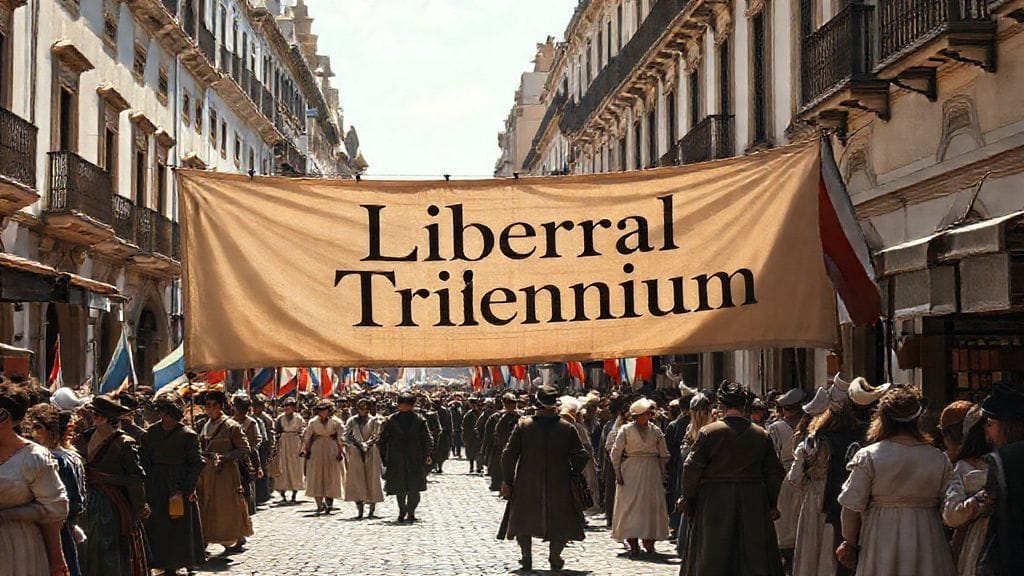
- The Dawn of a Revolutionary Era: Cádiz, January 1820
- Spain on the Brink: The Legacy of Absolutism and War
- The Seeds of Liberalism: Ideas Brewing in a Restless Nation
- The Role of the Military: Young Officers and the Call for Change
- General Rafael del Riego: The Soldier Who Ignited a Revolution
- The Mutiny in Cádiz: From Military Rebellion to Popular Uprising
- The Restoration of the 1812 Constitution: A Radical Break from Ferdinand VII
- The Political Landscape of the Triennium: Liberals, Royalists, and Foreign Powers
- Social and Economic Pressures During the Early 1820s
- The Press and Public Opinion: Propaganda and Political Dialogue
- The Struggle for Power: Moderates versus Ultras
- The Impact of the Triennium on Spain’s Overseas Empire
- Women and the Liberal Cause: Emerging Voices in a Turbulent Time
- The International Context: European Reaction to the Spanish Revolution
- Daily Life under the Triennium: Hopes, Tensions, and Uncertainties
- The Downfall Begins: The Restoration of Absolutism Looms
- Legacy of the Liberal Triennium: Constitutionalism and Spanish Modernity
- Repercussions on Later Spanish History: The Road to Democracy
- Memory and Myth: How the Triennium Lives On in Spanish Culture
- Conclusion: The Triennium’s Enduring Spirit of Liberty
- FAQs: Understanding the Spanish Liberal Triennium
- External Resource
- Internal Link: Visit History Sphere
1. The Dawn of a Revolutionary Era: Cádiz, January 1820
The cold Atlantic wind swept over the fortress city of Cádiz as dawn broke on January 1820, swirling mists around the battered walls and colorful rooftops that clung stubbornly to the Spanish coast. Inside the grim barracks, a murmuring crowd of young soldiers prepared quietly, the imminent crackle of gunfire simmering beneath their words. They spoke of liberty, of a constitution, and of a Spain freed from the shackles of absolutism. General Rafael del Riego, a determined young officer, stood at the center, a pawn and a king in the unfolding drama. This was no mere mutiny; it was the embers of a revolution destined to ignite a three-year storm—the Spanish Liberal Triennium.
The air was tense; the past decade had been dark and turbulent for Spain—defeat, foreign occupation, collapse of empire, and royal tyranny. Yet in Cádiz, a city that had borne witness to the creation of the 1812 Constitution, hope flickered once more. The Liberal Triennium, from 1820 to 1823, was Spain’s bold, if short-lived, leap towards constitutional monarchy and liberal reform. But as the mutiny erupted, no one could say how long this flicker would last, or what price the nation would pay for its yearning freedom.
2. Spain on the Brink: The Legacy of Absolutism and War
Spain at the dawn of the 19th century was a land fractured by years of war and political repression. The Napoleonic invasion (1808-1814) had devastated the country, turning towns and cities into battlefields and leaving a trail of destruction. Though Spanish patriots and guerrillas fought fiercely, the war exacted a steep toll on the population and the economy.
After Napoleon’s defeat, King Ferdinand VII was swiftly restored to the throne in 1814. The king quickly abolished the progressive Constitution of 1812, which had championed liberal principles such as representative government, civil liberties, and limits on royal power. Instead, Ferdinand restored absolutist rule and persecuted liberals relentlessly.
The king’s return to despotism alienated many who had hoped for reform and reconciliation. Spain became a repressive state where dissent was crushed, censorship tightened, and the military police maintained a climate of fear. Such autocracy, combined with deep economic crisis and the loss of colonies in the Americas, created a volatile environment ripe for upheaval.
3. The Seeds of Liberalism: Ideas Brewing in a Restless Nation
Yet behind the oppressive façade, liberal ideas percolated throughout Spain’s cities and countryside. The Enlightenment’s legacy and the example of revolutionary France and the American Republic inspired intellectuals, lawyers, and young officers alike. The 1812 Constitution had demonstrated that a constitutional monarchy was possible—a Spain governed by laws rather than royal whim.
Secret societies, salons, and student groups buzzed with debates on liberty, equality, and national sovereignty. These conversations were not only academic but deeply personal: Spain was cracking under the strain of its contradictions, torn between the desire for reform and the weight of tradition. The pen and the sword alike were weapons for change.
The liberal cause also found support among emerging bourgeoisie who sought economic modernization and political influence. At the same time, rural unrest simmered as peasants demanded relief from feudal burdens. This complex layering of interests and ideas set the stage for what was to come.
4. The Role of the Military: Young Officers and the Call for Change
In this charged atmosphere, the Spanish military played a crucial political role. Young, patriotic officers—many influenced by liberal thought and frustrated with the monarchy’s failures—felt compelled to act. They saw the army not just as defenders of the realm but as instruments of national salvation.
Among these was General Rafael del Riego, a figure emblematic of the military’s revolutionary potential. Having fought in the Peninsular War and later exiled due to his liberal sympathies, Riego embodied the discontent and hope swelling within the ranks. In 1820, when ordered to lead an expedition to quell rebelling colonies in the Americas, he and his troops instead initiated a revolt demanding the re-implementation of the 1812 Constitution.
This military mutiny would ripple throughout Spain, transforming from a localized rebellion into a nationwide movement that forced the king into concessions.
5. General Rafael del Riego: The Soldier Who Ignited a Revolution
Rafael del Riego y Nuñez was no ordinary soldier. Born in 1784 in Asturias, he had seen Spain’s dramatic transformation during the Napoleonic invasions and had harbored progressive political ideals throughout. His charismatic leadership and radical vision made him the nucleus around which opposition would crystallize.
When Riego’s troops took up arms in Cádiz in January 1820, the act was at once a military intervention and a political declaration. Their slogan, “The Constitution will be saved,” was a rejection of absolutism and a pledge to constitutional governance. Though initially small in scale, this mutiny spiraled swiftly into a popular revolutionary wave.
Riego journeyed across the country rallying support, his speeches galvanizing those yearning for change. Yet, his fate would be cruel: after the eventual fall of the Triennium, he was captured and executed by royalist forces—becoming both a martyr and a symbol of Spain’s tortured path towards liberalism.
6. The Mutiny in Cádiz: From Military Rebellion to Popular Uprising
The uprising began in Cádiz, a city with special revolutionary significance. The harbor and fortress had long served as a refuge for liberal thought, dating back to the drafting of the 1812 Constitution during the Peninsular War.
On January 1, 1820, the army officers under Riego’s leadership refused to embark to America and instead marched through Cádiz demanding reforms. The rebels’ boldness inspired sympathetic military units and civilians in various provinces to join the cause. Soon, revolutionary juntas—a form of local councils—sprang up in several regions, challenging royalist authority.
With the mutiny gaining momentum, Ferdinand VII was forced to yield. By March 1820, the king reinstated the 1812 Constitution, marking an extraordinary moment of constitutional revival not seen since his restoration.
7. The Restoration of the 1812 Constitution: A Radical Break from Ferdinand VII
The restoration of the 1812 Constitution was a seismic political event. It re-imposed limits on royal power, established a representative Cortes (Parliament), declared national sovereignty, and enshrined civil liberties like freedom of the press and equality before the law.
For Ferdinand VII, it was a humiliating constraint, but he publicly acquiesced to preserve his throne. The king’s acceptance created a constitutional monarchy where the monarch ruled under the law rather than above it—a fundamental shift for a nation accustomed to absolutism.
However, the reality was more fractured. Many conservatives, the church hierarchy, and parts of the military opposed these liberal reforms. The insufficient buy-in from powerful sectors set the stage for an intense political tug-of-war in the coming years.
8. The Political Landscape of the Triennium: Liberals, Royalists, and Foreign Powers
Spain’s political scene from 1820 to 1823 was a storm of competing forces. The liberals who controlled the government were themselves divided—between moderates who sought gradual reforms and radicals who pushed for sweeping social change.
The royalists, allied with conservative nobility and the Catholic Church, schemed to restore absolutism. Meanwhile, European monarchies, alarmed by Spain’s liberal experiment, conspired to intervene. The Holy Alliance, comprising Russia, Austria, and Prussia, perceived the Triennium as a dangerous precedent inspiring revolutionary zeal elsewhere.
France, under King Louis XVIII and his ultra-royalist advisors, was particularly eager to help Spain’s Ferdinand VII dismantle the constitutional regime and restore absolute rule. This international dimension would have decisive consequences.
9. Social and Economic Pressures During the Early 1820s
While the political battles consumed the spotlight, Spain’s society grappled with harsh economic realities. The country was burdened by debt, declining colonial revenues, and widespread poverty. The revolutionary government faced the colossal task of stabilizing public finances, stimulating growth, and reforming antiquated institutions.
Industrialization was embryonic and uneven, especially when compared to Britain or France. Rural areas suffered agrarian stagnation and factional violence. Amid these problems, popular support for the constitution waxed and waned, often thwarted by the elite’s conflicting interests.
Liberal reforms attempted to secularize the state and reduce church privileges, much to the dismay of conservative sectors. This added another layer of social tension to a country already fragile.
10. The Press and Public Opinion: Propaganda and Political Dialogue
The period saw a flowering of the press and political pamphleteering. Newspapers, journals, and broadsheets proliferated, becoming essential vehicles for debate and agitation.
Liberal writers celebrated notions of freedom, equality, and the fight against tyranny, while royalists waged fierce campaigns defending tradition and divine right. This vibrant media landscape engaged broader segments of society in political life, marking a cultural shift towards public participation.
Yet, censorship and repression remained tools of both sides when power waned. Words were weapons and words could be dangerous.
11. The Struggle for Power: Moderates versus Ultras
Within the liberal camp, fierce rivalries emerged. Moderates, often aristocrats and intellectuals, advocated for limited reforms respecting social order, fearing chaos and revolution. In contrast, the ultras—radical liberals or “doceañistas”—championed popular sovereignty, ecclesiastical reforms, and deeper social transformation.
This friction paralyzed effective governance and undermined popular trust. Attempts to reconcile these factions failed, weakening the constitutional experiment and creating openings for royalist counterattacks.
12. The Impact of the Triennium on Spain’s Overseas Empire
By 1820, Spain’s American empire was collapsing under independence movements inspired by liberal ideals and national self-determination. The Triennium’s government hoped to reverse these losses by military expeditions and political negotiation.
However, with limited resources and internal instability, Spain was unable to reclaim its once-vast colonies, including large territories in South and Central America. The Triennium thus coincided with the definitive end of Spain’s imperial dominance, reshaping its identity as a European rather than global power.
13. Women and the Liberal Cause: Emerging Voices in a Turbulent Time
Though rarely in the historical spotlight, women played subtle but vital roles during the Triennium. Educated women disseminated liberal ideas through salons and underground circles, while some dared to speak publicly about rights and reforms.
In an era when political participation excluded women formally, their influence took cultural and moral forms—promoting education and social change. These early stirrings sowed seeds of future feminist movements, offering a glimpse of another kind of liberty emerging from upheaval.
14. The International Context: European Reaction to the Spanish Revolution
Spain’s liberal revolution resonated across Europe. Monarchies feared the contagion of revolution spreading to their realms. Austria, Russia, and Prussia, bound by the conservative Holy Alliance, debated intervention.
The French monarchy decided to act decisively. In 1823, a French army known as the “Hundred Thousand Sons of Saint Louis” invaded Spain, aiming to crush the liberal government and restore Ferdinand VII’s absolute rule.
Thus, the Spanish Liberal Triennium was not merely an internal Spanish affair but a pivotal episode in the broader post-Napoleonic European order—a testing ground between revolution and reaction.
15. Daily Life under the Triennium: Hopes, Tensions, and Uncertainties
For ordinary Spaniards, the years 1820 to 1823 were marked by contrasts. Some celebrated the promise of liberty—markets revived, festivals opened, and debates flourished in taverns and plazas. Others feared the instability—soldiers marched through towns, taxes increased, and whispers of civil violence grew.
Religious ceremonies became politicized, guilds clashed with reformers, and uncertainty weighed heavy on peasants and merchants alike. Every step towards progress was shadowed by the possibility of violent backlash—the nation was on a knife’s edge.
16. The Downfall Begins: The Restoration of Absolutism Looms
By 1822, cracks deepened in the liberal regime. Divisions among reformers persisted, repression of royalist plots grew severe, and economic woes deepened. The monarchist faction regrouped, plotting with foreign allies.
When the French army invaded in 1823, the liberal government resisted but was overwhelmed. Madrid fell, and Ferdinand VII was fully restored to absolute power. The Constitution was abolished once again, and harsh reprisals followed — imprisonments, executions, and exiles decimated the liberal movement.
Thus ended the Spanish Liberal Triennium, a brief but incandescent experiment with constitutional monarchy and reform.
17. Legacy of the Liberal Triennium: Constitutionalism and Spanish Modernity
Though the Triennium was short and ultimately crushed, its impact reverberated through Spanish history. It revived the notion that Spain could be governed by a constitution, inspiring future generations.
It also exposed the limits of absolutism and revealed the deep social divisions hindering reform. The conflict between tradition and modernity played out sharply during this period, framing later 19th-century struggles. The Triennium thus stands as a foundational chapter in Spain’s long journey toward democracy and liberal statehood.
18. Repercussions on Later Spanish History: The Road to Democracy
Spain’s 19th century remained turbulent, with waves of civil wars (the Carlist Wars), alternating governments, and changing constitutions. Yet, every liberal moment looked back to the 1820-1823 experiment for inspiration.
The memory of the Triennium fueled political discourse, shaped emerging parties, and influenced cultural expressions. Ultimately, Spain’s path to modern democracy in the 20th century was forged through these early, painful trials.
19. Memory and Myth: How the Triennium Lives On in Spanish Culture
In literature, art, and folklore, the Liberal Triennium remains a symbol of hope and sacrifice. Poets eulogized figures like Riego as martyrs of liberty. Historians have debated its successes and failures, often seeing it as a heroic but doomed effort.
Festivals, monuments, and political rhetoric have kept the memory alive, reminding Spaniards that the fight for freedom is a perpetual endeavor. The Triennium is both a cautionary tale and a beacon of possibility.
20. Conclusion: The Triennium’s Enduring Spirit of Liberty
The Spanish Liberal Triennium began as a spark of courage and conviction against oppression, a fleeting chapter where ideals clashed fiercely with reality. Though crushed, it left an indelible mark on Spain’s political and cultural landscape.
Its story teaches us about the resilience of liberty, the costs of revolution, and the perpetual tension between order and freedom. In Cádiz’s cold dawn of January 1820, a nation dared to dream anew—and though that dream was briefly silenced, it never died.
FAQs: Understanding the Spanish Liberal Triennium
Q1: What triggered the Spanish Liberal Triennium in 1820?
The immediate trigger was a military mutiny led by General Rafael del Riego in Cádiz, demanding the restoration of the liberal 1812 Constitution against King Ferdinand VII’s absolutist rule.
Q2: Why was Ferdinand VII opposed to the 1812 Constitution?
He believed it limited his royal power and threatened the traditional monarchy. He had abolished the Constitution in 1814 to restore absolutism.
Q3: How did the European powers react to Spain’s liberal revolution?
Conservative European monarchies, especially France through the Holy Alliance, viewed it as a threat to stability and intervened militarily in 1823 to restore absolutism.
Q4: What were the main social tensions during the Triennium?
Economic crisis, conflict between liberals and conservatives, church-state tensions, and the ongoing loss of the Spanish empire fueled unrest.
Q5: How did the Triennium affect Spain’s colonies?
Spain failed to regain control over most American colonies, which proceeded with independence movements during and after the Triennium.
Q6: What happened to General Rafael del Riego?
After the fall of the Triennium, Riego was captured by royalist forces and executed in 1823, becoming a martyr for the liberal cause.
Q7: What is the historical significance of the Liberal Triennium?
It was Spain’s first major post-Napoleonic experiment with constitutional monarchy and liberal reforms, influencing later political developments and modern democracy.
Q8: How is the Triennium remembered in Spain today?
It is commemorated as a symbol of the struggle for liberty, often evoked in political and cultural narratives emphasizing constitutionalism and reform.