Table of Contents
- A Dawn of Dreams: The Setting of Cúcuta, 1821
- The Winds of Independence: The Struggle Leading to Unification
- The Visionaries and the Titans: Key Figures Behind Gran Colombia
- The Political Landscape: Fragmented Lands and Fragile Alliances
- Convening at Cúcuta: The Gathering of Minds and Hopes
- The Congress Begins: Debates and Decisions in a War-torn Land
- Defining a Nation: The Drafting of the Constitution
- The Idea of Gran Colombia: An Experiment in Unity
- Sovereignty and Federalism: Negotiating Power and Identity
- The Role of Simón Bolívar: The Liberator’s Ambitious Gamble
- Francisco de Paula Santander: The Architect of Order
- Challenges Within: Regional Rivalries and Ideological Clashes
- The Final Session: Ratification and the Birth of Gran Colombia
- Reverberations Beyond Borders: The International Context
- The Limits of Unity: Early Signs of Dissension
- The Constitutional Framework: Rights, Citizenship, and Government
- Economic Aspirations: Trade, Taxes, and the Promise of Prosperity
- Social Dimensions: Slavery, Indigenous Peoples, and Social Hierarchies
- Legacy and Dissolution: How Gran Colombia Transformed South America
- Memory and Myth: The Congress of Cúcuta in Today’s Imagination
A Dawn of Dreams: The Setting of Cúcuta, 1821
The sun rose softly over the small yet strategically poised city of Cúcuta, nestled on the northern reaches of what was once called New Granada. The air was thick with a mixture of anticipation and weariness, as delegates and revolutionaries from disparate regions converged to forge something unprecedented. It was August 30, 1821 — a date that would echo through the annals of Latin American history. The Congress of Cúcuta sought to stitch together fragmented lands recently shaken free from the yoke of Spanish colonial rule. But the task ahead was far from simple: to unify a sprawling, diverse territory into a single nation — Gran Colombia.
This moment was charged with hope, uncertainty, and the heavy weight of history. The brilliant heat of the sun seemed to mirror the fiery debates about national identity, sovereignty, governance, and the future of millions. Cúcuta was more than just a place; it was a crucible where dreams of liberty clashed with the reality of politics, personalities, and power.
The Winds of Independence: The Struggle Leading to Unification
The years leading to 1821 had been marked by relentless struggle — wars of independence that tore across South America. New Granada, Venezuela, Quito (modern-day Ecuador), and other territories had been battlegrounds for revolutionaries inspired by Enlightenment ideals and the successes of the American and French revolutions. The collapse of the Spanish Empire’s control over the continent set the stage not only for freedom from the old regime but also for a fierce contest over what the new order might look like.
Fragmentation was the specter haunting the liberated peoples. Would the task of shedding colonial chains be undone by discord among the victors themselves? Regionalism, divergent economic interests, social inequalities, and the legacy of Spanish authoritarianism threatened to splinter the nascent nations into smaller, weaker states vulnerable to internal strife or reconquest.
Amidst this turbulence, the idea of a unified republic arose, one that could preserve the victories won and protect against future dangers. Gran Colombia was conceived as this bulwark.
The Visionaries and the Titans: Key Figures Behind Gran Colombia
Simón Bolívar, the Liberator, towers over this story like a colossus. Born of a wealthy Creole family in Venezuela, Bolívar’s fiery passion for liberty drove him to become the leading champion of independence across northern South America. Yet Bolívar was no mere military leader; he was a dreamer of grand political designs — a federal republic stretching from the Caribbean to the Andes, united by shared values and mutual defense.
But Bolívar did not stand alone. Francisco de Paula Santander, the austere and methodical statesman from New Granada, provided the legal and administrative backbone to Bolívar’s military conquests. Santander’s commitment to constitutionalism and the rule of law helped shape the emerging republic’s political architecture.
Together with other figures — Antonio Nariño, José María Córdova, and José de San Martín, among others — these men animated the Congress and sought to build a future from the ashes of colonial subjugation.
The Political Landscape: Fragmented Lands and Fragile Alliances
Before Cúcuta, the political map was a patchwork of provinces and territories at various stages of governance and stability. The central highlands of New Granada, the mountainous regions of Venezuela, and coastal Ecuador were connected by shared history but divided by geography, language variations, and economic models.
Some regions relied on cattle ranching and mining, while others depended heavily on agriculture or trade — and each had distinct elite classes and competing visions for governance. Conservatives favored centralized authority, while liberals championed federalism and local autonomy.
Chaos often competed with order. Military commanders ruled by force in some areas, while civilian governments struggled to establish legitimacy. The specter of foreign intervention loomed, especially with Spain’s attempts to reconquer its lost territories and the interests of Britain and the United States watching closely.
Convening at Cúcuta: The Gathering of Minds and Hopes
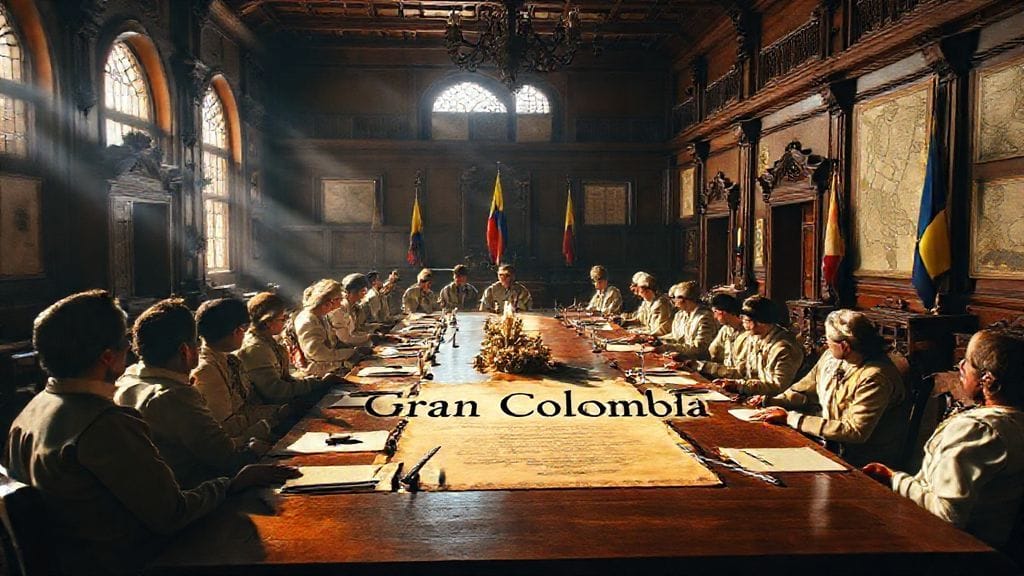
Against this backdrop, the Congress of Cúcuta convened in late August 1821. Delegates arrived from the departments aspiring to join the union: Venezuela, New Granada, and Ecuador. The town itself was modest but symbolically significant — situated near the frontier, it was a crossroads of cultures and commerce.
The Congress was intended as a constitutional assembly, tasked with drafting a permanent framework for governance. Initial meetings were both euphoric and tense, as delegates brought their regional baggage and ideological differences into the room. Yet a common purpose prevailed: the survival of the hard-won independence.
The opening session was marked by Bolívar’s stirring speeches, invoking unity and duty. Yet while inspiring, his words masked deep divisions that would surface repeatedly during the debates.
The Congress Begins: Debates and Decisions in a War-torn Land
Sessions spilled over weeks — sometimes days of heated rhetoric, sometimes delicate negotiation. Issues of representation, the balance of power between the executive and legislature, and the protection of regional interests came to the fore. Questions of citizenship, suffrage, and rights also provoked intense discussion.
One constant was the urgency to stabilize governance before external threats could reemerge. Spain had not renounced its ambitions; internal strife could undo everything.
The delegates worked tirelessly. Every word recorded bore the weight of a continent’s fate.
Defining a Nation: The Drafting of the Constitution
The Constitution of Gran Colombia, adopted on August 30, 1821, was a remarkable document for its time. It sought to balance republican ideals with the practicalities of governing a vast and diverse territory. It embraced the separation of powers, established a bicameral legislature, and created a strong executive presidency — a nod to Bolívar’s vision of a presidential system robust enough to maintain unity.
The constitution declared equality before the law, freedom of the press, the abolition of certain colonial privileges, and established Catholicism as the state religion, reflecting the era’s realities.
It was a democratic experiment, ambitious in scope.
The Idea of Gran Colombia: An Experiment in Unity
Gran Colombia was more than a constitution; it was a grand vision. Bolívar imagined a state that could compete with older powers, project strength, and ensure liberty and justice for its diverse peoples. This new nation stretched from the Caribbean Sea down the Andes mountains, encompassing modern-day Colombia, Venezuela, Ecuador, and even Panama.
To many, it was a beacon of hope in a world still dominated by empires. To others, it was an unwieldy project, difficult to govern and prone to internal conflict.
Yet the dream of unity was powerful — a promise to transcend parochial interests and forge a new destiny.
Sovereignty and Federalism: Negotiating Power and Identity
One of the Congress's central challenges was to reconcile the competing ideas of sovereignty. Should power reside chiefly with a central authority, or be distributed among provinces?
Federalists argued that local control would protect regional cultures and economies, preventing tyranny. Centralists feared that too much decentralization would fracture the union.
Ultimately, the constitution favored a strong central government but allowed departments certain local authorities. This uneasy compromise sought to hold the disparate parts together, but it planted seeds of future discord.
The Role of Simón Bolívar: The Liberator’s Ambitious Gamble
Bolívar’s role extended beyond that of a mere delegate: he was the ideological heart and strategic mind behind Gran Colombia. His speeches at the Congress crystallized his era-defining belief that unity was the only path to lasting freedom and prosperity.
Yet he was keenly aware of obstacles — regional jealousies, the lingering colonial mindset, economic disparities.
His leadership style was both inspirational and authoritarian, anticipating that a strong hand might be necessary to preserve the fragile republic.
His famous declaration, “America is ungovernable; those who serve it well must serve it harshly,” hinted at the tensions that would soon surface.
Francisco de Paula Santander: The Architect of Order
In contrast to Bolívar’s charisma and military prowess, Santander represented the rule of law and bureaucratic order. He had forged much of the legal framework that underpinned the new republic and was a staunch defender of constitutionalism.
Santander’s vision at Cúcuta was clear: a republic not only of ideals but of institutions. He sought to temper Bolívar’s sweeping ambitions with a practical legal structure.
Their partnership, though sometimes strained, was crucial to the Congress’s success.
Challenges Within: Regional Rivalries and Ideological Clashes
Despite the aspirations, the Congress faced immediate challenges. Delegates from Venezuela were wary of centralized New Granadian dominance. Ecuadorian representatives feared marginalization.
These rivalries manifested in debates over representation, fiscal policies, and military command.
Ideological divides, too, shaped the proceedings — conservatives who upheld traditional Catholic and social hierarchies clashed with liberals pressing for deeper reforms.
The Congress was both a union of lands and a battleground of ideas.
The Final Session: Ratification and the Birth of Gran Colombia
After intense deliberation, the constitution was ratified on August 30, 1821. The birth of Gran Colombia was official, hailed by many as a monumental achievement of diplomacy and vision.
Yet the celebrations were tempered by knowledge that the union’s work was only beginning. The real test lay ahead: governance, defense, economic development — and maintaining unity among diverse peoples.
Reverberations Beyond Borders: The International Context
Gran Colombia’s creation resonated far beyond South America. European powers watched warily, Spain chafing at the loss of its empire. The United States viewed the development with cautious interest, aligning itself with the cause of republicanism but wary of European reactions.
Simultaneously, Gran Colombia’s existence inspired other independence movements, fueling the wave of decolonization sweeping Latin America.
The Congress of Cúcuta thus marked a turning point in global geopolitics.
The Limits of Unity: Early Signs of Dissension
Despite its founding, Gran Colombia was fraught from the start with centrifugal forces. Economic disparities between regions, differences in political culture, and the sheer geographic expanse made governance difficult.
Within a decade, tensions grew into open conflict, with Venezuela and Ecuador seeking independence from Bogotá’s control.
The dream of unity, admirable though it was, confronted the hard reality of diverse national identities.
The Constitutional Framework: Rights, Citizenship, and Government
The 1821 constitution established rights such as freedom of speech, equality before the law, and secular education initiatives — revolutionary in a continent formerly bound to rigid monarchy and church authority.
Citizenship was extended to all born within the republic, setting foundations for political participation.
However, the continued establishment of Catholicism as the state religion underscored ongoing contradictions between enlightenment ideals and entrenched tradition.
Economic Aspirations: Trade, Taxes, and the Promise of Prosperity
Economically, Gran Colombia aimed to integrate markets, promote trade, and modernize taxation systems. The hope was that a unified currency, roads, and infrastructure could ensure prosperity.
Tobacco, coffee, cacao, and minerals were valuable exports, but uneven regional development presented challenges. Efforts to stimulate internal commerce had mixed success.
Additionally, war debts and the costs of independence strained coffers.
Social Dimensions: Slavery, Indigenous Peoples, and Social Hierarchies
Socially, Gran Colombia inherited deeply unequal structures. Slavery persisted, though the constitution hinted at gradual abolition. Indigenous peoples largely remained marginal to political power, their rights and identities often overlooked.
The creole elite dominated politics and land ownership, even as new republican identities emerged.
Balancing revolutionary ideals and social realities presented a persistent dilemma for the Congress’s architects.
Legacy and Dissolution: How Gran Colombia Transformed South America
Though short-lived—Gran Colombia dissolved by 1831 into separate nation-states—its legacy was profound. It shaped national boundaries, inspired later federalist experiments, and contributed to the discourse on Latin American identity.
Further, the Congress of Cúcuta stands as a testament to early republicanism’s triumphs and trials, embodying both the promise and peril of revolutionary change.
Memory and Myth: The Congress of Cúcuta in Today’s Imagination
Today, the Congress of Cúcuta occupies a complex place in Latin American memory. Bolívar’s legacy as “El Libertador” immortalizes the efforts of this era, though historians grapple with the contradictions and failures of the union.
The ideal of Gran Colombia continues to inspire some visions of regional integration, while others remember it as a cautionary tale about the difficulties of nation-building.
In Colombia, Venezuela, and Ecuador, the Congress remains a powerful symbol of aspiration and collective history.
Conclusion
The Congress of Cúcuta was far more than a historical event: it was a crucible of dreams, struggles, and paradoxes. In a time when empires crumbled and the very notion of sovereignty was being reimagined, a group of impassioned leaders sought to forge unity from diversity. Their vision of Gran Colombia was audacious— a young republic spanning vast lands, embodying the ideals of liberty and constitutional governance.
Yet, as with many revolutionary projects, the path was fraught with tension—between central authority and local autonomy, between idealism and reality, between unity and fragmentation. The Congress’s work embodied the fragile hope that freedom alone could bind an entire continent. It offers a compelling narrative of courage, complexity, and human aspiration.
As history carves its unfolding chapters, the Congress of Cúcuta endures as a testament to the power and limits of collective will in shaping nations. It invites us to reflect not only on the past but on the ongoing quest for justice, identity, and belonging that defines our shared human experience.
FAQs
Q1: What prompted the convening of the Congress of Cúcuta in 1821?
A1: The Congress was convened to create a unified republic out of the recently independent territories of New Granada, Venezuela, and Ecuador. It intended to consolidate gains of independence and establish a stable constitutional framework for governance.
Q2: Who were the main leaders influencing the Congress?
A2: Simón Bolívar, known as the Liberator, was the dominant political and military figure advocating for unity and strong central government. Francisco de Paula Santander was a key legal architect emphasizing constitutionalism and rule of law.
Q3: What were the main challenges faced by the Congress?
A3: The main issues included reconciling regional interests, negotiating the balance of power between the central government and provinces, addressing social inequalities, and creating a sustainable economic and political system amidst ongoing conflict.
Q4: How was the constitution of Gran Colombia structured?
A4: It established a republican government with a strong executive president, a bicameral legislature, separation of powers, and included rights such as freedom of the press and equality before the law. Catholicism was affirmed as the state religion.
Q5: Why did Gran Colombia ultimately dissolve?
A5: Internal regional rivalries, economic disparities, political conflicts, and competing visions of governance led to fragmentation. By 1831, Venezuela and Ecuador had seceded, leaving New Granada to evolve into modern Colombia.
Q6: What is the historical significance of the Congress of Cúcuta today?
A6: It represents the early republican aspirations of Latin America, a bold attempt at continental unity, and a foundational moment in defining national identities. It remains a symbol of both potential and the complexities of nation-building.
Q7: Did the Congress address social issues like slavery and indigenous rights?
A7: While the constitution and Congress touched on abolition and citizenship, social inequalities persisted. Slavery was not immediately abolished, and indigenous peoples’ rights remained limited, reflecting contradictions in revolutionary ideals.
Q8: How did international powers react to the emergence of Gran Colombia?
A8: European powers, notably Spain, opposed the secession of its colonies. The United States supported the independence movements cautiously, seeing the new republics as ideological allies but also navigating complex international diplomacy.