Table of Contents
- The Twilight of an Empire: March 19, 1823
- Mexico City in Turmoil: The Stage Is Set
- From Colony to Kingdom: The Rise of the First Mexican Empire
- Agustín de Iturbide: Hero and Monarch
- Fragile Foundations: Political and Social Divides
- Economic Woes and Regional Discontent
- The Seeds of Rebellion: Republican Sentiment Grows
- The Plan of Casa Mata: Call for Change
- Iturbide’s Crisis of Power: A Monarch Besieged
- The Imperial Court Collapses: Flight and Abdication
- The Proclamation of the Republic: A New Dawn
- The Role of Antonio López de Santa Anna
- Popular Response: Hope and Uncertainty
- Immediate Challenges of the New Republic
- Political Fragmentation and Continued Instability
- Legacy of the First Mexican Empire’s Fall
- The Republic’s Place in Mexican National Identity
- International Repercussions in the Americas
- Reflections on Monarchy and Republicanism
- History’s Verdict: Lessons from 1823
- Epilogue: Mexico’s Long Road to Stability
The Twilight of an Empire: March 19, 1823
Mexico City, light emanating from flickering oil lamps, lay shrouded in the chill of an early spring night. Outside, the narrow streets buzzed with whispers, footsteps hurried towards the Plaza Mayor, where rumors swirled like the desert dust—Augustín de Iturbide’s reign had come to a brutal and irrevocable end. The First Mexican Empire, barely two years in existence, unraveled amid political upheaval, economic distress, and social fracture. On that fateful day, March 19, 1823, the republic was proclaimed, and a new chapter in Mexico’s tumultuous history began, promising freedom but delivering uncertainty.
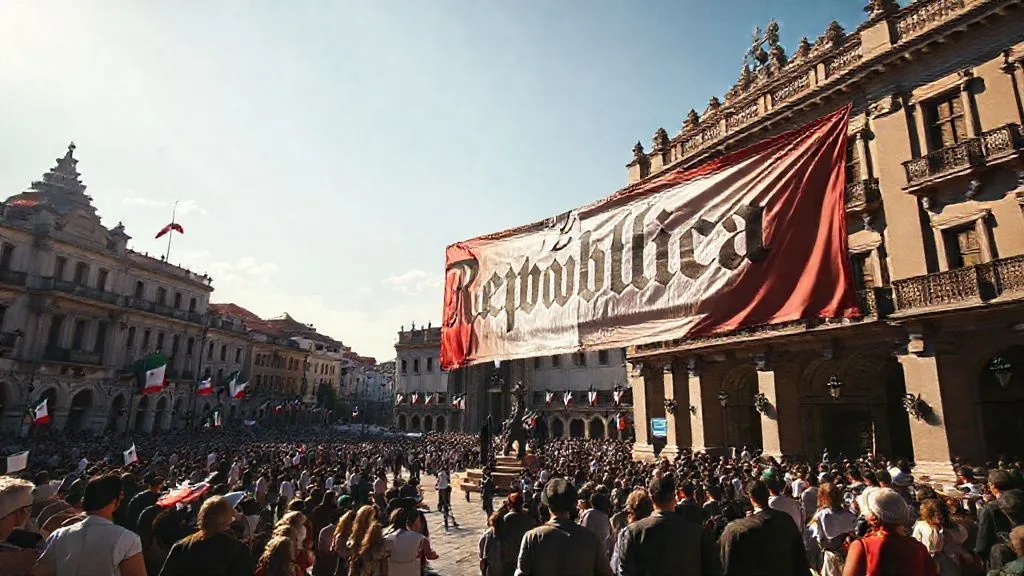
As the sun rose the next morning, the city awoke to the sound of proclamations echoing from balconies and the fluttering of banners emblazoned with republican slogans. The empire of Iturbide was no more. What led to this seismic political shift? How did a man celebrated as a liberator transform into an overthrown emperor? To understand that pivotal moment, we must delve deep into the volatile turbulence that gave birth and death to the First Mexican Empire.
Mexico City in Turmoil: The Stage Is Set
In early 1823, Mexico City was a city of contrasts. Colonial grandeur stood beside the burgeoning shadows of revolution. The viceroyalty had faded, but the ghosts of centuries-old hierarchies hung thick in the air. The streets were filled with the restless murmurs of factions vying for control—royalists loyal to Spain, supporters of monarchy, fierce republicans, and indigenous groups seeking recognition.
Beyond the city walls, the Mexican heartland was fractured. Vast provinces, often isolated by rugged terrain and poor infrastructure, wrestled with their own ideas of governance and representation. Mexico was not yet a nation in the sense we understand today; it was a fragile mosaic of interests, held tenuously together by the charisma of a former military hero turned emperor.
From Colony to Kingdom: The Rise of the First Mexican Empire
The journey from colony to independent empire was nothing short of dramatic. After over three centuries under Spanish rule, Mexico’s independence movement ignited in 1810 with Miguel Hidalgo’s famous “Grito de Dolores.” The war of independence raged for over a decade, marked by sacrifice, brutal battles, and shifting alliances.
In 1821, a decisive moment came with the Plan of Iguala, championed by Agustín de Iturbide—a smart, ambitious officer who had once fought for the royalists but switched sides to embrace independence. The Plan promised a constitutional monarchy, equality between Spaniards and Creoles, and Roman Catholicism as the sole religion. These “Three Guarantees” sparked the end of the conflict and Mexico’s formal independence.
The new state emerged as the First Mexican Empire, with Iturbide crowned Emperor Augustín I in 1822 amidst great fanfare. His coronation seemed, at first, to fuse Mexico’s diverse factions under a single banner. But it was a fragile unity—based on promises and cautious hope, not firm foundations.
Agustín de Iturbide: Hero and Monarch
Iturbide’s figure was enigmatic—a man whose charisma and military prowess masked political inexperience. To some, he was the savior of Mexico; to others, a usurper who imposed an uncertain crown. His reign was marked by bold decisions but also grave miscalculations.
As emperor, Iturbide dissolved the Constituent Congress, centralized power, and raised taxes. Such actions alienated many supporters who had dreamed of a representative government, not authoritarian monarchy. His court struggled to win favor among the clergy and military, further isolating the emperor.
Yet Iturbide was more than a mere autocrat; his ambitions reflected a genuine, if flawed, desire to cement Mexico’s sovereignty in a turbulent era. He wrestled with internal threats and external pressures, attempting to govern a nation newly carved out of empire and rebellion.
Fragile Foundations: Political and Social Divides
The fall of the First Mexican Empire cannot be understood without appreciating the deep fissures in Mexican society. The Creole elite, wealthy landowners of European descent born in the Americas, held most political power but feared both Spanish loyalists and popular revolts.
The indigenous peoples and mestizos, who formed the majority of the population, remained largely marginalized. The promises of equality often rang hollow, leading to widespread dissatisfaction. Regional identities and loyalties complicated governance—New Spain was not a unified territory but a patchwork of provinces with competing agendas.
Within this volatile brew, the idea of monarchy itself was divisive. Some factions clamored for a republic—a government by the people or their representatives—seeing monarchy as an outdated relic tied to colonial dominance. Others feared chaos without a strong central authority.
Economic Woes and Regional Discontent
Compounding political issues were economic hardships. Mexico’s war-ravaged economy struggled to recover from the decade-long conflict. Agriculture and mining, key pillars of wealth, languished. Trade disrupted, revenues shrank, and inflation soared.
In addition, regions far from Mexico City felt neglected or exploited. The northern provinces, with their distinct cultures and economic interests, chafed under imperial policies perceived as favoring the capital. Discontent simmered and spread, creating fertile ground for opposition movements.
The Seeds of Rebellion: Republican Sentiment Grows
Throughout 1822, opposition to Iturbide’s empire gained momentum. Intellectuals, lower-ranking military officers, and the emerging middle classes increasingly called for a republic. Revolutionary fervor rekindled, this time not against foreign rule, but against an unpopular, autocratic monarch.
Key to this opposition was the Plan of Casa Mata, drafted early in 1823. This revolutionary manifesto rejected Iturbide’s empire, declaring that sovereignty resided with the people, and called for the restoration of the Constituent Congress to draft a new constitution.
The Plan rapidly garnered support from provinces and influential figures, marking a coordinated challenge to imperial authority.
The Plan of Casa Mata: Call for Change
On February 1, 1823, Antonio López de Santa Anna, a rising military leader and staunch republican, proclaimed the Plan of Casa Mata in the province of Veracruz. The plan united disparate factions demanding the fall of the empire and the establishment of a constitutional republic.
What made Casa Mata remarkable was its appeal across social and regional lines. The plan’s rhetoric of popular sovereignty resonated widely, reflecting the Mexican people’s exhausted patience with monarchy, and their yearning for self-governance.
Iturbide’s Crisis of Power: A Monarch Besieged
Iturbide faced this opposition with a mixture of stubbornness and desperation. His refusal to compromise alienated moderates who might have otherwise mediated. The military proved divided; key generals defected to the republican cause.
Isolated politically, Iturbide attempted to negotiate briefly but ultimately lost the will and ability to maintain control. On March 19, 1823, forced by the overwhelming opposition, he abdicated the throne and left Mexico City, marking the effective end of the empire.
The Imperial Court Collapses: Flight and Abdication
The emperor’s sudden departure was a dramatic moment. Crowds in Mexico City rejoiced openly in the plaza, transforming the mood from fear to hope. The imperial court dissolved in chaos—a symbol of the fragility of Iturbide’s regime and the limits of personal rule.
Iturbide’s abdication was not merely a political event—it symbolized the rejection of monarchy and the assertion of new political ideals struggling to take root in Mexico.
The Proclamation of the Republic: A New Dawn
In the days following the abdication, revolutionary leaders worked swiftly to consolidate power. The Constituent Congress was restored, and republican leaders declared the Republic of Mexico, anchoring the nation’s future on popular representation and constitutional governance.
This moment was not the end of struggle. The new republic faced immense challenges: political instability, regional rivalries, economic hardship, and the daunting task of crafting a viable nation from the ruins of empire.
The Role of Antonio López de Santa Anna
Santa Anna emerged as a prominent figure during this transition. Though his later career would be controversial, in 1823 he was hailed as a champion of republicanism who helped dismantle Iturbide’s empire.
His military acumen and populist rhetoric galvanized support for the republic, but his ambitions also foreshadowed future centralization of power. For now, though, he embodied hope for a freer and more representative Mexico.
Popular Response: Hope and Uncertainty
Among ordinary Mexicans, reactions to the fall of the empire were mixed. Many celebrated the end of an unpopular monarchy, dreaming of a government that might better serve their needs. Yet uncertainty loomed large; the new republic was untested, and fears of factional violence persisted.
Stories from the streets relate moments of jubilation tempered by anxiety—families debating the meaning of “republic,” artisans wondering if their livelihoods would improve, and indigenous communities cautiously watching whether the new order might finally recognize their rights.
Immediate Challenges of the New Republic
The proclamation of the republic did not erase Mexico’s internal struggles overnight. The government faced a daunting task: drafting a constitution, managing provincial dissent, rebuilding an economy in ruins, and defining Mexico’s place in a continent dominated by powerful neighbors.
The republic lacked experienced institutions. Political factions battled for influence, and military leaders like Santa Anna wielded significant power, at times threatening civilian rule.
Political Fragmentation and Continued Instability
The fall of the empire gave way to a decade marked by coups, rebellions, and shifting power blocs. Provincial caudillos—regional strongmen—emerged as central figures, challenging the authority of Mexico City.
This period revealed deep divisions in Mexican society and politics—between conservatives who longed for strong, sometimes autocratic leadership, and liberals pushing for federalism and broader democracy.
The republic’s birth was thus tumultuous, setting patterns that would affect Mexico well into the 19th century.
Legacy of the First Mexican Empire’s Fall
Though short-lived, the First Mexican Empire and its dramatic collapse left a lasting imprint. It revealed the challenges inherent in creating a new nation from colonial fragments.
Iturbide’s reign became a cautionary tale—warning against concentration of power without popular consent. The fall of the empire underscored the Mexican people’s preference for republicanism, despite its difficulties.
The Republic’s Place in Mexican National Identity
In the long view, the establishment of the republic after Iturbide’s fall helped shape Mexican identity around ideals of self-determination, constitutionalism, and representative government.
Despite setbacks and ongoing struggles, this moment in 1823 symbolized a break from colonial pasts and monarchical experiments towards a modern nation-state whose legitimacy would derive, at least in theory, from its people.
International Repercussions in the Americas
Mexico’s transition inspired and complicated politics beyond its borders. In a hemisphere grappling with colonial independence and emerging states, Mexico’s move from empire to republic was closely watched.
It served as a cautionary example to monarchists and as encouragement to republican movements in Latin America and beyond. Meanwhile, Spain’s hopes of reconquest dimmed, and the United States eyed the region with increasing strategic interest.
Reflections on Monarchy and Republicanism
The fall of the First Mexican Empire invites broader reflection on the tension between monarchy and republicanism in the early 19th century. Mexico’s brief flirtation with monarchy was unique in the Americas—most newly independent states adopting republican models.
It perceptively reveals the complexities of nation-building, the allure and limits of charismatic leadership, and the powerful drive toward popular sovereignty.
History’s Verdict: Lessons from 1823
Looking back, historians recognize the fall of the empire as a formative moment of painful but necessary transformation. Iturbide’s failure highlighted the dangers of premature centralization, while the republic’s birth underscored the promise and perils of democratic ideals in a fragmented society.
Mexico’s experience reminds us that nationhood is often forged through struggle, compromise, and the indomitable will of its people.
Epilogue: Mexico’s Long Road to Stability
The republic proclaimed in March 1823 was but a first step. Mexico’s 19th century would see cycles of revolution, reform, foreign intervention, and civil war.
Yet from the ruins of empire rose a resilient nation, shaped in part by the hopes and failures of those dramatic days in Mexico City. The fall of the First Mexican Empire remains a powerful testament to the enduring quest for self-determination and democracy in the Americas.
Conclusion
The fall of the First Mexican Empire on March 19, 1823, was a moment steeped in both triumph and tragedy—the end of an ill-fated monarchy and the daring birth of a republic. Iturbide’s rise and fall embodied the contradictions of early independent Mexico: yearning for unity tangled with deep social divides, ambitions of order clashing with the reality of fragmentation.
But beyond the political machinations and military maneuvers, it was the hopes of millions—the dreams of freedom, justice, and participation—that truly shaped this turning point. The proclamation of the republic was more than a regime change; it was the crystallization of a new Mexican ideal, imperfect but enduring.
This chapter in Mexican history reminds us that nation-building is never easy. It demands resilience, sacrifice, and continual negotiation between power and principle. As Mexico continued its turbulent journey, the lessons of 1823 echoed—democracy is a prize often won through struggle, and the voice of the people, once awakened, cannot easily be silenced.
FAQs
Q1: Why did the First Mexican Empire fall so quickly?
A1: The empire collapsed due to deep political divisions, economic difficulties, regional discontent, and Iturbide’s authoritarian tendencies. Lack of broad support for monarchy and increasing republican sentiment hastened its fall.
Q2: Who was Agustín de Iturbide and what role did he play?
A2: Iturbide was a military leader who orchestrated Mexico’s independence and became its emperor. Initially a hero, his autocratic rule alienated many, leading to his abdication and exile.
Q3: What was the Plan of Casa Mata?
A3: A revolutionary manifesto proclaimed in 1823 that rejected the empire, called for the restoration of a constituent congress, and demanded the establishment of a republic.
Q4: How did Antonio López de Santa Anna influence these events?
A4: Santa Anna was a key military leader supporting the Plan of Casa Mata and the push for republicanism, playing a central role in the empire’s overthrow and early republic.
Q5: What immediate challenges did the new republic face?
A5: The republic struggled with political fragmentation, economic recovery, regional rivalries, and building effective governance institutions.
Q6: How is the fall of the empire remembered in Mexico today?
A6: It is seen as a complex but crucial turning point—an episode that ended monarchical experiment and set Mexico on a republican path despite ensuing instability.
Q7: Did the fall of the empire affect Mexico’s relations with other countries?
A7: Yes; it discouraged Spanish reconquest attempts and influenced neighboring nations by highlighting the difficulties of establishing stable governance post-independence.
Q8: Why did some Mexicans support monarchy while others wanted a republic?
A8: Support for monarchy often came from conservatives desiring order and continuity, while republicans, influenced by enlightenment ideals and revolutionary experiences, sought popular sovereignty and federalism.