Table of Contents
- The Morning of July 27, 1830: Paris Awakens to Upheaval
- Seeds of Revolution: The Bourbon Monarchy in Crisis
- Charles X and the July Ordinances: Sparks in a Powder Keg
- The Velvet Mob: Who Were the July Revolutionaries?
- Barricades and Gunfire: The Streets of Paris Turn to Battlefields
- Tales from the Front: Voices from the July Days
- The Fall of a King: Charles X’s Flight and Abdication
- The Rise of Louis-Philippe: The Citizen King Takes the Throne
- The July Monarchy: Promise and Reality
- Republican Dreams and Socialist Whispers in the Aftermath
- The International Echo: How July 1830 Resonated Across Europe
- The Cultural Revolution: Art, Literature, and the Spirit of 1830
- Women and the Revolution: Unsung Participants of Insurrection
- Economic Turmoil and Social Strain in Post-July France
- The Legacy of July 1830: A Turning Point in French Political Culture
- Repressions, Reforms, and the Road to 1848
- The July Revolution in Memory: Commemoration and Debate
- Conclusion: The Human Cost and Enduring Spirit of the Three Glorious Days
- Frequently Asked Questions about the July Revolution
- External Resource
- Internal Link
1. The Morning of July 27, 1830: Paris Awakens to Upheaval
On the cusp of dawn, the usually serene streets of Paris bore the rumble of restless footsteps. The summer air was thick, not just with heat, but with tension and whispered anxieties. It was July 27, 1830 — a day ordinary by calendar but extraordinary in destiny. Here, where revolutionary spirits had echoed before, a new storm was about to burst. The barricades were being built, not in confusion but with fierce purpose, stone by stone, cart by cart. The cobbled avenues bristled with makeshift weaponry; the cries of citizens—students, workers, and soldiers—pledged a burning desire for change.
The July Revolution, sometimes called "Les Trois Glorieuses" (The Three Glorious Days), had erupted, ready to overthrow the seemingly invincible Bourbon monarchy, tightening its grip after decades of struggle in post-Napoleonic France. The streets of Paris were not just battlegrounds but arenas of hope, fury, and the raw pulse of human yearning for liberty.
2. Seeds of Revolution: The Bourbon Monarchy in Crisis
To understand the fiery wave that swept Paris in 1830, one must journey back through the troubled years following Napoleon’s defeat. The restored Bourbon monarchy, under Louis XVIII and then Charles X, attempted to impose an order reminiscent of absolutist ancien régime ideals. These kings were monarchs in a Europe reshaped by liberal nationalism, burgeoning industrialism, and citizens increasingly convinced of their rights.
Despite the constitutional Charter of 1814, which appeared progressive on paper, Charles X and his successors resisted the tide of political reform. Society was sharply divided between aristocratic conservatives seeking to restore old privileges and a growing middle class that demanded political voice and economic freedom.
By the 1820s, France was a powder keg: workers lived in poverty, the press was heavily censored, electoral rights were restricted to a tiny elite, and nationalism stirred both republican dreams and monarchical fears. This was the troubled backdrop to the coming eruption.
3. Charles X and the July Ordinances: Sparks in a Powder Keg
The immediate catalyst came on July 25, 1830, when Charles X, determined to stem the tide of liberal dissent, issued the July Ordinances (also known as the July Decrees). These royal edicts dissolved the newly elected Chamber of Deputies, curtailed the freedom of the press, and restricted voting rights. In effect, the king slammed the door on constitutional governance and dared his subjects to challenge him.
To many, this was a declaration of war—not just on political opponents but on the very ideas of freedom and progress. Newspapers defied the censorship decrees, incendiary pamphlets spread with lightning speed, and Parisians took to the streets. The government believed repression would restore control; instead, it ignited a blaze.
4. The Velvet Mob: Who Were the July Revolutionaries?
The insurgents of July 1830 were a heterogeneous band—students draped in blue, white, and red, workers wielding iron bars, petty bourgeois patriots clutching rifles, and even some disillusioned members of the National Guard. They came not from a single class but from an uneasy coalition bound by outrage and hope.
This "velvet mob," as some contemporaries dubbed them, were no professional soldiers but citizens galvanized by immediate threats to their freedoms. Parisian neighborhoods became crucibles of solidarity, where neighbors turned into brigades in a spontaneous, democratic army of insurrection.
Among the heroes were figures like Adolphe Thiers, a fiery journalist and historian, whose vivid accounts captured the revolutionary zeitgeist; and Louis-Philippe, Duke of Orleans, whose cautious positioning would make him king after the upheaval.
5. Barricades and Gunfire: The Streets of Paris Turn to Battlefields
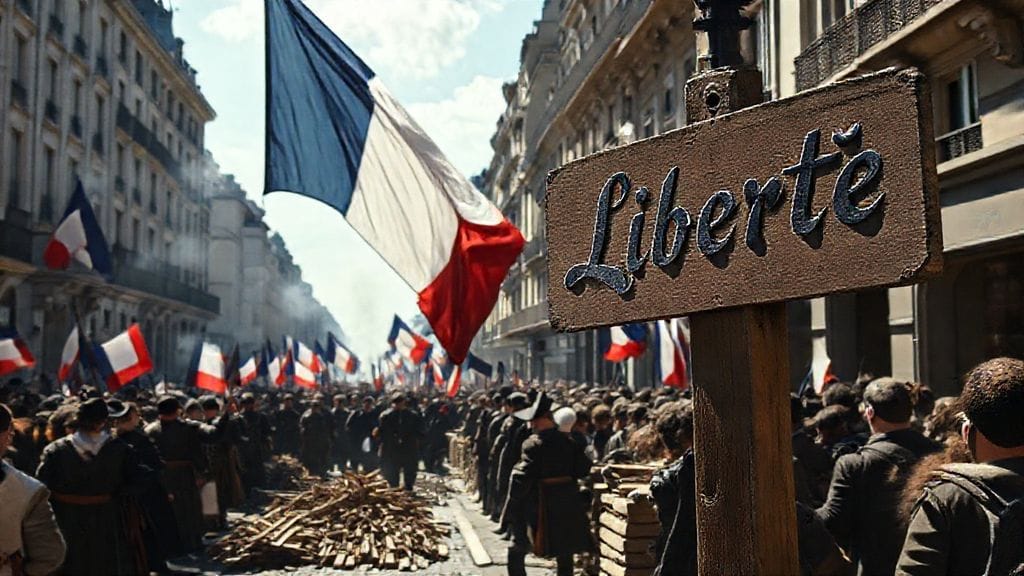
July 27 to 29 were days of relentless street combat. Barricades were erected in fierce anticipation, narrow streets transforming into labyrinths of defiance. Musket and cannon fire rang out. Unlike the wars of empires, this was a war of neighbors—neighbors with neighbors, barricade builders with soldiers loyal to the crown.
The images emerging from this three-day chaos are iconic: youths perched on rooftops, smoke curling in the sultry evening air, mothers clutching infants while shouting for justice below. The barricades themselves became potent symbols—not just of resistance but of democratic participation, as every stone laid was a brick in the edifice of future freedom.
Despite superior weaponry, royal troops were overwhelmed by a populace driven by more than arms—by conviction and desperation.
6. Tales from the Front: Voices from the July Days
Among the cacophony, personal stories shine. Jeanne, a seamstress, transformed by rage into a sharpshooter on Rue Saint-Denis; Philippe, a student, whose poignant diary captures both terror and hope; and ordinary Parisians who hid wounded rebels despite risk. These testimonies humanize the upheaval, reminding us that revolutions are never abstractions but deeply rooted in human lives.
One soldier defected to the insurgents, declaring, “I fight not for the king but for France’s soul.” Another witness recalled seeing the tricolor flag—the symbol of revolution—raised atop the Hôtel de Ville with tears streaming down the crowd’s faces.
7. The Fall of a King: Charles X’s Flight and Abdication
Faced with the swelling rebellion, Charles X hesitated but ultimately fled Paris, taking refuge outside the city before abdicating in favor of his grandson, Henri, Count of Chambord. But the flames of revolution had moved beyond royal decrees; the people wanted a different future.
This marked the dramatic collapse of the Bourbon line’s last serious attempt to maintain power. The king’s flight was both a personal failure and an emblem of a waning era, underscoring the power of popular will in reshaping institutions.
8. The Rise of Louis-Philippe: The Citizen King Takes the Throne
Into the void stepped Louis-Philippe, Duke of Orleans, whose appeal stemmed from his image as a “Citizen King.” Proclaimed King of the French on August 9, he promised constitutional monarchy and moderate reform, seeking to appease both radicals and conservatives.
His reign, known as the July Monarchy, was marked by bourgeois dominance and stability compared to prior chaos—but it was not without contradictions. His grip on power relied on property qualifications that excluded working-class voices, setting seeds for future discontent.
9. The July Monarchy: Promise and Reality
Louis-Philippe’s regime balanced on a knife’s edge between liberal aspirations and practical governance. Economically, France modernized, with burgeoning railroads and factories, but social inequality persisted. Politically, the middle class gained influence, but republican and socialist movements simmered beneath the surface.
Many hailed the regime as a breakthrough—France was no longer ruled by divine right kings but by a constitutional monarch subject to law. Yet others decried the compromise, seeing a betrayal of revolutionary ideals.
10. Republican Dreams and Socialist Whispers in the Aftermath
Though the July Revolution succeeded in dethroning Charles X, it fell short of republicanism. The working class and radical intellectuals continued to dream of a republic. Socialist thinkers like Louis Blanc and early socialists used the post-revolutionary momentum to push for wider social reforms.
This era saw the rise of political clubs, debates, and press outlets that nurtured alternative visions for France’s future. The tensions between reformists and revolutionaries would eventually erupt again in the Revolutions of 1848.
11. The International Echo: How July 1830 Resonated Across Europe
The July Revolution introduced a domino effect. In Belgium, it propelled independence from the Netherlands; in Poland and Italy, uprisings were inspired; across Europe, monarchies watched nervously as French citizens challenged absolutism.
The event heralded a new age where monarchs could no longer rule unchecked. The idea that people might force change by taking to the streets spread contagiously, influencing nationalist and liberal movements far beyond France’s borders.
12. The Cultural Revolution: Art, Literature, and the Spirit of 1830
While cannons roared, artists and writers responded with portraits of resistance and hope. Eugène Delacroix’s painting "Liberty Leading the People," though created for the 1830 revolution of 1830 (the July), immortalized the spirit with revolutionary symbolism. Literature celebrated the heroism and tragedy of the days—Victor Hugo among them, who mourned the fallen and hoped for a better France.
Music, theater, and poetry all became vessels for revolutionary ideals, influencing cultural memory. July 1830 was as much a cultural turning point as a political one.
13. Women and the Revolution: Unsung Participants of Insurrection
Though often sidelined in official narratives, women played crucial roles during the July Revolution—as messengers, nurses, combatants, and moral pillars. Figures such as Adèle de Bellegarde who tended to the wounded, or citizens who maintained barricades, reveal a dimension of the uprising too often overlooked.
Their stories constitute a hidden history of courage and sacrifice, hinting at the complex gender dynamics that shaped revolutionary participation.
14. Economic Turmoil and Social Strain in Post-July France
The upheaval brought instability to the economy—factories interrupted, trade disrupted, hunger staggering some districts. The new regime’s policies favored capital and industry but often neglected the plight of workers, exacerbating social tensions.
Unemployment and poor living conditions festered in urban centers, framing the social challenges confronting the July Monarchy. This economic backdrop fueled future unrest.
15. The Legacy of July 1830: A Turning Point in French Political Culture
July 1830 did not just dethrone a king—it helped recalibrate France’s political compass. It underscored the rise of citizenship as a potent force and demonstrated that legitimacy now stemmed more from the people's acceptance than divine right.
It also embedded the tricolor flag and revolutionary symbols deeper into French identity, shaping republicanism and democracy for decades. The events forged a political culture wary of extremism but keenly aware of the power of popular mobilization.
16. Repressions, Reforms, and the Road to 1848
Despite promises of moderation, the July Monarchy regularly clamped down on dissent. Restrictive press laws, police surveillance, and repression of protest were common, highlighting paradoxes that alienated many.
Yet reforms in education, infrastructure, and trade were pursued, showing an attempt to modernize. This fragile balance unravelled by the late 1840s, culminating in yet another revolution—one that would finally topple Louis-Philippe.
17. The July Revolution in Memory: Commemoration and Debate
How should we remember July 1830? In France, commemorations have celebrated the “Three Glorious Days” as a heroic reset, yet debates persist over the revolution’s nature. Was it a bourgeois coup, a popular uprising, or a mixture?
Public memory continues to grapple with contradictions: liberty and inequality, revolution and order, hope and disillusionment. The event remains a vital symbol in discussions over French identity and democracy.
Conclusion
The July Revolution of 1830—three days of fury, hope, and transformation—was a defining moment in French history. It swept away an ancient monarchy but did not produce a perfect democracy. Instead, it created a new political order, fraught with contradictions yet bursting with potential.
The revolution’s human stories—of barricade builders, mothers, students, and kings fleeing in confusion—remind us that history is fought and forged not by abstract forces, but by people driven by dreams and fears. Its legacy lives on in the rhythms of modern democracy and the enduring quest for liberty.
Through the smoke and gunfire, the people of Paris in July 1830 taught the world that the spirit of revolution is as alive as ever—complex, powerful, and deeply human.
FAQs
Q1: What caused the July Revolution of 1830?
A1: The immediate cause was Charles X’s July Ordinances, which attempted to suppress the press and dissolve parliament, provoking widespread outrage. More broadly, it was a culmination of political repression, social inequality, and demands for liberal reforms.
Q2: Who were the main actors in the revolution?
A2: Primarily workers, students, and middle-class citizens of Paris united against the monarchy. Key figures included Louis-Philippe, who became king, and political leaders like Adolphe Thiers. Many ordinary Parisians also played critical roles.
Q3: How did the July Revolution change France’s government?
A3: It replaced the conservative Bourbon King Charles X with Louis-Philippe, who ruled under a constitutional monarchy known as the July Monarchy, which aimed to be more liberal but favored the bourgeoisie.
Q4: What was the international impact of the revolution?
A4: The revolution inspired uprisings across Europe—in Belgium, Poland, and Italy—and intensified the struggle between monarchy and liberalism continent-wide, influencing revolutions later in 1848.
Q5: Did the revolution immediately benefit all French citizens?
A5: No. While political elites gained more power, many workers and peasants remained excluded from political participation and suffered economic hardships, leading to future social unrest.
Q6: Why is the July Revolution sometimes called “The Three Glorious Days”?
A6: Because the intense fighting and uprising occurred over July 27, 28, and 29 in 1830, and these days were later celebrated as emblematic of popular resistance and victory.
Q7: How is the July Revolution remembered today?
A7: It is remembered as a pivotal but complex moment in French history, symbolizing popular opposition to absolutism and the messy birth of modern democracy, though interpretations vary between viewing it as bourgeois or truly popular.
Q8: What cultural legacies did the revolution leave?
A8: It inspired iconic art like Delacroix’s "Liberty Leading the People" and influenced literature, music, and political thought, embedding revolutionary symbols deeply in French national identity.