Table of Contents
- A Storm Brewing Over Spain: The Prelude to the Carlist War
- The Death of Ferdinand VII and the Dynastic Crisis
- Isabella II: A Child Queen in a Divided Nation
- Don Carlos: The Challenger to the Throne
- The Clash of Ideologies: Absolutism vs. Liberalism
- Regional Loyalties and the Basque Question
- The Outbreak of Hostilities: October 1833 in Bilbao
- The Early Battles and the Mobilization of Forces
- The Role of Foreign Powers and International Observers
- The Siege of Bilbao: Fortitude and Desperation
- Guerrilla Warfare and the Brutality of the Conflict
- Women and Civilians: Endurance Under Fire
- Leadership on Both Sides: Heroes, Villains, and Visionaries
- Propaganda and the War of Hearts and Minds
- The Struggle for Control of Navigation and Trade Routes
- The War Expands: From Northern Spain to the Heartland
- The Political Chessboard: Madrid and the Regents’ Decisions
- Social Upheaval Amidst the Chaos
- The Endgame: Military Turning Points and Exhaustion
- The Aftermath: Political Reconfiguration and Peace Treaties
- The Cultural Legacy: Memory and Myth-making of the Carlists
- The Impact on Spain’s Modernization and National Identity
- Lessons from the War: Divisions That Echo Through Time
- Conclusion: The Carlist War as a Mirror of Spain’s Soul
- FAQs: Questions Answered About the Carlist War
- External Resource
- Internal Link
A Storm Brewing Over Spain: The Prelude to the Carlist War
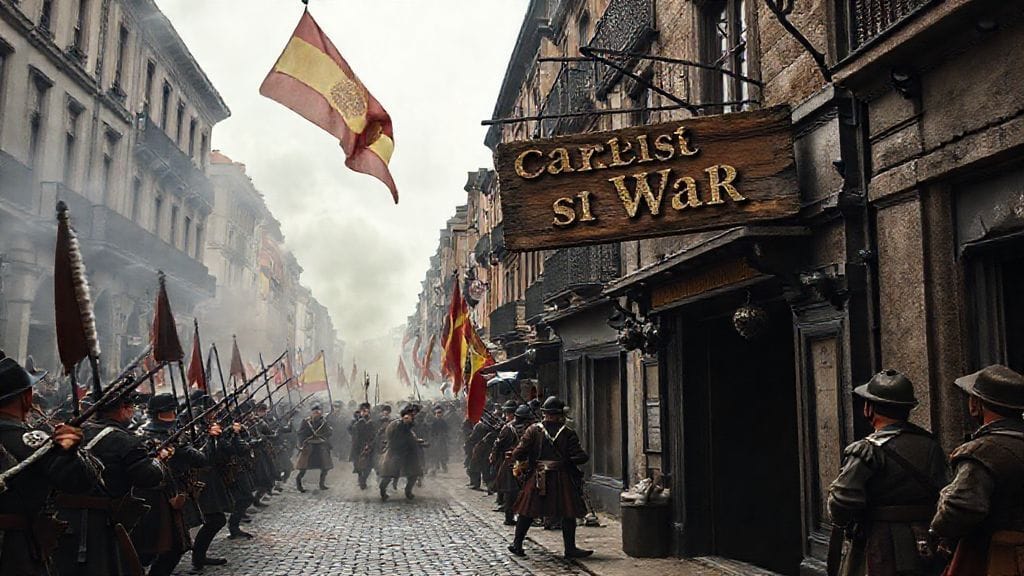
The chill of a northern autumn in 1833 carried an air heavy with tension over the bustling port city of Bilbao. It was here, amid the misty hills and cobbled streets, that the sparks of a bloody civil war were about to ignite, threatening to consume Spain in a brutal conflict that would last nearly a decade. As the fog rolled over the Nervión River, whispers filled taverns and parlors alike—a split was widening within the heart of the nation, one that pitted brother against brother, tradition against progress, and old monarchist dreams against the rising current of liberalism.
This was the dawn of the First Carlist War, a conflict forged from dynastic dispute but fueled by profound ideological and social rifts. The death of King Ferdinand VII left a contested throne, and simultaneously awakened old rivalries and formidable ambitions. In the northern regions, especially the Basque Country and Navarre, the fervor for the cause of Don Carlos surged with impassioned militancy, while the central government rallied under the banner of Queen Isabella II. But Bilbao stood at the crossroads of fate, a gateway between past and future, where the first volley would set the tone for an unprecedented ordeal in Spanish history.
The Death of Ferdinand VII and the Dynastic Crisis
Ferdinand VII, known to his contemporaries as “El Deseado” (the Desired), died on September 29, 1833, leaving no male heir. His death unraveled decades of contentious ruling marked by repression, oscillation between liberal and absolutist tendencies, and personal tragedies that shadowed the throne. Crucially, on his deathbed, Ferdinand overturned the Salic Law—which barred women from succession—and declared his infant daughter, Isabella, his successor.
This decree, known as the Pragmatic Sanction of 1830, was a seismic shift. It directly challenged the claims of his brother, Don Carlos, who was widely believed in many quarters to be the rightful heir by traditionalist standards. For many Spaniards—especially conservatives, rural landowners, and the clergy—this was not simply a question of dynastic legality but a test of Spain’s soul. The Salic Law was more than a legal code; it symbolized the old order, the ‘natural’ monarchy guided by God’s will. To reject it was seen as a usurpation and a dire signal that Spain was veering away from its historic path.
Isabella II: A Child Queen in a Divided Nation
Isabella María Luisa Fernanda de Borbón, barely three years old at her father’s death, was thrust upon the throne amid uncertainty and hostility. A regency was established under her mother, Maria Christina of the Two Sicilies, but the political landscape that greeted young Isabella was perilous. The nation was fractured along political, social, and regional lines.
Liberal factions in Madrid and urban centers embraced the regency and the new queen, viewing the change as an opportunity to cement constitutional monarchy, expand civil liberties, and modernize Spanish institutions. Yet, the provinces—especially the mountainous Basque region and Navarre—remained bastions of traditional values and fierce loyalty to Don Carlos, whose claim retained a near-sacred legitimacy in their eyes.
Don Carlos: The Challenger to the Throne
Don Carlos of Bourbon was a charismatic, resolute figure, the embodiment of traditional Spanish Catholicism and absolutism at a time of rapid change. His supporters viewed him as the true king, the guardian of Spain's historical identity and divine order. For them, Isabella's reign was an anathema, a puppethood manipulated by liberals and foreign influences.
Carlos' cause was not merely dynastic ambition; it was a rallying cry for the conservative forces who felt marginalized under the evolving liberal regime. His accession promised to restore fueros—traditional regional rights and laws, particularly in the Basque territories—and the primacy of the Catholic Church, both pillars of identity for many Spaniards.
The Clash of Ideologies: Absolutism vs. Liberalism
The Carlist War was far more than a whirling contest over crowns—it represented a collision of clashing worlds. On one side, the Carlists fought for the ancient regime, for centuries-old customs intertwined with social hierarchy and the Catholic faith's social supremacy. On the other, the liberals saw themselves as the champions of a new Spain, forged in the Enlightenment, progress, and constitutional rule which challenged the divine right of kings and absolute monarchy.
This ideological anxiety gripped every corner of Spain. In towns and villages, civil rights debates took on visceral meaning — it was tradition or reform, church or state, old loyalties or new allegiances. Few wars in Spanish history carried such intensity for identity and change.
Regional Loyalties and the Basque Question
The northern territories, particularly the Basque provinces and Navarre, were pivotal in the conflict. The region’s unique legal privileges—collectively known as fueros—had preserved a certain autonomy for centuries. The Carlists promised to defend these privileges, a significant allure to many Basques, who feared their erosion under the centralizing liberal government.
Bilbao, a thriving commercial port city, was a strategic jewel and symbolic prize. Unlike much of Basque country which leaned to the Carlists, Bilbao tended to favor the liberal cause, a reflection of its mercantile class and its exposure to broader European ideas and trade. This division within the Basque region added complexity, making Bilbao a focal point where economic interests and ideological loyalties collided dramatically.
The Outbreak of Hostilities: October 1833 in Bilbao
The decisive moment came in the early days of October 1833. Tensions that had simmered for weeks erupted into violence as Carlist militias moved to assert control over key territories, including the Basque strongholds. In Bilbao, the atmosphere was electric with fear and resolve. Citizens, militia groups, and military commanders scrambled to either defend the city or smuggle reinforcements.
The first shots fired near the port were more than military skirmishes; they were declarations. The fragile peace was shattered. The city's role as a liberal stronghold made it a key target in the Carlists’ campaign to seize northern Spain and hold a foothold for what they hoped would become a broader campaign for the throne.
The Early Battles and the Mobilization of Forces
The months following the outbreak saw swift mobilization on both sides. The Carlists employed traditional warfare tactics—conservative yet ruthless—drawing heavily on the rural populace for manpower, while the liberal government struggled to control a patchwork of militias, royal troops, and foreign mercenaries.
Skirmishes erupted around Bilbao and extended through the rugged mountains, with battles at key passes and fortresses defining the early phase. Both sides suffered setbacks and victories, but the war quickly assumed the character of a guerilla conflict, with ambushes, supply raids, and brutal retributions shaping the landscape.
The Role of Foreign Powers and International Observers
Though largely a Spanish civil war, the Carlist conflict attracted the attention of European powers wary of the balance of power. France and Britain, seeking stability and liberal governments that would align with their interests, generally supported the Isabeline faction, providing materiel, volunteers, and diplomatic assistance.
Meanwhile, absolutist sympathies in parts of Europe looked favorably on Don Carlos, hoping his rise would check liberal revolutions. This international dimension heightened the stakes and helped prolong the war as arms and ideas crossed borders.
The Siege of Bilbao: Fortitude and Desperation
One of the war's defining episodes came in 1835, when Carlist forces laid siege to Bilbao. The city, despite being outnumbered, resisted tenaciously. The siege tested civic spirit to its limits—food shortages, bombardments, and constant assaults battered the population and the defenders alike.
Yet, Bilbao's endurance became a symbol of liberal resilience and resolve against other forces seemingly bent on regression. Although the city eventually fell briefly into Carlist control, a coalition of naval and military efforts ultimately lifted the siege, a turning point that galvanized both the government and its supporters.
Guerrilla Warfare and the Brutality of the Conflict
Beyond formal battles, the Carlist War was characterized by a brutal guerrilla aspect. The difficult terrain favored hit-and-run tactics, and neither side spared the population from retaliation. Executions, scorched earth policies, and reprisals created a legacy of bitterness and mistrust.
Communities were torn apart, and the lines between combatants and civilians blurred tragically. The war was not a heroic saga of chivalry but an often savage conflict that left scars hard to heal.
Women and Civilians: Endurance Under Fire
The conflict's human dimension was stark. Women—whether in Bilbao or remote villages—found themselves caught in the crossfire, tending to wounded fighters, maintaining farms, and often participating in resistance efforts. Their courage and endurance, while seldom recorded in official histories, stand as testimonies to an often unsung part of the war.
Children, artisans, priests, and merchants lived in constant uncertainty, with their loyalties tested and their futures imperiled.
Leadership on Both Sides: Heroes, Villains, and Visionaries
Figures such as Zumalacárregui, the revered Carlist general who became a folk hero for his tactical brilliance and symbolic leadership, contrasted sharply with liberal commanders like Baldomero Espartero, whose military and political careers would shape Spain for years to come.
Their personalities and decisions had profound impacts on the war’s course—sometimes ruthless, sometimes visionary, but always deeply human and fallible.
Propaganda and the War of Hearts and Minds
The Carlist War was fought not just on battlefields but in newspapers, pamphlets, and sermons. Both factions waged a fierce information campaign to win the support of local populations and international audiences.
Carlist rhetoric evoked loyalty to God, king, and country, while liberals championed progress, unity, and constitutionalism. This battle for public opinion was as vital as any front line, illustrating the war’s deeply ideological nature.
The Struggle for Control of Navigation and Trade Routes
Bilbao’s port was a gateway not only for people and ideas but also for commerce vital to sustaining both the region’s economy and the war effort. Control over these trade arteries—rivers, roads, and the coast—was fiercely contested.
The Carlists understood that economic power translated directly to military advantage, and much of the conflict centered around securing or denying these crucial supply lines.
The War Expands: From Northern Spain to the Heartland
Initially rooted in the northern provinces, the Carlist uprising soon flared across broader Spain. The conflict drew in diverse regions, each with its own political dynamics and social structures, further complicating the war and diffusing its singular identity.
The battlefields stretched from the Pyrenees to Andalusia, turning Spain into a fractured mosaic of revolt and repression.
The Political Chessboard: Madrid and the Regents’ Decisions
In Madrid, the regency faced harrowing choices. Maria Christina and her advisors balanced harsh military measures with diplomatic overtures to stabilize the country. Their policies shaped everything from army organization to civil liberties and set precedents for modern Spain’s political evolution.
Social Upheaval Amidst the Chaos
The war exacerbated existing social tensions—between peasants and landowners, clergy and secularists, cities and countryside. Feudal structures clashed with emerging capitalist trends, and the shadow of the Carlist conflict extended far beyond the battlefield, influencing lives and social hierarchies.
The Endgame: Military Turning Points and Exhaustion
By the late 1830s, the tide of war began to turn against the Carlists. Military defeats, defections, and dwindling resources exhausted their capacities. The protracted conflict drained Spain’s economy and spirit, leading to peace talks and gradually restoring fragile order.
The Aftermath: Political Reconfiguration and Peace Treaties
The Convention of Vergara in 1839 marked a pivotal ceasefire in the Basque region, with many Carlist officers agreeing to lay down arms in exchange for guarantees around regional privileges—a compromise indicative of the war’s complex nature.
The peace did not annihilate the Carlist cause but relegated it to the margins, where it would resurface intermittently in later decades.
The Cultural Legacy: Memory and Myth-making of the Carlists
The Carlist War entered Spain’s cultural memory deeply—songs, novels, and histories transformed it into an epic tale of martyrdom and heroism for some, and a cautionary tale of division and fanaticism for others.
The mythmaking shaped Spanish identity, particularly in the Basque Country, Navarre, and among conservative circles.
The Impact on Spain’s Modernization and National Identity
Ultimately, the Carlist War forced Spain to confront its fragmented identity and modernize its political and social structures, however violently. The conflict underscored the challenges of unifying a diverse nation and hastened reforms in administration, law, and the military.
Lessons from the War: Divisions That Echo Through Time
The war served as a grim reminder of the costs of deep political and social divisions. Though nearly two centuries old, its echoes resonate in contemporary debates about identity, regional autonomy, and political polarization in Spain.
Conclusion
The Carlist War was more than a dynastic dispute. It exposed the fault lines beneath Spain’s surface—between tradition and progress, religion and secularism, local autonomy and centralized power. Amidst the smoke and turmoil of battles around Bilbao and across Spain, a nation's soul was torn, reshaped, and ultimately redefined.
This brutal conflict, marked by heroism and horror alike, reminds us that history is never merely about kings or armies, but about people grappling with profound questions of identity, loyalty, and change. The Carlist War is an enduring testament to Spain’s struggle to reconcile its past with its future—a saga as rich and conflicted as the land itself.
FAQs
Q1: What triggered the Carlist War in Spain?
The immediate trigger was the death of King Ferdinand VII in 1833, which led to a dynastic dispute between his daughter Isabella II and his brother Don Carlos, complicated by ideological conflicts between liberalism and absolutism.
Q2: Who was Don Carlos in the Carlist War?
Don Carlos was Ferdinand VII’s brother and claimant to the throne, supported by conservatives who favored traditional monarchy and the Catholic Church's influence. He led the Carlist faction opposing the liberal regency.
Q3: Why was Bilbao significant in the Carlist War?
Bilbao was a liberal stronghold in the Basque Country, a region with strong Carlist sympathies. Its strategic port and economic importance made it a critical battleground in the war’s northern theater.
Q4: How did the Carlist War affect civilians?
Civilians suffered greatly—subject to sieges, battles, and guerrilla warfare. Women, children, and non-combatants endured hardship, displacement, and violence, with many communities caught between conflicting loyalties.
Q5: What role did foreign powers play in the Carlist War?
France and Britain mostly supported the liberal government, providing aid and volunteers, while some European absolutists sympathized with the Carlist cause, adding an international dimension to the conflict.
Q6: How did the war end?
The war began winding down with military defeats for the Carlists and negotiations, culminating in the Convention of Vergara in 1839, which secured regional agreements and temporary peace though tensions persisted.
Q7: What was the impact of the Carlist War on Spain’s future?
The war accelerated political modernization, influenced regional autonomy debates, and left a legacy of division and myth-making that influenced Spanish politics and identity well into the 20th century.
Q8: Are there commemorations or memorials dedicated to the Carlist War today?
Yes. In regions like the Basque Country and Navarre, as well as in Spain more broadly, the Carlist War is remembered through monuments, reenactments, literature, and historical societies preserving its complex legacy.