Table of Contents
- A Day of Destiny: February 6, 1840, at Waitangi
- The Meeting of Two Worlds: Māori and British Contexts
- The Winds of Change: Early Encounters and Tensions
- The Rise of British Interest in New Zealand
- Māori Society Before the Treaty: Chiefs, Clans, and Culture
- The Role of Missionaries: Bridging or Dividing?
- Captain William Hobson: Architect of the Treaty
- Drafting the Treaty: Words, Meanings, and Misunderstandings
- The Gathering at the Bay of Islands: Who Was Present?
- The Signing Ritual: Ceremony, Speeches, and Symbolism
- Treaty Texts: The English and Māori Versions
- Immediate Reactions: Hope, Skepticism, and Confusion
- Beyond Waitangi: Spread of the Treaty Across the Islands
- Early Conflicts and Compliance: Reality vs. Promise
- The Treaty’s Legal Ambiguity: A Shadow over Sovereignty
- Long-Term Consequences for Māori Land and Rights
- The Treaty as a Living Document: Revival and Recognition
- The Treaty in Modern New Zealand Identity
- Global Perspectives: Colonial Treaties and Indigenous Rights
- Anniversary Commemorations: Reflection and Reconciliation
- Contested Memories: Historians, Politicians, and Activists
- Treaty Waitangi Today: Challenges and Opportunities
- Conclusion: The Ongoing Journey of Partnership and Justice
- FAQs: Understanding the Treaty of Waitangi
- External Resource
- Internal Link
1. A Day of Destiny: February 6, 1840, at Waitangi
On a misty morning in early February, the gentle breeze from the Pacific Ocean kissed the shores of the Bay of Islands. Here, beneath an open sky, history was quietly unfurling, destined to shape a nation. Men cloaked in cloaks patterned with intricate Māori designs stood alongside British naval officers, their faces a mosaic of hope and uncertainty. The sun rose on February 6, 1840, in Waitangi — a day that would echo unceasingly through New Zealand’s history, a day marking both union and fracture: the signing of the Treaty of Waitangi.
It was not just a document being signed; it was a moment pregnant with ambition, fear, misunderstanding, and fragile promises. For some, it was a beacon of protection and partnership; for others, a shadow of colonization and dispossession. Reverberations from this ceremony would challenge paradigms of sovereignty and identity far beyond the peaceful seas and verdant lands of the islands.
2. The Meeting of Two Worlds: Māori and British Contexts
The Treaty of Waitangi was the product of an encounter between two fundamentally different worlds. The Māori, indigenous Polynesian people of Aotearoa (New Zealand), had thrived for centuries on these islands — their society was woven around tribal connections, deep spirituality, and a profound relationship with land. Meanwhile, the British Empire was expanding, driven by industrial ambitions, global trade, and a conviction of moral and civilizational superiority.
Understanding the treaty demands immersing oneself in these two contrasting realms. For the Māori, land was not property but a taonga (treasure), a repository of whakapapa (ancestry) and identity. For the British, land represented wealth, control, and strategic advantage; New Zealand promised fertile grounds for settlers, sovereignty, and a foothold in the Pacific.
3. The Winds of Change: Early Encounters and Tensions
The 18th century witnessed the first decisive encounters as European explorers, whalers, and traders reached New Zealand’s shores. Captain James Cook charted these islands in the 1770s, and over the ensuing decades, British presence swelled in trading posts and mission stations. But with opportunity came volatility.
Māori communities found themselves facing muskets, diseases, and new forms of economic exchange. The musket wars of the early 19th century caused upheaval between iwi (tribes), rewritten alliances, and devastating losses. The increasing arrival of Pākehā (Europeans) unsettled traditional power structures, while the British government grew increasingly concerned about lawlessness among settlers and threats of French colonization.
4. The Rise of British Interest in New Zealand
New Zealand’s strategic location and resources did not escape London’s notice. By the 1830s, rumors of French ambitions and simmering lawlessness amongst British settlers raised alarms. The Crown faced pressure to assert sovereignty before it was too late.
Lord Normanby, British Secretary of State for the Colonies, commissioned Captain William Hobson in 1839 to secure British sovereignty through a treaty with Māori chiefs. Hobson’s mission was clear yet fraught: negotiate a peaceful agreement that recognized Māori rights while satisfying imperial interests.
5. Māori Society Before the Treaty: Chiefs, Clans, and Culture
Māori society prior to the treaty was vibrant, diverse, and complex. Iwi and hapū (tribes and sub-tribes) operated through tikanga (customary law), governed by rangatira (chiefs) bound by mana (prestige, authority). Whānau (extended families) formed the social matrix that linked individuals to land and ancestors.
The arrival of Europeans had both destabilizing and enriching effects. Missionaries introduced literacy and Christianity, shaping new ways of thinking, while trades in flax and timber integrated Māori economies into global networks. Yet Māoridom remained fiercely protective of their mana and land.
6. The Role of Missionaries: Bridging or Dividing?
Christian missionaries, mostly from the Church Missionary Society, played a paradoxical role. They translated the Bible into te reo Māori, offered education, and often acted as intermediaries between Māori and Pākehā. Their moral authority lent weight to the calls for peace and order.
But missionaries also propagated European values, sometimes undermining traditional practices and customs. Their involvement in the treaty process was vital: Henry Williams and his son Edward, both missionaries, helped translate the treaty document and explain its terms to chiefs — an enormous responsibility that later faced criticism over accuracy and intent.
7. Captain William Hobson: Architect of the Treaty
William Hobson, a former Royal Navy officer, arrived in New Zealand with a clear mandate yet scarce understanding of Māori culture. His pragmatic approach was shaped by imperial duty, personal convictions, and the challenges of delicate diplomacy.
Hobson’s leadership during the treaty negotiations would be decisive. His interactions with Māori rangatira, his collaboration with missionaries, and his firmness in pushing for British sovereignty illustrated the contradictions between negotiation and imposition.
8. Drafting the Treaty: Words, Meanings, and Misunderstandings
The Treaty of Waitangi was drafted in weeks, relying heavily on drafts proposed by Lord Normanby, Hobson, and the missionaries. Yet significant differences existed between the English and Māori versions of the text.
The English version promised “sovereignty” to the Crown and guaranteed Māori “full exclusive and undisturbed possession” of their lands and properties. The Māori text, however, used the term “kawanatanga” (governance) instead of sovereignty, a concept less absolute, and “tino rangatiratanga” (full chieftainship) to affirm Māori authority. This linguistic dissonance would prove a fault line for future conflict.
9. The Gathering at the Bay of Islands: Who Was Present?
On February 6, around 40 Māori rangatira gathered at the grounds of the Waitangi Treaty House, a converted missionary residence. They were joined by British officials, including Hobson and his officers.
The meeting was a spectacle of dialogue and ritual, featuring speeches, speeches, and the presentation of the treaty. Most participants were northern chiefs from the Ngāpuhi iwi, yet the occasion evoked broader implications for tribes across both islands.
10. The Signing Ritual: Ceremony, Speeches, and Symbolism
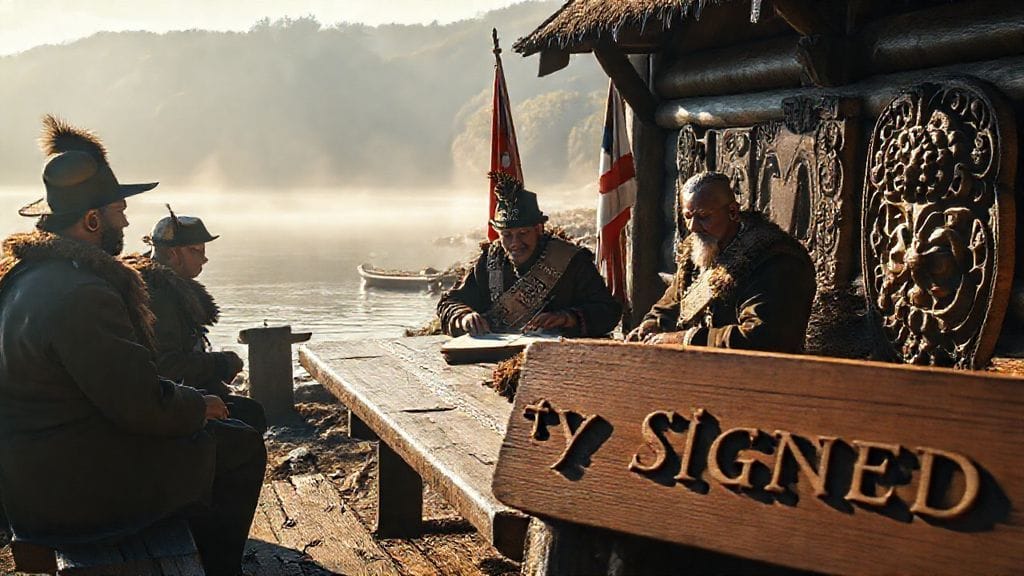
The signing ceremony fused British formal protocol with Māori tikanga. Chiefs signed with their marks beneath the Union Jack, while Hobson proclaimed British sovereignty. The exchange carried layers of symbolism: the flag, the ink-stained parchment, the mutual handshakes — all gestures of alliance but also submission.
Some chiefs expressed enthusiasm; others approached with guarded scepticism. Hone Heke, a prominent chief who would later famously oppose the Crown by cutting down the flagstaff, was among the signatories — his complex relationship with the treaty foreshadowed future strife.
11. Treaty Texts: The English and Māori Versions
The Treaty consisted of three articles:
- Cession of sovereignty to the British Crown (English version) / granting kawanatanga (Māori version).
- Guarantee of Māori full possession of lands, estates, forests, fisheries, and other properties.
- Extension of British rights and privileges to Māori, alongside promises of protection.
The divergence in wording and conceptual frameworks led to competing interpretations: for the Crown, the treaty legitimized colonization; for many Māori, it was a pact of shared governance and protection.
12. Immediate Reactions: Hope, Skepticism, and Confusion
Not all chiefs signed on that day, and those who did did so under varying degrees of understanding and pressure. While some saw opportunity in the alliance against other iwi and European threats, others feared loss of autonomy.
Among Pākehā settlers, reactions ranged from relief at formal British authority to concern over protections for Māori lands. Missionaries saw it as a triumph of peace and order, but some questioned whether the treaty’s promises could be enforced.
13. Beyond Waitangi: Spread of the Treaty Across the Islands
Once initial signatures were secured, copies of the treaty were taken on the wings of ships and horseback to other regions. The signing process stretched over months, with key chiefs in the South Island and interior regions adding their marks.
The reception varied widely. Some iwi embraced the treaty for its benefits; others resisted or remained suspicious. This uneven uptake revealed the complexities of uniting disparate groups under a common framework.
14. Early Conflicts and Compliance: Reality vs. Promise
The years following the treaty’s signing were fraught with challenges. Land disputes escalated as colonial authorities acquired Māori land in ways that contradicted treaty guarantees. The New Zealand Wars of the 1840s through 1870s, fought largely over land and sovereignty issues, underscored the breakdown of trust.
For Māori, the promised protection often failed to materialize; for settlers, expansion was imperative. The treaty’s ambiguity left space for exploitation, contested governance, and conflict.
15. The Treaty’s Legal Ambiguity: A Shadow over Sovereignty
For much of New Zealand’s early history, the Treaty of Waitangi was regarded as a “simple nullity” under law — a political agreement without enforceable authority. It was omitted from constitutional frameworks and largely ignored by courts.
This legal limbo sowed decades of injustices and grievances, as Māori claims to land and rights were overridden by British and later New Zealand governments’ interests.
16. Long-Term Consequences for Māori Land and Rights
Perhaps the most dramatic consequence of the treaty was the massive loss of Māori land. Through dubious purchases, confiscations, and legislative acts, Māori were dispossessed of an estimated 90% of their ancestral territories by the mid-20th century.
This land loss fractured social structures, undermined economic sustainability, and challenged cultural survival. Yet Māori resilience persisted through language retention, cultural revival, and political activism.
17. The Treaty as a Living Document: Revival and Recognition
The late 20th century witnessed a renaissance in Treaty recognition. The establishment of the Waitangi Tribunal in 1975, tasked with investigating breaches and recommending reparations, marked a turning point.
Treaty claims reshaped New Zealand’s constitutional landscape and public consciousness. The recognition of tino rangatiratanga as a core principle of partnership renewed efforts towards bicultural governance.
18. The Treaty in Modern New Zealand Identity
Today, the Treaty of Waitangi is central to New Zealand’s evolving identity. It is taught in schools, referenced in government policies, and invoked in debates on race relations and national unity.
Commemorations on February 6th provide a solemn moment of reflection and a platform for dialogue on reconciliation, equity, and shared futures.
19. Global Perspectives: Colonial Treaties and Indigenous Rights
Waitangi is not unique but part of a broader tapestry of indigenous treaties across the globe—from Canada’s Numbered Treaties to Australia’s ongoing struggles over native title.
Its story offers lessons on the limits of colonial agreements, the resilience of indigenous peoples, and the possibilities of negotiated coexistence in a postcolonial age.
20. Anniversary Commemorations: Reflection and Reconciliation
Each Waitangi Day is a striking blend of celebration and contestation. Official ceremonies honor partnership but are often accompanied by protests reminding the nation of unfulfilled promises.
The day invites citizens to confront historical wounds and imagine futures grounded in justice and respect.
21. Contested Memories: Historians, Politicians, and Activists
Interpretations of the treaty vary widely. Some historians emphasize betrayal and colonization; others highlight diplomacy and adaptation. Politicians use the treaty in debates over sovereignty and rights, while activists evoke it to demand reparations and cultural autonomy.
This contestation reflects the treaty’s complexity and its enduring emotional power.
22. Treaty Waitangi Today: Challenges and Opportunities
The journey towards honoring the treaty remains unfinished. Issues like land claims, education inequities, and political representation persist.
However, initiatives in co-governance, language revitalization, and shared stewardship offer hopeful signs of a renewed partnership.
23. Conclusion: The Ongoing Journey of Partnership and Justice
The Treaty of Waitangi was born of a moment charged with hope and contradiction. Its promise was partnership, its history marked by loss and resistance. As New Zealand moves forward, the treaty’s true significance lies not in a static document but in an active dialogue — between cultures, pasts, and futures.
This ongoing journey continues to define what it means to be a nation rooted in honor, respect, and shared destiny.
FAQs
Q1: Why was the Treaty of Waitangi signed in 1840?
The treaty was signed to establish British sovereignty over New Zealand, prevent French colonization, and regulate relations with Māori amid increasing European settlement and lawlessness.
Q2: Who were the main signatories of the treaty?
British representatives led by Captain William Hobson and around 40 Māori chiefs, mainly from the North Island’s Ngāpuhi iwi, participated in the initial signing.
Q3: What are the main differences between the English and Māori versions of the treaty?
The English version cedes full sovereignty to Britain; the Māori text uses “kawanatanga” (governance), implying a lesser degree. The Māori text guarantees “tino rangatiratanga” (chieftainship), preserving Māori authority over their lands.
Q4: What were the immediate impacts of the treaty on Māori?
While some Māori hoped for protection and stability, many experienced land loss, marginalization, and conflicts that soon followed as colonial authorities expanded control.
Q5: How is the treaty viewed in contemporary New Zealand?
It is regarded as the foundational document of the nation, a symbol of partnership and a framework for justice and reconciliation, though debates continue over its interpretation and application.
Q6: What is the Waitangi Tribunal?
Established in 1975, it is a commission that investigates claims by Māori relating to breaches of the treaty and recommends remedies to redress historical grievances.
Q7: How does the Treaty of Waitangi impact New Zealand’s legal system?
The treaty informs contemporary laws and policies, particularly regarding Māori rights, though its direct legal status has been historically ambiguous.
Q8: Why is Waitangi Day significant today?
Waitangi Day, February 6th, commemorates the treaty’s signing and serves as a day of national reflection, debate, and celebration of New Zealand’s bicultural heritage.