Table of Contents
- A Storm Brewing on the Danish Horizon: The Schleswig Crisis Reignited
- The Legacy of Schleswig-Holstein: A Region Poised Between Two Worlds
- Nationalism Ascendant: The Mid-19th Century European Maelstrom
- Copenhagen in Turmoil: The Political Climate of Early 1848
- Denmark’s Constitutional Aspirations and the Shadow of Absolutism
- The Spark in March: How the Schleswig Crisis Erupted Anew
- The Players on the Stage: Monarchs, Statesmen, and Revolutionaries
- The Mass Mobilization: From Protests to Paramilitary Formations
- The Role of the Danish National Assembly and its Divisions
- German Nationalism and the Wider German Confederation’s Response
- The Media’s Pulse: Newspapers, Pamphlets, and Public Opinion
- The Military Standoff: Deployment and Skirmishes at the Border
- The International Arena: European Powers Weigh In
- Popular Sentiment: Voices from Both Danish and German Communities
- The Constitutional Debates and the Clash of Loyalties
- The Aftershock: Immediate Political Repercussions in Denmark
- Economic Turbulence Amid Political Chaos
- Cultural Reflections: Literature and Art Respond to Crisis
- The Broader Impact: Schleswig-Holstein as a Prelude to German Unification
- Lessons Learned and the Road to the Second Schleswig War
- Conclusion: A Fractured Identity and a Divided Kingdom
- FAQs: Understanding the 1848 Schleswig Constitutional Crisis
- External Resource
- Internal Link
1. A Storm Brewing on the Danish Horizon: The Schleswig Crisis Reignited
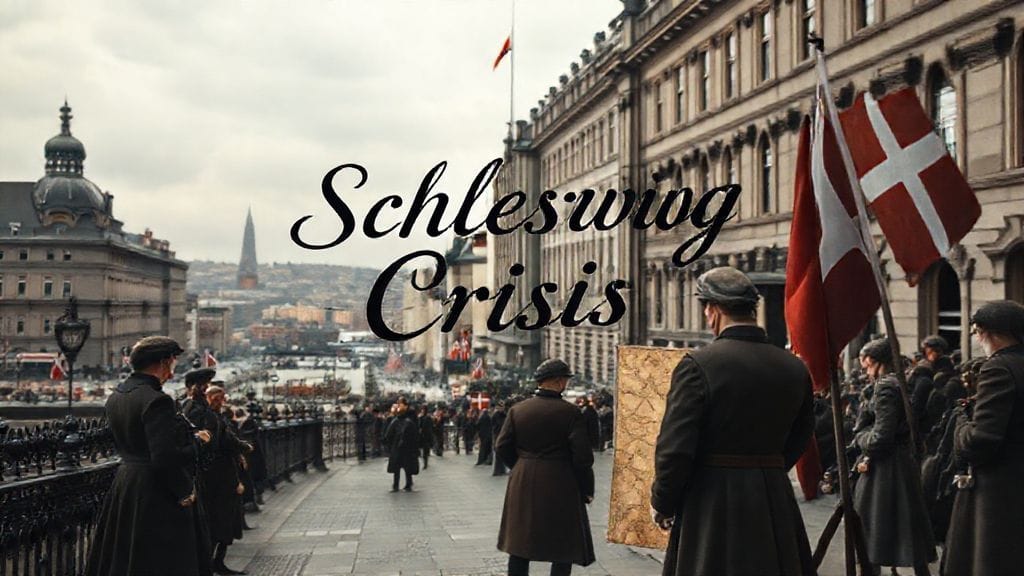
March 1848. The air in Copenhagen was thick with anticipation and unease. It was a time when the old order—marked by royal absolutism and fragile multinational empires—teetered on the brink of collapse throughout Europe. Denmark, a kingdom straddling cultures and nationalisms, stood at a crossroads. The question of Schleswig, that long-disputed duchy nestled between Denmark and the German confederation, rekindled a constitutional crisis that would test the very fabric of Danish identity and sovereignty.
From the cobblestones of Amalienborg Palace to the bustling cafes of the city’s Latin Quarter, whispers and shouting alike spoke of change—or upheaval. The aspirations for a modern constitutional state clashed violently with the aspirations of German-speaking Schleswig and Holstein, whose populations clamored for closer ties with Germany. This tension was more than political chess: it was the eruption of centuries-old grievances, stirred by the gases of 19th-century nationalism and liberalism.
2. The Legacy of Schleswig-Holstein: A Region Poised Between Two Worlds
Schleswig and Holstein have long defied simple categorization. Schleswig, largely Danish-speaking in the north and German-speaking in the south, was a Danish fiefdom under royal control. Holstein, on the other hand, was a member of the German Confederation with a predominantly German population. The duality of these duchies—caught between Danish and German sovereignties—turned them into a tinderbox.
Throughout the 18th and early 19th centuries, treaties and dynastic inheritance had created a convoluted sovereignty. The Danish crown ruled Schleswig but held Holstein in a more federal German context. Nationalism—an emergent and potent force in 1848—would exploit these ambiguities mercilessly.
3. Nationalism Ascendant: The Mid-19th Century European Maelstrom
Across Europe, March 1848 was a month of revolutions and revolts. From Paris to Vienna, the old regimes found themselves besieged by demands for liberal constitutions, national self-determination, and political reforms. Denmark was no exception. The Danish nation confronted not just constitutional pressures internally, but also the seething nationalism of the German Confederation.
King Frederick VII was urged by liberals to embrace constitutional monarchy, promising parliamentary reforms and civil liberties. Yet, the situation in Schleswig-Holstein complicated matters. Any reaffirmation of Danish control risked igniting conflict with German nationalists, while concessions could fracture Denmark's territorial integrity.
4. Copenhagen in Turmoil: The Political Climate of Early 1848
The capital was awash with political agitation. Students, intellectuals, and members of the burgher class demanded a constitution that would limit monarchical power and grant broad political freedoms. News of revolutions elsewhere in Europe emboldened the opposition.
Meanwhile, the Schleswig-Holstein question remained the omnipresent elephant in Denmark’s political parlor. How to reconcile Danish nationalist aspirations with the multi-ethnic reality of the duchies? Debates in public chambers and coffeehouses alike oscillated between demands for hardline Danish sovereignty and calls for negotiations with Schleswig-Holstein’s German-speaking citizens.
5. Denmark’s Constitutional Aspirations and the Shadow of Absolutism
King Frederick VII, newly ascended and relatively inexperienced, found himself caught between conservative advisors clinging to absolutism and liberal politicians demanding constitutional change. His reign would soon mark the transition from absolute monarchy to constitutional monarchy, but the Schleswig crisis delayed this historic transformation.
Legal ambiguities over the status of Schleswig—and whether it was an integral part of the Kingdom of Denmark or a semi-autonomous entity—added layers of complexity to constitutional reform efforts. Every step forward was hampered by the threat of German irredentism supported by nationalist paramilitary groups.
6. The Spark in March: How the Schleswig Crisis Erupted Anew
The immediate trigger for the crisis in March 1848 was rooted in the refusal of the Danish government to recognize a proposed constitution for Schleswig that would grant it autonomy while binding it more closely with Denmark. German activists in Schleswig and Holstein, inspired by the revolutionary fervor sweeping Europe, declared their intention to establish their duchies as sovereign entities under the German Confederation.
On March 21, 1848, violent clashes erupted in Kiel and Flensburg—major urban centers in Schleswig-Holstein—as German nationalists mobilized against Danish authorities. These confrontations spread southwards, igniting fears in Copenhagen of an imminent rebellion.
7. The Players on the Stage: Monarchs, Statesmen, and Revolutionaries
Key figures shaped this drama. King Frederick VII, sometimes perceived as hesitant, wielded the royal prerogative with caution. On the Danish side, statesmen such as Orla Lehmann, a vocal nationalist and constitutionalist, championed Danish sovereignty over Schleswig but struggled to navigate the complex ethnic realities.
Opposite them stood the German-speaking elites of Holstein and Schleswig, some tacitly supported by Prussia and Austria. Individuals like Johann Friedrich Krüger played pivotal roles in mobilizing local German nationalists, framing the conflict in the language of liberation and unity.
8. The Mass Mobilization: From Protests to Paramilitary Formations
The constitutional dispute soon escalated into military mobilization. Local militias formed on both sides, and volunteer corps pledged allegiance either to Denmark or to the German Confederation. The streets of Flensburg and Copenhagen alike witnessed rallies where flags bearing red-and-white crossed swords clashed with black-red-gold banners symbolizing German nationalism.
This was no longer a simple political disagreement; it was edging towards civil war.
9. The Role of the Danish National Assembly and its Divisions
Within the Danish political structure, the National Assembly was fragmented. Liberals pushed for swift constitutional reform and firm control over Schleswig, while more conservative elements urged prudence, fearing a wider German invasion.
The assembly’s debates became battlegrounds of rhetoric, identity, and strategy. Some proposed integrating Schleswig fully into Denmark, others suggested a federated solution. The path forward was nebulous, muddied by the passions of nationalism and the pragmatism required by sovereign governance.
10. German Nationalism and the Wider German Confederation’s Response
The German Confederation, especially Prussia and Austria, watched the Danish turmoil with strategic interest. Though initially cautious, Prussian sympathies increasingly leaned towards supporting German compatriots in Schleswig-Holstein, framing the conflict as a fight against Danish oppression.
The 1848 revolutions in Germany had unleashed powerful currents: calls for Greater Germany, a unified German nation encompassing all German-speaking lands—including Schleswig and Holstein—threatened to redraw the borders.
11. The Media’s Pulse: Newspapers, Pamphlets, and Public Opinion
The press played an outsized role in fanning tensions. The Danish newspaper Fædrelandet fiercely advocated for Danish sovereignty, while German-language papers across Schleswig-Holstein echoed nationalist demands for unification.
Pamphlets and political caricatures circulated widely, inflaming popular passions and simplifying complex realities into slogans and symbols. The burgeoning print culture transformed the conflict into a war of words as potent as any on the battlefield.
12. The Military Standoff: Deployment and Skirmishes at the Border
By late March and early April, both Denmark and the German states deployed troops to the Danish-German border. Skirmishes flared, most notably around Mysunde and Sonderburg, where control of strategic passes and ports was contested.
Though no full-scale war erupted immediately, these clashes set the stage for the more brutal Second Schleswig War that would follow two years later. Both sides tested each other’s resolve—and the limits of European diplomacy.
13. The International Arena: European Powers Weigh In
Europe’s great powers—Britain, France, Russia—watched nervously. The Concert of Europe, designed to preserve stability after the Napoleonic Wars, was fraying fast. Yet none wished to see an all-out war in the strategically vital Baltic region.
Britain, especially, favored maintaining Danish control over Schleswig as a buffer against Prussian expansionism. France, embroiled in its own 1848 upheavals, took a more distant stance but saw in Denmark a potential ally against German ambitions.
14. Popular Sentiment: Voices from Both Danish and German Communities
Letters recovered from ordinary citizens reveal a patchwork of loyalties and fears. Danish farmers in northern Schleswig feared losing their cultural heritage, while German townsfolk in the south felt increasingly alienated.
One Flensburg merchant wrote, “We speak German, we feel German, yet the crown in Copenhagen rules over us—a crown that seems blind to our cries.” Conversely, a Danish soldier stationed near the border confided, “We fight not just for land, but for the soul of Denmark itself.”
15. The Constitutional Debates and the Clash of Loyalties
As armed tension grew, so did debates over the nature of the Danish constitution. Could a unified Denmark include ethnically and linguistically diverse territories? Would Schleswig enjoy autonomy, or be subsumed entirely into a Danish nation-state?
Compounding this was the emotional loyalty many Danes felt to Schleswig as part of their historical realm, counterbalanced by German claims framed in the modern language of national self-determination.
16. The Aftershock: Immediate Political Repercussions in Denmark
By summer 1848, the constitutional crisis forced the Danish government to delay reforms and focus on security. The King reluctantly accepted some demands for parliamentary government, but at a pace dictated by military necessity.
The stalemate deepened political divisions within Denmark, sowing seeds of discord that would resurface dramatically in the coming years.
17. Economic Turbulence Amid Political Chaos
Trade disruptions along the Jutland Peninsula and maritime blockades around the Baltic exacerbated economic hardships. Schleswig’s border towns, dependent on commerce, suffered unemployment and shortages.
The Danish crown attempted to stabilize the economy through reforms and loans, but the financial strain heightened public anxiety and mistrust.
18. Cultural Reflections: Literature and Art Respond to Crisis
Amid the crisis, Danish writers and painters grappled with national identity. Romantic nationalism flourished; poets like Adam Oehlenschläger evoked images of a united Denmark encompassing Schleswig.
Meanwhile, German authors in the duchies documented their community’s struggles for autonomy, blending myth with political sentiment in impassioned prose.
19. The Broader Impact: Schleswig-Holstein as a Prelude to German Unification
The crisis foreshadowed the larger processes that would reshape Europe: the push for nation-states based on language and ethnicity. For Germany, Schleswig-Holstein became a symbol of contested territories whose eventual incorporation would mark milestones on the path to unification under Prussian leadership.
For Denmark, it was a painful reminder of the limits imposed by geography and great power politics.
20. Lessons Learned and the Road to the Second Schleswig War
Though the 1848 conflict subsided without immediate full-scale war, it left unresolved tensions simmering. The fragile balance collapsed in 1864, leading to the devastating Second Schleswig War, where Danish forces were overwhelmed by Prussian and Austrian armies.
The constitutional crisis of 1848 thus stands as a critical prelude—a painful testing ground for nationalism, diplomacy, and constitutional reform.
Conclusion
The Schleswig Constitutional Crisis of March 1848 was more than a regional dispute: it was a profound struggle over identity, sovereignty, and the meaning of nationhood in an age of revolutionary change. Set against the backdrop of a transforming Europe, it exposed the fault lines between ethnic communities, the challenges of constitutional reform, and the fragility of dynastic empires. For Denmark and the German Confederation alike, Schleswig symbolized dreams deferred and animosities inflamed—lessons that echo through history.
As we revisit these events today, the human dimension stands out: hopes for self-determination, fears of cultural erasure, and the raw power of political ideals enacted on the lives of ordinary men and women. The crisis beckons us to reflect on the complexities of national belonging and the often painful journey toward modern statehood.
FAQs
Q1: What triggered the Schleswig Constitutional Crisis in March 1848?
A1: The refusal of the Danish government to accept Schleswig's demand for a constitution granting autonomy, combined with the rise of German nationalist movements in Schleswig and Holstein, sparked violent clashes in March 1848.
Q2: Why was Schleswig-Holstein such a contested region?
A2: Its mixed Danish and German-speaking populations, complex legal status, and strategic location made it a focal point for competing Danish and German nationalisms, especially during the age of increasing nation-state formation.
Q3: Who were the key political figures during the crisis?
A3: King Frederick VII of Denmark, constitutionalist Orla Lehmann, and German nationalist leaders like Johann Friedrich Krüger were central figures shaping the conflict and its political discourse.
Q4: How did the European powers react to the crisis?
A4: While Britain and France favored maintaining the status quo to prevent Prussian expansion, the German Confederation, especially Prussia and Austria, supported the German nationalists, seeing Schleswig-Holstein as part of a greater German nation.
Q5: Did the crisis lead to immediate war?
A5: No full-scale war erupted immediately, but skirmishes and military mobilization foreshadowed the Second Schleswig War in 1864.
Q6: What was the impact of the crisis on Danish constitutional development?
A6: The crisis delayed the transition to constitutional monarchy but also forced political concessions towards parliamentary governance under King Frederick VII.
Q7: How did the crisis affect ordinary people in Schleswig-Holstein?
A7: Local populations were divided in loyalty, suffered economic hardships, and experienced rising tensions in everyday life, caught between clashing national aspirations.
Q8: Why is this event significant in European history?
A8: It exemplified the turbulent intersection of nationalism, constitutionalism, and imperial politics during the revolutionary wave of 1848, foreshadowing larger conflicts and the nation-state formation of Germany and Denmark.