Table of Contents
- A Frail Peace Along the Seine: The Signing of the Treaty of Paris, 1856
- The Crimean War’s Grim Prelude: From the Black Sea to the Siege of Sevastopol
- Clash of Empires: The Great Powers on a Collision Course
- The Ottoman Empire’s Struggle for Survival
- Religious Sparks and Diplomatic Flashpoints: The Road to War
- Britain and France: Champions of Balance or Agents of Ambition?
- Russia’s Imperial Dreams and Strategic Vulnerabilities
- War on the Shores of the Black Sea: Battles, Blockades, and Hardship
- The Siege of Sevastopol: Heroism and Horror in the Crimean Peninsula
- Technological and Tactical Innovations of the Crimean War
- The Role of Media and Public Opinion: Florence Nightingale and the War Correspondents
- Exhaustion and Diplomacy: Towards a Negotiated End
- The Congress of Paris: Negotiating Peace Amongst Old Rivals
- Key Provisions of the Treaty of Paris: Reshaping Europe’s Balance of Power
- The Neutralization of the Black Sea: A New Strategic Order
- The Ottoman Empire’s Sovereignty and European Guarantees
- Russia’s Concessions and the Limits of Imperial Power
- Immediate Repercussions: Reactions Across Europe and Beyond
- The Treaty’s Legacy in International Law and Diplomacy
- How the Treaty Set the Stage for Future Conflicts
- Remembering the Crimean War: Memory, Monuments, and Literature
- Conclusion: The Fragile Peace that Redrew the Map of Europe
- FAQs: Understanding the Treaty of Paris and the Crimean War
- External Resource
- Internal Link
A Frail Peace Along the Seine: The Signing of the Treaty of Paris, 1856
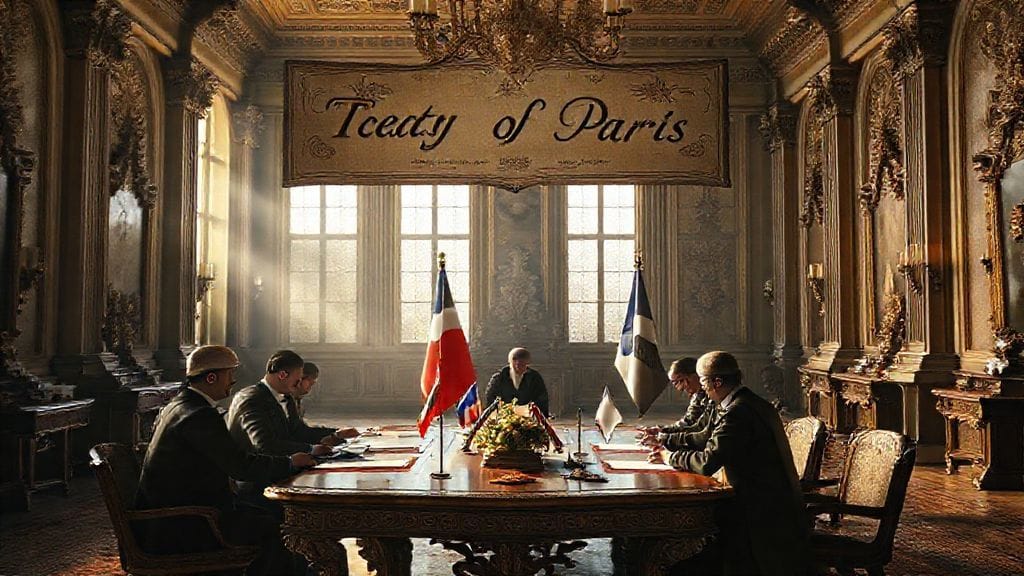
On a bright but somber March day in 1856, beneath the grandeur of Parisian skies, envoys from Europe’s great powers converged in a stately hall lined with crimson curtains and glittering chandeliers. Their task was daunting: to conclude a devastating conflict that had wrought bloodshed and upheaval across the Black Sea region—the Crimean War. As the ink dried on the Treaty of Paris, a tentative peace was born, fragile as the spring breeze that stirred the city’s treetops outside. The atmosphere was one of relief tinged with uncertainty—a recognition that while war had ended, the fragile balance of power was far from secured.
The Crimean War (1853-1856), a conflict that pitted Russia against an alliance of the Ottoman Empire, Britain, France, and Sardinia, was born from a tangled web of geopolitical ambitions, religious tensions, and the slow demise of the Ottoman Empire. This war was not merely about territorial control but about the soul and future of Europe’s order. The signing of the Treaty of Paris was not a triumphant conclusion but a complex moment of reluctant compromise—a peace that promised stability, yet foreshadowed the entangled alliances and rivalries that would culminate in later continental upheavals.
The Crimean War’s Grim Prelude: From the Black Sea to the Siege of Sevastopol
The origins of the Crimean War trace back to long-standing tensions in Eastern Europe and the Near East. The Ottoman Empire, known as “the sick man of Europe,” had been steadily losing ground to expanding Russian ambitions. Russia’s quest to gain a warm-water port, secure influence over the declining Ottoman territories, and protect Orthodox Christians in the Holy Land inflamed diplomatic tensions. When disputes over the rights of Christian minorities in Ottoman domains escalated, all parties found themselves on a path toward war.
The war itself unfolded across harsh landscapes—snow-covered steppes, rugged peninsulas, and storm-lashed seas—each battlefield marked by grueling sieges and attrition. The protracted and brutal Siege of Sevastopol—a symbol of Russian naval power—came to epitomize the war’s human cost. Soldiers suffered not only from enemy fire but from disease, poor logistics, and unforgiving weather. The war shocked Europe with its staggering casualties and the inadequacies of military methods.
Clash of Empires: The Great Powers on a Collision Course
The Crimean conflict was never simply a regional dispute; it was a powder keg in European diplomacy. Britain and France entered the war not only to check Russian expansionism but to defend the Ottoman Empire as a bulwark against destabilization that might upset the continental status quo. Sardinia, seeking to elevate its position in Italy’s complex political landscape, joined the Coalition as well.
Russia, under Tsar Nicholas I, harbored expansive visions—securing the Danube delta, dominating the Balkans, and forcing open the Bosporus straits for naval passage. The contest was as much ideological as territorial: autocratic Russia versus constitutional Western powers, with the Ottoman Empire’s sovereignty caught between.
The Ottoman Empire’s Struggle for Survival
The Ottoman Empire was the reluctant battlefield and one of the war’s most dramatic protagonists. Its rulers grappled with internal decay, military weaknesses, and the dilemma of relying on European powers for survival while striving to maintain sovereignty. The sultans’ appeal to France and Britain against Russian encroachments was a desperate gambit that underscored the Empire’s fragile position.
Yet, the conflict would revitalize Ottoman military reforms and expose the empire’s critical place in European geopolitics. The Empire’s survival was linked not just to its own destiny but to the complex web of alliances and rivalries imposed by the European states.
Religious Sparks and Diplomatic Flashpoints: The Road to War
At the heart of the diplomatic storm were questions about religious authority and prestige. Russia portrayed itself as protector of Orthodox Christians in the Ottoman Empire, while France championed the rights of Catholics in the region. The conflict over control of holy places in Jerusalem and Bethlehem, though seemingly minor, ignited passions and hardened diplomatic positions.
Diplomatic negotiations faltered as mutual mistrust grew, with Russia interpreting Western support for the Ottomans as hostility. These religious pretexts obscured deeper territorial and power-driven ambitions, making compromise elusive.
Britain and France: Champions of Balance or Agents of Ambition?
Britain and France joined the war ostensibly to uphold the Ottoman Empire and maintain Europe’s balance of power. Yet beneath the surface, their interests were manifold. Britain feared Russian dominance over the eastern Mediterranean would threaten its routes to India; France sought to reassert its influence after past setbacks.
The war became a test of allied coordination and military capability, highlighting differences in strategy and national priorities. The partnership was one of uneasy necessity rather than wholehearted unity.
Russia’s Imperial Dreams and Strategic Vulnerabilities
Russia’s drive into the Crimean peninsula was as much about prestige as strategic gain. The Tsar’s vision for southern expansion aimed at creating a protectorate over Orthodox peoples and opening naval routes. However, Russia’s logistical challenges, military deficiencies, and the vast distances to be defended rendered its ambitions precarious.
The Crimean War exposed Russia’s need for modernization and foreshadowed internal unrest that would later shake the empire.
War on the Shores of the Black Sea: Battles, Blockades, and Hardship
The combat was fierce, taking place mostly on the Crimean Peninsula. Naval battles, such as the bombardment of Sevastopol, and land engagements like the Battle of Balaclava—famous for the ill-fated Charge of the Light Brigade—became part of military lore.
The conditions for soldiers were brutal. Disease claimed more lives than bullets; the encampments were rife with unsanitary conditions that compounded the military setbacks. The Black Sea itself became a strategic theater, blockaded and contested fiercely.
The Siege of Sevastopol: Heroism and Horror in the Crimean Peninsula
Sevastopol was the war’s pivotal siege. Russian forces, dug in behind fortifications, resisted for eleven long months. Allied forces endured relentless artillery bombardments and counterattacks, witnessing a war of attrition unlike any seen in Europe for decades.
Stories of individual courage and suffering emerged—wounded soldiers, medics like Florence Nightingale who revolutionized battlefield medical care, and the relentless spirit of both attackers and defenders. The siege drained resources and morale on both sides but ultimately fell to the allied forces, marking a turning point.
Technological and Tactical Innovations of the Crimean War
The Crimean War was a crucible of military innovation. It saw the use of railways and telegraphs for the first time in large-scale war, enabling faster movement of troops and more efficient communication.
Weaponry evolved with the introduction of rifled muskets and explosive shells, changing battlefield dynamics. The war also exposed the need for improved logistics and medical care, setting precedents for future conflicts.
The Role of Media and Public Opinion: Florence Nightingale and the War Correspondents
Perhaps nowhere was the modern dimension of this war more visible than in the media. For the first time, war correspondents sent vivid reports and sketches back to European newspapers, bringing the grim realities of conflict to the public eye.
Florence Nightingale emerged as a figure of compassion and reform, transforming nursing and inspiring humanitarian responses. Public opinion began to shape political decisions, marking an early intersection of war and the press.
Exhaustion and Diplomacy: Towards a Negotiated End
After nearly three years of exhaustion and stalemate, all parties recognized the futility of further bloodshed. The rising costs, military setbacks, and diplomatic pressures pushed Europe toward negotiation.
The Congress of Paris convened amidst fragile hopes of peace, where war-weary diplomats sought to stitch together agreements that would prevent future violent eruptions.
The Congress of Paris: Negotiating Peace Amongst Old Rivals
The assembly brought together representatives from Russia, the Ottoman Empire, Britain, France, Austria, Prussia, and Sardinia. The talks were protracted and difficult, marked by mistrust but pressed by a shared desire to restore order.
The negotiation reflected competing priorities: Russia sought to retain influence; Britain and France aimed at curbing it; the Ottomans desired guarantees for sovereignty. The resulting treaty was a delicate compromise.
Key Provisions of the Treaty of Paris: Reshaping Europe’s Balance of Power
The Treaty of Paris, signed March 30, 1856, contained significant terms: the Black Sea was neutralized and closed to military naval forces, drastically limiting Russia's power in the region. The Danube River was placed under international control, and the Ottoman Empire’s territorial integrity was guaranteed by the signatories.
The treaty also addressed religious freedoms and minority protections in Ottoman domains, though enforcement remained complex. Importantly, the treaty marked a temporary check on Russian ambitions but at the expense of sowing future distrust.
The Neutralization of the Black Sea: A New Strategic Order
Perhaps the treaty’s most consequential provision was the neutralization and demilitarization of the Black Sea. This clause prevented any warships from Russia or the Ottoman Empire entering the waters, effectively limiting their naval power.
This strategic shift redefined the balance in Eastern Europe and the Near East, constraining Russian influence and protecting British and French interests.
The Ottoman Empire’s Sovereignty and European Guarantees
The European powers’ guarantee of the Ottoman Empire’s territorial integrity was both a political shield and a source of tension. The balance imposed was precarious, as the Empire's internal weaknesses persisted.
The treaty underscored the role of "Great Power protection," which paradoxically exposed Ottoman dependency while delaying the Empire’s inevitable decline.
Russia’s Concessions and the Limits of Imperial Power
For Russia, the treaty was a bitter pill. The loss of influence in the Black Sea and curbing of naval capabilities was a humiliating setback. Yet, the Tsarist regime emerged intact, though forced to reckon with its military and administrative deficiencies.
The treaty exposed the limits of autocratic expansion and stimulated future reforms under Alexander II, including emancipation of the serfs and modernization efforts.
Immediate Repercussions: Reactions Across Europe and Beyond
Reactions to the treaty varied widely. Britain and France hailed it as a diplomatic victory that preserved peace and curbed Russian aggression. Russia’s internal response was anger and resolve to rebuild.
The Ottoman Empire, while preserved on paper, remained a fragile actor. Other powers, such as Austria and Prussia, adjusted their policies in the new order. Across the globe, the treaty was a reminder of the fragile and often cynical nature of international diplomacy.
The Treaty’s Legacy in International Law and Diplomacy
The Treaty of Paris laid groundwork for principles of international law, including guarantees of sovereignty and rules governing neutral waters. It marked an early example of multilateral diplomacy to resolve conflict.
Yet, its temporary nature and inability to resolve underlying tensions revealed the limitations of treaties as instruments of lasting peace.
How the Treaty Set the Stage for Future Conflicts
Though it ended the Crimean War, the treaty failed to solve the "Eastern Question" — the fate of the Ottoman Empire — which remained a simmering issue. Nationalist movements, great power rivalries, and shifting alliances would lead directly to later upheavals, including the Franco-Prussian War and World War I.
In many ways, the Treaty of Paris was a pause in a long, fraught century of contestation.
Remembering the Crimean War: Memory, Monuments, and Literature
The Crimean War left a deep cultural imprint. Memorials such as the Crimean War Memorial in London and accounts by war correspondents fixed the conflict in public memory.
Literary figures like Leo Tolstoy and Charles Dickens engaged with the war’s themes, while contemporary medicine and military studies transformed because of it. The war’s memory remains a testament to human suffering and the cost of imperial ambition.
Conclusion
The Treaty of Paris in 1856 did more than end a brutal and costly war; it reshaped Europe’s order in profound ways, imposing a frail peace that balanced ambition with compromise. It revealed the complexities of international diplomacy, where empires clashed yet leaders sought to maintain a fragile equilibrium. The treaty codified a new strategic geography but left deep undercurrents of tension unresolved. As history would show, peace won by ink on parchment is only as solid as the forces that uphold it.
Yet, the Crimean War and its conclusion also marked a turning point. It exposed the limits of imperial might, the price of modern warfare, and the new role of public opinion and media in shaping conflict. Its legacy resonates today in the patterns of diplomacy, the quest for balance of power, and the human stories that remind us of war’s profound cost.
The Treaty of Paris stands as a solemn chapter in the story of Europe’s tangled destinies—a reminder of both the promise and perils of peace forged amidst the embers of war.
FAQs
Q1: What triggered the Crimean War and led to the Treaty of Paris?
The war was triggered by disputes over the rights of Christian minorities in Ottoman lands and Russia’s desire to expand influence in the Balkans and access warm-water ports. This escalated tensions between Russia and the Ottoman Empire, bringing Britain and France into the conflict to preserve the European balance of power.
Q2: Which major powers were involved in the Crimean War?
The main combatants were Russia on one side and an alliance of the Ottoman Empire, Britain, France, and later Sardinia on the other.
Q3: What were the key outcomes of the Treaty of Paris (1856)?
The treaty neutralized the Black Sea, closed it to military fleets, guaranteed the Ottoman Empire’s territorial integrity, placed the Danube under international control, and made provisions for religious freedoms within Ottoman domains.
Q4: How did the treaty impact Russia’s position in Europe?
Russia’s naval power in the Black Sea was curtailed, marking a diplomatic defeat and forcing Russia to pursue internal reforms. However, it remained a European great power despite the setback.
Q5: What role did Florence Nightingale and the media play during the Crimean War?
Florence Nightingale revolutionized battlefield nursing, improving soldiers’ survival rates. War correspondents brought vivid reports to European publics, creating one of the first instances of mass media shaping public opinion on warfare.
Q6: Why is the Treaty of Paris considered only a temporary peace?
Though it ended the immediate conflict, it failed to resolve the broader "Eastern Question" about the Ottoman Empire’s fate, leaving tensions that contributed to future conflicts in Europe.
Q7: How is the Crimean War remembered today?
It is remembered through monuments, literature, and historical studies that highlight its human cost, military innovations, and diplomatic significance.
Q8: Did the treaty influence later international law?
Yes, it helped establish principles regarding sovereignty, neutral waters, and multilateral diplomacy that influenced future international treaties.