Table of Contents
- The Calm Before the Storm: Guangzhou in the Mid-19th Century
- The Arrow Incident Unfolds: A Spark in the Powder Keg
- British Presence in Guangzhou: Power, Trade, and Tension
- The Arrest and Boarding of the Arrow: Clash of Jurisdictions
- Chinese Authorities React: The Imperial Mandate and local power
- The Diplomatic Fallout: From Dispute to Diplomatic Crisis
- Sir John Bowring and British Strategy: Calculated Provocation
- Local Chinese Resistance and Rising National Sentiment
- The Outbreak of Hostilities: Guns, Bombardments, and Urban Chaos
- The Broader Context: The Second Opium War’s Prelude
- The British Naval Response: Modern Firepower in Action
- Negotiations and Reprisals: The Battle for Honor and Face
- Impact on Canton’s Citizens: Human Cost amid the Warfront
- The Arrow Incident’s Role in the Retaliation and Treaty Demands
- Western Imperialism vs. Qing Sovereignty: Clash of Worlds
- The Legacy of the Arrow Incident in Sino-British Relations
- How the Incident Reshaped International Law and Extraterritoriality
- Historical Misinterpretations and National Myths Around the Event
- The Incident in Cultural Memory: From Propaganda to Literature
- Conclusion: The Arrow Incident as a Turning Point in Chinese Modern History
- FAQs: Unpacking the Arrow Incident and Its Consequences
- External Resource
- Internal Link
The sun dipped low over the bustling docks of Guangzhou on October 8, 1856, casting long shadows over the wooden hulls of trading vessels moored at the Pearl River’s edge. The chants of dockworkers fused with the sharp cries of merchants and customs officials, all wrapped in a humid, restless southern China autumn air. Then came the arrest of a seemingly inconspicuous Chinese-owned ship, the Arrow, flying a British flag—a small spark destined to ignite an inferno of conflict that would plunge a great empire and a proud nation into another devastating clash: the Second Opium War.
The Calm Before the Storm: Guangzhou in the Mid-19th Century
Guangzhou—or Canton, as the West knew it—was the throbbing artery of China’s international trade. By mid-century, its docks overflowed with tea, silk, and porcelain destined for Europe and America. Foreign powers clamored for control over lucrative trade routes, but beneath this economic vibrancy brewed a complex stew of friction. The British Empire, fresh from the humiliation of the First Opium War (1839–1842), maintained a growing foothold in China through the Treaty of Nanking but remained hungry for broader privileges.
The Qing dynasty, weak and plagued by internal rebellions, guarded its sovereignty fiercely yet clumsily. Guangzhou was a steaming melting pot of cultures and tensions—foreign merchants navigating murky waters of Chinese law, Chinese officials trying to assert their authority under the watchful, often provocative eyes of Western powers. An uneasy peace prevailed, but it was fragile.
The Arrow Incident Unfolds: A Spark in the Powder Keg
At the heart of the coming storm was a Chinese-owned lorcha, the Arrow, operating under a contentious British license. Its ownership was murky, but the flag it flew was clear, a symbol of British protection and imperial prerogative. On the night of October 8, 1856, Chinese authorities boarded the Arrow docked in Guangzhou, accusing its crew of piracy and smuggling—serious crimes under Qing law—and arrested 12 men.
From the British perspective, the boarding was a violation of their extraterritorial rights guaranteed by treaty—thus an insult and a challenge. The captain and crew had already been released by Chinese officials, but the act of boarding under the British flag provoked fury among British consular officials and naval commanders. They claimed Chinese authorities had no right to interfere with a ship flying the Union Jack, sparking a diplomatic firestorm.
British Presence in Guangzhou: Power, Trade, and Tension
British imperial ambitions had transformed this southern port into a focal point of strategic power. The Treaty of Nanking had opened five treaty ports and ceded Hong Kong to Britain. Foreign traders dominated lucrative commerce, yet struggled constantly with Chinese local authorities seeking to enforce domestic law on imperial soil.
British residents saw the Arrow incident as emblematic of China’s refusal to honor their extraterritorial rights, which was, in their eyes, essential for the rule of law protecting foreigners. From Canton’s perspective, allowing a Chinese vessel’s crew to smuggle and pirate with impunity under a foreign flag was an egregious humiliation, a breach of sovereignty that risked undermining domestic order.
The Arrest and Boarding of the Arrow: Clash of Jurisdictions
This incident was more than a mere legal spat. It was a clash of fundamentally different worldviews about sovereignty, law, and power. The Qing officials had clear orders to maintain control over piracy—a scourge in waters surrounding Guangdong—and they acted accordingly despite knowing the risks of offending British authorities.
When the Arrow’s crew was seized, the British demanded their immediate release and restoration of their rights, interpreting the act as a direct challenge to their treaty privileges. The Chinese side, though releasing the crew eventually, refused to apologize or admit wrongdoing. Diplomatic tension ratcheted up, with military posturing on both sides.
Chinese Authorities React: The Imperial Mandate and Local Power
In Beijing, messages arrived that the situation in Guangdong was delicate but non-negotiable. The imperial court was beset by internal strife—Taiping rebels swept across southern China, draining Qing resources. Yet surrendering to foreign demands would erode the Mandate of Heaven and Qing dignity.
Local Guangdong officials found themselves caught between obeying imperial directives and dealing with aggressive British diplomats. Their decision to board the Arrow reflected a determination to uphold internal law and order. But uncertainties and conflicting signals from the Qing court complicated their stance.
The Diplomatic Fallout: From Dispute to Diplomatic Crisis
British envoy Harry Parkes and the consulate reacted swiftly, demanding reparations and the right to execute justice within China’s borders. Tensions escalated quickly, the rhetoric more bellicose. British naval commanders positioned warships in the Pearl River, prepared to strike.
British public opinion, inflamed by newspapers depicting Chinese intransigence, called for decisive action. Pressure mounted on London’s government to respond aggressively, seeing this as both a test of British honor and a means to enforce imperial treaty rights.
Sir John Bowring and British Strategy: Calculated Provocation
Sir John Bowring, governor of Hong Kong and a key British strategist, favored a strong military response. He believed peaceful negotiations were futile given Chinese intransigence and that force would open deeper concessions. Bowring’s vision fed directly into the imperialist mindset driving Britain’s expanding role in Asia.
The Arrow incident became the casus belli for a second punitive expedition, a harsh lesson intended to coerce China into further liberalization of trade and legal privileges for foreigners.
Local Chinese Resistance and Rising National Sentiment
Despite government weakness, Chinese merchants, fishermen, and common folk viewed British provocations with deep hostility. Guangzhou itself was a hotbed of anti-foreign sentiment, fed by memories of previous foreign incursions and cultural resistance to humiliations.
Patriotic volunteers and local militias began organizing around Qing banners, unwilling to cede any further ground to the British elephant in the room. This rising tide of nationalism found symbolic fuel in the Arrow incident.
The Outbreak of Hostilities: Guns, Bombardments, and Urban Chaos
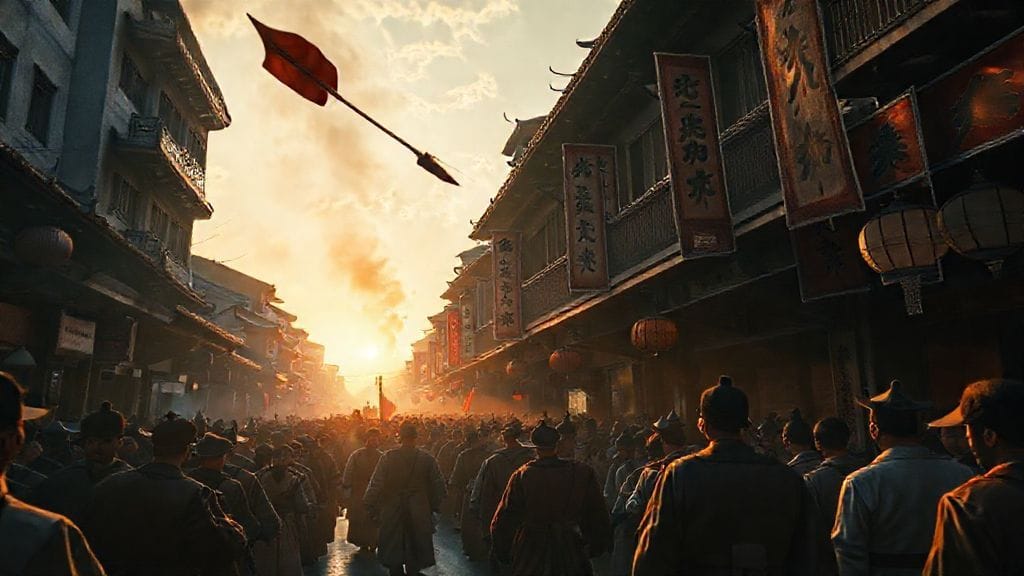
By late 1856, negotiations had failed and warships firing cannon on shore batteries signaled the official outbreak of hostilities. British forces bombarded city walls, destroying fortifications and spurring chaotic evacuations and violent street clashes within Guangzhou.
The war was swift and brutal. Modern British ironclad ships and artillery clashed with Qing forts and river defenses. In the city, civilians suffered from shortages, fire, and displacement as hostilities raged.
The Broader Context: The Second Opium War’s Prelude
The Arrow incident laid bare the unresolved conflicts left by the First Opium War: unequal treaties, extraterritoriality, and opium smuggling. But it also reflected new dimensions—greater British military power, Qing internal decline, and global imperial expansion.
The Arrow incident became the opening gambit of the Second Opium War (1856–1860), a conflict which would end with further humiliations for China—treaty ports expanded, the capital looted, and Western powers gaining unprecedented sway.
The British Naval Response: Modern Firepower in Action
British naval dominance was decisive: their ships’ steam engines and rifled cannons outmatched Qing wooden war junks and outdated forts. The Pearl River was militarized as British gunboats patrolled relentlessly, asserting dominance over southern Chinese waters.
This technological supremacy underscored the asymmetry of power—China was fighting with archaic weapons and fractured command, while Britain wielded empire-backed discipline and firepower.
Negotiations and Reprisals: The Battle for Honor and Face
Throughout 1857, diplomatic wrangling blurred with forced treaties and military campaigns. Qing officials sought to preserve honor and sovereignty but under immense pressure from British advances and French involvement.
Reprisals intensified after the Arrow incident, as Britain justified expanding attacks inland and demanding sweeping treaty revisions, including legalized opium trade and open inland commerce.
Impact on Canton’s Citizens: Human Cost amid the Warfront
Amid this imperial chess game, ordinary people bore the brunt. Canton’s markets emptied, food prices soared, homes destroyed. Refugees fled the shelling; disease and starvation followed. Tales from survivors paint a grim portrait of daily struggle amidst foreign guns and domestic collapse.
The Arrow incident thus was far more than a diplomatic quarrel—it precipitated human suffering with echoes for generations.
The Arrow Incident’s Role in the Retaliation and Treaty Demands
The incident justified to the British Crown a harsh approach, eventually leading to the Treaty of Tientsin (1858) and the Convention of Peking (1860). These imposed foreign residencies in Beijing, freedom of missionary activity, and legalized opium.
For China, it signaled the beginning of deeper subjugation, weakening Qing control and increasing domestic unrest that would contribute to future revolutions.
Western Imperialism vs. Qing Sovereignty: Clash of Worlds
The Arrow incident was a flashpoint highlighting irreconcilable visions: European global capitalism, gunboat diplomacy, and legal-imperialism versus Chinese Confucian statecraft, sovereignty, and tradition.
This collision underscored the tragic trajectory facing Qing China—forced openness under Western guns while trying to maintain ancient order.
The Legacy of the Arrow Incident in Sino-British Relations
Long after the guns silenced, the Arrow incident remained a symbol of imperial aggression in Chinese collective memory, often cited as proof of foreign duplicity and disrespect.
In British histories, it was portrayed as a justifiable defense of treaty rights. This duality reflects the complex legacy shaping diplomatic relationships over a century later.
How the Incident Reshaped International Law and Extraterritoriality
The Arrow affair intensified debates over extraterritoriality—the imposition of foreign law on Chinese soil—and sovereignty. It accelerated international treaty negotiations enforcing Western privileges but at the cost of Chinese self-determination.
This precedent influenced colonial practices across Asia for decades.
Historical Misinterpretations and National Myths Around the Event
Confusion persists around the Arrow’s flag status and the legitimacy of British claims. Chinese narratives stress British provocation; Western accounts highlight Qing illegal boarding.
These competing narratives fed nationalist movements and diplomatic anxieties well into modern times.
The Incident in Cultural Memory: From Propaganda to Literature
The Arrow incident inspired novels, political pamphlets, and government propaganda promoting colonial agendas or patriotic resistance. Artistic depictions memorialized the event as a defining clash of civilizations.
Today, it is studied as a cautionary tale about cultural misunderstandings and imperial hubris.
Conclusion
The Arrow Incident was far more than an isolated maritime dispute—it was the flashpoint of an epochal collision between empire and empire’s twilight. It revealed the fault lines of sovereignty, trade, and power in a world hurtling toward modernity through violence and diplomacy alike.
By illuminating individual faces—the Chinese officials trying to uphold ancient law, the British naval officers enforcing imperial decree, the merchants caught between worlds, and the civilians bearing the cost—we glimpse history not just as dates and battles but as a vivid human tragedy.
The incident’s reverberations shaped not only Sino-British relations but also the global narrative of power, resistance, and the painful journey toward modern nationhood. It stands as a solemn reminder of what happens when misunderstood symbols become the tinder for wars, and how history’s smallest sparks can set ablaze the fate of empires.
FAQs
Q1: What was the Arrow incident exactly?
The Arrow incident was a dispute sparked by the British-flagged Chinese lorcha, Arrow, being boarded and its crew arrested by Qing authorities in Guangzhou in October 1856, triggering British outrage and military retaliation.
Q2: Why was the Arrow flying the British flag?
The Arrow was Chinese-owned but operated under a dubious British license or flag, which Britain claimed gave it extraterritorial protection, though the Qing considered this misuse of British privilege.
Q3: How did the Arrow incident lead to the Second Opium War?
The incident became the immediate cause used by Britain to justify renewed military action against China to force treaty revisions and further open Chinese markets.
Q4: Who were the main figures involved?
Key figures included Sir John Bowring, Governor of Hong Kong; Harry Parkes, British envoy; and various Qing local officials and imperial representatives.
Q5: What were the consequences for Guangzhou’s inhabitants?
Citizens suffered displacement, food shortages, and violence due to the bombardment and war activities following the incident, highlighting the human cost of imperial conflicts.
Q6: How did this incident reflect broader imperialist policies?
It exemplified British use of treaty rights and naval power to expand influence, imposing unequal treaties under threat of force.
Q7: How is the Arrow incident remembered in China today?
It is seen as an emblem of foreign aggression and humiliation, often taught as part of the "Century of Humiliation" narrative.
Q8: Did the incident change international law or diplomacy?
Yes, it highlighted tensions over extraterritoriality and sovereignty, influencing later treaties and international legal standards regarding imperial privileges.