Table of Contents
- The Spark Ignites: The Morning of May 10, 1857, in Meerut
- The British East India Company in India: Power, Policies, and Frictions
- Seeds of Discontent: Cultural and Military Tensions Before the Rebellion
- The Enigmatic Cartridge: A Catalyst for Uprising
- The Indian Sepoys: Soldiers Torn Between Loyalties
- Meerut’s Barracks: A Powder Keg Ready to Explode
- The Mutiny Unfolds: From Arrests to Revolt
- The Attack on the Parade Ground: The First Flames of Rebellion
- Running Through the Streets: Rebellion’s Spread Beyond Meerut
- British Panic and Martial Response: Early Days of the Crisis
- The Role of Indian Civilians: Allies, Spectators, or Opportunists?
- The Rebellion’s Geography: Spreading Like Wildfire Across Northern India
- The Siege of Delhi: Turning Point and Symbol of Resistance
- British Military Strategy and Indian Resistance: A War Within Governments
- The Brutal Aftermath: Reprisals, Executions, and Cultural Trauma
- Political Ripples: The End of the East India Company and the Birth of the Raj
- Social and Religious Consequences: Rethinking Empire and Identity
- Literary and Artistic Memory: How the Rebellion Entered the Cultural Imagination
- Voices from the Past: Letters, Diaries, and Testimonies of the Rebellion
- Lessons Learned: The Indian Rebellion’s Legacy in Colonial and Postcolonial India
- Conclusion: A Story of Resistance, Loss, and Transformation
- FAQs: Unpacking the Indian Rebellion of 1857
- External Resource: Wikipedia Link
- Internal Link: Visit History Sphere
The Spark Ignites: The Morning of May 10, 1857, in Meerut
As dawn broke over the dusty cantonments of Meerut on May 10, 1857, there was little to suggest that this quiet colonial town, nestled in the heart of northern India, would become the epicenter of a vast uprising shaking the very foundations of British rule. The air was tense with an uneasy anticipation; sepoys—the Indian soldiers in the employ of the British East India Company—were restless, their minds burdened with a mixture of loyalty, resentment, and doubt.
The morning began like any other, with soldiers preparing for routine drills and daily duties. But beneath the surface, a storm was brewing—a collective will to resist that had been slowly kindling for years. When the order came to arrest select sepoys accused of insubordination, the simmering frustration finally ignited. The imprisoned soldiers shouted defiance, and their comrades soon took up arms not just in protest, but in full rebellion.
Meerut shattered into chaos. Doors were broken down, muskets fired, and the echoing cries of “Azadi!”—freedom—began to ripple outward. This was not a spontaneous explosion of violence; it was the culmination of years of accumulation of grievances against foreign domination, cultural insensitivity, and suppression.
The events of this day marked the outbreak of what the British would grimly label the “Sepoy Mutiny,” but what Indians have long remembered as the First War of Independence or the Indian Rebellion of 1857.
The British East India Company in India: Power, Policies, and Frictions
To understand why a military revolt in Meerut sparked a vast rebellion, we must first gaze back at the century-long expansion of the British East India Company, whose tentacles gripped India with increasing intensity by the mid-19th century. Established as a trading entity, the Company transformed into a sovereign power by defeating regional kingdoms and carving a sprawling empire across the subcontinent.
The Company functioned both as a commercial enterprise and a government, wielding military might to impose order and collect revenues. Yet beneath the apparent control lurked deep contradictions: the British were foreigners ruling a diverse land, enforcing policies often blind to the local traditions, customs, and religious sensitivities that framed Indian society.
Economic exploitation further strained relations. The Company’s land revenue demands impoverished peasants, disrupted traditional agriculture, and rued the artisan classes. British administrators often disparaged Indian culture and faith, fueling resentment.
Above all, the army—consisting predominantly of Indian sepoys trained and led by British officers—became a crucible of tension. These soldiers occupied the uncertain space between serving their colonial masters and maintaining allegiance to their ancestral identities, beliefs, and honor.
Seeds of Discontent: Cultural and Military Tensions Before the Rebellion
The path to rebellion was paved with cultural misunderstandings and growing mistrust. The sepoys were not mere instruments of British power; they were individuals steeped in religious beliefs, caste customs, and social codes that the colonial regime frequently disregarded or demeaned.
One persistent source of friction was the fear that the British intended to impose Christianity or undermine Hinduism and Islam. Missionary activity, though officially limited, had created unease among many Indians. The new rifle cartridges used by the army, rumored to be greased with cow and pig fat—offensive to Hindu and Muslim soldiers respectively—became emblematic of a broader assault on identity.
Moreover, the sepoys faced discrimination and disrespect from British officers. Pay was often inadequate, promotions rare, and their cultural observances sidelined. Official policies such as the annexation of Indian states—including the princely kingdom of Awadh (Oudh)—displaced local rulers who commanded loyalty among soldiers and civilians alike.
The accumulation of grievances among sepoys and Indian society set the stage for a moment when violence could erupt with explosive force.
The Enigmatic Cartridge: A Catalyst for Uprising
The immediate spark that ignited the uprising was the introduction of the new Pattern 1853 Enfield rifle cartridges. To load, sepoys had to bite the cartridge open, and rumors circulated that the cartridges’ grease was derived from cow fat—an unclean substance dishonorable to Hindu soldiers—or pig fat, offensive to Muslims.
Though some British officers attempted to quell fears by offering alternatives, the damage was done. The cartridge became a potent symbol of disregard and humiliation. Soldiers faced a direct affront to their religious purity and identity under the guise of military efficiency.
When sepoys in Meerut were ordered to use these cartridges, murmurs of dissent became shouts of defiance. The cartridge, though a small piece of waxed paper greased in animal fat, became a lightning rod for centuries-old tensions between colonizer and colonized.
The Indian Sepoys: Soldiers Torn Between Loyalties
The Indian sepoy was an embodiment of the colonial paradox. Many sepoys joined the British army seeking steady employment, social status, or adventure. They were driven by complex motivations—loyalty, pragmatism, and sometimes, hope for a better future under British rule.
Yet, their allegiance was fragile. Bound by caste, religion, and regional identity, many soldiers saw the British presence as an alien intrusion. The regiment was not simply a military unit; it was also a microcosm of the social order outside the barracks.
When confronted with policies or incidents that compromised their beliefs or dignity, the sepoys faced wrenching choices: to obey a foreign power or to defend ancestral heritage. In Meerut, this tension culminated in a dramatic rupture—as soldiers chose rebellion over subservience in a courageous, desperate bid for justice and autonomy.
Meerut’s Barracks: A Powder Keg Ready to Explode
Meerut had long been a vital military station for the East India Company, housing thousands of sepoys and British officers. By early May 1857, tensions in the cantonment were palpable. The men spoke in quiet, fearful tones about the cartridge issue, about whispered rumors of conspiracies and conspirators.
The British attempted to assert control with a wave of arrests targeting sepoys perceived as agitators. But this only fueled discontent. The arrested soldiers became unwilling martyrs, their plight galvanizing comrades.
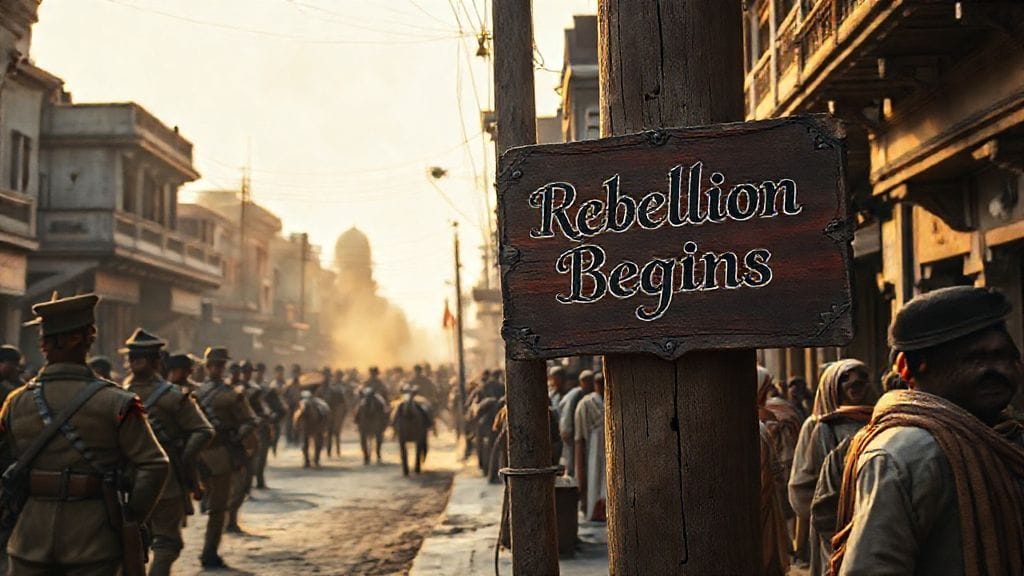
On May 10, the powder keg exploded. Soldiers missed their morning parade and instead broke ranks, freed their imprisoned fellows, and launched a violent uprising. The simplicity of armed soldiers revolting against their commanders soon transformed into a complex and widespread rebellion.
The Mutiny Unfolds: From Arrests to Revolt
What began as a localized mutiny in Meerut rapidly spiraled into an all-out insurrection. As the sepoys revolted, they took over the arsenal, released prisoners, and marched toward Delhi, the symbolic heart of the Mughal Empire.
Along the way, their numbers swelled with thousands of civilians and soldiers disaffected by colonial rule. This movement was no longer a mere military protest but an eruption of diverse social groups united by rage against foreign dominance and hope for restoration.
The mutiny defied British attempts at quick suppression. Instead, the rebels reclaimed swaths of territory, disrupting administrative control and challenging the very notion of British invincibility.
The Attack on the Parade Ground: The First Flames of Rebellion
The attack on the parade ground at Meerut remains one of the iconic moments of the rebellion's outbreak. The orderly morning discipline of the East India Company's forces gave way to chaos as sepoys seized weapons, defied orders, and refused to submit to British authority.
British officers found themselves overwhelmed and vulnerable, as the soldiers they had commanded turned against them. Panic dominated the cantonment, and the sepoys attacked with a fierce resolve driven as much by desperation as by long-suppressed fury.
Witnesses later described scenes of brutal violence and confusion, as colonial symbols were torn down and the colonial order briefly flipped on its head.
Running Through the Streets: Rebellion’s Spread Beyond Meerut
The rebellion did not halt at Meerut’s borders. News of the uprising reached Delhi, and the Mughal emperor Bahadur Shah Zafar, hitherto a figurehead with little power, was implored by rebels to lead the restored Indian sovereignty.
From northern provinces to the plains of Awadh and beyond, the flames spread rapidly. Cities and towns experienced riots, sieges, and shifting alliances. The complex mosaic of Indian society found itself engulfed in war, with families displaced, landlords challenged, and communities divided.
British officials fled or barricaded themselves, while sepoys and local insurgents laid siege to colonial posts. What had started as a military mutiny was swiftly becoming a full-scale war for the subcontinent’s future.
British Panic and Martial Response: Early Days of the Crisis
The British establishment in India was caught off-guard by the ferocity and scale of the rebellion. Initial responses were frantic and disorganized. Communication lagged, troops loyal to the Company dwindled, and the sheer size of the territory made swift recapture impossible.
Military reinforcements were hurriedly summoned from Britain and other colonies, but months would pass before decisive campaigns could be mounted.
Meanwhile, the British met violence with violence. Harsh reprisals, summary executions, and scorched earth tactics marked the first responses—measures that left deep wounds in the Indian psyche and further inflamed resistance.
The Role of Indian Civilians: Allies, Spectators, or Opportunists?
While sepoys were the rebellion’s backbone, Indian civilians played multifaceted roles. Some sided with the British, others joined the rebels, and many sought only to survive amid chaos.
Local rulers, landlords, peasants, and merchants navigated shifting loyalties amid the upheaval. In some regions, long-standing grievances merged with the rebellion's political aims; in others, opportunistic factions exploited the disorder to settle personal scores.
Stories abound of heroism and betrayal alike—a testament to the complex social fabric of India and the unpredictable nature of revolt.
The Rebellion’s Geography: Spreading Like Wildfire Across Northern India
From Meerut, the rebellion spread with a contagious energy, engulfing vast portions of the north. Cities like Kanpur, Lucknow, and Jhansi emerged as theaters of fierce conflict. Each region bore its own dynamics, influenced by local leaders, historical grievances, and demographic compositions.
Rebels seized control of key fortresses and strategic towns, establishing a network that challenged the colonial government’s territorial grip.
Yet pockets of loyalty to the British survived, creating a patchwork of contested power that would become the battleground for months to come.
The Siege of Delhi: Turning Point and Symbol of Resistance
Delhi’s fall to the rebels soon after Meerut was both a strategic and symbolic milestone. The aging Mughal emperor Bahadur Shah Zafar, reluctantly swept up in the rebellion, became a unifying figurehead for diverse factions yearning to restore indigenous rule.
The city became a fortress of defiance, with intense fighting marking the British attempt to reclaim the capital city of the Mughal Empire. Siege warfare, desperate negotiations, and bloody street battles defined this phase.
Ultimately, Delhi’s recapture in September 1857 marked a turning of the tide, but not an end to resistance.
British Military Strategy and Indian Resistance: A War Within Governments
The rebellion forced the British to rethink their military and administrative approach to India. Reinforcements, better training, and harsh retaliatory strategies became central to their efforts.
Indian resistance, meanwhile, was marked by guerrilla tactics, shifting alliances, and the rallying power of local leaders—figures like Rani Lakshmibai of Jhansi and Tantia Tope, who inspired widespread admiration.
The uprising blurred lines between regular armies and popular insurgents, turning into a prolonged, multi-layered conflict.
The Brutal Aftermath: Reprisals, Executions, and Cultural Trauma
When the British finally quelled the rebellion by mid-1858, their response was brutal and uncompromising. Public hangings, massacres, and punitive destruction left lasting scars.
The trauma extended beyond the battlefield. The cultural psyche of both colonizers and colonized was forever transformed by the horror, heroism, and heartbreak of those tumultuous months.
This violence seeded deep distrust and resentment, laying groundwork for future struggles.
Political Ripples: The End of the East India Company and the Birth of the Raj
One of the rebellion’s most significant consequences was the political overhaul of British rule in India. The East India Company, long the subcontinent’s dominant power broker, was dissolved.
In its place, the British Crown took direct control—ushering the era of the British Raj, which aimed (ostensibly) to govern India with more caution but maintained imperial dominance.
This transfer altered laws, administration, and the supposed relationship between ruler and ruled forever.
Social and Religious Consequences: Rethinking Empire and Identity
The uprising forced both Indians and the British to reckon with questions of identity, faith, and sovereignty.
Attempts at assimilating Indian society into British norms were questioned, while Indians increasingly fostered nationalist sentiments—laying seeds for 20th century independence movements.
Religious revivalism and social reform gained new impetus as communities grappled with colonial oppression and rebellion’s legacy.
Literary and Artistic Memory: How the Rebellion Entered the Cultural Imagination
The Indian Rebellion of 1857 lingered in histories, stories, poems, and paintings. Both British and Indian writers sought to capture its magnitude, tragedy, and heroism.
From British accounts portraying a “mutiny” threatening civilization, to Indian narratives celebrating resistance, the event shaped cultural memory, inspiring debate and reflection.
Voices from the Past: Letters, Diaries, and Testimonies of the Rebellion
Personal accounts add humanity and immediacy to the rebellion’s story. Letters penned by British officers, diaries of sepoys, and testimonies of civilians reveal the fear, hope, and complexity behind the headlines.
These voices remind us that history is lived experience, full of nuance and emotional depth.
Lessons Learned: The Indian Rebellion’s Legacy in Colonial and Postcolonial India
The rebellion was more than a failed uprising—it was a turning point. It highlighted the perils of cultural arrogance, the power of identity, and the limits of imperial control.
Its memory continues to inform discussions of resistance, colonialism, and nationhood in India and beyond.
Conclusion: A Story of Resistance, Loss, and Transformation
The Indian Rebellion of 1857 erupted from the crowded barracks of Meerut but reverberated across continents and centuries. It was a collision of empires and identities, a moment when soldiers and civilians alike confronted the realities of colonial domination.
Though the uprising was ultimately suppressed, it shattered illusions of British invulnerability and catalyzed profound changes. It reminds us that history is not merely dates and facts, but human stories of courage, pain, betrayal, and hope.
The rebellion’s legacy endures—a testament to the enduring quest for freedom and dignity in the face of overwhelming odds.
FAQs
Q1: What caused the Indian Rebellion of 1857?
The rebellion was caused by a combination of political, economic, cultural, and military grievances, including resentment against British policies like land annexations, disrespect for Indian religious beliefs, and the introduction of greased rifle cartridges offensive to Hindu and Muslim soldiers.
Q2: Why did the rebellion start in Meerut?
Meerut housed a large contingent of Indian sepoys, and tensions over cartridge use and arrest of sepoys suspected of disobedience ignited the mutiny there on May 10, 1857.
Q3: Who were the major leaders of the rebellion?
Notable leaders included the Mughal emperor Bahadur Shah Zafar, Rani Lakshmibai of Jhansi, Tantia Tope, and Nana Sahib, among others.
Q4: How did the British suppress the rebellion?
Through military reinforcements, brutal reprisals, sieges (notably Delhi and Lucknow), and coordinated campaigns, the British suppressed the rebellion by mid-1858.
Q5: What was the outcome for the East India Company?
The Company was dissolved, and the British Crown assumed direct control, marking the start of the British Raj.
Q6: How did the rebellion influence future Indian nationalism?
The rebellion became a symbol of resistance, inspiring later nationalist movements seeking complete independence from British rule.
Q7: How is the rebellion remembered differently in British and Indian histories?
British narratives traditionally framed it as a “mutiny,” focusing on lawlessness, whereas Indian perspectives emphasize it as a war of independence and uprising against colonial injustice.
Q8: What sources help us understand the rebellion today?
Historical records include official reports, personal letters, soldiers’ diaries, eyewitness accounts, and oral histories that provide varied perspectives on the events.