Table of Contents
- A Fateful Moment at the Gates of Tianjin
- The Opium Wars and Growing Western Pressure
- China’s Internal Turmoil: The Taiping Rebellion Looms
- The Players on the International Stage
- Tianjin: From Provincial Harbor to Global Crossroads
- The Road to Negotiation: Military Clashes and Stalemates
- June 1858: The Day the Treaty was Signed
- Dissecting the Treaty: Terms and Concessions
- The Opening of Ports: A New Era of Trade and Influence
- Missionaries and Extraterritoriality: Cultural and Legal Shockwaves
- The Impact on Chinese Sovereignty and Imperial Pride
- Western Powers: Strategic Gains Beyond Commerce
- The Qing Court’s Dilemma: Reform or Resistance?
- The Aftermath: Escalating Conflicts and the Arrow War
- Treaty Ports as Footholds for Global Powers
- The Role of Diplomacy and Gunboat Diplomacy Combined
- Voices from Chinese Society: Intellectual and Popular Reactions
- Anecdotes from the Negotiation Table
- Global Reflections: How Other Nations Viewed the Treaty
- The Treaty’s Legacy: Shaping Modern Sino-Western Relations
- A Prelude to Modern China’s Turbulent Century
- Conclusion: Lessons from a Signed Document
- FAQs: Understanding the Treaty of Tientsin
- External Resource
- Internal Link
1. A Fateful Moment at the Gates of Tianjin
The moon had barely risen over the ancient city of Tianjin on a humid June evening, yet the air was thick with tension and smoke. Cannons boomed a heavy cadence days earlier, echoing from the ramparts, a grim reminder that China’s centuries-old walls were under assault—not just by bullets and cannonballs, but by the irresistible wave of foreign demands. Amidst this precarious atmosphere, delegations gathered in austere chambers, their voices low but laced with urgency. The Treaty of Tientsin was about to be signed, a document that would forever fracture China’s sovereignty and widen the fissures of empire and resistance.
For the Qing dynasty—the last imperial dynasty to rule China—this was a moment drenched in uncertainty and reluctant pragmatism. For the Western powers amassed, from Britain to France and Russia, it was a moment of triumph, the fulfillment of a relentless push to open China wide to commerce, Christianity, and geopolitical leverage. But beyond the ink and signatures lay the unfolding of a broader contest—a clash of civilizations, ideologies, and empires—that would alter the course of global history.
2. The Opium Wars and Growing Western Pressure
The roots of the Treaty of Tientsin trace back to the turbulent mid-19th century, when the British Empire’s hunger for Chinese tea collided with imperial commerce and Chinese sovereignty. The Opium Wars (First: 1839–1842; Second: 1856–1860) framed much of this confrontation. The first conflict ended with the Treaty of Nanking, which forced China to cede Hong Kong and open five treaty ports. Yet, this “unequal treaty” was only a prelude.
British traders, backed by gunboat diplomacy, craved deeper access and legal protections not afforded under the Nanking terms. The spark that ignited the Second Opium War was the seizure of the British-registered ship Arrow in Canton by Chinese officials, which the British government used as a casus belli in 1856 to escalate the conflict.
France, seeking to expand its own influence, joined the fray citing the execution of a French missionary in Guangxi Province as justification, while Russia and the United States eyed opportunities for expansion and securing trade footholds in Asia.
3. China’s Internal Turmoil: The Taiping Rebellion Looms
While foreign bullets tore into Chinese cities, far greater wounds raged within the empire’s borders. The Taiping Rebellion, a millenarian and quasi-Christian uprising led by Hong Xiuquan, had already unsettled the Qing regime since 1850. By 1858, it had engulfed vast swaths of southern China, draining resources, destabilizing governance, and shaking imperial confidence.
This dual stress—a foreign military assault coupled with domestic insurrection—had exhausted the Qing’s capacity for resistance. The emperor’s court was divided, oscillating between stubborn defiance and reluctant negotiations. Recognizing their precarious position, Qing officials sought to buy time and strategic breathing space through treaties—however humiliating—while hoping to quell uprisings inside.
4. The Players on the International Stage
The treaty negotiations brought together a cast of powerful actors. Representing Britain was Sir James Bruce, 8th Earl of Elgin, a seasoned diplomat and resolute imperial enforcer. On France’s side stood Baron Gros, an experienced envoy with both military and diplomatic credentials. The Russians appointed their envoy Yevfimiy Putyatin, who was keen to secure influence in Northern China and Mongolia. The United States, with a smaller footprint, dispatched a delegation seeking expanded trade rights and legal protections.
The Qing side was represented by Prince Gong and other Manchu nobles. Prince Gong, known for his pragmatic views, worked to navigate the court’s entrenched factions, balancing calls for resistance with the increasingly stark realities.
5. Tianjin: From Provincial Harbor to Global Crossroads
Tianjin, though not one of the grand imperial capitals, was central in this drama. Located strategically at the confluence of the Hai River and close to Beijing, Tianjin evolved rapidly from a market town to a vital port. Its geographic importance made it the natural venue for diplomatic engagement as well as military operations.
The city buzzed with the foreign troops, merchants, missionaries, and diplomats—a volatile mixture reflecting the era’s imperial ambitions and cultural collisions.
6. The Road to Negotiation: Military Clashes and Stalemates
Before pen met parchment, intense military operations unfolded. The British and French forces, superior in weaponry and naval power, staged several campaigns to seize strategic locations like the Taku Forts guarding the mouth of the Hai River. Their successes pressed Chinese negotiators to the table.
Curiously, despite the military imbalance, Qing forces mounted fierce resistance and attempted tactical delays. Night raids, guerrilla actions, and negotiations filled the interim as both sides sought advantage.
7. June 1858: The Day the Treaty was Signed
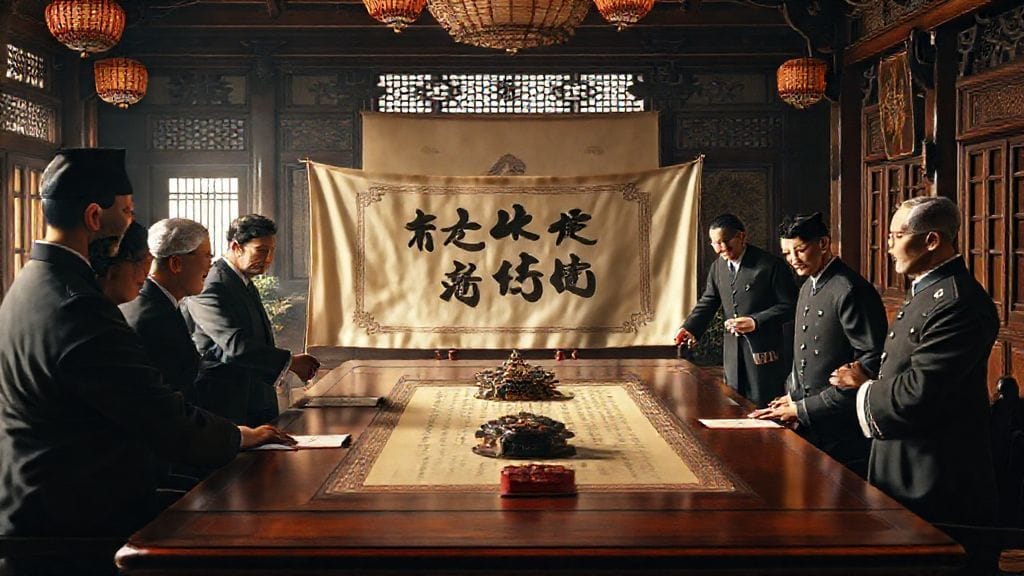
On June 26, 1858, delegates convened in Tianjin’s government offices. The room was heavy with silent unease. The treaty text, written in dense legalese but carrying seismic consequences, was read aloud.
This document ratified the cessation of hostilities, opened 11 new Chinese ports to foreign trade—including Tianjin, among others—and legalized the presence of foreign legations in Beijing. Importantly, the treaty granted foreigners the right to travel within China’s vast interior, established freedom for Christian missionary activities, and accorded extraterritorial rights for Western nationals—immunities from Qing law.
Each clause punctuated China’s sovereignty with fresh wounds, yet for pragmatic men like Prince Gong, signing was a necessary step to prevent further devastation.
8. Dissecting the Treaty: Terms and Concessions
A deep dive into the 16 articles reveals a layered instrument of coercion cloaked in diplomatic language:
- Opening of 11 additional Treaty Ports, eroding the Qing monopoly on trade.
- Legalization of opium importation—controversial yet tacitly accepted.
- Installation of foreign embassies in Beijing, symbolizing intrusion into the imperial core.
- Guarantee of freedom for Christian missionaries to propagate religion.
- Granting of extraterritorial privileges for Westerners, undermining Qing judicial authority.
- Fixed tariffs and indemnities, ensuring continued economic subjugation.
Each of these stipulations chipped away at centuries of Chinese political and cultural autonomy.
9. The Opening of Ports: A New Era of Trade and Influence
From Tianjin to Canton, the new treaty ports became throbbing arteries of foreign economic and cultural influence. Steamships pumped their engines, warehouses rose, and multinational trading firms—Hong Kong-based Jardine Matheson and others—expanded their reach.
Yet prosperity for foreign merchants came often at local expense: flooding local markets with cheap goods, generating social tensions, and frequently encouraging opium consumption.
10. Missionaries and Extraterritoriality: Cultural and Legal Shockwaves
The legalization of missionary activity unleashed a wave of religious fervor and cultural imposition seldom previously tolerated. Missionaries ventured deep inland, often clashing with local traditions and officials.
Extraterritoriality, meanwhile, created enclaves immune to Chinese law. For the Qing legal system, this was an unprecedented blow to sovereignty, fostering resentment and a sense of humiliation among officials and citizens alike.
11. The Impact on Chinese Sovereignty and Imperial Pride
The Treaty of Tientsin became more than a set of provisions—it became a symbol of national humiliation, an emblem of an empire’s enforced acquiescence. The Qing emperor’s authority was publicly challenged; campaigns to resist “foreign devils” became rallying cries.
But ironically, the treaty also sowed seeds for reformist thinking, sparking debates about modernization, self-strengthening, and eventually, revolution.
12. Western Powers: Strategic Gains Beyond Commerce
For Britain and France, as well as for Russia and the United States, the treaty was a diplomatic victory solidifying spheres of influence in East Asia. It secured naval bases, expanded markets, and positioned these nations for the geopolitical contests that would dominate the late 19th century.
13. The Qing Court’s Dilemma: Reform or Resistance?
The signs of internal division deepened: conservatives within the court decried the treaty as betrayal, advocating for military resistance; reformers saw in the humiliations a mandate for urgent modernization.
Prince Gong, along with other influential officials, became emblematic of the complex balancing act between preserving tradition and adapting to new realities.
14. The Aftermath: Escalating Conflicts and the Arrow War
The Treaty of Tientsin did not bring lasting peace. Soon, Chinese reluctance to honor all terms, combined with further Western provocations, ignited the Second Opium War’s final phase.
Notably, in 1859, renewed assaults on Taku Forts culminated in violent clashes, while British and French troops marched to Beijing in 1860, leading to the eventual signing of the Convention of Peking.
15. Treaty Ports as Footholds for Global Powers
The treaty ports blossomed into multicultural hubs where East met West in commerce, architecture, cuisine, and sometimes conflict. Zones like the British concession in Tianjin became springboards for diplomatic, military, and economic penetration throughout northern China.
16. The Role of Diplomacy and Gunboat Diplomacy Combined
The Treaty of Tientsin crystallized a new form of international relations where diplomacy was inseparable from military power—“gunboat diplomacy” became the modus operandi, intertwining threats with treaties and forcing reluctant acceptance.
17. Voices from Chinese Society: Intellectual and Popular Reactions
From the scholar-gentry to ordinary farmers, reactions ranged widely. Some lamented the erosion of millennia of empire, others debated China’s place in the world anew. Stories of local uprisings and anti-foreign sentiment underlined the sociopolitical fault lines exposed by the treaty.
18. Anecdotes from the Negotiation Table
Accounts reveal moments of tension, cultural misunderstanding, and even rare amusement. The British envoy reportedly scrawled impatient notes; the Qing negotiators employed subtle rhetoric to mask their grievances. These human elements remind us of the complex personalities behind grand history.
19. Global Reflections: How Other Nations Viewed the Treaty
News of the treaty rippled worldwide. European courts interpreted it as a triumph of imperialism; American newspapers debated the morality of “manifest destiny” in Asia; Asian neighbors watched uneasily the erosion of a once-powerful neighbor.
20. The Treaty’s Legacy: Shaping Modern Sino-Western Relations
The Treaty of Tientsin laid foundational dynamics for interactions between China and the West—patterns of cooperation, conflict, and contradiction that persisted into the 20th century.
21. A Prelude to Modern China’s Turbulent Century
Ultimately, the treaty foreshadowed the century of humiliation that would confront China, igniting debates over identity, sovereignty, and reform that continue to resonate today.
Conclusion
The signing of the Treaty of Tientsin in 1858 is a story not merely of ink on paper, but of an empire grappling with the forces of modernity, power, and survival. It encapsulates the tragic clash between an ancient civilization and aggressive imperial powers, set against the backdrop of war, rebellion, and cultural collision.
Yet, amid the layers of coercion and capitulation, it also ignited China’s awakening—a complex journey towards self-strengthening and transformation in a rapidly changing world. The treaty stands as a somber reminder of the costs of empire and the enduring human struggle to find dignity amid upheaval.
FAQs
Q1: Why was the Treaty of Tientsin signed?
The treaty was signed to end hostilities during the Second Opium War after Western forces gained military advantages, forcing China to concede to demands for expanded trade, diplomatic representation, and legal protections for foreign nationals.
Q2: What were the main terms of the treaty?
Key terms included opening 11 new treaty ports, allowing foreign envoys to reside in Beijing, legalizing missionary activity, granting extraterritorial rights to foreigners, and permitting freedom of movement for foreign traders within China.
Q3: Who were the main signatories involved?
Representing China was Prince Gong and other Qing officials, while British, French, Russian, and American diplomats, including Earl of Elgin and Baron Gros, represented Western powers.
Q4: How did the treaty affect Chinese sovereignty?
It significantly undermined China’s sovereignty by imposing legal and territorial concessions, allowing foreign powers to operate with immunity and control key ports, thereby limiting the Qing government’s authority.
Q5: What was the reaction within China to the treaty?
Reactions included widespread anger and humiliation, sparking anti-foreign sentiment, debates within the Qing court about reform or resistance, and fueling further uprisings.
Q6: Did the treaty bring lasting peace?
No, it only temporarily halted hostilities. Resistance and further conflicts soon erupted, culminating in the continuation of the Second Opium War and subsequent treaties that deepened foreign control.
Q7: How did the treaty influence Western imperial ambitions in Asia?
It expanded Western economic and political footholds in China, demonstrating the effectiveness of gunboat diplomacy and encouraging further imperialist ventures throughout East Asia.
Q8: What is the treaty’s historical significance today?
It marks a pivotal moment in China’s modern history, symbolizing both foreign subjugation and the beginning of national reform efforts that shaped China’s trajectory into the 20th century.