Table of Contents
- The Dawn of a New Conflict: Setting the Stage for War
- The Political Chessboard of 1850s Europe
- Piedmont-Sardinia’s Ambition and French Alliance
- Austrian Dominance in Northern Italy
- Prelude to Battle: Strategic Movements and Intelligence
- June 4, 1859: The Battle of Magenta Begins
- The Geographical Theatre: The Small Town of Magenta
- Clash of Titans: French and Sardinian Troops Against Austrian Forces
- The Fog, The Roads, and The Railroad: Elements Shaping the Battlefield
- The Heroic Charges and Deadly Firefights
- General MacMahon’s Leadership: A Calculated Risk
- The Austrian Command’s Struggles and Tactical Responses
- Turning Point: The French Breakthrough
- Human Cost: Stories from the Frontline
- Immediate Aftermath: Victory, Retreat, and Shadows
- The Battle’s Ripple Effect on the Second Italian War of Independence
- The Rise of Italian Nationalism and European Repercussions
- Cultural Memory: How Magenta Became a Symbol of Unification
- Commemorations, Monuments, and Legacy in Italy and France
- Conclusion
The Dawn of a New Conflict: Setting the Stage for War
On a humid June morning in 1859, the small town of Magenta awoke not to the clatter of market stalls or the casual hum of daily life, but to the thunderous echoes of artillery and the ragged shouts of soldiers. The air was thick with smoke, churned earth, and the iron scent of blood — the ominous heralds of one of the fiercest battles that would mark the frenetic struggle for the soul of Italy. As French and Sardinian troops surged forward against the entrenched Austrian defenders, history was unfolding in violent brushstrokes upon the quiet Lombard plains. This was the Battle of Magenta, a decisive moment in the turbulent tapestry of the 19th century’s fight for Italian unification and European realignment.
The sun had barely risen when thousands of men, clad in the blue and white of France and the Savoyard red and white, poised themselves against the mighty Austrian army, a force steeped in tradition, discipline, and occupying power. The drama of the battle would extend far beyond the fields of Magenta — it would ignite national fervor, shift power balances, and write its name in the annals of history.
The Political Chessboard of 1850s Europe
To fully grasp why armies met at Magenta, one must peer into the dense political quagmire of mid-19th century Europe. This was a continent still recovering from the aftershocks of the Napoleonic Wars and the 1848 revolutions, a patchwork of empires, kingdoms, duchies, and restless peoples longing for self-determination.
Austria, ruled by the Habsburg dynasty, was the dominant power in Central Europe and exercised significant control over northern Italy, specifically Lombardy and Venetia. Its grip on these territories was not merely political but emblematic of the conservative order that sought to quell nationalist and liberal uprisings.
Conversely, the Kingdom of Piedmont-Sardinia, under the pragmatic and cunning leadership of Victor Emmanuel II and his astute prime minister Count Camillo di Cavour, was stirring aspirations for Italian unification — “Il Risorgimento.” This push was not only ideological but geopolitical; a unified Italy would alter the strategic landscape profoundly.
Yet, Piedmont-Sardinia was too small to challenge Austria alone. Enter France, led by Emperor Napoleon III. France sought to assert its influence, contain Austria, and expand its prestige. The secret Treaty of Plombières (1858) between Napoleon III and Cavour laid the groundwork for joint military action against Austrian dominance. The chessboard was set; pieces were moved inexorably toward conflict.
Piedmont-Sardinia’s Ambition and French Alliance
For Piedmont-Sardinia, the alliance with France represented a rare opportunity — to wrest yet more territory from the aging empire that had long suppressed Italian nationalistic will. Cavour, a master of diplomacy, deftly balanced the kingdom’s needs and aspirations with the realpolitik of the time.
Napoleon III’s France agreed to support a war that would eject Austrian influence from Lombardy, with a tacit understanding that France would gain strategic territories in return, primarily Nice and Savoy. This quid pro quo would later fuel bitterness but, in 1859, it galvanized the Sardinian cause.
On the ground, soldiers from both nations prepared for a war that promised glory, yet dreaded the price. Military reforms, armament upgrades, and new tactical doctrines reflected the spirit of the age — modern war was brutal and fast-moving.
Austrian Dominance in Northern Italy
The Austrian presence in northern Italy was long entrenched and potent, but increasingly vulnerable. The Habsburg military was a seasoned and well-disciplined force, boasting veterans and officers steeped in a tradition of rigid hierarchy and classical tactics.
Yet beneath this surface vigor lay contradictions — a multinational empire grappling with rising nationalism not only in Italy but also in Hungary and Bohemia. Austrian forces at Magenta were commanded by General Karl von Urban and others who faced the difficult task of defending territory that many local inhabitants regarded as foreign occupation.
Moreover, for the Austrians, the strategic crossroads of Magenta were crucial — loss here would open the way toward Milan and the heart of Lombardy, with catastrophic political implications.
Prelude to Battle: Strategic Movements and Intelligence
In the weeks prior to June 4, 1859, both sides maneuvered cautiously but with increasing boldness. Intelligence efforts sought to uncover enemy positions while logistical challenges mounted. The French and Sardinian armies advanced on a wide front with the goal of forcing Austria to fight on open ground rather than in fortified cities.
The terrain near Magenta, crisscrossed by rivers, roads, and rail lines, was both a tactical asset and challenge. Commanders sought to exploit these features to disrupt supply lines and launch surprise attacks.
Tensions ran high in the war rooms and on the march, with officers aware that victory might hinge on the ability to coordinate diverse forces operating sometimes in difficult weather and unfamiliar landscapes.
June 4, 1859: The Battle of Magenta Begins
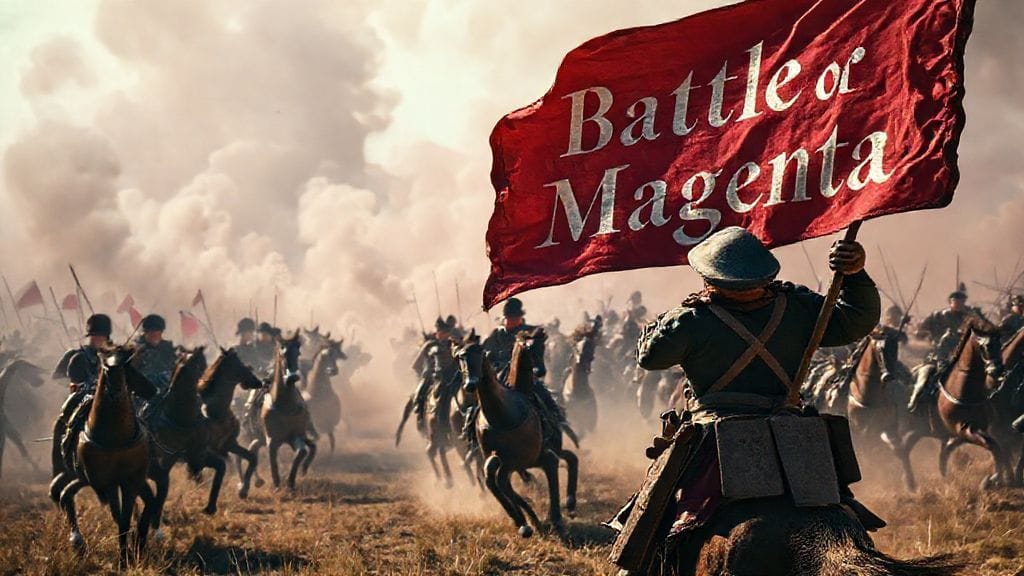
At dawn on June 4, the battle erupted in earnest. French and Sardinian troops moved forward, supported by well-placed artillery batteries. The sound of cannon fire soon drowned out the morning birdsong, and the air thickened with smoke and the cries of men.
From the outset, the fighting was intense and chaotic. The Austrian defenses, arranged along the defensive works around Magenta, responded fiercely. Infantry and cavalry units clashed amid the fields and villages, each side taking and losing ground multiple times.
The commanders faced agonizing decisions as their lines stretched thin and reserves were committed. Battles at this scale often swung on small margins; the courage of individual soldiers mixed with the tactical acumen of generals shaped the unfolding conflagration.
The Geographical Theatre: The Small Town of Magenta
Magenta itself, a nondescript town in Lombardy, became an unwilling witness to history. Its narrow streets, rustic buildings, and surrounding farmlands were transformed into a labyrinth of blood and smoke.
The route to Milan ran nearby, and control of Magenta meant dominion over one of the critical arteries into the region’s richest heartland.
The geography — with marshy areas, the Naviglio Martesana canal, and wooded patches — complicated maneuvers. French and Austrian troops alike adapted their plans to these natural features, with skirmishes raging across unpredictable terrains.
Clash of Titans: French and Sardinian Troops Against Austrian Forces
The fighting at Magenta was characterized by ferocity and determination. French infantry, supported by Sardinian units, pressed repeatedly against the Austrian defenses. Bayonets clashed, sabers flashed, and artillery thundered.
The French, under General Patrice de MacMahon, displayed both tactical flexibility and aggressive spirit. Sardinian troops augmented this with intimate knowledge of the terrain and shared nationalist zeal.
For the Austrians, holding their line was not just a military imperative but a battle for honor and empire. Their resistance was fierce, at times repelling assaults with discipline and deadly fire.
But as hours passed, French artillery bombardments and coordinated attacks began to erode Austrian resolve.
The Fog, The Roads, and The Railroad: Elements Shaping the Battlefield
One of the striking features of the battle was the dense summer fog that rolled over the battlefield in the early hours, shrouding movements and sowing confusion.
Visibility was poor, which made command and control more difficult and sometimes gave small units the chance to surprise opponents. Roads became clogged with troops and wagons, while the adjacent railroad lines were crucial for logistical support and troop redeployment.
This mixture of modern infrastructure and natural conditions underpinned the unpredictability and chaos that defined the encounter.
The Heroic Charges and Deadly Firefights
Amid the smoke and noise, tales of individual and unit heroism emerged. French cuirassiers, armored heavy cavalry, launched bloody charges that broke through Austrian lines, at the cost of mounting casualties.
Infantry units fought house-to-house in the outskirts of Magenta. Amidst this chaos, doctors and stretcher bearers worked feverishly, and chaplains moved among the wounded, trying to bring solace in a hellish landscape.
It was a testament to the human spirit that men endured such brutality — their motivations a mixture of duty, patriotism, camaraderie, and fear.
General MacMahon’s Leadership: A Calculated Risk
General Patrice de MacMahon stood out during the battle for his boldness and strategic insight. Understanding that hesitation could mean disaster, he ordered a decisive counterattack at a crucial moment.
His ability to quickly grasp the fluid battle conditions and inspire his men turned the tide.
MacMahon’s leadership would later be immortalized; he was made Duke of Magenta, symbolizing the personal and national significance of the victory.
The Austrian Command’s Struggles and Tactical Responses
The Austrian leaders found themselves on the back foot, forced to redeploy units under tough conditions and counter French breakthroughs.
They grappled not only with battlefield challenges but also with supply shortages and lower morale among troops weary of fighting on what some perceived as foreign soil.
Despite attempts to regroup, the pressure mounted relentlessly, exposing the fragility of Austria’s hold over Lombardy.
Turning Point: The French Breakthrough
By late afternoon, after hours of brutal fighting, the French managed to break through the Austrian lines.
This breakthrough opened the path to Milan, leading to the Austrian retreat. The ebb and flow of the day, marked by moments of desperation and inspired counterattacks, culminated in a clear French-Sardinian victory.
The cost, however, was high — estimates range around 5,000 casualties for the allied forces and 8,000 or more for the Austrians.
Human Cost: Stories from the Frontline
Behind the statistics lay countless human stories — of young conscripts facing death for causes they barely understood, of seasoned veterans wounded and unbowed, of civilians caught in the crossfire.
Letters home spoke of harrowing conditions, bravery, and deep hope for what victory might bring.
Some Austrians, fighting on distant soil, mourned a defeated empire; Italians saw in their victory a glimpse of freedom yet to be fully realized.
Immediate Aftermath: Victory, Retreat, and Shadows
The victory at Magenta was a crucial psychological and strategic boost to the Franco-Sardinian alliance.
Shortly after, Austrian forces evacuated large swaths of Lombardy. Yet the war was far from over — the Battle of Solferino awaited on the horizon, promising even fiercer combat.
Politically, news of the victory swept Lombardy and Italy, igniting celebrations but also sparking fears of prolonged strife and foreign influence.
The Battle’s Ripple Effect on the Second Italian War of Independence
Magenta was a turning point in the Second Italian War of Independence, hastening the decline of Austrian power in Italy.
It paved the way for the annexation of Lombardy by Piedmont-Sardinia and significantly shifted the balance in favor of Italian unification.
Moreover, the battle demonstrated new tactics and the increasing importance of coordinated, multinational armies engaged in modern warfare.
The Rise of Italian Nationalism and European Repercussions
The victory at Magenta fed the embers of Italian nationalism. Across the peninsula, people saw tangible proof that the century-old dream of unity was within reach.
Meanwhile, the European powers observed closely. Austria’s defeat weakened its prestige, France carved out new influence, and the balance of power in the region tilted.
This shift laid foundation stones for future conflicts and alliances, including the eventual unification of Italy under the House of Savoy.
Cultural Memory: How Magenta Became a Symbol of Unification
In the decades that followed, Magenta transcended its military significance to become an emblem of Italian patriotism.
Poets, painters, and politicians invoked the battle to inspire collective memory and national pride.
Its date, June 4, became a touchstone in historical commemorations, teaching new generations the cost of liberty.
Commemorations, Monuments, and Legacy in Italy and France
Today, Magenta hosts memorials honoring the fallen on both sides. Streets and squares bear the names of generals and units, while museums recount the battle’s narrative.
France remembers MacMahon’s triumph with reverence; Italy celebrates its role as a step towards freedom.
The legacy of Magenta endures not only in stone and ceremony but in the ongoing discourse about patriotism, war, and identity.
Conclusion
The Battle of Magenta in 1859 was more than a mere clash of armies — it was a crucible wherein the dreams of a fragmented Italy were forged toward unity. The smoke and fire that engulfed the Lombard plains that June morning carried with them hopes, sacrifices, and a reshaping of European destiny.
General MacMahon’s decisive leadership, the courage of countless soldiers, and the confluence of politics and patriotism turned this battle into a defining moment of the 19th century.
Magenta’s legacy, carved in blood and valor, reminds us that the struggle for freedom is arduous and costly, yet its rewards echo through history. It invites us to honor those who fought and to reflect on the intricate dance of power, identity, and hope that shapes our world.
FAQs
What was the main cause of the Battle of Magenta?
The battle was a crucial engagement in the Second Italian War of Independence, triggered by Piedmont-Sardinia’s alliance with France to expel Austrian control from northern Italy as part of the Risorgimento movement.
Who were the key military leaders involved?
On the French-Sardinian side, General Patrice de MacMahon was prominent, while the Austrian forces were commanded by General Karl von Urban and other senior officers.
Why was Magenta strategically important?
Magenta controlled important roads and railways leading to Milan, making it a critical point for movement and supply during the conflict.
What were the immediate consequences of the battle?
The victory led to the Austrian retreat from Lombardy, boosting Italian unification efforts and shifting the balance of power in Italy and Europe.
How did the battle affect civilian populations?
Local civilians suffered greatly due to displacement, collateral damage, and the presence of armies; yet the battle also inspired increased nationalist solidarity.
What role did Napoleon III play in the conflict?
Napoleon III allied with Piedmont-Sardinia and provided military support, with ambitions to reshape European influence, gaining territories like Nice and Savoy as compensation.
How is the Battle of Magenta remembered today?
Through monuments, commemorations, and historical scholarship in both Italy and France, Magenta is remembered as a symbol of courage and the struggle for national identity.
Did the battle influence future European conflicts?
Yes, it indicated the weakening of Austria’s dominance and foreshadowed changing alliances leading up to the unification of Italy and broader European realignment.