Table of Contents
- The Fortress on the Edge of an Empire: Setting the Stage at Taku
- The Brewing Storm: Prelude to Conflict in 1859
- Echoes of Opium: A Century of Tensions Between China and the West
- The Second Opium War: A Clash of Powers and Principles
- The Strategic Significance of the Taku Forts: Gatekeepers of Tianjin
- June 25, 1859: The Day That Shook the Taku Forts
- The Anglo-French Expeditionary Force: Ambitions and Anxieties
- Chinese Defenses and the Qing Military Response
- The Battle Unfolds: Smoke, Blood, and the Walls that Held
- Heroism and Horror: Human Stories from the Taku Front
- The Aftermath of Defeat: Shockwaves Through the Western Command
- Reverberations in Beijing: The Qing Court’s Reaction
- The Global Stage: How the Conflict Redefined Imperial Asia
- Diplomacy Deadlocked: The War’s Escalation Beyond Taku
- Remembering Taku: Historical Legacy and Cultural Memory
- Lessons from the Siege: Imperial Hubris and the Limits of Force
- The Route to Future Battles: How Taku Shaped 1860 and Beyond
- Taku Forts in Modern Times: Symbolism and Preservation
- Changemakers at the Frontline: Personalities Who Shaped the Battle
- The Opium Wars Revisited: A Mirror to West-East Relations Today
- Conclusion: The Taku Forts—Echoes of a Fraught Encounter
The summer air was thick and oppressive as the massive stone walls of the Taku Forts loomed over the edge of the Yellow River’s mouth. The clang of artillery preparations mingled with the salt-laden breeze, while the anxious breath of thousands — soldiers, engineers, and commanders — hung heavy beneath the cerulean skies of June 1859. This wasn’t merely a battle for land or pride. For the Chinese Qing Empire and the Anglo-French expeditionary forces, Taku represented the gatekeeper of northern China’s destiny and a vivid symbol of sovereignty under siege.
It was a moment fraught with tension, desperation, and ambition — the Second Opium War escalating toward a violent crescendo. The day would mark a crucial turning point, a tale of shattered expectations and unexpected consequences, etched forever into the complex story of East-West relations.
The Fortress on the Edge of an Empire: Setting the Stage at Taku
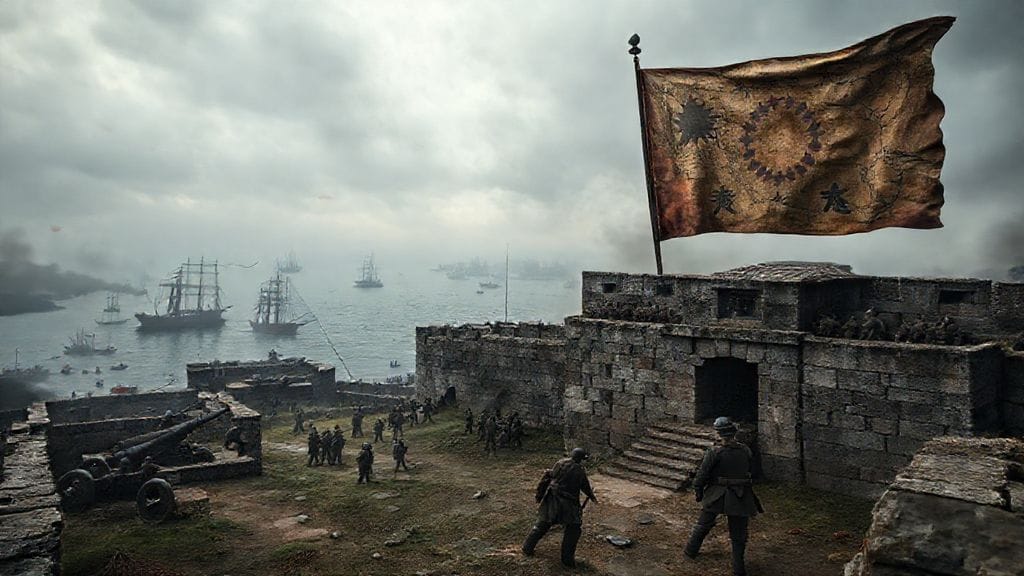
By mid-19th century, the Taku Forts— a formidable cluster of six strongholds along the estuary near Tianjin — were more than mere military installations; they were sentinels guarding the gateway to the Forbidden City and the imperial capital, Beijing. Their sturdy walls, artillery batteries, and strategic positioning made them both formidable and indispensable in the Qing’s defensive network.
Controlling the Taku Forts was tantamount to controlling northern China’s access point to the sea and, by extension, access to the West. As Western powers sought to deepen their reach into China’s interior, these forts stood in their way — symbolic and literal barriers to untrammeled trade, influence, and political leverage.
The Brewing Storm: Prelude to Conflict in 1859
The year leading up to the fateful siege at Taku was a tapestry of uneasy diplomacy, mutual suspicions, and aggressive maneuvering. The Treaty of Nanjing (1842) had ended the First Opium War but left many issues unresolved—most notably, the issue of diplomatic representation, trade rights, and the opium trade itself.
Efforts at peaceful negotiation gave way to repeated saber-rattling in 1858, as British and French envoys pushed for expanded privileges, including the opening of new treaty ports and the legalization of the opium trade. The Qing court, under the cautious yet resolute leadership of officials such as Prince Gong, resisted vehemently.
Despite the 1858 Treaty of Tianjin, which nominally opened diplomatic channels and trade routes, the Chinese government delayed implementation and sought to fortify key positions like Taku, anticipating renewed conflict.
Echoes of Opium: A Century of Tensions Between China and the West
The Second Opium War was the violent continuation of tensions that dated back decades, rooted in a collision of cultures, trade imbalances, and moral ambiguities. British merchants had flooded Chinese markets with opium, creating dependency and social upheaval. The Qing administration’s campaigns to suppress the opium trade triggered retaliation and war.
But it was never only about opium; beneath the surface were competing claims of sovereignty, national pride, and expanding imperial reach. The West viewed China as a reluctant participant in the modern world order, while the Qing leadership grappled with defending centuries-old traditions and fending off humiliation.
The Second Opium War: A Clash of Powers and Principles
The Second Opium War (1856-1860), often called the Arrow War, was a brutal struggle that unfolded across multiple battlefronts, shaped by shifting alliances, technological disparities, and cultural misunderstandings.
By 1859, the conflict had escalated into a standoff with high stakes: Western powers demanded access, Chinese sovereignty quaked, and diplomacy threatened collapse. The Taku Forts became the crucible of this tension — their capture a prerequisite for the advance on Beijing.
The Strategic Significance of the Taku Forts: Gatekeepers of Tianjin
The Taku Forts' strategic importance cannot be overstated. Nestled where the Hai River meets the Bohai Sea, the forts protected the fluvial supply routes critical for approaching Beijing and ensured control over maritime ingress.
The forts had been reinforced heavily: ramparts rebuilt, new artillery emplacements installed, and garrisons strengthened by experienced Manchu and Han troops. Their capture would open the way for Western forces up the river to the capital.
For the Qing dynasty, the forts were not just defensive bastions but a symbolic bulwark preserving autonomy. For British and French commanders, they were the choke points blocking imperial ambitions.
June 25, 1859: The Day That Shook the Taku Forts
On the misty dawn of June 25, 1859, the allied Anglo-French fleet moved cautiously toward the formidable Taku Forts. The morning sun cast long shadows over the cheerless stone walls as preparations began — gun crews readied their cannons, men braced for combat, and commanders debated last-minute strategies.
But the Chinese defenders, under the leadership of General Sengge Rinchen, were unusually prepared. Having spent months reinforcing the forts and adopting Western artillery techniques, the garrison was ready to withstand the assault.
When the British fleet attempted to breach the river’s shoals and bombard the forts, the Chinese counters were swift and precise. It soon became clear — this would not be a swift victory.
The Anglo-French Expeditionary Force: Ambitions and Anxieties
Behind the polished uniforms and military pomp hid a complex web of ambition and anxiety. British and French officers, hardened by successive colonial campaigns, looked to Taku as a gateway to securing victory in China.
Yet logistical challenges, the uncertainties of navigating unfamiliar waters, and miscalculations loomed large. The fleet’s commanders underestimated the Chinese resolve and overestimated their technological and tactical advantages.
Despite a veneer of confidence, internal disagreements and cautiousness hampered the assault's momentum.
Chinese Defenses and the Qing Military Response
Sengge Rinchen, the Mongol cavalry officer and Qing general, emerged as a pivotal figure. Known for his tenacity and strategic acumen, he rallied his troops with fervor and exploited every advantage.
Innovative use of fortified cannon emplacements, interlocking fields of fire, and well-trained artillery proved deadly. The Chinese forces incorporated foreign artillery techniques gleaned through prior contact and adapted efficiently.
Moreover, the defenders' intimate knowledge of the terrain and river currents stymied the attackers' navigation and assault plans.
The Battle Unfolds: Smoke, Blood, and the Walls That Held
As the cannonade erupted, the skies filled with choking smoke, punctuated by thunderous booms and flashes of fire. British ships pushed forward under fire but soon encountered a withering hail of cannonballs and musket volleys.
Casualties mounted rapidly on the Anglo-French side. The tightly coordinated Chinese counter-attacks on landing parties repelled initial assaults. One after another, attempts to scale the walls, breach gates, or disable defenses failed.
The forts, impregnable in their design and preparations, held firm as day gave way to an uneasy dusk.
Heroism and Horror: Human Stories from the Taku Front
Amid the chaos, stories of courage, suffering, and tragedy emerged. Lieutenant George Augustus Elliot of the British Navy fell in the fray, remembered for his valor in the face of overwhelming fire. On the Chinese side, a young artillery officer burned powder with steady hands despite heavy shelling.
Local villagers watched helplessly from beyond the battle lines, their homes and livelihoods cast into uncertainty. The cacophony of war rippled beyond the forts’ walls, reaching into families and memories.
Each shrapnel wound, each crack of musket fire, carried the weight of personal loss and collective strife.
The Aftermath of Defeat: Shockwaves Through the Western Command
For the British and French, the defeat at Taku was humbling and perplexing. The overwhelming technological superiority they had assumed evaporated under the unexpected ferocity and skill of Chinese defenses.
Plans to negotiate from a position of strength were undercut, and the prestige of Western arms took a blow. Commanders grappled with blame and viewed their setbacks with skepticism about intelligence and preparation.
Yet, this setback did not diminish their determination, but rather set the scene for a more aggressive campaign ahead.
Reverberations in Beijing: The Qing Court’s Reaction
News of the victory at Taku soared through Beijing. For the Qing court and Prince Gong, it was a rare moment of pride amid growing external threats and internal decay.
The court cautiously celebrated but recognized the fragile nature of the triumph. The Qing elite debated whether to pursue more diplomatic overtures or to seize the moment for further territorial defense.
The victory boosted morale but also underscored the unpredictable nature of the struggle to come.
The Global Stage: How the Conflict Redefined Imperial Asia
The battle at Taku was not an isolated incident — it was emblematic of the broader imperial contest sweeping Asia in the mid-19th century. News of the clash traveled across the world, shaping perceptions of China's stability and the West's reach.
It forced other powers to reconsider their positions in the region. Russia watched with interest, while Japan observed the shifting balance with caution and curiosity.
Taku became a symbol of the collision between traditional empires and emergent imperialism.
Diplomacy Deadlocked: The War’s Escalation Beyond Taku
If the Taku defeat was a setback for the Anglo-French forces, it also intensified their resolve. Diplomatic efforts stalled; negotiations grew bitter.
Within months, a renewed campaign would launch, culminating in the capture of the Taku Forts in 1860 following a tenacious siege and brutal fighting. The failure of 1859 proved merely a pause in escalating antagonism.
The war’s trajectory was now towards greater bloodshed and irrevocable change.
Remembering Taku: Historical Legacy and Cultural Memory
In the decades since the battle, the Taku Forts have entered the collective memory of China and the West in different ways. Chinese narratives highlight the steadfast defense and the heroism of Qing soldiers.
Western accounts often focus on militaristic lessons and imperial hubris. Museums, literature, and academic studies have interpreted the events from a variety of perspectives.
Taku remains a potent symbol of resistance, loss, and the complexities of empire.
Lessons from the Siege: Imperial Hubris and the Limits of Force
The failed assault on Taku stands as a cautionary tale about underestimating an opponent and the dangers of overconfidence. The episode illuminated the need for better intelligence, respect for local conditions, and the unpredictable human dimension of war.
It also exposed the limits of Western military technology when faced with strategic ingenuity and prepared defenders.
The siege challenged presumptions about “civilized” superiority and forced a reevaluation of imperial tactics.
The Route to Future Battles: How Taku Shaped 1860 and Beyond
The 1859 failure catalyzed a more determined and meticulously planned campaign for the following year. The Anglo-French forces arrived again with greater forces, better knowledge, and renewed urgency.
The grim lessons learned motivated operational reforms and showcased the persistence of imperial ambition.
Eventually, the Taku Forts would fall, but the 1859 battle remained a painful memory in the historiography of the conflict.
Taku Forts in Modern Times: Symbolism and Preservation
Today, the remnants of the Taku Forts stand as historical monuments along the Bohai coast. They attract visitors interested in military history, Sino-Western relations, and architectural resilience.
Efforts to preserve and study the forts reflect a broader dedication to remembering the complex history of the Opium Wars and their enduring global impact.
The forts are at once relics of pain and testimony to perseverance.
Changemakers at the Frontline: Personalities Who Shaped the Battle
The battle’s outcome was shaped by key figures – from Sengge Rinchen’s tactical brilliance to British Rear Admiral Sir James Hope’s cautious leadership.
Their decisions, personalities, and experiences humanized an often abstract geopolitical conflict, turning battles into dramas of ambition, courage, and failure.
Understanding these personalities enriches our grasp of why Taku unfolded as it did.
The Opium Wars Revisited: A Mirror to West-East Relations Today
The echoes of Taku and the Opium Wars resonate still in modern debates about sovereignty, foreign intervention, and unresolved historical grievances.
Scholarship and popular discourse increasingly interrogate the complexities of the wars, challenging simplistic narratives of victimhood or conquest.
Taku reminds us of the enduring relevance of history in shaping identity and diplomacy.
Conclusion
The struggle at the Taku Forts on that June day in 1859 was more than a military engagement — it was a collision of histories, cultures, and destinies. It encapsulated the wider drama of the Second Opium War, where pride and power, tradition and modernity, East and West intertwined in a tragic, indelible confrontation.
The stout walls of Taku held firm that day, foreshadowing both the resilience and vulnerability of the Qing dynasty. For the Western powers, it was a humbling check on their imperial ambitions. Yet the battle’s reverberations shaped the course of history far beyond the river mouths — influencing diplomacy, warfare, and collective memory even today.
In the stones and scars of the Taku Forts, one hears whispers of bravery, folly, and the unyielding spirit of those caught in the tides of a changing world.
FAQs
Q1: What triggered the battle at the Taku Forts in 1859?
The battle was sparked by tensions over the implementation of the Treaty of Tianjin, with Western powers demanding unimpeded access through the forts to advance diplomatic and commercial interests, while the Qing government sought to resist these encroachments.
Q2: Why were the Taku Forts strategically important?
Located at the river mouth controlling access to Tianjin and Beijing, the Taku Forts served as a defensive choke point, preventing foreign navies and armies from advancing inland.
Q3: Who commanded the Qing forces defending the Taku Forts?
General Sengge Rinchen, a Mongol cavalry officer famed for his military skill and leadership, commanded the defense.
Q4: What was the outcome of the June 25, 1859, confrontation?
The British and French forces were repelled with heavy casualties, suffering a significant defeat; the Chinese forces successfully defended the forts.
Q5: How did the battle affect the course of the Second Opium War?
The defeat delayed Western advances but hardened their resolve, leading to a more forceful campaign in 1860 that ultimately took the forts and moved on toward Beijing.
Q6: What lessons did the Western powers learn from the failed assault?
They recognized the need for better preparation, intelligence, and respect for the Chinese defenses, altering their tactics in subsequent operations.
Q7: How is the battle of Taku remembered in China today?
It is often seen as a symbol of anti-imperialist resistance, reflecting Chinese resilience against foreign aggression during a period of humiliation.
Q8: What broader significance does the battle hold in historical memory?
The battle exemplifies the complexities of imperial expansion, resistance, and cultural clashes in the 19th century, serving as a cautionary tale about war, diplomacy, and sovereignty.