Table of Contents
- A Day of Change: Turin, March 24, 1860
- The Kingdom of Sardinia at a Crossroads
- The Winds of Italian Unification
- The Strategic Importance of Nice and Savoy
- France’s Ambitions under Napoleon III
- Count Cavour: The Mastermind Behind the Treaty
- The Diplomatic Dance: Negotiations in Turin
- From Diplomacy to Ink: Signing the Treaty of Turin
- Immediate Reactions in Italy and France
- The Sorrow and Fury in Nice and Savoy
- The Treaty’s Role in the Second Italian War of Independence
- The Plebiscites: Voices of a Divided Population
- The Ripples Across Europe: Reactions from Great Powers
- The Treaty and the Decline of Austrian Influence
- The Unification March Accelerates: Italy’s New Borders
- Cultural and Social Shifts in Nice and Savoy After the Cession
- The Treaty’s Long Shadow over Franco-Italian Relations
- The Legacy of the Treaty of Turin in Italian National Memory
- Lessons from 1860: Sovereignty, Identity, and Power
- Conclusion: A Treaty’s Echo Through Time
- Frequently Asked Questions
- External Resource: Wikipedia on Treaty of Turin (1860)
- Internal Link: Visit History Sphere
1. A Day of Change: Turin, March 24, 1860
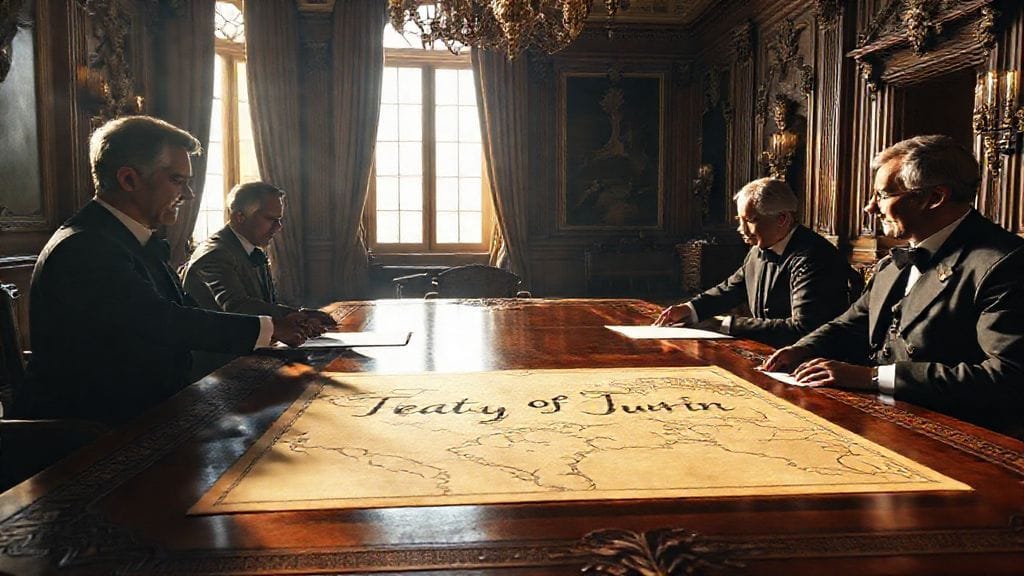
The chill of early spring in Turin did nothing to cool the feverish tension that filled the air on March 24, 1860. Inside the grand halls of Palazzo Carignano, the beating heart of the Kingdom of Sardinia’s political life, Prime Minister Count Camillo di Cavour and his French counterpart, Emperor Napoleon III, sat poised to finalize a document that would redraw the map of Europe and alter the lives of thousands. The Treaty of Turin, inked that day, sanctioned the cession of the Duchies of Nice and Savoy to France. What seemed an administrative agreement on paper was, in reality, a turning point in the struggle for Italian unification—risks and hopes intertwined in the delicate strokes of the pen.
The light streaming through the lofty Renaissance windows bore silent witness to the hopes and anxieties that engraved themselves into every signature, every clause. For the inhabitants of Nice and Savoy, this treaty would mark the tearing away of familiar identities—their ancient ties to the House of Savoy supplanted by the French tricolor. For the leaders shaping this new Europe, the Treaty of Turin was both a strategic concession and a step toward a dream long pursued: a unified Italy.
2. The Kingdom of Sardinia at a Crossroads
To understand the Treaty of Turin’s profound significance, one must step back to the Kingdom of Sardinia’s precarious position in mid-19th century Europe. Far from being merely a small Mediterranean kingdom perched on an island and a sliver of the mainland, Sardinia was the political and military engine that would ignite the Risorgimento—the movement to unify the scattered Italian states into one nation.
Since the end of the Napoleonic Wars, the peninsula was a patchwork quilt of independent kingdoms, duchies, and foreign enclaves: the Austrian Empire wielding dominance in the north and east, the Bourbon Kingdom of the Two Sicilies controlling the south, the Papal States asserting spiritual and temporal power in the center. Sardinia-Carignano’s rulers, the House of Savoy, sought to navigate these treacherous currents to transform their realm into the nucleus of a united Italy.
But Sardinia was not merely a bystander; it was a shrewd player balancing alliances and rivalries. Its strategic territories—specifically Savoy and Nice—bordered France and Switzerland, providing economic lifelines and military corridors but also geopolitical vulnerabilities.
3. The Winds of Italian Unification
The decades before 1860 had been stormy seas in the quest for Italian unification. Romantic nationalist sentiments coursed through intellectual salons in Turin, Milan, and Florence alike, feeding the visions of Giuseppe Mazzini, Giuseppe Garibaldi, and others who sought freedom and unity.
Yet the path was anything but smooth. The Great Powers of Europe—Austria, France, Britain, and Russia—each played their own chess games. Austria, guarding its Italian possessions, staunchly opposed any threat to its Italian dominance. France’s position was more ambiguous, a mixture of revolutionary support and imperial ambition under Napoleon III.
In this charged atmosphere, Count Camillo di Cavour rose as a consummate statesman. He recognized that unification could only proceed via careful diplomacy and, when required, military force. For this, alliances had to be forged—notably an alliance with Napoleon III’s France, despite the latter’s own designs on Italian territory.
4. The Strategic Importance of Nice and Savoy
Nice and Savoy were not just peripheral lands. They represented gateways between Italy and France, buffers against Austrian power, and territories rich in cultural and economic value.
Savoy’s alpine passes commanded key routes for commerce and armies. Politically tied to the House of Savoy since the medieval period, it was considered part of the dynasty’s hereditary lands. Nice, on the Mediterranean coast, was economically vibrant and culturally unique, with a blend of Italian and French influences.
Yet, in the grand designs of diplomacy, these territories became bargaining chips. Cavour knew that sacrificing Nice and Savoy might secure France’s indispensable support for war against Austria. The decision unleashed a deep controversy—how much territory could a nascent Italy afford to trade away in exchange for its very survival?
5. France’s Ambitions under Napoleon III
Napoleon III, nephew of the great Napoleon Bonaparte, was a ruler with ambitions that extended beyond the borders of France. His reign was marked by a desire to restore France’s place as a European power and influence the reshaping of the continent.
Supporting Italian unification served multiple purposes: it weakened Austria, a rival; it endeared France to liberal and nationalist elements in Europe; and it brought the possibility of territorial expansion in the form of acquiring Nice and Savoy.
But Napoleon was a cautious emperor. He understood the limits of military adventures and the importance of international legitimacy. The Treaty of Turin was an expression of this pragmatic balancing act: supporting Italian nationalism while strengthening French territorial claims.
6. Count Cavour: The Mastermind Behind the Treaty
If Napoleon III was the imperial hand, Count Camillo di Cavour was the calculating brain of the Risorgimento. Born into Piedmontese nobility, Cavour combined political savvy with economic modernization, understanding that a strong and industrialized Italy was a prerequisite for sovereignty.
Cavour’s vision extended over the long term. He skillfully negotiated with France, leveraging the necessity of alliance against Austria to extract the price of Nice and Savoy.
Yet Cavour was not blind to the ironies. “One must always believe in Italy,” he famously said, “even if it means sacrificing pieces of Italy to gain the whole.” This sacrifice was a bitter pill, especially when it involved the lands of his own dynasty.
7. The Diplomatic Dance: Negotiations in Turin
Negotiations leading to the Treaty were intense, secretive, and politically charged. Sardinian diplomats in Paris coordinated closely with their French counterparts, balancing demands and concessions.
Behind closed doors, delicate issues—the timing of cession, guarantees for the local populations, plebiscitary procedures—were ironed out amid mutual suspicion. The Sardinians wanted to ensure that once France entered the war against Austria on Italy's side, the cession of Nice and Savoy would be honored.
Turin, then a hub of political intrigue, buzzed with rumors. The city’s cafes and salons were rife with speculation: Was this treaty a betrayal or a brave gambit for national unity?
8. From Diplomacy to Ink: Signing the Treaty of Turin
When the Treaty was finally signed on March 24, 1860, it was more than an act of writing. It was a symbolic moment sealing alliances and shaping destinies.
The document stipulated that Nice and Savoy would be ceded to France in exchange for French military support in the upcoming conflicts aimed at removing Austrian dominance from northern Italy. It also provided for plebiscites in the ceded territories to legitimize the transfer.
As the quill scratched the final strokes, leaders present sensed they were witnessing the birth pains of a new Europe. The treaty was a foundation stone, but the building would be far from complete.
9. Immediate Reactions in Italy and France
News of the treaty sparked contrasting waves across the landscape. In Turin and other Italian cities, many hailed the move as a necessary sacrifice for the greater cause of unification. The press generally portrayed the treaty as a victory, spotlighting France’s role as a crucial ally.
Meanwhile, in France, Napoleon III received popular acclaim. The acquisition of Nice and Savoy was seen as reclaiming historically French lands. French newspapers celebrated the augmentation of national territory, a win amid the complex web of European politics.
Yet these headlines masked a deeper disquiet brewing in the ceded provinces.
10. The Sorrow and Fury in Nice and Savoy
For many inhabitants of Nice and Savoy, the Treaty of Turin was a betrayal and a rupture of identity. These regions, historically linked to the House of Savoy and Italian culture, were suddenly handed over to the French state, often without their enthusiastic consent.
Local elites, clergy, and common folk expressed dismay. Anti-French protests erupted, especially in Nice, where pro-Italian sentiments remained strong. The famous Italian poet Giuseppe Garibaldi—himself born in Nice—denounced the cession as a wound to the Italian cause.
The plebiscites held later in 1860 showed majorities favoring annexation, but historians note that pressure and irregularities likely influenced results. The sense of loss lingered as Nice and Savoy were absorbed into France.
11. The Treaty’s Role in the Second Italian War of Independence
The Treaty of Turin served as the diplomatic prelude to the Second Italian War of Independence (1859-1861). With French military backing secured, the Kingdom of Sardinia declared war on Austria with lofty goals: to expel Austrian forces from Lombardy and Venetia and to consolidate more Italian territories under Sardinian leadership.
The resulting military campaigns, including the famous Battles of Magenta and Solferino, were bloody yet pivotal. Sardinia and France succeeded in wresting Lombardy from Austria, though Venetia remained beyond reach for a few more years.
Thus, the Treaty was not a mere territorial transaction but rather the keystone in a diplomatic and military strategy that reshaped Italy forever.
12. The Plebiscites: Voices of a Divided Population
Following the treaty, plebiscites were organized in Savoy and Nice to ratify the cession. These referenda, held under French oversight, yielded results overwhelmingly in favor of joining France.
However, historians have long debated the fairness of these votes. Reports of voter manipulation, coercion, and suppression of dissenting voices cast shadows on their legitimacy. Many locals abstained or protested but found no legal recourse.
These plebiscites highlight the complexities of nation-building: democratic procedures employed amid power asymmetries and nationalistic pressures.
13. The Ripples Across Europe: Reactions from Great Powers
The Treaty of Turin did not pass unnoticed by Europe’s other great powers. Austria was incensed by the Sardinian-French alliance and the implicit threat to its Italian territories. Britain adopted a cautious stance, sympathetic to Italian unification but wary of upsetting the continental balance.
Prussia, still rising in power, watched closely, understanding that the Italian situation might foreshadow strategic shifts elsewhere.
Through these reactions, the treaty revealed the intricate web of alliances and rivalries shaping mid-19th century Europe—where national aspirations were invariably entangled with imperial interests.
14. The Treaty and the Decline of Austrian Influence
One of the Treaty of Turin’s most profound legacies was accelerating the decline of Austrian influence in Italy. The alliance and resulting war stripped Austria of Lombardy—the crown jewel of its Italian possessions—and weakened its grip on Venetia in the north-east.
This loss was a dramatic blow to the Habsburg Empire’s prestige and territorial reach. The Treaty, therefore, acted as a catalyst, tipping the scales toward Italian self-determination and foreshadowing further Austrian retreats.
15. The Unification March Accelerates: Italy’s New Borders
With Nice and Savoy ceded—and liberation victories won—Italy’s unification process advanced rapidly. By 1861, the Kingdom of Italy was proclaimed, with Victor Emmanuel II crowned as its first king.
While the eastern and southern questions remained, the Treaty of Turin had helped secure a western flank, ensuring the fledgling nation’s diplomatic and military foundations.
This new kingdom was still fragile and incomplete but had taken a decisive step toward the modern Italian state.
16. Cultural and Social Shifts in Nice and Savoy After the Cession
The absorption of Nice and Savoy into France initiated complex processes of integration: administrative restructuring, language policies, and socio-cultural adjustments.
French became the official language, Catholic Church hierarchies were reshaped to align with French authority, and local traditions encountered French assimilationist policies.
For many residents, this created identity tensions—a negotiation between regional heritage and new citizenship. The effects of these changes are still discernible today in local customs and dialects.
17. The Treaty’s Long Shadow over Franco-Italian Relations
Though a political necessity, the Treaty of Turin sowed seeds of future friction. Italian nationalists never completely forgave what they saw as France’s opportunistic claim on Italian lands.
Throughout subsequent decades, memories of Nice and Savoy’s cession colored Franco-Italian diplomatic relations. These historical wounds re-emerged intermittently during periods of tension, illustrating how territorial arrangements resonate beyond mere cartography.
18. The Legacy of the Treaty of Turin in Italian National Memory
Today, the Treaty of Turin occupies a paradoxical place in Italian history. Celebrated as a step toward a unified Italy, it is also remembered as a painful concession.
Museums and historians evoke the event to reflect on the costs of nationhood—how sovereignty sometimes requires sacrifice and compromise.
Ultimately, the treaty reminds us that the path to unity is rarely straightforward or uncontroversial.
19. Lessons from 1860: Sovereignty, Identity, and Power
The Treaty of Turin’s story offers timeless lessons on the complexities of sovereignty and identity. It underscores that nation-building is a multifaceted process, balancing diplomacy and force, ideals and realpolitik.
In an era when borders remain contentious globally, the 1860 cession of Nice and Savoy exemplifies how geopolitical strategies can ripple through cultures and histories across generations.
20. Conclusion: A Treaty’s Echo Through Time
The Treaty of Turin, signed in a quiet yet momentous ceremony in Turin on March 24, 1860, was far more than a territorial agreement. It was a hinge upon which the fate of nations turned—an instrument of both pragmatic diplomacy and emotional sacrifice.
Its legacy persists—etched in maps, memories, and nations. It teaches us that history is sculpted not only by grand ideals but also by the difficult decisions leaders and peoples must make.
As we contemplate that spring day in Turin over 160 years ago, the treaty emerges as a vivid testament to the human drama at the heart of nationhood: hope, compromise, loss, and the inexorable march toward unity.
Frequently Asked Questions
Q1: Why were Nice and Savoy ceded to France in 1860?
A1: Nice and Savoy were ceded to France as part of a diplomatic agreement securing French military support for the Kingdom of Sardinia in its war against Austria. The treaty was a strategic sacrifice meant to advance Italian unification.
Q2: Who were the main figures involved in the Treaty of Turin?
A2: Count Camillo di Cavour, Prime Minister of Sardinia, and Napoleon III, Emperor of France, were the principal architects of the treaty. Their negotiations shaped the terms and conditions of the cession.
Q3: How did the people of Nice and Savoy react to the cession?
A3: Many inhabitants of Nice and Savoy felt betrayed and mourned the loss of their connection to the House of Savoy and Italy. Protests and resistance, especially in Nice, contrasted with plebiscites that officially ratified the cession under contentious circumstances.
Q4: What role did the Treaty of Turin play in the Italian Wars of Independence?
A4: The treaty secured French military alliance crucial for Sardinia’s campaign against Austria in the Second Italian War of Independence. This alliance enabled Italy to reclaim Lombardy and strengthened the push toward unification.
Q5: Did the treaty cause tensions between France and Italy later on?
A5: Yes, the cession of traditionally Italian lands caused lingering distrust and tensions in Franco-Italian relations, with nationalist Italians viewing the treaty as a strategic but painful betrayal.
Q6: How legitimate were the plebiscites in Nice and Savoy?
A6: While the official results favored annexation to France, historians debate their legitimacy due to reported irregularities, voter intimidation, and political pressure that may have skewed outcomes.
Q7: What was Austria’s reaction to the Treaty of Turin?
A7: Austria saw the treaty and resulting Sardinian-French alliance as a direct threat, leading to a harsher stance that ultimately culminated in military defeat and territorial losses.
Q8: How does the Treaty of Turin feature in modern Italian historical memory?
A8: It is remembered both as a necessary step toward unification and as a reminder of the compromises and losses endured in the process—a complex symbol of Italy’s birth as a nation.