Table of Contents
- A River City Under Siege: The Scene Before the Surrender
- The Strategic Heart of the Confederacy: Why Vicksburg Mattered
- A Nation Divided: The War’s Context in Early 1863
- Ulysses S. Grant: The Relentless Commander
- The Confederate Defense: John C. Pemberton’s Struggle
- The Campaign Begins: Maneuvers Along the Mississippi
- The Siege Emerges: Encirclement and Entrenchment
- Civilians in the Crossfire: Life Inside Vicksburg’s Walls
- Starvation and Suffering: The Human Cost of Siege Warfare
- The Final Days: Letters, Hopes, and Desperation
- July 4, 1863: The Moment of Surrender
- Grant’s Magnanimity: Honoring the Enemy
- The Turning Point: Military and Psychological Ramifications
- Mississippi’s Fall and the Union’s Control of the Mississippi River
- The Confederate Collapse: Morale and Resources After Vicksburg
- The Parallel Event: Gettysburg’s Impact on the War’s Tide
- Legacy of Vicksburg: Memory, Monuments, and Historical Debate
- Vicksburg in American Cultural Imagination
- The Siege’s Role in Modern Military Strategy
- Reflections on Leadership, Tenacity, and the Cost of War
- Conclusion: The End of a Fight, The Dawn of a New Era
- FAQs: Vicksburg Surrenders Explained
- External Resource
- Internal Link
1. A River City Under Siege: The Scene Before the Surrender
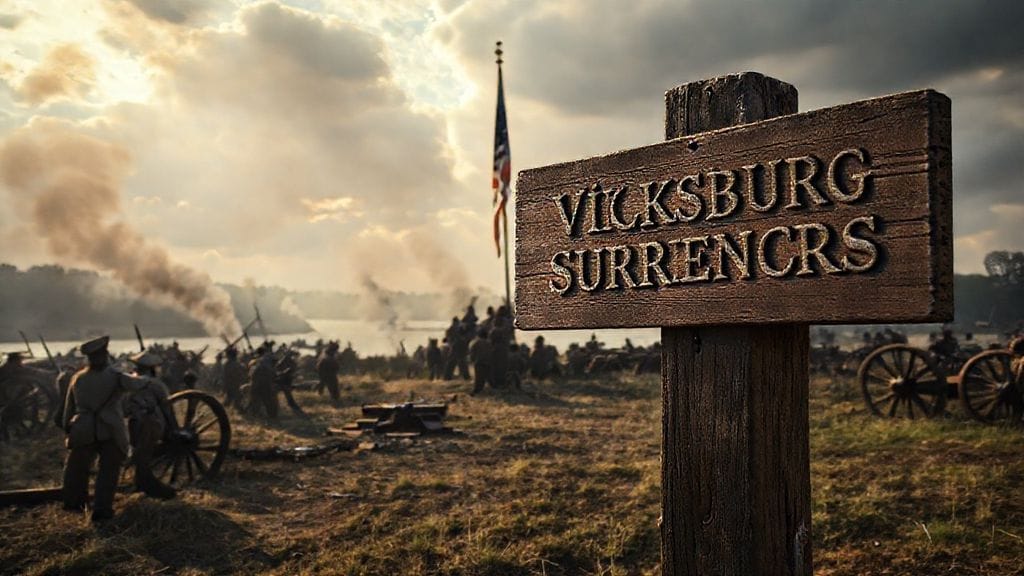
The sun had barely broken over the Mississippi River on July 4, 1863, when the weary citizens and soldiers of Vicksburg braced themselves once more. The air was heavy with dust and despair, the haunting echoes of artillery fire still fresh in the ears of the defenders. For forty-seven grueling days, this fortified city had withstood the unyielding pressure of a well-orchestrated Union siege. The streets, once vibrant with commerce, were now trenches; the homes, now shelters or hospitals, bore the scars of relentless bombardment. Hunger gnawed at every stomach, yet a grim determination refused to die out. That morning, however, amidst the scorching heat and the ghostly silence between the gunfire, the decision to surrender set the course for a new chapter in American history.
2. The Strategic Heart of the Confederacy: Why Vicksburg Mattered
Vicksburg was not just another city along the Mississippi. Perched atop high bluffs, it was a fortress guarding the lifeline of the Confederacy’s western states. The Mississippi River was the artery of supply, communication, and transportation, and Vicksburg was its beating heart. Control over this river meant splitting the Confederacy in two, severing Texas, Arkansas, and Louisiana from the rest of the Southern states. For the Union, it represented a vital step to chisel away at the rebellious South’s resilience. Holding Vicksburg was to hold the key to the Western theater and potentially shorten a war that was dragging on with catastrophic costs.
3. A Nation Divided: The War’s Context in Early 1863
By 1863, the United States was battleground and bloodbath. Two years into the Civil War, the initial hopes of quick victories had collapsed under brutal reality. The Union sought a decisive victory to bolster morale and cripple the Confederacy’s capacity. The Emancipation Proclamation, issued in January 1863, had also transformed the war into a moral crusade against slavery, hardening Southern resistance but inspiring Northern troops. Set against this backdrop, the contest for Vicksburg symbolized more than military strategy — it was a test of will, ideals, and the future direction of the nation.
4. Ulysses S. Grant: The Relentless Commander
Ulysses S. Grant was a man shaped by perseverance. Before the war, he was a relatively obscure officer, burdened by failures and personal struggles. Yet the Mississippi campaign was his arena of redemption. Known for his quiet confidence and audacity, Grant embraced unconventional tactics — daring river crossings, rapid marches through hostile terrain, and unyielding pressure on Confederate defenders. His refusal to retreat or negotiate early surrender distinguished him from many commanders. As he orchestrated the siege, his strategic mind was relentless; failure was unthinkable.
5. The Confederate Defense: John C. Pemberton’s Struggle
Opposing Grant was Lieutenant General John Clifford Pemberton, entrusted by the Confederacy to hold Vicksburg at all costs. A native Northerner fighting for the South, Pemberton's position was precarious — isolated, outnumbered, and under constant threat. His forces, though fortified, lacked the resources and reinforcements desperately needed. Pemberton was caught between duty and pragmatism: to defend the city was to prolong suffering without guarantee of relief, yet surrender felt like betrayal. His predicament painted a human face on the cost of divided loyalties and the torment of command decisions.
6. The Campaign Begins: Maneuvers Along the Mississippi
The Union’s campaign toward Vicksburg was a masterpiece of maneuver warfare. Rather than a straightforward assault, Grant executed a series of daring crossings south of the city, outflanking Confederate positions and severing supply lines. The coordinated use of Navy gunboats and infantry advanced the siege lines relentlessly. Each move tightened the noose around Vicksburg, pushing Confederate troops and civilians into shrinking confines. The campaign remained fluid and unpredictable, underscoring the complexity of 19th-century warfare amidst geography and logistics.
7. The Siege Emerges: Encirclement and Entrenchment
By mid-May, Grant’s forces had encircled Vicksburg, initiating a siege seldom witnessed in the American hinterlands. Trenches were dug, artillery emplacements constructed, and attacks launched with grinding regularity. The city’s defenders fortified their positions behind earthworks, turning every street corner into a potential deathtrap. Bombardments reduced buildings to rubble, and sappers dug tunnels beneath enemy positions. This standoff, marked by attrition and grinding patience, was war’s brutal reality — a contest of endurance testing every ounce of humanity on both sides.
8. Civilians in the Crossfire: Life Inside Vicksburg’s Walls
While soldiers fought for survival, civilians bore an invisible siege of their own. Families cramped into basements and caves to avoid bombardments, scarce food rations stoked desperation, and disease surged amid unsanitary conditions. Children, women, and elderly endured hunger and fear alongside wounded soldiers. Tales survive of mothers scavenging riverbanks for food scraps, pastors delivering sermons of hope amid despair, and quiet acts of kindness breaking through the darkness. The ordeal etched scars on the city’s collective soul that would linger long after guns fell silent.
9. Starvation and Suffering: The Human Cost of Siege Warfare
The hardships of the siege went beyond military tactics — they cut deep into the fabric of life. As supplies dwindled, malnutrition set in, weakening defenders and citizens alike. Cholera and dysentery claimed lives indiscriminately, compounding the agony. Soldiers scavenged rats and mules as food, while civilians endured relentless hunger. Letters sent home whispered of anguish and fading hope. This human cost was the brutal underbelly of a campaign sometimes reduced to numbers and strategies, reminding us that history is built from lived pain and resilience.
10. The Final Days: Letters, Hopes, and Desperation
As June drifted into July, the walls of Vicksburg tightened invisibly. Pemberton’s forces were fractured; deserters slipped away under darkness, and rumors of surrender gathered traction. Letters exchanged between commanders revealed the weight of impending decisions—a balance between pride, pragmatism, and survival. The Confederate high command debated relief attempts, but reinforcements were nowhere near. Inside the city, hopeful prayers battled the grim realism of starvation. When July 3 brought a relentless bombardment, it was clear that the city’s resistance was nearing its limits.
11. July 4, 1863: The Moment of Surrender
At last, on Independence Day itself, the decision came. Rising smoke hung like a bad omen as Pemberton, accompanied by his staff, stepped toward Union lines. The ceremony of surrender was solemn and laden with exhaustion. Grant and Pemberton met and discussed terms — officers permitted to keep sidearms, soldiers paroled. The Confederate flag was lowered, replaced by the star-spangled banner. The capture of Vicksburg was a victory not merely tactical, but symbolic, marking the Union’s ascendancy in the war's Western theater.
12. Grant’s Magnanimity: Honoring the Enemy
In what many historians regard as an exemplar of military honor, Grant treated his surrendered foes with respect. He refused to demean the Confederates and ensured the humane treatment of prisoners and civilians. This measure earned him admiration and mirrored a hope to heal a fractured nation rather than deepen its wounds. Grant’s magnanimity was not naïveté but a strategic gesture toward reconciliation — an early glimpse of the challenges that would shape post-war America.
13. The Turning Point: Military and Psychological Ramifications
The fall of Vicksburg was a seismic event for the Civil War. Militarily, it gave the Union undisputed control of the Mississippi River, splitting the Confederacy territorially. Psychologically, it shattered the aura of Confederate invincibility and galvanized Northern morale. The twin victories of Gettysburg and Vicksburg, achieved within days of each other, turned the tide irrevocably. For the South, Vicksburg was a wound that sapped hope and exposed vulnerabilities that would be exploited in the years ahead.
14. Mississippi’s Fall and the Union’s Control of the Mississippi River
With Vicksburg under Union control, the Mississippi River became a conduit for Northern logistics and a barrier to Southern unity. Towns along the river fell into Line of communication, and Confederate supply routes were severed. This territorial gain hastened campaigns in the South and weakened Confederate strategic options. Controlling the Mississippi was akin to controlling the South’s economic heart, and Vicksburg was the key to that dominance.
15. The Confederate Collapse: Morale and Resources After Vicksburg
The aftermath of Vicksburg’s surrender saw a demoralized Confederate command struggling to regroup. The loss deprived them of critical resources—from food to manpower—and forced a reevaluation of defensive strategies. Morale among troops plummeted, desertions rose, and the political pressure on Confederate leadership intensified. The psychological blow dealt at Vicksburg would reverberate throughout the war’s remaining years, hastening the erosion of Southern resistance.
16. The Parallel Event: Gettysburg’s Impact on the War’s Tide
Coinciding almost exactly with the Siege of Vicksburg was the Battle of Gettysburg (July 1–3, 1863), where Robert E. Lee’s Army of Northern Virginia suffered a decisive defeat. Together, these twin battles marked a definitive shift in the war’s momentum. While Gettysburg halted the Confederate invasion of the North, Vicksburg dismantled Southern control over vital infrastructure. The Union emerged from these blows with renewed confidence, and the international perception of the Southern cause as invincible was forever altered.
17. Legacy of Vicksburg: Memory, Monuments, and Historical Debate
Vicksburg's legacy is preserved in countless memorials, particularly the Vicksburg National Military Park, created to honor the soldiers and civilians who endured the siege. The event has been the subject of extensive historical debate—over decisions by commanders, the siege’s ethical implications, and its place in the broader narrative of the Civil War. It remains a touchstone for understanding the complexities of war, leadership, and resilience. The memory of Vicksburg echoes in American identity as both tragedy and triumph.
18. Vicksburg in American Cultural Imagination
Beyond the military sphere, Vicksburg occupies a symbolic space in American culture. It has inspired literature, poetry, and art portraying themes of endurance, sacrifice, and the cost of division. Songs and stories passed down within families preserve the voices of those who lived through it. Vicksburg’s story helps younger generations connect with the tangible realities of history beyond abstract conflict, fostering empathy and a deeper understanding of national unity’s fragile foundation.
19. The Siege’s Role in Modern Military Strategy
The Siege of Vicksburg continues to be studied in military academies worldwide as a classic example of siege warfare and joint operations. Grant’s campaign demonstrated the importance of maneuver, supply lines, psychological pressure, and coordination between land and naval forces. Lessons from Vicksburg echo in later conflicts and underscore how warfare extends beyond battlefield clashes to the civilian lives and infrastructures entwined with them.
20. Reflections on Leadership, Tenacity, and the Cost of War
At its core, the story of Vicksburg is a story of human character. The determination of soldiers and civilians alike, the burden carried by commanders, and the devastating costs of conflict resonate across time. Leadership and tenacity were often measured not in glory but in survival, compassion, and pragmatism amid chaos. By reflecting on Vicksburg, we confront the paradox of war — where honor and horror coexist — and are reminded of the preciousness of peace.
21. Conclusion: The End of a Fight, The Dawn of a New Era
When the guns fell silent over Vicksburg, the war was far from over, but the course had irrevocably changed. The city’s surrender on July 4, 1863, marked a pivotal chapter not only in the Civil War but in the American experiment itself. It was a moment that tested the nation’s resilience, reshaped its geography, and challenged its ideals. As we remember Vicksburg, we are called to honor the sacrifices made, to learn from the past’s wounds, and to strive for a future where such divisions need never resurface.
Conclusion
The surrender of Vicksburg stands as a testament to the fierce determination and profound cost of America’s Civil War. It encapsulates the tangled web of strategy, human endurance, leadership challenges, and moral complexity faced by a nation divided. Through relentless siege, hunger, hope, and heartbreak, the story of Vicksburg transcends its military significance. It is a human drama, a pivot point in the fight for unity and freedom, and a mirror reflecting the sacrifices that accompany the quest for a more perfect union. Today, its legacy invites us to remember that history is not a distant tale, but a living lesson in courage, compassion, and the fragility of peace.
FAQs
1. Why was Vicksburg so important during the Civil War?
Vicksburg controlled a strategic segment of the Mississippi River, critical for supply and communication. Its capture split the Confederacy and allowed the Union to dominate the river, effectively crippling Southern logistics and unity.
2. Who were the main military leaders involved in the siege?
Union forces were commanded by Ulysses S. Grant, whose aggressive tactics shaped the siege. The Confederate defense was led by Lieutenant General John C. Pemberton, tasked with holding the city despite limited resources.
3. What was the experience like for civilians during the siege?
Civilians endured constant bombardment, starvation, disease, and fear. Many sought refuge in caves and basements, coping with scarcity while hoping for relief that never came.
4. How did the surrender of Vicksburg influence the course of the Civil War?
The Union’s control of the Mississippi severed Confederate territories and boosted Northern morale. Coupled with the Union victory at Gettysburg, it marked a turning point that began the South’s strategic decline.
5. What terms did Grant offer Pemberton at surrender?
Grant granted honorable terms: Confederate soldiers could keep their personal sidearms and were paroled rather than imprisoned. This respectful treatment helped maintain military decorum and sowed seeds for eventual reconciliation.
6. How is the Siege of Vicksburg remembered today?
It is commemorated through monuments and the Vicksburg National Military Park. The siege is studied for its military significance and remembered for its human impact, symbolizing sacrifice and endurance in American history.
7. Were there any controversies surrounding the siege?
Historical debates focus on command decisions, the ethics of siege warfare, the treatment of civilians, and whether relief efforts could have changed the outcome for the Confederates.
8. How does the Siege of Vicksburg influence modern military strategy?
Vicksburg is a case study in siege operations, joint army-navy coordination, and logistics, emphasizing the blend of maneuver warfare and attrition tactics still relevant in contemporary conflicts.