Table of Contents
- The Moment at Versailles: January 18, 1871
- From Fractured States to Empire: The Road to Unification
- The Franco-Prussian War: Catalyst of a New Power
- Otto von Bismarck: The Iron Chancellor’s Masterstroke
- Politics and Diplomacy: The Chessboard of Europe
- The Palace of Versailles: Symbolism and Sovereignty
- The Proclamation Ceremony: Drama and Display
- The Figure of Wilhelm I: King Turned Emperor
- Reactions Across Europe: Awe, Alarm, and Ambivalence
- The German Empire’s Constitution and Structure
- Military Might and National Identity: The Empire Solidifies
- The French Perspective: Humiliation and Resolve
- Economic Transformation: Industrial Powerhouse Rising
- Social and Cultural Consequences Within Germany
- The Empire’s Place in the Global Balance of Power
- Long Shadow: How 1871 Shaped the 20th Century
- Legacy and Memory of the German Empire’s Birth
- The Versailles Proclamation in Historical Narrative
- Revisiting the Event: Historiography and Debate
- Conclusion: An Empire’s Dawn and the Preludes of Destiny
- FAQs: Understanding the German Empire’s Proclamation
- External Resource
- Internal Link
On a frigid winter day, beneath ornate ceilings and frescoed walls in the Palace of Versailles—an edifice synonymous with French monarchy and glory—history was about to be reshaped forever. January 18, 1871, marked not merely the abdication of France’s unquestioned prestige on the battlefield but the fiery birth of a new behemoth. The German Empire was proclaimed. Crowned by iron resolve and political cunning, it would rise from the fractured states of old Germania to rule the destinies of Europe. The sound of formal proclamations echoed across the grand hall, revealing the emergence of Wilhelm I as the first German Emperor, a symbol of unity forged through war, diplomacy, and realpolitik.
Yet the scene was more than ceremonial pomp; it was a decisive statement against centuries of division and weakness, an announcement that the landscape of power in Europe had irrevocably shifted. For the French, the ceremony inside Versailles was a bitter wound. For the Germans, it was the long-awaited answer to national aspirations deferred since time immemorial.
But behind those stately declarations and the cheers lay a perilous new order—one that would shape alliances, ignite rivalries, and steer the continent toward the tumultuous 20th century. The proclamation of the German Empire was not just the birth of a nation-state but the dawn of a new age in European history.
From Fractured States to Empire: The Road to Unification
The German lands were once a patchwork quilt of duchies, kingdoms, and principalities. The Holy Roman Empire, a sprawling and often unwieldy entity, had dissolved in 1806 after Napoleon’s decisive campaigns scattered centuries-old institutions. What remained was a constellation of over 30 independent states, each jealously guarding its own sovereignty.
The 19th century witnessed a growing tide of German nationalism—part cultural pride, part political agitation. Intellectuals, bourgeoisie, and revolutionaries alike dreamt of forging a unified Germany from these myriad fragments. However, this vision was snagged by practical obstacles: old rivalries, the interests of powerful neighbors, and competing political models ranging from liberal constitutionalism to authoritarian monarchy.
In this simmering atmosphere, the Kingdom of Prussia emerged as the natural leader. Under the guidance of King Wilhelm I and his astute minister-president Otto von Bismarck, Prussia positioned itself as the architect of unification—not through utopian ideals, but through calculated strategy and the calculated use of force.
The Franco-Prussian War: Catalyst of a New Power
If unification was the dream, the Franco-Prussian War (1870–1871) was the crucible. Triggered by diplomatic tensions—most famously the Ems Dispatch—this conflict became a war of survival and dominance between a modernizing, assertive Germany and a declining but proud France under Emperor Napoleon III.
The war revealed Prussia’s military superiority, modern mobilization, and strategic prowess. Battles like Sedan lamented the humiliation of the French as Napoleon III fell captive. The Siege of Paris, a protracted ordeal, tested French resolve but ultimately cracked the city’s defenses.
Victory was not just military; it became a psychopolitical weapon. The German princes from various states gathered around the Prussian banner, lauding the success as the justification for political unity. The defeated French were forced into an armistice that set the stage for the dramatic proclamation in Versailles.
Otto von Bismarck: The Iron Chancellor’s Masterstroke
Bismarck’s genius lay in his relentless pragmatism. Eschewing lofty ideals, he wove alliances, provoked wars selectively, and always prioritized realpolitik—politics grounded in power, not principle.
To Bismarck, unification through Prussian dominance was the surest way to advance Germany. The defeat of France was a political masterstroke that allowed him to convene the German princes in Versailles itself—a French palace turned theater for German ascendance. His careful orchestration of the proclamation ensured the birth of the empire would be perceived not as conquest but as destiny fulfilled.
Bismarck’s vision did not end with the ceremony. The empire’s federal structure, the role of the Kaiser, and the powers of Prussia within it all reflected his balancing act of power consolidation and state collaboration.
Politics and Diplomacy: The Chessboard of Europe
The creation of the German Empire sent shockwaves far beyond the palace halls. Europe’s great powers—Austria-Hungary, Russia, Britain—watched warily as a new colossus took shape. The balance of power, delicately maintained since the Congress of Vienna in 1815, was suddenly upended.
Diplomatic relations became tighter, fraught with suspicion and new alliances. Britain, confident in its navy but uneasy about a strong continental rival, began a cautious recalibration. Italy cheered the rise of a fellow unifier. Austria, the former hegemon of the German Confederation, was left sidelined and wary.
In the coming years, this reconfiguration laid the seeds for complex entanglements that would one day explode into world conflict.
The Palace of Versailles: Symbolism and Sovereignty
Choosing Versailles as the site of the proclamation was a symbolic coup. The grand palace had epitomized French absolute monarchy—the Sun King’s seat of power—and its very walls bore the prestige and pride of France.
To proclaim the German Emperor there, in its Hall of Mirrors, was to proclaim the eclipse of old France and the dawn of a new Germany. It was a deliberate message: Germany was the successor to European grandeur.
Yet this choice also intensified French humiliation, planting the bitterness that would fester as revanchism—revenge fueled by national trauma.
The Proclamation Ceremony: Drama and Display
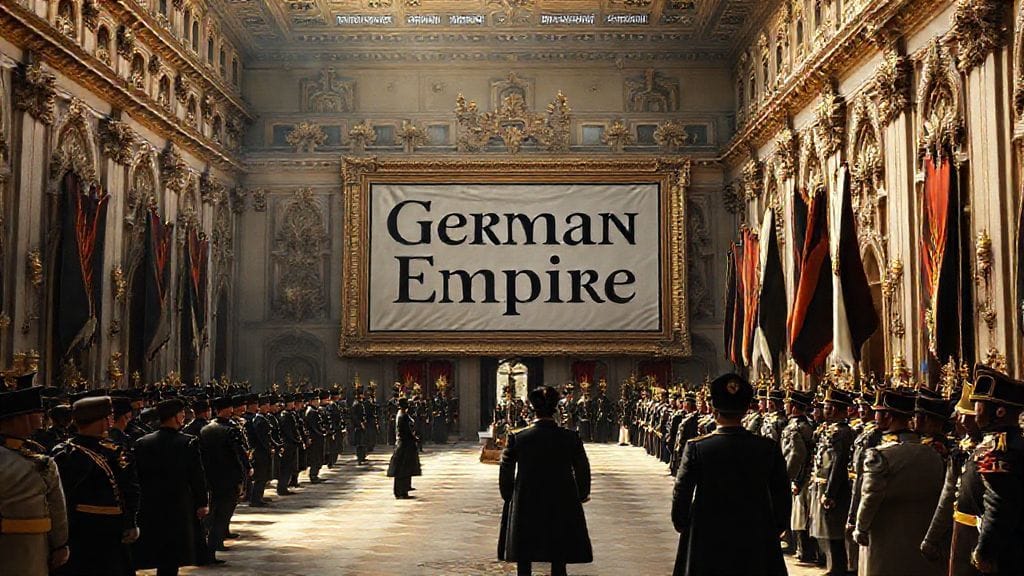
On that frosty January day, the German princes, chancellors, and generals assembled within the glittering Hall of Mirrors. Wilhelm I, standing proud and resolute, accepted the crown offered by the princes, not a crown plucked from the hands of defeated kings but borne as a symbol of unity and honor.
The ceremony was charged with emotion: the clatter of sabers, the solemnity of oaths, the swell of nationalist hymns. It was a pageant affirming the birth of a new European order.
Eyewitnesses recorded Wilhelm’s measured words and Bismarck’s quiet satisfaction. Reporters of the time wrote of the irony of the French hosts forced to serve as spectators to their own political eclipse.
The Figure of Wilhelm I: King Turned Emperor
Wilhelm I was no fiery revolutionary but a symbol of continuity and stability. Having led Prussia through modernization and war, his elevation to Emperor was emblematic of a monarchy adapting to modern nationalism.
His stature, both physical and political, commanded respect. The modest king from Königsberg was now Kaiser, emblematic of a Germany both ancient and modern.
Yet Wilhelm remained personally reserved, often overshadowed by Bismarck’s dynamism, but his role as the empire’s father figure was central to its identity.
Reactions Across Europe: Awe, Alarm, and Ambivalence
The news of the German Empire’s proclamation rippled throughout Europe. Some greeted it with admiration—a powerful new state promising stability after decades of fragmentation.
Others, particularly France and Britain, met it with anxiety, realizing that a united Germany was a potential rival and disruptor.
In Russia, the event was observed carefully, weighing potential alliances. Italy hailed a compatriot success story but also recognized Germany’s growing ambitions.
Across Europe, the balance was delicate, and the proclamation was a signal of change and challenge.
The German Empire’s Constitution and Structure
The empire fashioned itself as a federal monarchy. Power was shared between the Kaiser, the Chancellor, and constituent states, with Prussia dominant among them.
The Bundesrat (Federal Council) embodied state representation, while the Reichstag (parliament) allowed for elected participation—though limited in scope.
This constitutional framework reflected Bismarck’s pragmatic approach: unity without obliteration of local identity, monarchy tempered by parliamentary mechanisms.
Military Might and National Identity: The Empire Solidifies
The empire’s military successes fostered intense national pride. The Reichswehr (later renamed the Imperial German Army) became a symbol of unity and power.
Military parades, war memorials, and public celebrations cemented collective identity around martial valor. Education and popular culture began to emphasize German heritage and destiny.
This militarization, while galvanizing, also planted seeds of future militarism within European politics.
The French Perspective: Humiliation and Resolve
For France, the empire’s proclamation was a national trauma. The recent defeat, the exile of Napoleon III, and the loss of Alsace-Lorraine gnawed at collective pride.
The Third Republic, established in the war’s wake, mustered resolve to recover from this humiliation. Revanchism became a potent political force, nurturing French aims of future redemption.
French literature, politics, and public discourse for decades echoed with longing to erase the stain of 1871.
Economic Transformation: Industrial Powerhouse Rising
Germany’s unification catalyzed its industrial expansion. Freed from internal tariffs and divisions, the empire monetized resources, technology, and infrastructure.
Coal, steel, chemicals, and railways surged. Cities grew, and Germany positioned itself as a burgeoning economic rival to Britain and France.
The empire promised economic opportunity for many, but also social tensions from rapid urbanization and labor struggles.
Social and Cultural Consequences Within Germany
The empire’s birth gave rise to renewed German cultural confidence. Science, philosophy, music, and arts flourished under this new national umbrella.
However, social cleavages persisted: conservative elites clashed with emerging socialist movements; rural traditions met industrial modernity.
Jewish communities, minorities, and political dissidents navigated a society in flux, sometimes with acceptance, sometimes with exclusion.
The Empire’s Place in the Global Balance of Power
As empire and industrial giant, Germany increasingly projected influence beyond Europe.
Colonial ambitions followed, adding competition in Africa and Asia. Naval buildup began to challenge Britain’s maritime supremacy.
The proclamation in Versailles was, thus, not just a European event, but a step toward global repositioning.
Long Shadow: How 1871 Shaped the 20th Century
The declaration of the German Empire was a defining event whose repercussions echoed through alliances, wars, and revolutions.
It contributed directly to tensions leading to World War I, reshaped diplomatic realignments, and influenced nationalist movements.
Understanding 1871 is essential to grasping the tumult of Europe’s subsequent half-century.
Legacy and Memory of the German Empire’s Birth
The proclamation has remained a potent symbol in German history. Whether celebrated as the foundation of modern Germany or critiqued as the origin of aggressive nationalism, it is a cornerstone of historical identity.
Monuments, textbooks, and political debates continue to engage with this legacy.
The Versailles Proclamation in Historical Narrative
Historians have long debated the meaning of the 1871 proclamation—was it inevitable? Was Bismarck a hero or manipulator? Was the empire’s architecture sustainable?
Such interpretations have evolved with time, reflecting contemporary concerns as much as past facts.
Revisiting the Event: Historiography and Debate
Modern scholarship benefits from broader perspectives—social history, international relations, cultural studies—that enrich our understanding.
New archival discoveries and comparative studies continue to shed light on the complexities surrounding the event.
Conclusion: An Empire’s Dawn and the Preludes of Destiny
The proclamation of the German Empire in Versailles was more than a ceremony; it was a pivotal moment reshaping Europe’s fate. Crowning Wilhelm I symbolized not only Prussia’s dominance but also the centuries-old German dream of unity.
Yet, the birth of the empire also set in motion forces—nationalism, militarism, rivalry—that would trouble the continent for decades to come.
It remains a vivid testament to how power and identity intertwine, and how history’s grand moments are forged in places ripe with symbolism and consequence.
Conclusion
The birth of the German Empire under the vaulted mirrors of Versailles, amid the cold January air of 1871, was a landmark moment charged with hope and hubris alike. It marked the fulfillment of nationalist aspirations, the triumph of statecraft, and decisive military conquest. But it was also the inception of a new era, one fraught with complications and contradictions.
For both winners and losers, this event shaped national psyches and geopolitical contours. It was a moment when history seemed to crystallize into a new shape, defined by iron and smoke, by ceremony and cynicism. To revisit this day is to confront the volatile pulse of a continent on the cusp of transformation.
The German Empire’s proclamation reminds us that the forces which unite and empower can also divide and destabilize—a lesson as relevant now as it was then.
FAQs
Q1: What were the primary causes leading to the proclamation of the German Empire?
A1: The main causes were decades of fragmented German states, rising nationalism, political leadership by Prussia and Bismarck, and the decisive Franco-Prussian War which shifted power and encouraged German unification under Prussian dominance.
Q2: Why was the proclamation held at the Palace of Versailles?
A2: Versailles was chosen for its symbolic weight as the seat of French power and monarchy, projecting a dramatic message that German unity and strength had eclipsed France’s former dominance.
Q3: What role did Otto von Bismarck play in the creation of the Empire?
A3: Bismarck was the mastermind behind unification, using diplomacy, war, and Realpolitik to orchestrate the conditions for the empire’s birth, and he shaped its constitutional and political framework.
Q4: How did France react to the proclamation and defeat in the war?
A4: France was humiliated and angry, leading to the establishment of the Third Republic and fostering a strong desire for revenge (revanchism) that influenced French politics for decades.
Q5: What was the political structure of the new German Empire?
A5: The empire was a federal monarchy with a constitution combining imperial authority centered on the Kaiser and Chancellor, while maintaining representation for individual German states through the Bundesrat and Reichstag.
Q6: How did the proclamation affect Europe’s balance of power?
A6: It disrupted the established order, creating a powerful new state that challenged Austria, France, and Britain, leading to new alliances and rivalries that contributed to later conflicts.
Q7: In what ways did the proclamation influence German society and culture?
A7: It fostered a surge in national pride, military emphasis, industrial growth, and cultural flourishing, while also exacerbating social tensions and political divisions.
Q8: What is the lasting historical legacy of the German Empire’s proclamation?
A8: The event stands as a symbol of German unity and power but also as a turning point leading to future conflicts, making it a subject of continual study and reflection in historiography.