Table of Contents
- The Thunder Rolls Over the Danube: The Prelude to Plevna
- Bulgaria on the Brink: A Land Set to Ignite
- Russian Ambitions and Ottoman Defiance: The Great Powers in Play
- July 20, 1877: The Siege of Plevna Commences
- The First Assault: Clash of Titans Under a Scorching Sky
- Osman Pasha’s Iron Will: Leadership Amid Siege
- The Siege Tightens: Strategies, Trenches, and the Waiting Game
- War on the Horizon: The Impact on Civilians and Soldiers
- International Eyes on Plevna: Diplomacy in the Shadow of War
- The Second Major Assault and Its Bloody Toll
- Artillery, Entrenchments, and the Evolution of Siege Warfare
- The Defiant City: Plevna’s Streets transformed into Battlefields
- Medical Crisis and Human Suffering in the Besieged Town
- The Turning Point: Russian Persistence Meets Ottoman Resilience
- The Fall of Plevna: The End of the Siege and a New Dawn
- Consequences for the Russo-Turkish War and the Balkans
- Plevna’s Legacy: Memory, Monument, and Myth
- Analyzing the Siege: Military Innovations and Lessons Learned
- The Siege in Global Context: Echoes Across Europe and Beyond
- The Human Stories Behind the Walls of Plevna
- Conclusion
The Thunder Rolls Over the Danube: The Prelude to Plevna
As the summer sun beat mercilessly down on the fields of Bulgaria in July 1877, the air was thick with anticipation and dread. The rumble of artillery echoed faintly across the Danube, a grim prelude to the storm about to descend. In the heart of the Balkans, the town of Plevna—known today as Pleven—stood as an unexpected symbol of imperial resolve, resistance, and the shifting tides of a continent on the brink. The siege that began on July 20 would come to define a pivotal moment in the Russo-Turkish War, reshaping borders, lives, and the very fabric of Eastern Europe.
Bulgaria on the Brink: A Land Set to Ignite
For decades, Bulgaria had simmered beneath the weight of Ottoman rule. A tapestry of diverse cultures, traditions, and national aspirations, the region was a tinderbox amid the declining Ottoman Empire. The Bulgarian people had endured oppression, yet their hunger for freedom only grew stronger. In the background, the Great Powers of Europe watched cautiously, calculating their moves in a complex chessboard of alliances, fears, and ambitions. The era was defined by nationalism and the painful birth of new nations.
Russian Ambitions and Ottoman Defiance: The Great Powers in Play
Russia’s entry into the war in April 1877 was motivated by a blend of ideological, religious, and strategic factors. Presenting itself as the liberator of Slavic peoples under Ottoman yoke, Russia declared war ostensibly to protect Orthodox Christians. However, beneath the rhetoric lay the desire to carve out influence in the Balkans and weaken the “sick man of Europe.” The Janissaries, Ottoman administrators, and soldiers braced for the inevitable, refusing to cede their centuries-old dominion without a fierce struggle.
July 20, 1877: The Siege of Plevna Commences
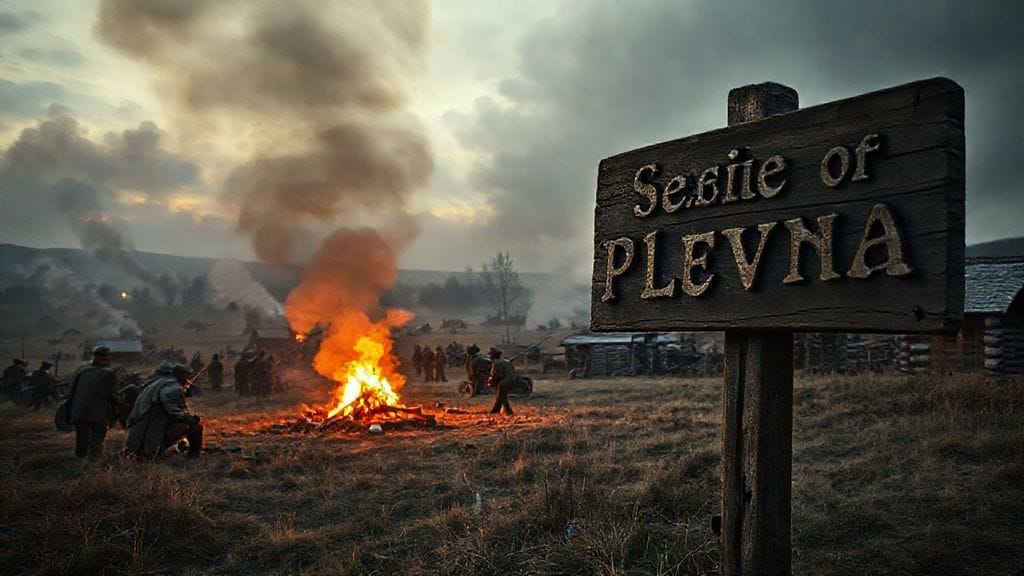
The siege began with an air of both confidence and caution. Russian forces, under the command of General Mikhail Skobelev and others, understood that capturing Plevna would open a gateway into the Balkan interior. Osman Pasha, appointed to defend the fortress city, was a masterful commander, keenly aware that to yield Plevna was to suffer a catastrophic loss. The first artillery volleys shattered the uneasy silence, announcing a brutal campaign that would test every ounce of endurance and willpower on both sides.
The First Assault: Clash of Titans Under a Scorching Sky
Russian infantry launched their initial attack with fiery zeal, expectation riding high. But against Osman Pasha’s well-fortified defenses and unyielding troops, the assault faltered. Concealed rifle fire, expertly laid out fortifications, and tactical finesse saw the defenders repulse the attackers, causing heavy casualties. The town became a cauldron of violence, a grim theater where the fortunes of empire wavered beneath cannon smoke and cries of the wounded.
Osman Pasha’s Iron Will: Leadership Amid Siege
Osman Pasha emerged as a figure of immense resolve amid this inferno. His leadership combined strategic insight and personal bravery, inspiring his men to hold against overwhelming odds. Despite isolation and dwindling supplies, Osman’s command ensured the fortress remained a thorn in the side of the Russian offensive. His correspondence and diaries reveal a man both burdened and deeply committed—aware that his legacy was being forged in these desperate days.
The Siege Tightens: Strategies, Trenches, and the Waiting Game
As days turned to weeks, the chaotic clashes gave way to a grueling siege war. Both sides dug trenches, mounted artillery batteries, and sought advantage through attrition. Disease and exhaustion became as deadly as enemy fire. The Russians experimented with new siege tactics, adjusting to the unexpected strength of Plevna’s defense, while Ottoman soldiers endured worsening conditions with grim determination. The town itself was a fortress and a prison, encircled but unbroken.
War on the Horizon: The Impact on Civilians and Soldiers
While generals and politicians mapped strategies, the people of Plevna and the surrounding countryside suffered immeasurably. Civilians endured food shortages, bombardments, and fear. Refugees streamed outward, and hospitals overflowed with the wounded. Soldiers—both Russian and Ottoman—faced the mental and physical toll of a protracted siege. Letters home speak of camaraderie, despair, hope, and the everyday heroism that history often overlooks.
International Eyes on Plevna: Diplomacy in the Shadow of War
Though fought in a remote Balkan town, the siege attracted intense interest abroad. European capitals monitored developments with bated breath, understanding that the outcome could alter the fragile balance of power. Newspapers chronicled the struggle with a mix of fact and fervor, stoking nationalist pride and anxieties. Diplomats debated back-channel negotiations even as guns fired relentlessly, a testament to the entanglement of war and politics.
The Second Major Assault and Its Bloody Toll
In late August and September, Russian forces launched successive major assaults designed to break Osman’s lines. These attacks met with devastating resistance. The defenders’ marksmanship and fortifications inflicted severe casualties; Russians lost thousands in bloody, fruitless charges. The brutal nature of these battles punctuated the medieval harshness of siege warfare amid the industrializing armies of the 19th century.
Artillery, Entrenchments, and the Evolution of Siege Warfare
The siege of Plevna highlighted the growing importance of artillery and entrenched positions. Tactical lessons emerged about balancing infantry assaults with artillery bombardments and siege engineering. The defenders, with carefully placed earthworks and redoubts supported by rifle fire, demonstrated the challenges attackers faced in the modern battlefield. Military observers took meticulous notes; the experience would inform future conflicts and the evolving science of war.
The Defiant City: Plevna’s Streets Transformed into Battlefields
Within the walls of Plevna, ordinary streets morphed into trenches, barricades, and bloody confrontation zones. Homes and churches were converted into makeshift hospitals and command centers. The city endured constant shelling; few buildings remained untouched by war’s cruel hand. Yet amid ruins, the spirit of resistance endured, symbolizing not just military prowess but a determination to assert identity and dignity.
Medical Crisis and Human Suffering in the Besieged Town
Medical staff faced overwhelming challenges treating the wounded amid scarcity and danger. Disease—typhus, dysentery, and more—spread rapidly, compounding the carnage. Makeshift infirmaries overflowed as men succumbed to infections, wounds, and exhaustion. The toll was physical but also profound psychologically, as despair threatened to erode the defenders’ resolve. This human dimension often eclipses statistics but defines the siege’s tragic core.
The Turning Point: Russian Persistence Meets Ottoman Resilience
As autumn approached, the stubborn siege caught in an exhausting stalemate, the wear on Osman’s forces became unbearable. Russian reinforcements arrived, and siege lines tightened like a noose. The defenders’ ammunition ran perilously low. The final months of resistance fused desperate courage with grim survival. It was a test not only of arms but of human endurance—a poignant narrative where the fate of empires felt inseparable from the fate of individual men.
The Fall of Plevna: The End of the Siege and a New Dawn
Finally, in December 1877, after nearly five months, Plevna fell. Osman Pasha surrendered with honor, spared perhaps by recognition of his valiant defense. The Russian victory cracked Ottoman resistance in the Balkans, a dramatic moment that symbolized the shift in regional power structures. The war would continue, but the Siege of Plevna was etched into history as a turning point—one that reshaped borders and the future of the Balkans.
Consequences for the Russo-Turkish War and the Balkans
Plevna’s fall accelerated the collapse of Ottoman authority in the region, leading to the Treaty of San Stefano and ultimately the Congress of Berlin in 1878. Bulgaria enjoyed autonomy, carving a new nation-state from centuries of imperial rule. The war redrew maps and spirits alike, fueling new nationalisms and realigning alliances. The Ottoman Empire’s retreat presaged the slow dissolution of a once-mighty entity and the awakening of the Balkan peoples.
Plevna’s Legacy: Memory, Monument, and Myth
The siege remains a powerful symbol in Bulgarian, Russian, and Turkish historical memory. Monuments commemorate valiant defenders and fallen heroes. Stories of bravery and sacrifice have inspired generations, even as historians debate the strategic lessons and ethics of siege warfare. Plevna became a narrative fulcrum where history, myth, and identity converged, a reminder of both the horrors of war and the resilience of the human spirit.
Analyzing the Siege: Military Innovations and Lessons Learned
Military scholars view the siege as a case study in the transition between traditional and modern warfare. The effectiveness of entrenched defenses against massed infantry attacks presaged future conflicts. Command decisions, logistical challenges, and innovations in artillery deployment provided valuable insights for military theory. Plevna’s story underscores how technology, terrain, and leadership intertwine in the crucible of combat.
The Siege in Global Context: Echoes Across Europe and Beyond
Though geographically peripheral, the Siege of Plevna rippled far beyond Bulgaria’s borders. European powers recalibrated their diplomatic strategies; the war influenced the declining Ottoman Empire’s status and inspired nationalist movements elsewhere. The conflict hinted at the approaching upheavals of the 20th century—a prelude to world wars defined by technology and mass mobilization. It is incredible how a small town could shape a continent’s destiny.
The Human Stories Behind the Walls of Plevna
Behind the grand narratives and statistics were thousands of individuals: soldiers fighting through freezing winters and blistering summers; civilians caught in the crossfire; medics running from makeshift hospitals to the battlefield; families waiting anxiously for news. Diaries, letters, and memoirs open windows into their pain, hope, and humanity. These voices make the siege a living story, alive beyond dates and facts.
Conclusion
The Siege of Plevna was not merely a clash of armies; it was a monumental struggle of will, identity, and the relentless forces of history. Its echoes remind us that behind every stone wall and battered trench lies a human spirit tested by fire and faith. As empires wavered and new nations emerged from the smoke, Plevna stood as a testament to resilience and transformation. Remembering this epic siege invites us to honor courage in the face of overwhelming odds and to reflect on how the past shapes our present.
FAQs
Q1: What triggered the start of the Siege of Plevna?
A1: The siege began as part of the Russo-Turkish War of 1877-1878, when Russian forces sought to invade Ottoman-held Bulgaria and encountered determined resistance at Plevna, whose capture was vital for advancing into the Balkans.
Q2: Who was Osman Pasha and why is he significant?
A2: Osman Pasha was the Ottoman commander in charge of defending Plevna. His leadership, strategic skill, and personal bravery turned the town into a formidable fortress and prolonged the siege far beyond initial Russian expectations.
Q3: What were the main military strategies employed during the siege?
A3: The defense relied on intricate fortifications, rifle fire, and artillery placements, while attackers used mass infantry assaults, artillery bombardments, and trench warfare, marking a transition into modern siege tactics.
Q4: How did the siege affect civilians in Plevna?
A4: Civilians suffered from food shortages, bombardments, and disease, facing immense hardship amid the battle’s destruction. Many were displaced, and the humanitarian crisis was severe alongside the military conflict.
Q5: What were the consequences of the siege’s outcome?
A5: The fall of Plevna marked a turning point in the Russo-Turkish War, leading to Ottoman defeat, Bulgarian autonomy, and significant shifts in the Balkan political landscape that rippled throughout European geopolitics.
Q6: How is the Siege of Plevna remembered today?
A6: The siege is commemorated with monuments and remains a symbol of heroism and national identity in Bulgaria, Russia, and Turkey, studied for its military significance and human stories.
Q7: What lessons did militaries learn from the siege?
A7: The siege highlighted the increasing importance of fortified defenses and artillery, and the limits of frontal infantry assaults, informing future military doctrines well into the 20th century.
Q8: Did the siege have any impact beyond the Balkans?
A8: Yes, the siege influenced international diplomacy and perceptions of the Ottoman Empire’s decline, foreshadowing nationalist movements and geopolitical changes across Europe.