Table of Contents
- A Shattered Dawn: The Signing of the Treaty of San Stefano
- The Ottoman Empire on the Brink: Prelude to Negotiation
- The Great Eastern Question: European Powers in Turmoil
- Russia’s Ambitions and the Balkan Chessboard
- The Russo-Turkish War: Flames of a Fading Empire
- The Siege of Pleven: Turning Points in the Conflict
- Diplomacy at Yeşilköy: Setting the Stage for the Treaty
- The Day of Reckoning: March 3, 1878
- The Treaty’s Terms: Redrawing the Map of the Balkans
- Bulgaria’s Giant Leap: The Birth of a New State
- The Reverberations in Constantinople: Ottoman Reactions
- Ripples Across Europe: The Concert of Powers Responds
- The Treaty’s Hidden Fault Lines: Seeds of Future Conflict
- The Congress of Berlin: Revisiting San Stefano’s Legacy
- Cultural Reverberations: Nationalism and Identity in the Balkans
- Human Stories from the Frontline of Change
- The Twilight of the Ottoman Age: Geopolitical Aftershocks
- The Legacy of San Stefano in Modern Memory
- Reflections on Imperial Ambitions and Realpolitik
- Conclusion: Echoes of a Treaty That Reshaped Europe
- FAQs About the Treaty of San Stefano
- External Resource
- Internal Link
1. A Shattered Dawn: The Signing of the Treaty of San Stefano
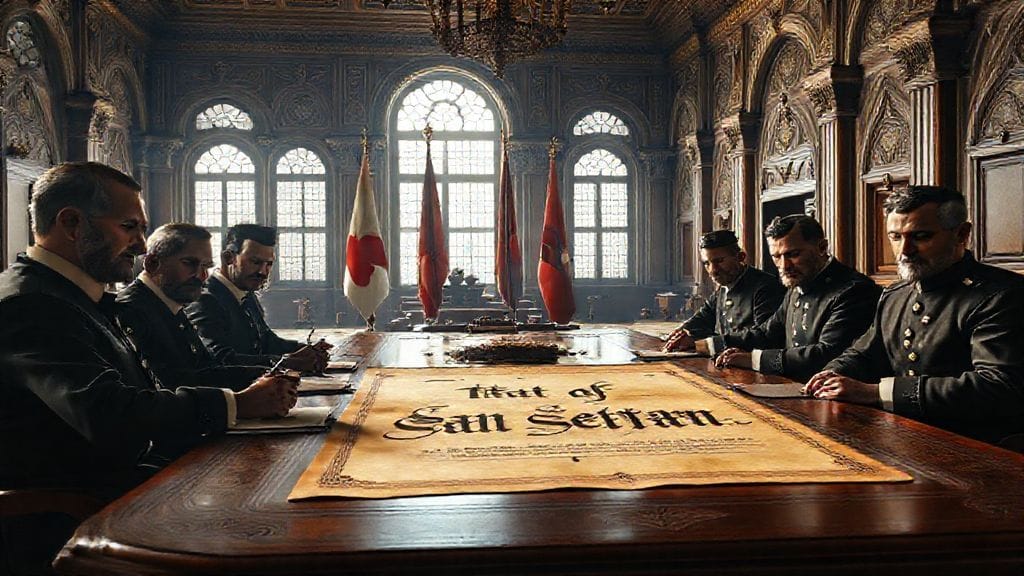
In the cold March morning of 1878, on the outskirts of Istanbul in the small coastal village of San Stefano—today known as Yeşilköy—the air carried a peculiar blend of hope and deep unease. Representatives from a waning empire and the victorious Russian negotiators sat across a simple wooden table within an Ottoman mansion, beneath thick beams echoing centuries of imperial history. Outside, the relentless sea whispered the coming of a new era, one that would irrevocably alter the fate of a region long caught between East and West.
The Treaty of San Stefano, signed on March 3rd, was more than an agreement; it was a seismic shift, a symbol of the Ottoman Empire’s fading grip on its European territories and the crescendo of nationalist aspirations across the Balkans. But as joyous celebrations erupted among newly empowered peoples, shadows loomed—unseen lines were drawn that would shape conflicts yet to come.
2. The Ottoman Empire on the Brink: Prelude to Negotiation
By the late 19th century, the Ottoman Empire, long revered as the “Sick Man of Europe,” faced existential threats. Its vast territories—once stretching from the heart of Europe through the Middle East and North Africa—had been steadily eroded by nationalist revolts, European intrigue, and internal decay. The empire struggled to maintain control, particularly over the Balkans, where ethnic tensions festered beneath the surface.
Economic stagnation and political corruption had weakened the empire’s cohesion. The rise of nationalist movements—Serbs, Bulgarians, Romanians, and others—challenged Ottoman authority, exacerbating internal fractures. The echoes of previous uprisings, such as the Serbian Revolt (1804–1817) and the Greek War of Independence (1821–1830), pervaded the atmosphere, reminding all that imperial borders could be fragile fortunes indeed.
3. The Great Eastern Question: European Powers in Turmoil
“The Eastern Question,” as it was ominously known, described the uncertainty facing Europe as the Ottoman Empire weakened. What would happen to its vast, diverse territories should the empire collapse? European powers—Britain, Austria-Hungary, Russia, France, and Germany—stood on edge, each eager to assert influence or prevent rivals from gaining too much.
Russia, the protector of Orthodox Christians and Slavic peoples, saw an opportunity. Britain and Austria-Hungary were wary, fearing shifts in the balance of power could threaten their own ambitions in the Mediterranean and Central Europe. The diplomatic dance was intricate and often secretive, with treaties and alliances crisscrossing the continent in a prelude to future wars.
4. Russia’s Ambitions and the Balkan Chessboard
Driven by pan-Slavism and a mix of genuine religious solidarity and imperial strategy, Russia pursued the weakening of Ottoman control. The Russian Empire imagined a revitalized sphere of influence in the Balkans, a corridor to the warm Mediterranean ports and a protectorate over the Slavic peoples.
Tsar Alexander II’s government maneuvered cautiously at first, gauging support among Balkan leaders and measuring the European powers’ responses. The desire to control the strategic Black Sea straits further ignited imperial ambitions. For Russia, the impending war was both a mission of liberation and a chance to extend its dominion.
5. The Russo-Turkish War: Flames of a Fading Empire
The spark came in April 1877 when Russia declared war on the Ottoman Empire. What followed was brutal and protracted—the Russo-Turkish War (1877–1878) spilled blood across the Balkans and the Caucasus. Armies clashed in dense forests, steep mountains, and besieged fortresses under appalling conditions, with disease often proving deadlier than bullets.
This conflict was not simply a military confrontation; it was also a war of ideologies, with nationalist fervor fueling both sides. Russian forces, bolstered by Balkan volunteers, aimed to topple Ottoman influence, while the empire fought desperately to retain its European lands.
6. The Siege of Pleven: Turning Points in the Conflict
One of the war’s pivotal moments was the siege of Pleven (Pleven), a fortress town in present-day Bulgaria. For months, Ottoman forces held the city against overwhelming Russian and Romanian armies, symbolizing the empire’s resistance and resilience.
Yet, when Pleven finally fell in December 1877 after a bloody siege, the momentum shifted decisively. The path to Constantinople lay more open than ever, and the Ottoman negotiating position weakened considerably. The capture was a psychological blow as well as a strategic one, marking the twilight of Ottoman power in the Balkans.
7. Diplomacy at Yeşilköy: Setting the Stage for the Treaty
With Ottoman forces reeling, European diplomacy swung into high gear. The Russians, now in a position of strength, pushed for a large settlement beneficial to Slavic interests. Sultan Abdul Hamid II’s government was forced to accept negotiations near its capital, in San Stefano—a symbolically potent choice, signaling the empire’s diminished position.
The discussions bore all the tension of a high-stakes game. Ottoman representatives, beleaguered and fearful, faced a Russian delegation confident in victory but cautious of alienating other European powers. Behind closed doors, they pored over maps and clauses that would redraw boundaries and define futures.
8. The Day of Reckoning: March 3, 1878
The ink had barely dried on March 3rd when word spread like wildfire: the Treaty of San Stefano was signed. It awarded Russia sweeping territorial gains and created a bulky, autonomous Bulgarian principality stretching from the Danube to the Aegean—a nation vastly larger than Bulgarian leaders themselves had dared to imagine.
Other concessions stripped the Ottoman Empire of lands in Bosnia and Herzegovina, and recognized the independence or autonomy of Serbia, Montenegro, and Romania. The treaty was a bittersweet triumph for many Balkan nationalists and a disaster in the eyes of the Ottoman sultan and his allies.
9. The Treaty’s Terms: Redrawing the Map of the Balkans
The treaty’s provisions were clear and radical. Bulgaria emerged as a potentially powerful state under Russian influence, its territory encompassing nearly half of Macedonia and other contested regions. Serbia, Romania, and Montenegro gained full independence.
Additionally, Russia secured the right to intervene in Ottoman affairs and gained access to key waterways, including the control of the Black Sea straits—vital for its naval ambitions. Ottoman sovereignty shrank abruptly, creating a power vacuum that sent shockwaves throughout Europe.
10. Bulgaria’s Giant Leap: The Birth of a New State
For Bulgarians, the treaty was euphoric. After centuries under Ottoman rule, a dream was realized—the formation of a large Bulgarian principality, autonomy guaranteed and borders flush with historic lands. This was not just a political gain but the flowering of national identity.
Schools, churches, and cultural institutions blossomed as the new Bulgaria began to assert itself on the European stage. Yet, the enormity of its territory and the influence of Russia cast long shadows, foreshadowing tensions within and beyond its borders.
11. The Reverberations in Constantinople: Ottoman Reactions
For Sultan Abdul Hamid II and the Ottoman court, the treaty was a bitter pill. The loss of so much Balkan territory represented not just a geopolitical defeat but a blow to the dynasty’s prestige and legitimacy.
Beyond the palace walls, fear and anger simmered among the populace and the military. The empire’s multiethnic mosaic seemed to unravel as Muslim populations in ceded territories faced displacement, violence, or flight. The sense of isolation deepened, especially as European powers appeared to conspire for Ottoman dismemberment.
12. Ripples Across Europe: The Concert of Powers Responds
The treaty did not sit well with Britain, Austria-Hungary, and Germany. They viewed the massive Bulgaria and Russian gains with alarm, fearing disruption to the European balance of power. Britain particularly dreaded Russian access to the Mediterranean, which threatened its imperial lifelines to India.
Inevitably, this led to the convening of the Congress of Berlin later that year, where the Treaty of San Stefano’s terms would face significant revision. Allies and rivals alike jockeyed to limit Russia’s triumph and recalibrate power structures in the Balkans.
13. The Treaty’s Hidden Fault Lines: Seeds of Future Conflict
Despite initial celebrations, San Stefano sowed discord. Bulgaria’s enlarged borders incorporated diverse populations with competing loyalties, planting the seeds of future ethnic strife. Serbia and Romania, though recognized as independent, chafed at the limited extent of their new territories.
Moreover, the treaty’s adjustment by the Congress of Berlin fueled resentment and mistrust, leading to a Balkan powder keg. The unresolved tensions from San Stefano would contribute decisively to the nationalist rivalries that ignited the First World War decades later.
14. The Congress of Berlin: Revisiting San Stefano’s Legacy
The Treaty of San Stefano lasted less than six months before the Congress of Berlin convened in June 1878. Under the orchestration of German Chancellor Otto von Bismarck, the major European powers redrew the Balkan map anew, curbing Bulgaria’s size and redistributing lands to favor Austro-Hungarian and British interests.
This diplomatic rerouting angered many Balkan peoples and Russia, setting the stage for continuing instability. The Congress’s decisions illustrated the tensions between nationalist self-determination and great power politics—a tragic, repeating theme in European history.
15. Cultural Reverberations: Nationalism and Identity in the Balkans
The treaty and its aftermath turbocharged nationalist movements across the Balkans. Folk songs, literature, and political discourse dwelled on liberation and betrayal, weaving the memory of San Stefano into the fabric of modern national identities.
This was more than political cartography—it was a catalyst for cultural renaissance and a deepening of ethnic consciousness. The idea of map and nationhood became inseparable, driving aspirations and animosities that survive to this day.
16. Human Stories from the Frontline of Change
Amid maps and treaties, ordinary lives were transformed. Refugees—Muslim, Christian, Slavic—fled advancing armies or changing borders. Families separated, communities uprooted, and new states struggled to integrate disparate populations.
Letters and memoirs from that period reveal a complex mosaic of hope, fear, betrayal, and courage. These human chronicles underscore the often overlooked cost of diplomacy writ large.
17. The Twilight of the Ottoman Age: Geopolitical Aftershocks
San Stefano marked a clear step in the Ottoman Empire’s contraction, signaling a transition from multiethnic imperial rule to fragmented national sovereignties. The empire’s European territories diminished, and Sultan Abdul Hamid II’s reign soon adopted a more paranoid and autocratic stance in response.
Internationally, the treaty intensified rivalries that shaped alliances, conflicts, and power struggles until the Great War. The shifting borders became a legacy of contested sovereignties and fractious diplomacy.
18. The Legacy of San Stefano in Modern Memory
Today, the Treaty of San Stefano remains a touchstone in the histories of Turkey, Russia, Bulgaria, and the Balkans at large. It symbolizes both liberation and loss, emancipation and geopolitical manipulation.
Commemorations and controversies arise whenever its anniversary comes, reminding us that borders drawn in moments of tension leave enduring human and political legacies.
19. Reflections on Imperial Ambitions and Realpolitik
The Treaty of San Stefano is a vivid historical case where imperial ambitions, nationalist desires, and international diplomacy collided. It reminds us how treaties, sewn with competing aims and fears, may stabilize temporarily but also embed future conflict.
Its story is the narrative of a world transitioning from empires to nation-states, from dynastic rule to popular sovereignty—and of the complex human stories etched in the shadows of political power.
20. Conclusion: Echoes of a Treaty That Reshaped Europe
The Treaty of San Stefano, signed in that chilly March of 1878, was more than a document—it was an upheaval. It marked the culmination of centuries of Ottoman decline, the rise of Balkan nationalism, and the intricate dance of European powers.
Though swiftly contested and revised, its terms transformed the geopolitical landscape, writing a new chapter of hope, anxiety, and turmoil for millions. From the cold walls of an Ottoman mansion beside the sea, one witnessed Europe’s past struggles, present fractures, and future conflicts converging—all within a single stroke of a pen.
FAQs About the Treaty of San Stefano
Q1: What were the main causes that led to the signing of the Treaty of San Stefano?
A: The primary causes were the Russo-Turkish War of 1877-1878, driven by Russian ambitions to weaken Ottoman control in the Balkans, coupled with rising nationalist movements and European power rivalries over Ottoman territories.
Q2: Who were the key figures involved in negotiating the treaty?
A: The main signatories included representatives of the Ottoman Empire under Sultan Abdul Hamid II and Russian diplomats acting for Tsar Alexander II. European powers influenced but were not directly involved in San Stefano negotiations.
Q3: What did the treaty change for the Balkans?
A: It established an enlarged autonomous Bulgarian principality, recognized the independence of Serbia, Montenegro, and Romania, and ceded various territories from Ottoman rule, drastically redrawing borders in Southeastern Europe.
Q4: Why was the Treaty of San Stefano short-lived?
A: Its terms alarmed major European powers like Britain and Austria-Hungary, prompting the Congress of Berlin where the treaty was revised to limit Russian and Bulgarian gains, ensuring a balance more favorable to Western interests.
Q5: How did the treaty influence future conflicts?
A: By creating new nation-states with contested boundaries and fostering nationalist rivalries, it laid groundwork for the Balkan Wars and contributed to conditions leading up to World War I.
Q6: What was the Ottoman reaction to the treaty?
A: The Ottoman Empire saw it as humiliating and disastrous, marking significant loss of territory and prestige, fueling internal anxieties that contributed to more repressive policies under Sultan Abdul Hamid II.
Q7: How is the Treaty of San Stefano remembered today?
A: It is seen variously as a moment of liberation, imperial overreach, and diplomatic failure, symbolizing the complex legacies of empire, nationalism, and great power politics in Eastern Europe.
Q8: What role did the Congress of Berlin play in relation to San Stefano?
A: The Congress of Berlin modified and reduced the Treaty of San Stefano’s territorial arrangements to rebalance power in Europe, becoming a crucial diplomatic event that reshaped the Balkans once again shortly after San Stefano.