Table of Contents
- The Thunderous Calm Before the Storm: South Africa in the Late 19th Century
- Seeds of Defiance: Boer Identity and British Expansion
- The Spark Ignites: The Outbreak of the First Boer War
- The Terrain of Guerrilla Warfare: Tactics, Battles, and Boer Resilience
- British Strategy and Struggles: Underestimating a People United
- The Siege of Majuba Hill: A Defining Moment of Pride and Loss
- Negotiations in Pretoria: From Gunsmoke to Diplomacy
- The Pretoria Convention Signed: Peace at Last?
- Terms of the Treaty: Autonomy Under the British Crown
- Reactions Across the Empire and Beyond
- The Human Cost: Lives, Losses, and Legacies
- The Boers’ Bold Message: Nationalism Takes Root
- British Lessons Learned and Military Reforms
- The Long Shadow of the First Boer War on South Africa’s Future
- Foreshadowing the Second Boer War: Tensions Rekindled
- The Role of Key Figures: From Paul Kruger to Sir Evelyn Wood
- Cultural Memory and Historical Narratives: How the War is Remembered
- The Impact on Indigenous Populations and Regional Dynamics
- Economic Shifts and the Struggle Over South African Resources
- A Reflection on Empire, Resistance, and the Ironies of Conquest
The Thunderous Calm Before the Storm: South Africa in the Late 19th Century
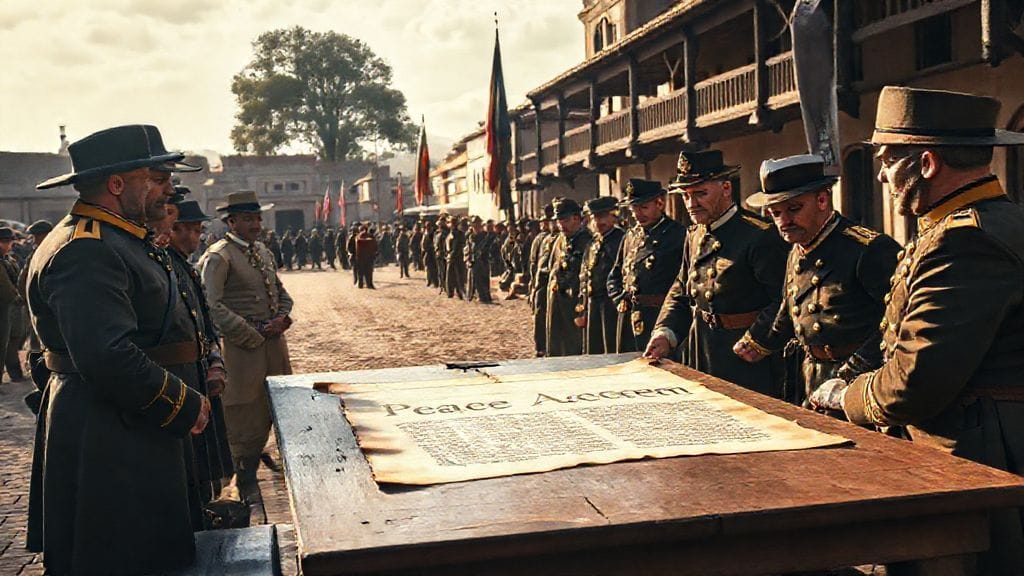
In the sweltering summer of 1881, the unmistakable scent of gunpowder still hung in the air over Pretoria. The crisp morning mist curling above the city streets struggled to veil the scars left behind by a conflict few outside South Africa truly understood yet one that would echo across continents and decades. It was the day the Pretoria Convention was signed, bringing an uneasy peace to a land long divided by culture, power, and ambition.
Imagine the rugged, dust-choked trails snaking through the veldt, where ox-wagons had borne families to carve out lives in the unforgiving wilderness. That same land had recently become the stage for a fierce, desperate struggle between the small, fiercely independent Boer republics and the formidable British Empire. As the delegates sat around polished wooden tables negotiating terms, the stories of valor, loss, and insubordination were still raw in every bone of those present. It was a war of identity, survival, and sovereignty — fought not with grand armies but with sharpshooters, guerrilla fighters, and an unyielding spirit.
But this moment of diplomatic resolution was more than just a treaty signing; it was a defining chapter in the larger narrative of colonial South Africa, a fragile truce born from the fires of conflict, poised precariously between empire and independence.
Seeds of Defiance: Boer Identity and British Expansion
The roots of the First Boer War trace deep into the 19th-century collision of imperial ambition and frontier nationalism. For the Boers—descendants of mainly Dutch settlers who called themselves Afrikaners—the land was more than territory; it was a symbol of freedom and faith. Their journey inland during the Great Trek had been both an escape from British rule in the Cape Colony and a profound assertion of self-determination.
Yet the discovery of gold and diamonds in the Transvaal region and white British expansionism stitched together a combustible tapestry of greed, pride, and ideology. The British Empire, at the zenith of its global power, saw in the resource-rich interior a jewel too valuable to concede. Conversely, the Boer republics were resolute in preserving their independence against what they considered an overreaching foreign power.
The contrasting visions of governance, culture, and identity gave rise to mounting tension. British officials viewed the Boers as unruly settlers needing to be brought under imperial law, while the Boers saw the Crown’s interference as a threat to their way of life and religious freedoms. Among the Boers, Paul Kruger—an austere, devout leader—became the emblem of this resistance, embodying the stoic defiance that would characterize the conflict.
The Spark Ignites: The Outbreak of the First Boer War
The fuse was lit in December 1880, when the Boers in the Transvaal risings against British control erupted into open rebellion. The war was short, but immensely intense—a stark contrast with the slow, sprawling imperial conquests elsewhere. Around 7,000 Boer fighters, largely irregulars skilled in marksmanship, mounted rifles, and intimate knowledge of the rugged terrain, challenged a larger but less agile British force.
The British had annexed the Transvaal in 1877, but their administration quickly grew unpopular due to heavy taxes and disregard for local autonomy. When armed resistance emerged, British commanders underestimated the resolve and tactical cunning of the Boer commandos. Skirmishes ignited from every corner—small ambushes cascading into bigger engagements that frustrated British regulars accustomed to traditional warfare.
The Terrain of Guerrilla Warfare: Tactics, Battles, and Boer Resilience
South Africa’s vast and often unforgiving landscape became the stage for a form of warfare unfamiliar to many British soldiers. The Boers exploited every knoll and thicket, executing lightning raids and fading ghosts in the veldt. Their intimate knowledge of the countryside allowed them to outmaneuver columns of British troops bogged down by heavy equipment and entrenched military doctrine.
Among the early battles, the fights at Laing’s Nek, Schuinshoogte (Ingogo), and Majuba Hill stand out not only for their tactical significance but for the sheer audacity and courage displayed. The Boers fought without the pomp and order of traditional European armies—jumping from cover to cover, delivering devastating volleys, then disappearing into the brush.
This style of irregular warfare revealed the limits of the British Empire’s martial reach. The rugged, independent spirit of the Boer fighters confounded commanders and sowed persistent anxiety in the upper echelons of London. The war hinted that imperial control could not be taken for granted, no matter how vast an empire might seem.
British Strategy and Struggles: Underestimating a People United
The British campaign struggled from the outset. Commanders such as Sir George Pomeroy Colley found themselves ill-prepared for the kind of hit-and-run tactics employed by their foes. Troops were often stationed in small, vulnerable garrisons, frequently isolated and overwhelmed.
The disparaging attitudes toward the Boer fighters—seen as mere farmers or rebels—fueled a fatal underestimation. After all, the British Empire had recently triumphed in grand conflicts across the globe. Yet in South Africa, a smaller, less equipped force repeatedly challenged and defeated British units. Morale plummeted amid rising casualties and the realization that traditional military superiority was no guarantee of success.
The Siege of Majuba Hill: A Defining Moment of Pride and Loss
The climax of the war came on February 27, 1881, at the Battle of Majuba Hill. British forces had fortified the summit of the hill to control the area around the town of Volksrust. However, the Boers, led by skilled commanders like Piet Joubert, launched a daring uphill assault under intense sniper fire.
The British troops were caught unprepared, and within hours, the hill was lost. The defeat was sweeping — more than 90 British soldiers were killed, including Sir George Pomeroy Colley, the General commanding forces, who fell from a fatal wound. This loss was more than a military setback; it was a symbolic blow to the British Empire’s prestige.
Majuba Hill became etched in Boer and British memory as a pivotal moment, signaling to both sides that the war’s end could no longer mean simple British dominance.
Negotiations in Pretoria: From Gunsmoke to Diplomacy
In the aftermath of Majuba Hill and a series of Boer victories, the British government recognized the impracticality of continued conflict. The pressures of the costly war, coupled with political debates at home, pushed London to seek a diplomatic resolution.
Negotiations began in Pretoria, the administrative capital of the Transvaal. The atmosphere was taut—former enemies weighed the costs of further bloodshed against the benefits of peace.
On August 3, 1881, the Pretoria Convention was signed, marking the end of hostilities. The document did not declare outright independence for the Boers; instead, it provided a framework for limited self-governance under British suzerainty.
The Pretoria Convention Signed: Peace at Last?
The Pretoria Convention was both a victory and a compromise. It recognized the South African Republic’s right to self-governance in most internal affairs, but upheld the British crown’s authority in foreign relations.
This nuance allowed both sides to claim a form of triumph: the Boers gained autonomy, while Britain retained symbolic and diplomatic control. For those gathered at the table, it was a pragmatic settlement—one that preserved peace but left many questions unresolved.
Terms of the Treaty: Autonomy Under the British Crown
The treaty’s core provisions allowed the Boers to elect their own government and control domestic policies, including law, taxation, and policing. However, Britain retained the right to manage external affairs, including defense and treaties with other nations.
In practical terms, this meant the Boers enjoyed significant independence but remained under the imperial umbrella—a relationship fraught with potential tension. British military presence was limited but symbolic, and the war-ravaged landscape required rebuilding and reconciliation.
Reactions Across the Empire and Beyond
News of the peace treaty rippled through once-loyal British colonies, the metropole, and the global press. Some saw the arrangement as a defeat for British imperial prestige — a blemish on the image of the “sun never sets” empire.
Within South Africa, the treaty stirred mixed emotions. British settlers feared Boer dominance; Afrikaners celebrated their newfound autonomy but remained wary of imperial intentions. International observers noted South Africa as a brewing cauldron, where these uneasy terms might only delay future conflict.
The Human Cost: Lives, Losses, and Legacies
For a war often overlooked, the human toll was tangible. Around 300 British soldiers and 90 Boers lost their lives, with thousands enduring injuries and psychological scars. Families were displaced, farms destroyed, and communities fractured.
The conflict also deepened ethnic and racial divides in the region, with indigenous Africans caught in the crossfire or marginalized further by shifting political dynamics. The war’s legacy of bitterness and pride would reverberate through generations.
The Boers’ Bold Message: Nationalism Takes Root
The First Boer War ignited something profound within the Afrikaner psyche—a fierce nationalism anchored in language, culture, and self-rule. The "Boer Republic" identity, shaped by struggle and survival, infused the community with purpose and unity.
Paul Kruger emerged as a symbol of this nationalist spirit, revered as a stoic guardian of Afrikaner rights. This war was no longer just a battle over land; it became a fight for cultural preservation and destiny.
British Lessons Learned and Military Reforms
Britain’s humiliation forced a reckoning. Military leaders studied the war closely, acknowledging the inadequacies of conventional tactics against guerrilla fighters in stark terrain.
The British army began reforms emphasizing mobility, reconnaissance, and light infantry tactics. The war also spurred political debates about the limits of imperial control and whether force alone could sustain such far-flung dominions.
The Long Shadow of the First Boer War on South Africa’s Future
Though brief, the war left a deep imprint on the region’s political landscape. It paved the way for future clashes by enshrining Boer self-rule alongside British imperial interests—a contradiction that bred suspicion and rivalry.
The fragile peace of the Pretoria Convention would give way less than two decades later to the far bloodier Second Boer War, as the region grappled with gold, power, and sovereignty.
Foreshadowing the Second Boer War: Tensions Rekindled
The Pretoria Convention did not resolve the fundamental conflicts over territory, governance, and identity. Instead, it placed a temporary lid on boiling tensions.
The discovery of rich gold deposits on the Witwatersrand in 1886 brought an influx of British settlers and capital, exacerbating conflicts over political control. The uneasy peace frayed, building toward the cataclysmic Second Boer War at the century’s close.
The Role of Key Figures: From Paul Kruger to Sir Evelyn Wood
The war’s personalities breathe life into events and illuminate its complexities. Paul Kruger’s steely resolve contrasted with British commanders like Sir Evelyn Wood, whose cautious leadership often clashed with imperial expectations.
Boer generals such as Piet Joubert and Commandant Joubert (not related), and other leaders epitomized the grassroots, decentralized approach the Boers championed. Their stories reveal a war fought as much with conviction as with rifles.
Cultural Memory and Historical Narratives: How the War is Remembered
In Afrikaner culture, the First Boer War is remembered as a heroic stand against overwhelming odds, a narrative that fortified Afrikaner identity through the 20th century.
Conversely, British recollections often framed it as a painful lesson in imperial hubris and adaptability. The war has been variously interpreted in literature, memorials, and historiography, mirroring changing political landscapes over time.
The Impact on Indigenous Populations and Regional Dynamics
While the war’s principal actors were European-descended, indigenous African groups experienced profound upheaval. The shifting power balances affected labor, land ownership, and political agency.
Certain African communities were conscripted, displaced, or marginalized as white settlement intensified. The war was a chapter in a broader story of conquest and survival that included multiple peoples beyond the Boer-British duel.
Economic Shifts and the Struggle Over South African Resources
The political outcome of the war could not be disentangled from economics. Control over mineral wealth was a central contended issue.
The British Empire’s desire to unlock and dominate South Africa’s gold mines would fuel future conflicts, investment, and industrial growth. The Pretoria Convention was a pause before the economic stakes erupted anew—ushering in a period of rapid transformation and exploitation.
A Reflection on Empire, Resistance, and the Ironies of Conquest
The First Boer War encapsulates the contradictions of empire—the might of a global power brought low by a determined frontier people armed with nothing but courage, rifles, and knowledge of the land.
It speaks to the resilience of identity against assimilation and the limits of military dominance in an age often defined by the rush for resources and territory. The war’s peace was fragile, but it marked a decisive moment when a small republic forced an empire to reckon with its own limits.
In the fading twilight of that August day in Pretoria, as the treaty was signed and the guns fell silent, both Boers and British sensed that this victory was but a prologue. The true and final struggles over South Africa’s soul were yet to come.
Conclusion
The end of the First Boer War, crystallized by the Pretoria Convention of August 1881, was a moment as fraught as it was momentous. It was a story of indomitable will meeting imperial ambition, of bitter defeats and modest triumphs. Despite its brevity, the conflict reshaped South Africa's political landscape, sowed the seeds of nationalism, and tempered the British Empire’s self-perception.
This war revealed the profound human desire for self-determination and the complex interplay of identity, culture, and power. The peace it brokered was tentative and imperfect, but born from a hard-earned recognition that even empire must bend before the fierce resolve of a people fighting to define their own destiny.
The legacy of this war echoes loudly today—not only in South Africa’s history but in global dialogues about resistance, sovereignty, and the costs of colonialism. It remains a reminder that the stories of the small and defiant often redefine the course of history itself.
FAQs
1. What caused the First Boer War?
The war stemmed from tensions following Britain's annexation of the Transvaal in 1877, with Boers resisting loss of their independence and British imposition of governance, taxes, and laws.
2. How long did the First Boer War last?
From December 1880 to August 1881—roughly eight months of intermittent fighting leading to the Pretoria Convention.
3. Who were the major figures in the conflict?
Paul Kruger led the Boer side as a political and symbolic figure; Sir George Pomeroy Colley and Sir Evelyn Wood commanded British forces.
4. Why was the Battle of Majuba Hill so significant?
Majuba Hill was a decisive Boer victory resulting in heavy British casualties, including the death of General Colley, dramatically shifting momentum and forcing Britain towards peace negotiations.
5. What did the Pretoria Convention stipulate?
It granted the South African Republic self-government while Britain retained control over foreign relations—an uneasy compromise.
6. Did the First Boer War resolve conflicts in South Africa?
No; it temporarily halted conflict but left underlying struggles over land, resources, and governance unresolved, leading to the Second Boer War in 1899.
7. How did the war affect indigenous African populations?
Indigenous communities were largely marginalized, with increased displacement and involvement as laborers or auxiliary forces, suffering social and economic disruptions.
8. What lessons did Britain learn from this war?
Emphasized the need for military reform and a better understanding of irregular warfare; the war challenged assumptions about imperial invincibility.