Table of Contents
- The Birthplace of Socialist Dreams: Paris, 1889
- A World on the Brink: Europe and the Ideologies of the Late 19th Century
- Tracing the Roots: The First International and the Quest for Workers' Unity
- The Spark of Inspiration: The Rise of Socialist and Labor Movements
- July 14, 1889: The Gathering Under the French Tricolor
- The Proclamation of the Second International: Vision and Goals
- Key Figures of the Second International: Engels, Jaurès, and Others
- The Debates That Shaped a Movement: Reform or Revolution?
- Emblematic Campaigns: May Day and Workers’ Rights
- Challenges from Within: Nationalism, Anarchism, and Ideological Divides
- The Second International’s Role in Colonialism and Imperialism Debates
- Women in the Second International: Voices Emerging from the Shadows
- The Influence of the Second International Beyond Europe
- The Road to World War I: The Cracks Begin to Show
- The Dissolution in 1916: The End of an Era or Seed of Future Movements?
- Consequences and Legacy: Foundations of 20th Century Socialism and Communism
- International Labor Rights: The Lasting Imprint of the Second International
- The Cultural and Political Ripple Effects Through the Twentieth Century
- Remembering the Second International: Commemorations and Historiography
- Lessons for Today: Unity, Division, and the Promise of Workers’ Solidarity
The Birthplace of Socialist Dreams: Paris, 1889
On a sweltering summer day—July 14, 1889—Paris, the City of Light, pulsed with a revolutionary heartbeat. The city was aglow with the splendor of the Exposition Universelle, a world’s fair celebrating the centennial of the French Revolution. Yet, amidst the grandeur of industrial marvels and the shimmering Eiffel Tower, a transformative gathering unfolded in the shadow of history itself. Leaders, intellectuals, and workers from across continents converged, their voices rising above the festive din with a singular ambition: to forge a new international order of solidarity for labor. This was the birth of the Second International, a beacon for millions seeking justice in an era riddled with inequality.
From the tumultuous streets of Paris emerged not just banners and slogans, but a vision laden with hope, conflict, and enduring complexity. The founding of the Second International was more than a convention; it was a testament to the restless spirit of a world in flux—an epoch poised between the old aristocratic order and the inexorable advance of industrial capitalism. By daring to unite under a common banner, these activists laid the groundwork for political movements that would shape the violent and vibrant century to come.
A World on the Brink: Europe and the Ideologies of the Late 19th Century
The late 19th century was an epoch of ferment—economic, social, and political upheaval coursed through Europe like an electric current. Industrialization had transformed societies at a dizzying pace, catapulting millions into urban factories under grueling conditions. Wealth concentrated in the hands of capitalists, while workers toiled with scant protections. Social stratification deepened, feeding resentment and sparking ideological battles.
Liberalism, socialism, anarchism, and emerging nationalist ideologies vied for dominance. In this fractured landscape, the workers’ movements sought coherence and strength. The aftermath of the 1848 revolutions and the short-lived Paris Commune of 1871 had left an indelible imprint—hope had been ignited and then brutally suppressed. It was clear to many that for the working class to make gains, unity beyond borders was essential.
The First International, founded in 1864 under Karl Marx’s stewardship, had attempted such unity but collapsed amidst internal rifts and political pressures. Yet the dream persisted—one that would become increasingly urgent as capitalism’s contradictions grew more glaring worldwide. By 1889, the climate was ripe for a renewal of international socialist solidarity.
Tracing the Roots: The First International and the Quest for Workers' Unity
The International Workingmen’s Association, known as the First International, had been a pioneering experiment in cross-border working-class cooperation. Established in London in 1864, it aimed to unite diverse socialist, communist, and anarchist factions. Marx’s towering influence led to the promotion of class struggle and historical materialism as guiding principles.
Yet the First International’s lifespan was fraught with tension. Ideological disputes, especially between Marxists and anarchists led by Mikhail Bakunin, unraveled the fragile alliance. Political repression from governments wary of revolutionary threats further eroded its capacity.
Despite its demise in 1876, the First International planted vital seeds. It established May 1st as a day of labor solidarity and fostered the idea that workers faced a shared global enemy: capitalist exploitation. Its memory lingered as a foundational myth inspiring the socialist resurgence that culminated in 1889.
The Spark of Inspiration: The Rise of Socialist and Labor Movements
The 1880s saw a flowering of labor unions, socialist parties, and intellectual currents advocating for change. The working class was becoming more organized and politically conscious. Emile Zola’s novels, Friedrich Engels’ analyses, and the relentless activism of figures like Auguste Blanqui galvanized public debate.
Across Europe and the Americas, struggles for the eight-hour workday, universal suffrage, and education reform animated political discourse. The success of Germany’s Social Democratic Party under August Bebel displayed the potential of parliamentary socialism. Meanwhile, anarchist thought, albeit divisive, remained influential among radical workers.
The centenary of the French Revolution provided a potent symbolic backdrop to launch a renewed international federation, spearheading aspirations for social justice and worker unity on a world scale.
July 14, 1889: The Gathering Under the French Tricolor
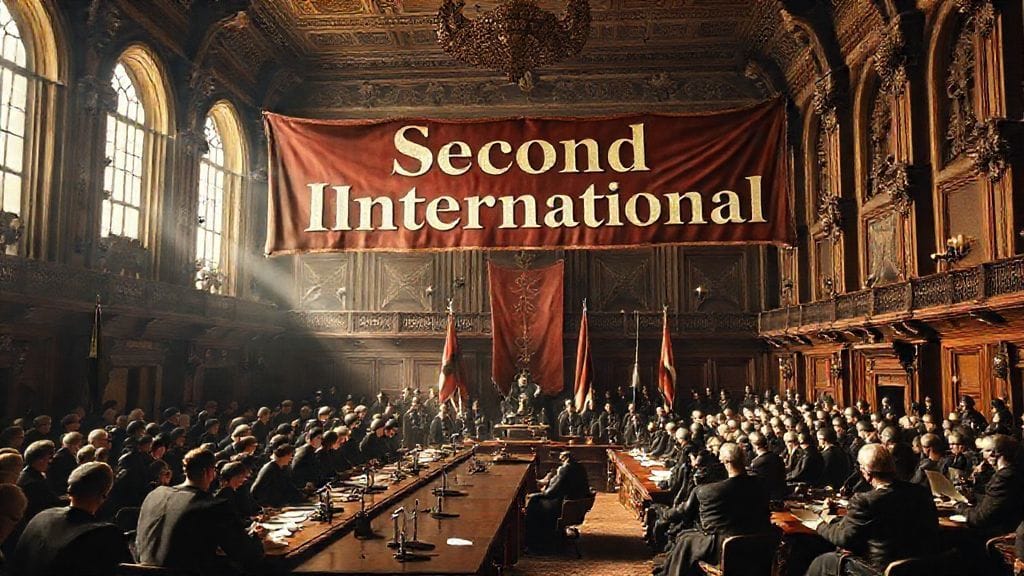
The congress convened on Bastille Day was neither accidental nor symbolic in mere coincidence. The echoes of 1789’s Revolutionary ideals of liberté, égalité, fraternité underscored the delegates’ mission. Almost 384 delegates from over twenty countries flooded Paris, driven by different languages but a singular commitment.
The plenary sessions unfolded with both convivial camaraderie and intense debate. Resolutions touched on contentious questions: Should workers align with bourgeois democratic forces, or wage unyielding revolutionary struggle? Was nationalism a barrier to international socialism, or a unifying force? How could women’s labor be fully included?
Among the delegates were towering figures like Friedrich Engels, who lent the occasion the authority of the old guard, alongside new voices representing the vibrant political currents of the day.
The Proclamation of the Second International: Vision and Goals
The establishment of the Second International marked a formal declaration of global worker solidarity. It adopted a platform calling for international cooperation to advance socialism through political means grounded in class struggle. The International declared support for eight-hour workdays, universal suffrage, social welfare measures, and solidarity across borders.
Unlike its predecessor, the Second International sought more durable organizational foundations. It aimed to support socialist parties coordinated across nations, promoting parliamentary infiltration while maintaining an undercurrent of revolutionary readiness.
One of its notable decisions was to institutionalize May Day as a day for labor activism—a tradition that would persist as a global symbol of workers’ rights.
Key Figures of the Second International: Engels, Jaurès, and Others
Friedrich Engels, although aging and in fragile health, was present as a living bridge to the earlier generation. His endorsement lent gravitas to the congress and affirmed the Marxist foundation of the movement. Engels exhorted the activists to remain vigilant against opportunism and reformism that could water down the struggle.
Jean Jaurès, a French socialist parliamentarian and orator, rose as a new face embodying the inclusive and democratic spirit of the International. Jaurès articulated a vision linking social justice with republican pluralism, feminism, and anti-militarism.
Other luminaries included German leader August Bebel, Russian Marxist Georgi Plekhanov, and British trade unionists who debated the path toward socialism in varying national contexts.
The Debates That Shaped a Movement: Reform or Revolution?
From the outset, the Second International was a cauldron of ideological tension. Marxist revolutionaries insisted on the necessity of overthrowing capitalism through class struggle, while reformists urged gradual legal gains within parliamentary systems.
The delicate balance between revolutionary zeal and pragmatic engagement was reflected in heated discussions around trade unionism versus political party activity. Should unions remain independent, focusing on direct workplace demands? Or integrate into political campaigns for systemic change?
These debates would echo throughout the International’s history, sometimes fostering dynamism, other times paralyzing unity.
Emblematic Campaigns: May Day and Workers’ Rights
One of the Second International’s most enduring legacies was the declaration of May 1st as International Workers’ Day, commemorating the Haymarket affair in Chicago, 1886, where striking workers demanding the eight-hour day met violent repression.
May Day became a rallying point for mobilization—parades, strikes, and demonstrations curated to spotlight labor grievances and assert the power of collective action.
Campaigns for labor protections, the abolition of child labor, and expanded suffrage characterized the International’s agenda and influenced nascent labor laws across Europe and beyond.
Challenges from Within: Nationalism, Anarchism, and Ideological Divides
Despite the vision of proletarian internationalism, national loyalties often complicated cooperation. Socialist parties were frequently torn between defending their countries’ interests and honoring international solidarity.
Anarchists, who rejected centralized political power, often clashed with Marxists and other socialists committed to political parties and parliamentary routes.
Moreover, disputes over colonialism and imperial policy tested the International’s cohesion—some socialists reluctantly endorsed colonial "civilizing missions," while others condemned imperial oppression, presaging future fractures.
The Second International’s Role in Colonialism and Imperialism Debates
The late 19th century was the age of imperialist expansion, especially by European powers claiming vast territories in Africa and Asia. The Second International wrestled with this reality uneasily.
While socialism preached equality and anti-exploitation, many parties in colonial powers hesitated to oppose imperialism fully, fearing loss of national prestige or economic interests.
At congresses, delegates condemned imperialist wars yet struggled to formulate a unified anti-colonial stance. This ambivalence sowed seeds of criticism from anti-imperialist activists and foreshadowed later anti-colonial movements.
Women in the Second International: Voices Emerging from the Shadows
The Second International was predominantly male and often ambivalent about women’s participation. Yet the late 19th century was witnessing the rise of feminist movements, and women activists sought inclusion.
Figures like Clara Zetkin emerged advocating for women’s labor rights, suffrage, and equality within the socialist movement. Zetkin’s work to establish International Women’s Day was directly inspired by this period.
While full gender equality remained elusive, the International provided a platform for beginning these crucial debates.
The Influence of the Second International Beyond Europe
Though centered in Europe, the Second International’s message resonated with workers worldwide. Delegates came from North and South America, and socialist literature was translated into multiple languages.
Labor movements in Argentina, the United States, and even early Chinese socialist groups drew inspiration from its ideas. The International promoted global consciousness about workers’ shared struggles, transcending colonial and racial hierarchies despite inherent contradictions.
The Road to World War I: The Cracks Begin to Show
By the early 20th century, the cohesion of the Second International was under strain. Nationalism surged as countries armed themselves for conflict, and socialist parties faced the dilemma of whether to support their governments in war.
Despite declarations against militarism, most parties ultimately backed their national war efforts in 1914, causing a catastrophic fracture. The ideal of proletarian internationalism was betrayed by patriotism, effectively paralyzing the organization.
This tragic failure marked a critical juncture in socialist history and presaged the upheavals that would follow.
The Dissolution in 1916: The End of an Era or Seed of Future Movements?
The Second International officially dissolved in 1916 amidst the carnage of World War I. Its failure to prevent or adequately oppose the war disillusioned many socialists and fractured the movement.
Yet, from its ashes emerged new currents, including the Communist International (Comintern) led by Lenin after the Russian Revolution, and renewed social democratic parties.
The legacy of the Second International lived on as a cautionary tale and a foundation for diverse socialist strategies in the 20th century.
Consequences and Legacy: Foundations of 20th Century Socialism and Communism
The Second International’s establishment was a pivotal moment, embedding key socialist principles into international consciousness. It normalized the notion that workers could and should organize beyond national borders.
Socialist parties across Europe grew in strength, influencing political reforms and the rise of welfare states. Meanwhile, the ideological battles nurtured by the International informed revolutionary praxis, most notably the Bolshevik Revolution.
Its failure to prevent war also ignited debates that shaped leftist divisions, missions, and strategies for decades.
International Labor Rights: The Lasting Imprint of the Second International
The practical achievements of the Second International’s activism are palpable today. May Day remains a global day of worker commemoration. Labor rights such as the eight-hour workday owe much to campaigns conceived in this era.
Social protections, organized labor influence, and the articulation of social justice as a political cause can be traced to the groundwork laid by this historic congress.
The Cultural and Political Ripple Effects Through the Twentieth Century
Beyond politics, the Second International inspired literature, theater, and art championing workers’ dignity. It influenced cultural narratives about justice, equality, and the possibility of a fair society.
As nations faced two world wars, decolonization, and new social challenges, the ideals of the International intensified debates about global solidarity, economic justice, and human rights.
Remembering the Second International: Commemorations and Historiography
Historians have portrayed the Second International both as an idealistic project and a flawed institution. Its anniversaries have been marked by reflections on the promises and pitfalls of international socialism.
Today, the International’s history invites reconsideration of present labor struggles and the potential of transnational cooperation in an increasingly globalized world.
Lessons for Today: Unity, Division, and the Promise of Workers’ Solidarity
The story of the Second International is a mirror reflecting the hopes and contradictions of collective action. It teaches us about the power of unity and the dangers of factionalism.
In a world grappling with inequality, climate crisis, and global labor shifts, the echoes of 1889 remind us that solidarity across borders remains not just an aspiration, but a necessity.
Conclusion
The founding of the Second International on July 14, 1889, was a moment of profound hope wrapped in complexity and contradiction. In the festive, revolutionary air of Paris, a diverse multitude of voices clamored for justice, equality, and dignity. They understood that the power of the working class could transcend national boundaries, forging a path toward social transformation.
Yet, the history of the Second International also reveals the challenges inherent in balancing ideological purity, strategic pragmatism, and divergent national interests. Its eventual unraveling on the eve of the First World War serves as a sobering reminder of the obstacles facing internationalism.
Still, the Second International’s legacy endures—in the labor rights we sometimes take for granted, in the global consciousness of solidarity, and in the persistent dream that working people might one day share a common destiny of freedom and equity. Its story invites us to engage with our own times by reflecting on how solidarity can be rekindled—even when the stakes are daunting and the path uncertain.
FAQs
Q1: Why was the Second International founded in Paris in 1889?
Paris was celebrating the centenary of the French Revolution and hosting the Exposition Universelle, symbolizing progress and democratic ideals. It was a natural stage for socialists and labor leaders to gather and renew international worker solidarity under the banner of liberty, equality, and fraternity.
Q2: How did the Second International differ from the First International?
While the First International was a pioneering but fragile alliance of diverse groups including anarchists, the Second International was more structured, focusing on socialist parties and parliamentary participation, aiming for long-term political organization rather than immediate revolutionary upheaval.
Q3: What were the main goals of the Second International?
The International sought to unify socialist parties, promote workers’ rights such as the eight-hour day, support universal suffrage, and foster international solidarity. It also aimed to coordinate worldwide labor movements and campaigns like the institution of May Day.
Q4: Who were some leading figures involved in the Second International?
Prominent leaders included Friedrich Engels, who lent ideological authority; Jean Jaurès, a French socialist advocating democratic socialism; August Bebel of Germany; Clara Zetkin, an early feminist and labor activist; and Georgi Plekhanov of Russia.
Q5: What internal conflicts weakened the Second International?
Disputes raged over reform versus revolution, nationalism versus internationalism, and approaches to colonialism. The rise of war nationalism ultimately fractured the International when socialist parties supported their own governments in World War I.
Q6: What is the significance of May Day, and how is it connected to the International?
May Day was declared by the Second International as an international day of workers’ solidarity, commemorating the 1886 Haymarket affair in Chicago. It became a symbolic and practical day for labor protests worldwide.
Q7: How did the Second International influence the 20th century?
It shaped the development of socialist and labor parties, influenced labor laws, inspired revolutions such as the Russian Revolution, and seeded ongoing debates about the strategy and priorities of socialist movements.
Q8: Why did the Second International dissolve, and what followed?
The outbreak of World War I revealed the limits of worker solidarity, as socialists sided with their national governments. The International collapsed in 1916, but from its downfall emerged new political formations like the Communist International and renewed social democratic movements.