Table of Contents
- The Dawn of Imperial Contest in Southern Africa: Setting the Stage for Bechuanaland
- The Geopolitical Chessboard: British, Boer, and Tswana Interests Collide
- Bechuanaland before 1885: A Land of Diverse Peoples and Fluid Power
- The Rise of Boer Republics and the Shadow of Expansionism
- The British Imperial Imperative: From Cape Colony to Protectorate
- September 1885: The Declaration of the British Protectorate over Bechuanaland
- Key Figures at the Forefront: Khama III, Sir Charles Warren, and the British Officials
- Vryburg and the Western Bechuanaland Factor: The Boer Enclave in Focus
- Military Movements, Diplomacy, and the Tensions that Preceded the Protectorate
- The Role of Indigenous Leadership: Tswana Chiefs and Their Complex Loyalties
- The Protectorate’s Legal and Administrative Framework: Governance under British Rule
- Immediate Reactions: Boer Republics’ Resistance and British Parliamentary Debates
- Economic Motives: Controlling Trade Routes, Resources, and Future Railways
- Implications for the Native Population: Autonomy, Resistance, and Adaptation
- The British Protectorate and Its Place in the Scramble for Africa
- Long-term Consequences: From Colonial Rule to Modern Botswana
- Cultural and Social Transformations under British Protectorate
- The Protectorate’s Legacy in Global Imperial History
- Reflections on Colonialism: Narratives of Power, Identity, and Survival
- The Road Ahead: Bechuanaland in the Twentieth Century
- Conclusion: Protectorate Origins and The Making of A Nation
- FAQs
- External Resource
- Internal Link
The Dawn of Imperial Contest in Southern Africa: Setting the Stage for Bechuanaland
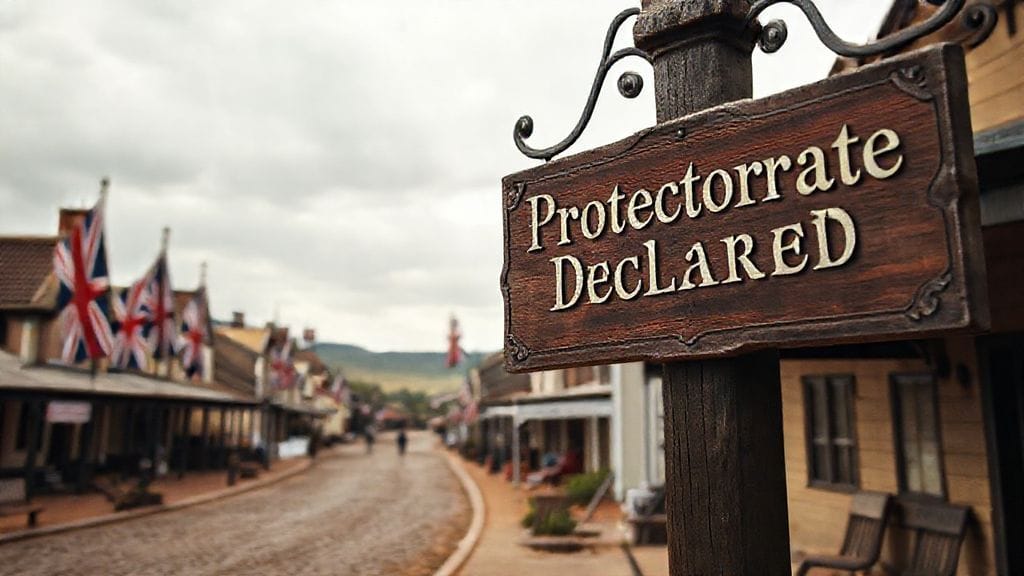
The afternoon sun cast long shadows over the dusty plains and thorn trees surrounding the small town of Vryburg in September 1885. The air was filled with a mix of tension and expectation as colonial officials debated, emissaries haggled, and local Tswana chiefs gathered where the vast African sky seemed to hold its breath. Beneath this tranquil scene, monumental changes were brewing — changes that would ripple across southern Africa’s political landscape for decades. In an act marked by urgency and imperial ambition, the British Crown declared a protectorate over the region known as Bechuanaland, a stretch of land inhabited predominantly by Tswana peoples, lying between the expanding Boer republics and the Cape Colony.
This declaration was more than a bureaucratic note; it was a geopolitical thunderclap, an assertion of control that laid the foundations of what would eventually become Botswana. The year 1885 marked a turning point — not only for the people of Bechuanaland, but also for the competing imperial and local powers maneuvering for dominance on a continent rapidly being carved up by European empires.
The Geopolitical Chessboard: British, Boer, and Tswana Interests Collide
In the late nineteenth century, southern Africa was a complex patchwork of cultures, polities, and competing ambitions. The British Empire, driven by the desire to connect its Cape holdings to the mineral riches of the Transvaal and beyond, eyed northern territories with strategic intent. Meanwhile, the Boer republics—the South African Republic (Transvaal) and the Orange Free State—sought to expand their frontier, often encroaching on indigenous territories or British spheres of influence. Local African leaders like the Tswana chiefs sought to maintain autonomy amidst these external pressures.
Bechuanaland, situated north of the Orange Free State and south of Matabeleland, was at the crossroads of this contest. Its strategic location along potential trade routes and railway lines made it a coveted prize. British officials feared Boer expansionism would cut the Cape Colony off from the hinterlands, undermining imperial dominance. For the Tswana, survival demanded delicate diplomacy with two imperial powers: a tightrope walk between cooperation and resistance.
Bechuanaland before 1885: A Land of Diverse Peoples and Fluid Power
Long before British flags waved over the plains, Bechuanaland was home to a tapestry of Tswana kingdoms. The region’s political structure was decentralized but resilient, dominated by powerful chiefs who commanded loyalty and wielded political influence over various clans. These communities engaged in cattle herding, agriculture, and controlled vital trade paths connecting the interior to coastal markets.
The arrival of European missionaries and traders in the early 19th century introduced new dynamics. British missionaries, particularly from the London Missionary Society, found significant inroads among the Tswana. Figures like Khama III, ruler of the Bangwato, would come to embody a new synthesis of indigenous leadership and European influence. Yet, these relationships were fragile and often shaped by larger forces beyond local control.
The Rise of Boer Republics and the Shadow of Expansionism
By the 1880s, the Boer republics—formed by Dutch-speaking settlers who left British rule in the Cape during the Great Trek—had developed a fierce independence. The discovery of gold and diamonds amplified their economic ambitions. The South African Republic, under Paul Kruger, sought territorial growth to control resources and consolidate Afrikaner nationalism.
Vryburg, a town in Western Bechuanaland, had become a focal point of Boer influence, administered by the neighboring republics yet situated within a contested zone claimed by indigenous groups and the British. This Boer-led enclave represented a tangible threat to British interests, signaling the possibility that the Boer republics might swallow up Bechuanaland altogether.
The British Imperial Imperative: From Cape Colony to Protectorate
For the British Crown, the stakes were unmistakably high. Control over Bechuanaland was essential to safeguard imperial routes northwards toward the mineral wealth of the Transvaal and Rhodesia (modern Zimbabwe). Strategists feared a Boer-controlled corridor would disrupt British ambitions and potentially isolate Cape Colony.
Thus, British authorities moved swiftly to formalize control. The period leading to September 1885 was marked by diplomatic overtures and increasing military presence. The British Indian Army’s Sir Charles Warren was dispatched in a show of strength to negotiate and, if necessary, establish imperial authority.
September 1885: The Declaration of the British Protectorate over Bechuanaland
September 30, 1885, witnessed an act that sent ripples across the colonial world — the British Crown officially declared a protectorate over Bechuanaland. This declaration, proclaimed at Vryburg, halted Boer expansion into the region and established British suzerainty. The protectorate status was a peculiar colonial form; it allowed traditional chiefs to retain some nominal authority under the oversight of British commissioners.
The announcement was both a diplomatic victory and a challenge. It signified British resolve in a tricky frontier zone but also committed imperial resources to a region far from the wealthy centers of influence. The move was strategic: by controlling Bechuanaland, the British could ensure a continuous land link between Cape Colony and its potential northern empire.
Key Figures at the Forefront: Khama III, Sir Charles Warren, and the British Officials
No recounting of the Bechuanaland protectorate is complete without spotlighting its personalities. Khama III, chief of the Bangwato, was a towering figure who embraced Christian missionary ideals and Western education, yet fiercely defended the sovereignty of his people. His leadership was pivotal in aligning Tswana interests with the British at this critical moment.
Sir Charles Warren, a seasoned British military officer with an explorative background in Africa, masterminded the protectorate’s establishment. His expedition into Bechuanaland demonstrated Britain’s willingness to use both negotiation and show of force. Alongside these men, British colonial administrators, local chiefs, and Boer representatives navigated the delicate balance between diplomacy and coercion.
Vryburg and the Western Bechuanaland Factor: The Boer Enclave in Focus
The town of Vryburg was a microcosm of the wider conflict in Bechuanaland. Established by Boers in the 1880s, it functioned as the capital of the short-lived Republic of Stellaland—a Boer attempt to assert a state within Bechuanaland’s western reaches. The British declaration directly challenged this Boer presence.
Vryburg’s fate symbolized the tension between imperial policy and Boer nationalism. The British takeover led to the dissolution of Boer political claims in Western Bechuanaland, incorporating the region under protectorate status. Yet resentment simmered, setting the stage for future conflicts in southern Africa.
Military Movements, Diplomacy, and the Tensions that Preceded the Protectorate
Before the declaration, Bechuanaland was a high-stakes theatre of uneasy peace. British forces conducted surveys and deployments, while Boer commandos and diplomats tried to assert influence. Tensions escalated with reports of clashes and the formation of Boer states within the region.
Diplomatic negotiations attempted to ease the situation, but mutual mistrust and competing ambitions limited success. The British saw the protectorate as a preemptive measure to avoid armed conflict, though military readiness remained critical. The maneuvering mirrored larger imperial dynamics unfolding across Africa in the era of the Scramble for Africa.
The Role of Indigenous Leadership: Tswana Chiefs and Their Complex Loyalties
The Tswana chiefs were no mere bystanders. Their decisions critically shaped the protectorate’s formation. Khama III and his peers were astute: they viewed British protection as a means to stave off Boer annexation and internal conflict. Yet their acceptance was cautious, aimed at preserving as much autonomy as possible.
This delicate alliance had lasting implications. While the protectorate curtailed Boer ambitions, it also imposed a colonial framework that disrupted traditional structures. Chiefs found themselves intermediaries in a new regime — defenders of their people but also agents within a colonial system.
The Protectorate’s Legal and Administrative Framework: Governance under British Rule
Once established, British administrators moved to organize the protectorate’s governance. Commissioners were appointed to oversee legal and political structures, introducing colonial institutions while negotiating power-sharing with Tswana chiefs. Colonial law replaced some indigenous customs, though British policy often pragmatically allowed traditional authorities to administer local affairs.
The protectorate’s status was unique: it was not a full colony but a negotiated buffer zone within the empire. This ambiguity had practical consequences for governance, economic development, and indigenous rights.
Immediate Reactions: Boer Republics’ Resistance and British Parliamentary Debates
The declaration was met with outrage from the Boer republics. Leaders in Transvaal and Orange Free State viewed it as a betrayal of their rights and expansionist goals. Letters of protest, military preparations, and political agitation followed, feeding longstanding tensions that would later explode in the South African War.
Within Britain, debates in Parliament revealed the complexities of imperial policy: some criticized the expense and military risks, others emphasized the need to assert control in a competitive colonial environment. Public opinion oscillated between imperial pride and skepticism over distant conflicts.
Economic Motives: Controlling Trade Routes, Resources, and Future Railways
Behind the political razzmatazz lay calculated economic interests. Bechuanaland’s position along emerging trade routes held tremendous value. The British envisioned railways extending northward, linking the Cape to mineral-rich northern territories and controlling the flow of goods.
The region’s natural resources, from cattle ranching to potential mining ventures, added layers of incentive. British businessmen and colonial officials understood that such infrastructure projects would consolidate imperial power but also stimulate regional development—though often to the benefit of settler economies.
Implications for the Native Population: Autonomy, Resistance, and Adaptation
For the Tswana people and other indigenous communities, the protectorate brought profound change. Some viewed British rule as protective against Boer threats; others resisted colonial impositions. Social structures evolved as missionaries promoted Christianity and Western education, altering cultural practices.
Yet beneath surface cooperation lay tensions over land, authority, and identity. The colonial encounter forced communities to navigate new power hierarchies, sometimes leading to internal divisions but also heightening a sense of collective endurance.
The British Protectorate and Its Place in the Scramble for Africa
Bechuanaland’s protectorate was a microcosm of the larger Scramble for Africa—Europe’s frenetic partition of the continent. Announced just days before the Berlin Conference ended, which formalized European colonial claims, the Bechuanaland protectorate underscored the high stakes and rapid decisions imperial powers made.
Unlike outright colonization, protectorates became a tool for flexible control in contested regions. Britain’s initiative in Bechuanaland demonstrated strategic foresight but also the brutal realpolitik of imperial competition.
Long-term Consequences: From Colonial Rule to Modern Botswana
The protectorate’s establishment charted a path from colonial control to the birth of an independent nation. While British administration continued into the 20th century, the foundations of what would become Botswana—established formally in 1966—were laid upon the protectorate’s legacy.
Retaining a measure of traditional authority, fostering local leadership, and preserving territorial integrity distinct from Boer violence shaped Botswana’s unique historical trajectory. Today, the country stands as a testament to resilience forged during this colonial crucible.
Cultural and Social Transformations under British Protectorate
The arrival of British administration brought missionary schools, Christian churches, and new social norms, weaving complex cultural narratives. Tswana chieftaincies integrated Western education, sparking debates on identity and modernization.
At the same time, colonial policies sometimes undermined indigenous customs, fomenting cultural hybridization as well as resistance movements. The protectorate era was a stage where African tradition and European modernity collided and coexisted.
The Protectorate’s Legacy in Global Imperial History
Though often overshadowed by larger African colonies, the Bechuanaland protectorate exemplifies imperial maneuvering in borderlands. It reveals how protectorates functioned as instruments of power projection and negotiation, balancing military, diplomatic, and economic interests.
Its story enriches our understanding of colonial governance complexities, indigenous agency, and the layered dynamics that shape historical memory.
Reflections on Colonialism: Narratives of Power, Identity, and Survival
Looking back, the protectorate’s formation challenges simplistic narratives of colonial domination. It illustrates a world where indigenous leaders retained agency, where colonial powers sometimes compromised, and where identities were negotiated rather than erased.
Such reflections invite us to reconsider colonial history not solely as conquest, but as contested human stories of survival, adaptation, and hope.
The Road Ahead: Bechuanaland in the Twentieth Century
The protectorate set the stage for turbulent decades ahead: the regional impact of the South African War, the rise of nationalist movements, and eventual independence struggles. Throughout these years, the legacy of 1885 lingered as a foundation for territorial unity and political coherence.
Understanding this epoch provides insights into southern Africa’s colonial past and postcolonial futures, reminding us of history’s enduring imprint.
Conclusion
The British Protectorate declaration over Bechuanaland in September 1885 was a decisive moment etched in the annals of southern African history. It was more than an act of imperial authority; it was a crossroads where empires clashed, indigenous leadership negotiated survival, and a fragile peace was brokered under the vast African sky.
From the dusty streets of Vryburg to the royal courts of Khama III, history unfolded with rich complexity—a drama of ambition, diplomacy, cultural encounter, and resilience. The protectorate’s legacy is palpable today in Botswana’s stability and development, serving as a reminder that history’s contours are shaped not only by conquest but by the enduring spirit of peoples navigating change.
As we look back over a century, the declaration remains a powerful narrative of how local and global forces intertwine, and how an imperial act became the seed of national identity and sovereignty.
FAQs
Q1: Why did Britain decide to declare a protectorate over Bechuanaland in 1885?
Britain acted to prevent Boer expansion from the South African Republic and Orange Free State, protect trade routes from the Cape Colony northwards, and secure potential railway paths. The declaration was a strategic measure to assert control over this vital region.
Q2: Who were the main indigenous leaders involved in the protectorate’s formation?
Chief Khama III of the Bangwato was the most prominent. Alongside other Tswana chiefs, he negotiated with both British and Boer powers, aiming to preserve autonomy amid competing imperial ambitions.
Q3: How did the Boer republics react to the British protectorate declaration?
The Boer republics vehemently opposed the British move, viewing it as a direct challenge to their territorial claims. They protested diplomatically and prepared militarily, exacerbating tensions that culminated in later conflicts.
Q4: What was the nature of administration under the British protectorate?
The protectorate combined British colonial administration with the retention of traditional authority. British commissioners oversaw governance, law, and policy while allowing chiefs limited self-rule under imperial oversight.
Q5: How did the protectorate affect the indigenous populations socially and culturally?
It introduced Western education, Christianity, and colonial laws, which transformed social structures and cultural practices. While some adapted or embraced the changes, others resisted the erosion of traditional customs.
Q6: How does the British protectorate over Bechuanaland relate to modern Botswana?
The protectorate laid the territorial and political groundwork for the future nation of Botswana. Maintaining relative stability, indigenous leadership, and distinct identity during colonial rule enabled Botswana’s peaceful transition to independence in 1966.
Q7: What role did the declaration play in the wider Scramble for Africa?
It served as a tactical response to European imperial competition, asserting British control in a contested borderland just as the Berlin Conference formalized colonial claims in Africa.
Q8: Was the protectorate status unique compared to other British colonies?
Yes, protectorates generally allowed local rulers limited authority under British oversight, distinguishing them from full colonies governed directly by British institutions.