Table of Contents
- The Heligoland–Zanzibar Treaty: A Moment Frozen in Time
- Setting the Stage: Europe’s Colonial Chessboard in the Late 19th Century
- The German Empire’s Ambitions under Chancellor Bismarck
- Britain’s Imperial Strategy and African Interests
- Tangled Threads: The Rivalry in East Africa
- Heligoland: A Small Island with Strategic Significance
- Zanzibar: The Gateway to East Africa’s Coastal Influence
- The Negotiations Begin: Berlin, Spring 1890
- The Delicate Art of Diplomacy: Channels, Secrets, and Stakes
- July 1, 1890: The Treaty is Signed — A New Imperial Order
- The Provisions in Detail: Territorial Exchanges and Maritime Rights
- Reactions in Europe: Press, Politicians, and Public Opinion
- Impact on East Africa: Shifting Control and Local Consequences
- Heligoland’s Transformation: The Island as a Military Outpost
- The Treaty’s Role in the Scramble for Africa — A Turning Point
- Long-Term Consequences: The Legacy of 1890 in Global Politics
- Personalities Behind the Treaty: Bismarck, Salisbury, and the Colonial Bureaucrats
- Anecdotes and Intrigues: The Human Side of Imperial Deal-Making
- The Treaty in Retrospect: Lessons and Ironies Over Time
- Conclusion: When Two Empires Drew Lines Across the Map
- FAQs: Unraveling the Mysteries of the Heligoland–Zanzibar Treaty
- External Resource
- Internal Link
1. The Heligoland–Zanzibar Treaty: A Moment Frozen in Time
On a humid summer day, July 1, 1890, in Berlin — a city simmering with imperial ambition and delicate diplomacy — two great empires sealed a compact that would redraw the map with invisible but potent strokes. The Heligoland–Zanzibar Treaty, signed between Great Britain and Germany, seemed at first a simple exchange of territories: a small North Sea island for subtle dominance in East Africa’s complex coastal tapestry. Yet beneath this façade lay the ambitions, rivalries, and strategic calculations that defined the age of imperialism.
Imagine the small volcanic island of Heligoland, barely 3 square kilometers, lying in the icy North Sea, a jewel Germany sought to militarize and transform into a bulwark against a rising British naval dominance. Across the continent, faraway Zanzibar — a sun-baked archipelago off the East African coast, a nexus of spice trade, African kingdoms, and colonial interests — belonged to Britain’s sphere but was increasingly contested by German expansionism.
This treaty, inscrutably distant to many today, was a microscopic yet crucial link in the vast chain of events that shaped not only the fate of Africa but the very contours of European power. It was an agreement signed behind closed doors, with the future of millions left unwittingly in the hands of men in Berlin and London.
But it was more than mere land-swapping; it was a symbolic and strategic shift — a grand diplomatic dance balancing empire, power, and influence in a world on the brink of radical transformation.
2. Setting the Stage: Europe’s Colonial Chessboard in the Late 19th Century
By the last decades of the 19th century, Europe had become a sprawling web of colonial empires, each racing to etch its influence on territories often far beyond their own borders. This era, known to historians as the “Scramble for Africa,” witnessed rival powers staking claims, often arbitrarily, to vast regions, driven by nationalism, economic interests, missionary zeal, and military competition.
Britain emerged as the preeminent imperial power, with sprawling dominions from India to Canada, and a vast network of protectorates and colonies in Africa. Germany, unified only in 1871, was a relative newcomer to this game, eager to assert itself and rival the older empires.
At the core of this rivalry were questions of maritime dominance, trade routes, and raw materials. East Africa, with its strategic position along the Indian Ocean and its access to local resources, became a critical ground for competing interests.
In this volatile environment, the very notion of borders was fluid, crafted by diplomats rather than geographers or local inhabitants. It was a world where a small volcanic island like Heligoland could suddenly become more valuable than vast tracts of African territory, simply by virtue of its location and potential military uses.
Understanding this backdrop is essential to grasp why Britain and Germany found themselves negotiating the treaty that bore these two names — an agreement that tethered together the fate of a little North Sea island and a distant archipelago off Africa.
3. The German Empire’s Ambitions under Chancellor Bismarck
At the helm of Germany's foreign policy during these critical years stood Otto von Bismarck, the Iron Chancellor, whose ability to juggle European diplomacy was unmatched. Though Bismarck is primarily remembered for orchestrating German unification, his imperial legacy extended to Africa — albeit with pragmatism and tradeoffs rather than unbridled conquest.
Germany’s African ambitions were born in part out of commercial interest, in part due to domestic pressures to emulate Britain and France’s colonial successes. Yet Bismarck remained cautious. He viewed colonies as bargaining chips and sources of influence rather than as vital strategic assets demanding vast resources.
The acquisition of Heligoland fit Bismarck’s vision perfectly. The island offered a military foothold close to Britain’s maritime approaches, potentially disrupting British naval supremacy. It also symbolized a nod to naval modernization and the growing German Imperial Navy, which would later become a central player in European tensions.
However, Bismarck was keenly aware of the delicate balance required. Germany’s African territories were scattered and fragmented — Togoland, Cameroon, German East Africa — and he sought to clarify spheres of influence with Britain to avoid conflict and focus on internal consolidation.
The Heligoland–Zanzibar Treaty reflected this balancing act: Germany obtained strategic value close to home, and in return conceded some African claims to Britain, effectively trading distant and diffused holdings for territorial coherence and military advantage.
4. Britain’s Imperial Strategy and African Interests
On the other side of the Channel, Britain’s empire was both its pride and its burden. The British government prioritized control of critical naval chokepoints, secure trade routes, and the containment of rivals like France and Germany in Africa.
Zanzibar, with its long-established Arab Sultanate and vibrant trade connections, represented an essential piece of the wider East African puzzle. It was a gateway to the rich interior regions—modern-day Tanzania and Kenya—and a point from which Britain could control the Indian Ocean littoral.
Yet Britain was not naïve about German ambitions. The rise of a unified Germany was seen with suspicion and rivalry. Early German colonial efforts along the East African coast threatened British dominance and exposed the fragility of existing arrangements.
In this dynamic, Britain sought to consolidate its control, securing protectorates and formal treaty rights while avoiding unnecessary conflict with Germany. The Heligoland–Zanzibar Treaty was a strategic way to patch over tensions: Britain assured its African dominance in exchange for relinquishing Heligoland, a remote island with dubious imperial value to itself but immense military potential to Germany.
This pragmatic swap revealed the realpolitik at the heart of the European imperial project — empires negotiating and trading influence like pieces on a chessboard, often without regard for the peoples whose lands were bartered.
5. Tangled Threads: The Rivalry in East Africa
East Africa was a patchwork of competing interests and complex sovereignties. The Sultanate of Zanzibar had long controlled the archipelago and coastal territories, engaging in trade, including the controversial slave trade, which Britain increasingly sought to suppress.
German colonial ventures had penetrated the nearby mainland, with treaties signed with local rulers to establish “protectorates.” These claims, however, were often contested by British traders, missionaries, and political agents.
The fertile lands, the promise of raw materials, and the strategic location near the Red Sea and Indian Ocean trade routes made East Africa a prize wider than just its size suggested.
For decades, both empires had attempted to carve spheres of influence through a mixture of treaties, military expeditions, and diplomatic pressure. The zone around Zanzibar was particularly contentious, as it represented a symbolic and economic lynchpin.
The result was a shadow war of influence, with local sultans and chiefs caught between two imperial lions. The Heligoland–Zanzibar Treaty was intended to draw clearer lines, but it was never a simple solution to a deeply fraught situation.
6. Heligoland: A Small Island with Strategic Significance
Heligoland, a jagged speck in the North Sea, hardly seemed worth a mention beyond local fishermen and bird watchers. Yet its geographic position made it strategically priceless.
For Britain, control of the North Sea was a non-negotiable element of its national security. The Royal Navy patrolled these waters vigilantly, guarding against any continental threats. The possession of Heligoland by Germany, therefore, was an irritant — indeed, a potential threat — to British naval dominance.
For Germany, Heligoland was a perfect naval base: a natural fortress, allowing the Imperial Navy to extend its reach and potentially challenge British ships near their own shores. The island would be transformed with fortifications, harbor facilities, and a military garrison, becoming a cornerstone of Germany’s plans for naval expansion.
It was a curious paradox: a tiny island, uninhabited for centuries, suddenly invested with immense geopolitical weight, a symbol of rising German ambitions and an early indicator of the naval arms race that would characterize the approach to World War I.
7. Zanzibar: The Gateway to East Africa’s Coastal Influence
Zanzibar was a vibrant island paradise turned imperial prize, with a melting pot of African, Arab, Indian, and European cultures. Its smoking spice markets, bustling ports, and palm-lined shores masked decades of colonial contestation.
The Sultanate, though influential, was increasingly under the shadow of British protection since the 19th century. Britain secured treaties that made it the paramount power in Zanzibar while officially recognizing the Sultan’s role — a delicate duality that maintained diplomatic appearances.
Control of Zanzibar meant more than controlling an island; it gave Britain sway over the interior regions and influence over the Indian Ocean trade routes.
Yet German advances threatened to undermine this grip. The coastal strip adjacent to German East Africa was a zone of recurrent friction, from commercial competition to military posturing.
The treaty thus symbolized Britain’s determination to maintain its hegemony in East Africa by making concessions in Europe, trading away Heligoland to secure and formalize its claims near Zanzibar.
8. The Negotiations Begin: Berlin, Spring 1890
Under heavy smoke and velvet drapes of Imperial Berlin’s diplomatic salons, the early months of 1890 saw British and German delegations quietly convene. These meetings were a mixture of formality and intrigue: coffee in gilded chambers, whispered bargaining, and the meticulous parsing of every word.
The complex interplay was not just about land; it was about maintaining peace between two rising powers, avoiding armed conflict, and stabilizing colonial claims that threatened to spiral into war.
German diplomats, operating under Bismarck’s keen guidance, pressed for Heligoland, while British negotiators demanded clear recognition of their protectorates in East Africa, including Zanzibar.
The talks were punctuated by moments of tension, subtle threats, and mutual understanding born of respect for the potential costs of escalated conflict.
Though the treaty would later be seen primarily from a colonial perspective, at the time it was as much about European balance of power as imperial administration.
9. The Delicate Art of Diplomacy: Channels, Secrets, and Stakes
The treaty negotiations illustrate diplomacy’s paradoxical nature—public assertions contrasting with secret pragmatism.
Correspondence reveals that Bismarck saw the treaty as a success, securing defensive advantage while avoiding costly colonial commitments elsewhere. British Prime Minister Lord Salisbury viewed the agreement as a means to protect critical interests without overextension.
Behind the scenes, diplomats leveraged intelligence, rumors, and alliances. German naval officers argued vociferously for Heligoland’s acquisition, warning of Britain’s monopoly.
At the same time, the British colonial office feared German intentions in East Africa and saw the treaty as a tool to defuse tensions while strengthening their regional position.
The negotiations lasted several months, with drafts exchanged and redrafted. Each clause concealed layers of strategic calculation, with every word infused with near-military precision to forestall misunderstanding.
10. July 1, 1890: The Treaty is Signed — A New Imperial Order
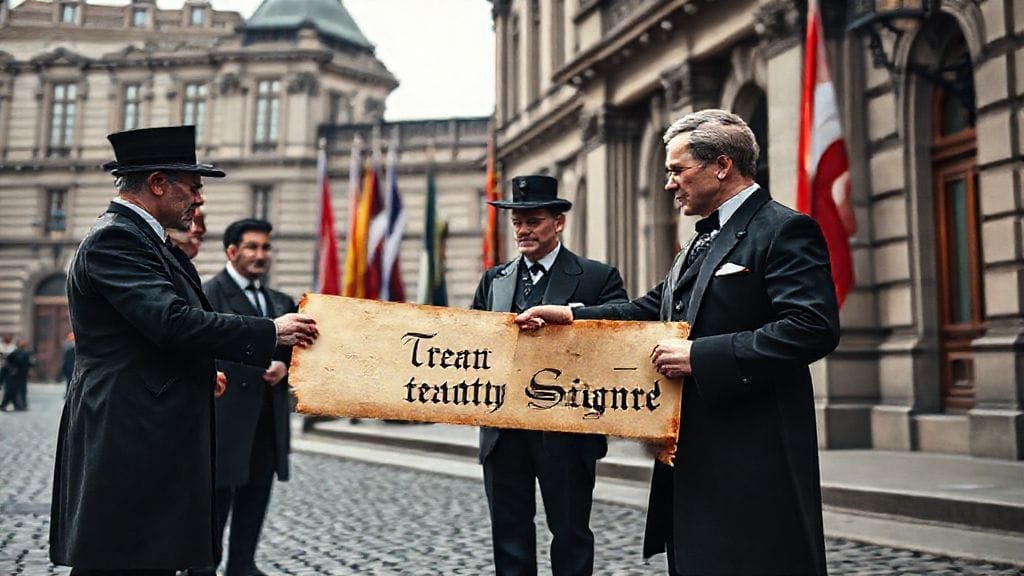
The ceremonial signing in Berlin was quiet but momentous. On this summer day, representatives of two empires affixed their seals to a document that would quietly shift the global balance.
The Heligoland–Zanzibar Treaty established German sovereignty over Heligoland and the North Sea archipelago, while Britain officially acquired control over the Sultanate of Zanzibar and extended influence over surrounding coastal territories.
The treaty also resolved conflicting claims in the mainland interior of East Africa, delineating spheres of influence and officially recognizing protectorates.
The document was the embodiment of diplomacy in its most pragmatic form: a curated compromise, redrawing maps without a single shot fired.
Yet, it masked deeper struggles and foreshadowed tensions that would only intensify in the coming decades — particularly with Germany’s naval build-up and the growing contest for African dominance.
11. The Provisions in Detail: Territorial Exchanges and Maritime Rights
At the heart of the treaty lay precise descriptions of territorial exchanges:
- Germany gained Heligoland and adjacent smaller islets, giving it naval bases crucial for defense and opening paths for a more assertive naval policy.
- Britain gained recognition of its protectorates over Zanzibar and the East African coastal strip stretching along mainland present-day Kenya and Tanzania.
- Both powers agreed to respect spheres of influence: Britain would withdraw claims on mainland coastal regions nearer to German holdings, and Germany would refrain from activities in British protectorates.
- The treaty also addressed access to ports and navigation rights along the East African coast, securing British commercial dominance.
This swap was not simply territorial—it was about control of trade routes, security against rival navies, and political influence over indigenous rulers.
12. Reactions in Europe: Press, Politicians, and Public Opinion
In European capitals and newspapers, the treaty was met with a mixture of curiosity, skepticism, and calculated endorsement.
British newspapers praised the arrangement as a clarifying moment for imperial boundaries, though some critics argued Britain was ceding too much by relinquishing Heligoland.
German press hailed the acquisition of Heligoland as a triumph, emphasizing expanding naval strength, but colonial critics lamented the loss of East African territories.
Politicians used the treaty to bolster their imperial credentials. Bismarck was seen as a skilled negotiator who strengthened Germany’s global position without risking confrontation.
Yet, among the general public, the treaty barely registered beyond the imperial circles—it was a silent pivot beneath the thunder of other political dramas.
13. Impact on East Africa: Shifting Control and Local Consequences
For the peoples of East Africa, the treaty represented yet another external imposition altering their futures.
British control over Zanzibar tightened, accelerating administrative reforms and impacting the Sultanate’s autonomy. British authorities intensified efforts to suppress the slave trade and expand commercial exploitation.
German East Africa’s borders stabilized, enabling Berlin to increase its colonial administration and economic ventures, though it faced resistance from local populations.
The treaty also deepened political divisions among indigenous groups, as colonial boundaries split ethnic and cultural communities, sowing future conflicts.
These changes, while largely decided across oceans, reshaped local realities: the machinery of empire turned inexorably forward.
14. Heligoland’s Transformation: The Island as a Military Outpost
Once under German control, Heligoland’s evolution was rapid and profound.
Germany invested heavily in fortifications, naval bases, and infrastructure, converting the island into a key defensive stronghold guarding the North Sea approaches.
Heligoland became a symbol of Germany’s naval ambitions, especially under Kaiser Wilhelm II, whose intense focus on building a powerful fleet sought to challenge Britain’s maritime supremacy.
During World War I, the island served as a vital naval base, underscoring the foresight of its acquisition in 1890.
Today, the island remains a subtle reminder of 19th-century power plays, its cliffs echoing the old imperial ambitions.
15. The Treaty’s Role in the Scramble for Africa — A Turning Point
The Heligoland–Zanzibar Treaty was more than a bilateral agreement; it was a milestone in the complex and often ruthless “Scramble for Africa.”
It exemplified how European powers negotiated over colonized lands with scant regard for indigenous sovereignty, choosing strategic advantage over justice.
By clarifying spheres of influence, the treaty temporarily stabilized competition in East Africa but also entrenched imperial control, paving the way for deeper colonization.
It reflected the limits of imperial diplomacy—achieving practical solutions while laying the seeds for future conflict through imposed boundaries and rivalries.
16. Long-Term Consequences: The Legacy of 1890 in Global Politics
The treaty’s significance extended beyond immediate territorial swaps.
It marked a stage in Germany’s emergence as a global naval power, intensifying the Anglo-German naval arms race that contributed to the tensions leading to World War I.
In Africa, it crystallized colonial boundaries whose effects persist to this day in national borders and ethnic divisions.
The agreement symbolized a diplomatic moment when imperial powers prioritized negotiation over war, yet simultaneously entrenched systems of exploitation.
It also highlighted Bismarck’s foreign policy pragmatism, which was soon eclipsed by more aggressive stances after his dismissal.
17. Personalities Behind the Treaty: Bismarck, Salisbury, and the Colonial Bureaucrats
No treaty is merely a document; it is shaped by men and women who wield influence.
Otto von Bismarck’s diplomatic genius was crucial. His ability to juggle European great powers while securing colonial footholds demonstrated his layered strategy.
British Prime Minister Lord Salisbury, a seasoned imperialist, sought a workable balance with Germany and the maintenance of British maritime supremacy.
Behind the leaders, colonial administrators, naval officers, and diplomats labored in shadows, compiling intelligence, lobbying, and drafting clauses that would have lasting impact.
Their interplay reveals the human complexity behind imperial machinations.
18. Anecdotes and Intrigues: The Human Side of Imperial Deal-Making
Stories from the treaty negotiations add color to this historic event.
One diplomat reportedly remarked that awarding Heligoland to Germany was “like giving the lion a better vantage point”—a metaphor for geopolitical perspective.
During tense moments, a misplaced phrase nearly derailed talks, only to be resolved by a late-night parley over brandy and cigars.
Secrecy was maintained with utmost care, avoiding public uproar and political backlash.
These vignettes remind us that history is not only the tale of nations but of individuals with moods, faults, and ambitions.
19. The Treaty in Retrospect: Lessons and Ironies Over Time
Looking back, the Heligoland–Zanzibar Treaty appears both visionary and shortsighted.
It foreshadowed naval contests that exploded into world war, yet it was also a model of diplomatic compromise during an age often defined by colonial conquest.
The “trade” of a small island for African territories seems lopsided, but context proves this was a strategic bargain for both sides.
Additionally, the treaty’s boundary-making disregarded local realities, echoing a pattern of empire that modern scholars critique as both unjust and enduring.
It stands as a reminder of the complexities and contradictions inherent in imperialism.
20. Conclusion: When Two Empires Drew Lines Across the Map
The Heligoland–Zanzibar Treaty was more than an exchange of territories; it was a defining moment where European imperial powers negotiated the fate of lands and peoples across continents.
It encapsulates the age’s blend of strategic calculation, diplomacy, and imperial ambition.
Though a footnote in broader history, it shaped the trajectory of German naval power and Britain’s imperial sphere in Africa, influencing decades of rivalry and colonial governance.
Ultimately, it serves as a testament to the profound ways diplomacy can redraw not just maps, but the lives and futures entwined within them.
FAQs
Q1: Why did Germany want Heligoland, and Britain wanted Zanzibar?
Germany valued Heligoland for its strategic naval position in the North Sea, essential for challenging British maritime dominance. Britain sought formal control over Zanzibar to secure its East African interests and trade routes.
Q2: How did the treaty affect local populations in East Africa?
The treaty imposed new colonial boundaries that disregarded ethnic and cultural divisions, intensified colonial administration, and altered power dynamics, often to the detriment of indigenous autonomy.
Q3: Did the treaty prevent conflict between Britain and Germany?
Temporarily, yes. It clarified spheres of influence and reduced immediate tensions, but it did not resolve the underlying rivalry, which escalated into global conflict decades later.
Q4: What role did Otto von Bismarck play in the treaty?
Bismarck orchestrated the treaty as a pragmatic solution balancing German and British interests, enabling German naval expansion while avoiding colonial overreach.
Q5: How did Heligoland change after the treaty?
Heligoland was heavily fortified and became a key naval base for Germany, particularly significant during World War I.
Q6: Why is the treaty considered part of the Scramble for Africa?
Because it involved formal recognition and division of territories in East Africa between European powers, reflecting the era’s imperial competition and disregard for indigenous sovereignty.
Q7: Were there other territorial exchanges in the treaty besides Heligoland and Zanzibar?
Yes. The treaty also settled conflicting claims on adjacent mainland territories in East Africa and maritime navigation rights.
Q8: How is the Heligoland–Zanzibar Treaty viewed by modern historians?
It is viewed as a classic case of imperial diplomacy that balanced power but perpetuated exploitative colonial structures with lasting regional impacts.