Table of Contents
- Dawn of a New Era: The Calm Before the Storm
- The Philippines at the Crossroads of Empire
- Rising Tensions: Spain’s Failing Grip on the Pacific
- The Birth of American Ambitions in the Orient
- Commanders and Fleets: Dewey and Montojo Face Off
- The Night Before the Battle: Manila Bay in Stillness
- May 1, 1898: The Dawn Breaks Over Manila Bay
- The Clash of Steel and Smoke: A Naval Battle Unfolds
- Tactical Brilliance and Technological Edge: Dewey’s Triumph
- The Spanish Fleet’s Last Stand and Surrender
- Aftermath in the Shadows: Casualties and Captives
- The Battle’s Broadcast: Newspapers and Propaganda
- The Philippines Caught in the Crossfire: Local Responses
- The Broader War: Spanish-American Conflict Escalates
- Dewey’s Fame and the Rise of American Naval Prestige
- Global Repercussions: The Shift in Imperial Power
- The Seeds of Philippine Nationalism Sown
- Historical Memory: The Battle’s Place in Philippine and American Hearts
- Lessons from Manila Bay: Naval Warfare and Empire
- Conclusion: An Ocean’s Ripple Turned a World’s Tide
- FAQs: Key Questions Answered About the Battle of Manila Bay
- External Resource: Wikipedia Link on the Battle of Manila Bay
- Internal Link: Visit History Sphere
Dawn of a New Era: The Calm Before the Storm
The first light of May 1, 1898, bathed Manila Bay in a soft, golden hue, shimmering across the tranquil waters of the Philippines' greatest harbor. From the shore, the city of Manila lay silent under the faint morning mist, its colonial facades still bearing the dust of centuries. Yet, beneath this deceptive calm rippled the currents of an empire in collapse and the stirrings of a new global power impatient to assert itself.
The sky held no hint of war. Fishermen cast their nets, merchants prepared their stalls, and the Spanish garrison nursed its weary pride. But on the horizon, the sleek, black battleships of the United States Navy, commanded by Commodore George Dewey, slithered like shadows, ready to strike a decisive blow against the deteriorating Spanish presence in Asia. This was not merely a battle over a bay; it was a turning point in the tides of colonial history.
The Philippines at the Crossroads of Empire
The Philippines, long a jewel in Spain’s Pacific crown, was by the late nineteenth century a colony in twilight distress. Spanish rule, marked by centuries of religious mission and military subjugation, had failed to quell local dissent or to transform the archipelago into a self-sustaining empire outpost. Instead, the islands simmered with revolutionary ferment.
Filipino insurgents, inspired by ideals of self-determination and republicanism sweeping through the Americas and Europe, challenged Spain's authority with increasing vigor. José Rizal, Andres Bonifacio, and other leaders articulated a yearning for freedom that Spain's bureaucratic neglect and brutal reprisals only inflamed.
Simultaneously, other powers watched with interest and envy. Britain’s empire was vast but cautious; France was entangled in Indochina; Germany eyed the Pacific; and the United States, fresh from its own Civil War and rapid industrial expansion, sought to cast its shadow overseas, believing its destiny was tied to the oceans.
Rising Tensions: Spain’s Failing Grip on the Pacific
By 1898, Spain was a weakening giant, strained by financial difficulties, political discord, and military inefficiencies. The Spanish-American War was born from this fragile state, fueled notably by the explosion of the USS Maine in Havana harbor — an event that galvanized American public opinion but underscored Spain’s vulnerability.
In the Pacific, Spain's naval assets were decrepit and outmatched, while its soldiers endured inadequate supplies and low morale. The colonial administration in Manila was isolated and increasingly anxious, aware that a U.S. naval squadron, modern and battle-hardened, had set sail across the vast Pacific to challenge Spanish dominion.
The Birth of American Ambitions in the Orient
For the United States, the war was not only about Cuba or the Caribbean but was a calculated move to establish itself as a world power with influence stretching to the Pacific. Manifest Destiny, long an American credo for continental expansion, had evolved beyond shores and plains—it now included islands and oceans.
The acquisition of the Philippines was envisioned by many American strategists as a pivotal base for trade with China and a stepping-stone toward broader Asian engagement. Commodore Dewey’s orders were unequivocal — neutralize the Spanish fleet, seize Manila Bay, and establish dominance in the region.
Commanders and Fleets: Dewey and Montojo Face Off
George Dewey, known for his cool demeanor and brilliant tactical mind, was the man chosen to lead the Asiatic Squadron in this bold venture. Across the bay, Rear Admiral Patricio Montojo y Pasarón commanded the Spanish squadron — a seasoned officer hampered by inferior ships, outdated weaponry, and the gnawing weight of defeatism.
The contrast between two naval leaders reflected the larger clash of empires: one rising with steam and steel, the other gasping under the weight of history. Dewey’s flagship Olympia, a modern protected cruiser, represented the cutting edge of Washington’s naval power, whereas Montojo’s ships were relics of a fading age.
The Night Before the Battle: Manila Bay in Stillness
As darkness fell on April 30, the waters of Manila Bay lay serene, the city glowing faintly under the stars. Both sides prepared anxiously—Spanish crews oiling guns and reefs raising defensive mines, American sailors quietly rehearsing their maneuvers under Dewey’s sharp eye.
There was a palpable tension, a feeling that the old world and the new world would soon collide in a moment that could alter the destinies of millions. Manila’s citizens felt it too — nervous whispers and hushed prayers mingled with the distant rumble of engines.
May 1, 1898: The Dawn Breaks Over Manila Bay
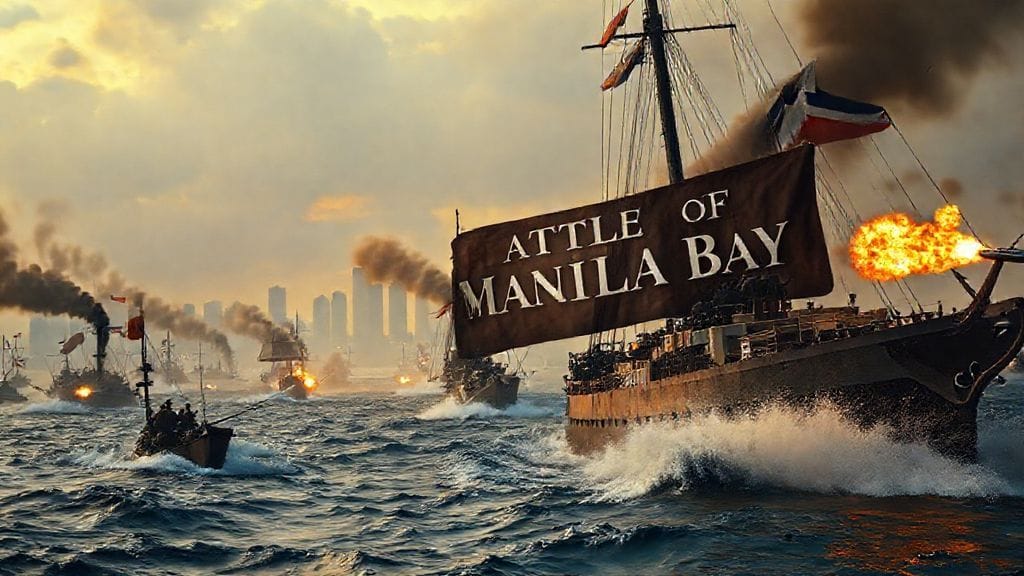
At the first blush of dawn on May 1, an eerie silence was shattered by the roar of American cannons. Dewey’s fleet slipped past Spanish minefields, their guns blazing in deadly accuracy. The battle had begun.
Smoke billowed over the harbor, shrouding the old Spanish fortifications while shells tore into the wooden hulls of the Spanish fleet. Despite being caught unprepared, Spanish sailors fought fiercely, manning their stations under blistering fire.
Yet the technological and tactical superiority of the Americans soon became undeniable. Dewey’s ships moved with precision and control; their modern guns unleashed destruction at ranges where Spanish artillery could not adequately respond.
The Clash of Steel and Smoke: A Naval Battle Unfolds
The battle was as much about nerve and strategy as about firepower. Dewey’s orders—to concentrate fire and maneuver deftly—confounded Montojo’s attempts at counterattack or retreat. Cruiser after cruiser sank or was scuttled; Spanish gunners fell silent one by one.
The air was thick with acrid smoke, the thunder of guns deafening, and the cries of sailors echoing across the water. Manila Bay transformed into a floating inferno as American shells set ablaze the once-proud Spanish fleet.
The spectacle was dramatic and devastating, a testament to the changing face of naval warfare and imperial ambition.
Tactical Brilliance and Technological Edge: Dewey’s Triumph
Dewey’s victory was no accident. He had meticulously studied the bay’s geography, Spanish defenses, and naval strategy. His use of rapid-fire guns, superior range, and disciplined coordination overwhelmed the defenders.
Moreover, the arrival of the American fleet was masked effectively, giving the Spanish little time to mount an effective defense. Dewey’s cool decisiveness epitomized modern naval leadership, while Spanish forces, hampered by slow communication and obsolete tactics, floundered.
The Spanish Fleet’s Last Stand and Surrender
By midday, the battle was effectively over. The Spanish flagship Reina Cristina was sunk, and the surviving Spanish ships retreated to the shore, where crews burned vessels to avoid capture. Admiral Montojo himself barely escaped in a small boat, his fleet shattered.
The Americans took the bay and positioned themselves to support a land campaign that would soon follow. The Spanish naval presence in the Pacific was extinguished, signaling the collapse of their centuries-old empire in Asia.
Aftermath in the Shadows: Casualties and Captives
Casualty figures were lopsided—American losses were minimal with only a handful wounded, while Spanish fatalities and captured sailors numbered in the hundreds. The human cost on the Spanish side was brutal, torn between valor and the misery of defeat.
For Filipino insurgents also watching the battle’s outcome, the results were bittersweet: Spain’s grip weakened but was about to be transferred to a new colonizer, adding layers of complexity to their own struggle for independence.
The Battle’s Broadcast: Newspapers and Propaganda
Back in the United States, news of Dewey’s victory exploded like fireworks. Newspapers seized the moment, heralding the triumph as proof of American prowess and manifest destiny. “Dewey’s Victory at Manila Bay,” proclaimed the headlines—capturing imaginations and stoking patriotic fervor.
Political leaders exploited the success to bolster support for the war effort, framing the conflict as a righteous extension of American ideals. Yet beneath the cheers lay the tensions of imperialism dressed up as liberation.
The Philippines Caught in the Crossfire: Local Responses
Among Filipinos, reactions were complicated. Some viewed the Spanish defeat as an opportunity for independence while others braced for new forms of colonial domination. Emilio Aguinaldo and other revolutionary leaders sensed the winds of change but were wary of American intentions.
For ordinary Filipinos, the battle was a herald of uncertainty—will this distant war bring freedom, or merely a change in masters?
The Broader War: Spanish-American Conflict Escalates
The naval clash at Manila Bay was one theater in a wider war that stretched from the Caribbean to the Pacific. The destruction of Spain’s fleet accelerated American advances, contributing to Spain’s eventual surrender and the Treaty of Paris later that year.
The war marked the emergence of the United States as a global power and the decline of Spain’s imperial role, reshaping colonial maps and influencing future conflicts.
Dewey’s Fame and the Rise of American Naval Prestige
George Dewey became a national hero overnight, celebrated with parades, honors, and political adulation. His victory symbolized the coming of age of the U.S. Navy and American military capability on the world stage.
The battle inspired naval expansion programs and fostered public support for a strong maritime force, fundamentally altering U.S. defense policy for decades to come.
Global Repercussions: The Shift in Imperial Power
Manila Bay was more than just a battle—it was a signal to the world that imperial power was shifting from Old Europe to the New World. Britain and France watched closely, while Germany recalibrated its ambitions. Japan, itself a rising power, also took note.
The battle’s outcome heralded a new phase in imperial competition, with the United States staking claims that would shape centuries of geopolitics in Asia and beyond.
The Seeds of Philippine Nationalism Sown
Ironically, the American victory planted seeds of both hope and betrayal. Filipino revolutionaries initially welcomed American intervention as liberation from Spain but soon confronted the harsh reality of a new colonial power unwilling to grant independence easily.
This period sowed the foundations of Philippine nationalism and struggles that would culminate in decades of resistance, shaping the nation’s identity well into the 20th century.
Historical Memory: The Battle’s Place in Philippine and American Hearts
Today, the Battle of Manila Bay is remembered differently across the Pacific. In the United States, it remains a symbol of emergence and naval mastery; in the Philippines, it occupies a more ambivalent space—signifying the end of Spanish colonialism but also the start of American rule.
Monuments, museums, and oral histories keep alive these memories, reminding us how one naval battle can resonate far beyond the waves.
Lessons from Manila Bay: Naval Warfare and Empire
Manila Bay teaches critical lessons about the evolution of naval technology, the importance of leadership, and the dynamics of empire. It underscored the obsolescence of wooden ships, heralded the era of steam and steel, and illustrated how modern communications and strategy were changing warfare.
Furthermore, it exemplifies how military events can accelerate social and political transformations across continents.
Conclusion: An Ocean’s Ripple Turned a World’s Tide
The Battle of Manila Bay was a moment when the quiet waters of a Philippine harbor carried the weight of history. It marked the sunset of an empire and the dawn of American imperial ambition, reshaping the destiny of millions.
But beyond ships and strategy, it was a human drama of courage, loss, and the unpredictable currents of change. As waves lapped Manila’s shores that May morning, no one could have foreseen how that day would echo through time—as a crucible where old empires died and new ones were born.
FAQs
Q1: What triggered the Battle of Manila Bay?
The battle was triggered by the outbreak of the Spanish-American War in 1898, following rising tensions over Spanish colonial rule in Cuba and the explosion of the USS Maine. The U.S. sought to destroy Spain’s Pacific fleet to secure dominance in the region.
Q2: Who were the main commanders involved?
The American fleet was commanded by Commodore George Dewey, renowned for his leadership and strategy. The Spanish fleet was led by Rear Admiral Patricio Montojo, who faced overwhelming disadvantages.
Q3: How did the technological differences impact the battle?
The U.S. fleet possessed more modern ships with advanced armaments, superior speed, and better-trained crews, which gave them a decisive edge over the slower, outdated Spanish vessels.
Q4: What were the immediate consequences of the battle?
The victory decisively destroyed the Spanish Pacific fleet, facilitating U.S. control over Manila Bay and the Philippines. It accelerated Spain’s defeat in the war and led to American colonial expansion.
Q5: How did Filipinos react to the battle?
Filipino reactions were mixed; some revolutionaries saw it as an opportunity to end Spanish rule, while others were wary of American intentions and feared replacing one colonial ruler with another.
Q6: What role did the battle play in U.S. naval history?
The battle marked the emergence of the U.S. Navy as a dominant global force, inspiring naval expansion and modernization, and boosting national pride in America’s growing military prowess.
Q7: How is the battle remembered today?
In the U.S., it is celebrated as a strategic triumph; in the Philippines, it is remembered both as a symbol of Spanish defeat and the beginning of American colonization, eliciting more complex feelings.
Q8: Did the battle impact global geopolitics?
Yes, it signaled a shift in imperial power from Spain to the United States and influenced the strategies of other world powers in Asia and the Pacific.