Table of Contents
- The Final Day Before Peace: Paris, December 10, 1898
- A Wound in the World: How the Spanish-American War Began
- Spain’s Empire on the Verge of Collapse
- The United States: Rising Tide of Imperial Ambitions
- The Battles that Echoed Across Oceans and Continents
- The Sinking of the Maine: Catalyst for War
- War in the Caribbean: The Fight for Cuba’s Freedom
- Conflict in the Pacific: The Philippines and Guam at Stake
- Diplomatic Chessboard: The Road to Paris Negotiations
- The Paris Peace Conference: Tense Moments and Deliberations
- Key Figures at the Negotiating Table: Diplomats and Statesmen
- The Terms of the Treaty: Ceding Empires and Shaping Futures
- Reactions Across Spain: National Humiliation and Political Upheaval
- American Public Opinion: Triumph, Controversy, and Debate
- The Fate of Cuba, Puerto Rico, Guam, and the Philippines
- The Philippine-American War: A New Chapter of Conflict
- Imperial Ambitions or New Republic? The United States’ Dilemma
- Global Repercussions: How the Treaty Reshaped World Power
- Cultural Shifts: Narratives of Empire and Identity
- Historical Debates: Was the Treaty a Victory or a Moral Defeat?
- Lessons from Paris: Diplomacy, War, and the Limits of Power
- The Treaty’s Legacy in Modern US-Spain Relations
- Reflections in Literature and Art: Remembering 1898
- The End of an Era: Spain’s Imperial Twilight
- The Aftermath and the Dawn of a New Century
The Final Day Before Peace: Paris, December 10, 1898
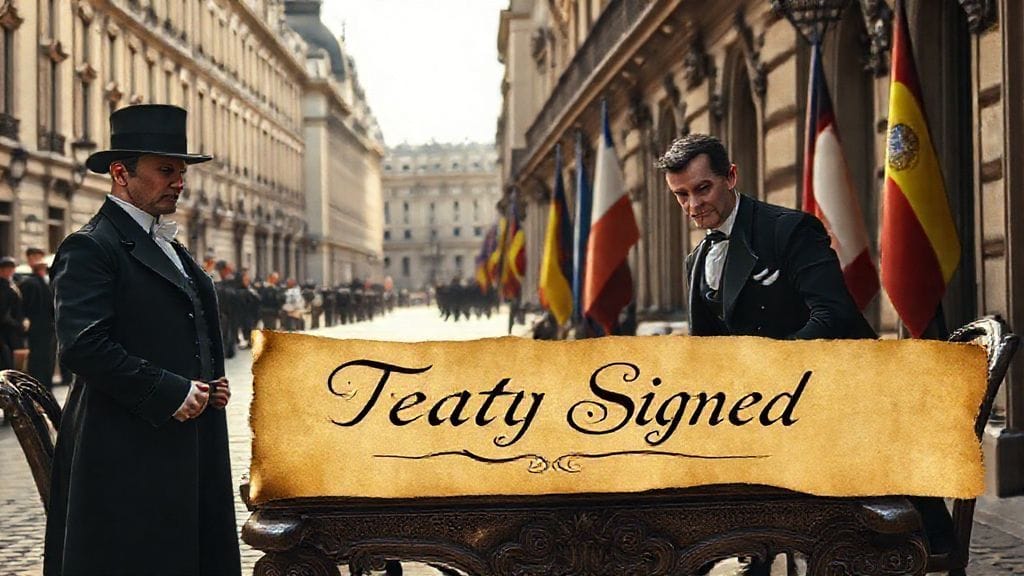
Paris was awash with an unusual chill that morning, not just of winter but of expectation. On December 10th, 1898, diplomats gathered in stately rooms resonant with centuries of treaties and alliances. Outside the ornate windows, the Seine flowed quietly under the weight of history. Inside — the fate of empires would be decided. The Treaty of Paris was about to be signed, bringing an official end to the brutal Spanish-American War that had shaken the world less than six months earlier.
This was not just the end of a conflict; it was a turning point where the old colonial order gave way to new hegemonies, where ideals of liberty collided with the realities of imperial ambition. As pens scratched across parchment, the future of millions hung in fragile balance.
A Wound in the World: How the Spanish-American War Began
The Spanish-American War was no spontaneous eruption but a powder keg lit by decades of unrest and geopolitical tension. Spain’s vast empire — once unrivaled — had been slowly crumbling throughout the 19th century. Nationalistic uprisings echoed from Cuba to the Philippines, where subjects yearned for self-determination.
The United States, emerging from its own civil war transformation, watched closely. Fueled by newspapers spinning fiery tales of Spanish atrocities and convinced that the Western Hemisphere was its rightful sphere of influence, American sentiment turned vehemently pro-intervention. The sinking of the USS Maine in Havana Harbor in February 1898 became the spark that ignited a war carved out of media hysteria, economic interests, and ideological crusades.
Spain’s Empire on the Verge of Collapse
Once, Spain's empire had spanned continents, its golden ships laden with riches crossing oceans. But by the late 19th century, this empire was a fragile shadow of its former self. Internal dissent, economic difficulties, and military defeats had hollowed out Spain’s majesty.
Cuba, a jewel of sugar and tobacco, was engulfed in rebellion. The Filipino insurgency, inspired by secular and nationalist ideals, urged independence with unyielding fervor. Spain’s ability to hold on was weakening by the day, yet the crown clung stubbornly to its legacy — unwilling to relinquish pride or territory without a fight.
The United States: Rising Tide of Imperial Ambitions
Across the Atlantic, the United States was becoming a new kind of power. Freed from its Continental borders by the doctrine of Manifest Destiny, the country eyed overseas expansion with a mixture of pragmatism and idealism.
Cuba’s proximity to American shores stirred calls for intervention under the guise of humanitarian aid, but strategic motivations underpinned every move. Naval officers, business magnates, and politicians debated the merits of empire versus republic, while newspapers fanned the flames of popular opinion—sometimes irresponsibly.
The Battles that Echoed Across Oceans and Continents
From the Caribbean to the Pacific, the war unfolded swiftly but dramatically. The US Navy's decisive victory at Manila Bay shattered Spanish naval power in the Pacific almost overnight. Meanwhile, Cuban guerrillas, supported subtly by American forces, harried Spanish troops on land.
Puerto Rico too became a theater of conflict, though less bloody. Each battle was more than a military engagement; it was a contest of national will, a redefinition of identity forged in fire and cannonade.
The Sinking of the Maine: Catalyst for War
On February 15, 1898, the USS Maine exploded in Havana's harbor under mysterious circumstances. The tragedy—266 sailors lost—was seized by American newspapers as irrefutable proof of Spanish treachery.
Whether accidental or sabotaged, the event became the rallying cry "Remember the Maine! To hell with Spain!" — and the war was effectively declared by popular consensus before formal declarations were exchanged.
War in the Caribbean: The Fight for Cuba’s Freedom
Cuba was the epicenter of the struggle. Decades of insurgency had worn down Spanish forces but had not secured freedom. American intervention tipped the balance.
Rough Riders led by Theodore Roosevelt charged up San Juan Hill in a battle that captured imaginations worldwide. Yet the harsh realities of tropical warfare—disease, famine, and scorched-earth tactics—highlighted the grim cost of liberation.
Conflict in the Pacific: The Philippines and Guam at Stake
While Cuba was America’s immediate concern, the Pacific theater would shape future world orders. The destruction of the Spanish fleet at Manila Bay opened the gates for US occupation.
For Filipinos, who had already declared independence and fought against Spanish rule, the arrival of a new foreign power was bittersweet—hope mingling quickly with resistance. Guam, a small island with strategic value, fell silently into American hands, portending a wider reach for the US Navy.
Diplomatic Chessboard: The Road to Paris Negotiations
As guns fell silent, real power struggles moved behind polished doors in Paris. Negotiations would be as much about rhetoric and reputation as about land and sovereignty.
Spain, weakened and humiliated, sought to salvage some dignity and mitigate hardship. The United States pressed for maximum gains, all while European powers watched carefully to understand the new balance unfolding on the world stage.
The Paris Peace Conference: Tense Moments and Deliberations
The delegates met with cautious posture but urgent purpose. Hours stretched into days; proposals met counterproposals. Each clause carried consequences far beyond the conference hall.
The French capital, symbol of enlightenment and revolution, now hosted a treaty that bore the paradox of progress and repression. Behind the scenes, personal tensions and political calculations shaped every word.
Key Figures at the Negotiating Table: Diplomats and Statesmen
Key personalities defined the tone and outcome of the treaty — notably the American diplomat William R. Day and Spain’s Eugenio Montero Ríos. Their correspondence and discussions reveal a mix of respect, frustration, and the burden of representing crumbled empires.
President McKinley’s administration, driven by the ideals of spreading democracy but tangled in realpolitik, cast a long shadow over the talks.
The Terms of the Treaty: Ceding Empires and Shaping Futures
The Treaty of Paris formalized Spain’s ceding of Cuba, Puerto Rico, Guam, and the Philippines to the United States. An indemnity of $20 million was agreed upon for the Philippine archipelago.
This transfer marked a stark shift from colonial possession to American imperialism, raising paradoxes between self-rule aspirations and external domination.
Reactions Across Spain: National Humiliation and Political Upheaval
In Spain, the treaty sparked an anguished national introspection. The “Disaster of ’98” became more than military defeat; it was a crisis of the soul and identity.
Political factions clashed—some advocating reform and modernization, others retreating into nostalgia. Cultural movements sought to grapple with the loss and define a new Spanish destiny.
American Public Opinion: Triumph, Controversy, and Debate
While many Americans hailed the treaty as a glorious expansion, debates churned beneath the surface. Anti-imperialists argued it betrayed foundational republican values.
Was the United States becoming a colonial power at heart? The debates resonated through newspapers, churches, and halls of Congress, illuminating the complexities of national identity versus global ambition.
The Fate of Cuba, Puerto Rico, Guam, and the Philippines
The Treaty’s clauses on sovereignty and autonomy were ambiguous. Cuba was technically independent but under US military occupation; Puerto Rico and Guam became unincorporated territories.
The Philippines, declared independent by Filipino revolutionaries, faced an uncertain fate—a decision that would soon trigger a brutal new conflict.
The Philippine-American War: A New Chapter of Conflict
What was hailed by some as liberation unleashed a bloody insurgency. The treaty ignored Filipino aspirations, prompting a war that lasted three years and caused enormous suffering.
It was a painful contradiction — fighting for freedom only to exchange one colonial master for another, spotlighting the limits of American ideals when tested abroad.
Imperial Ambitions or New Republic? The United States’ Dilemma
The Treaty of Paris raised profound questions about America’s role in the world. Was it a beacon of liberty or an empire in disguise?
The tension between expansionism and democratic values would haunt US foreign policy for decades, shaping its 20th-century global engagement.
Global Repercussions: How the Treaty Reshaped World Power
Europe watched warily as America stepped onto the imperial stage. The treaty shifted strategic balances, laying groundwork for future alliances and conflicts.
Colonial powers recalibrated, while emerging nationalist movements worldwide took new inspiration—or caution—from the unfolding events.
Cultural Shifts: Narratives of Empire and Identity
The war and treaty inspired waves of literature, journalism, and art. Americans celebrated heroism; Spaniards mourned loss; colonized peoples wrestled with identity and resistance.
This era reshaped narratives of power and possibilities, fueling both pride and protest.
Historical Debates: Was the Treaty a Victory or a Moral Defeat?
Historians remain divided. The treaty is seen alternately as America’s emergence as a world power or a departure from founding ideals—an uncomfortable compromise between pragmatism and principle.
Spain’s defeat marks the twilight of old empires but also raises questions about the human cost of imperialism.
Lessons from Paris: Diplomacy, War, and the Limits of Power
The Treaty of Paris teaches the fragility of empires and the complexities of peace—reminders that victory on the battlefield does not always translate into lasting harmony.
It demonstrates how diplomacy must contend with the ambitions, fears, and hopes of multiple actors, often at odds with each other.
The Treaty’s Legacy in Modern US-Spain Relations
Today, the treaty is remembered as a defining moment in the historical relationship between Spain and the United States. Diplomatic ties have matured into partnership, but the echoes of 1898 are never far.
Understanding this past is vital to appreciating the nuanced transatlantic friendship of the 21st century.
Reflections in Literature and Art: Remembering 1898
Writers like Miguel de Unamuno and artists reacted to the trauma and transformation of the age. Their works capture the emotional and intellectual currents unleashed by the war and treaty.
These cultural legacies offer rich perspectives beyond mere political chronicles.
The End of an Era: Spain’s Imperial Twilight
The treaty marked the final curtain on centuries of Spanish imperial dominance. It was a poignant ending and a painful beginning, as Spain embarked on national regeneration amid loss.
The 1898 catastrophe forced Spain to reimagine itself—politically, socially, and culturally.
The Aftermath and the Dawn of a New Century
As the 20th century dawned, the world’s map was reconfigured. The Treaty of Paris had not just ended a war but scripted a new chapter of globalization, conflict, and hope.
Its reverberations continue to inspire reflection on sovereignty, justice, and the intricate dance of nations.
Conclusion
The signing of the Treaty of Paris on December 10, 1898, was more than a legal act; it was a fulcrum of history where empires fell, new powers rose, and the ideals of freedom encountered the realities of imperial ambition. This treaty closed a violent chapter but opened a complex saga of identity, resistance, and transformation.
It reminds us that history is neither simple nor linear; it vibrates with human stories of courage and contradiction. In contemplating the Treaty of Paris, we confront the enduring tension between principle and power, a lesson as relevant today as it was over a century ago.
FAQs
1. What triggered the Spanish-American War?
The immediate catalyst was the explosion of the USS Maine in Havana Harbor in February 1898, but underlying causes included Cuban independence movements, American expansionism, and deteriorating Spanish colonial power.
2. What were the main terms of the Treaty of Paris?
Spain ceded Cuba, Puerto Rico, Guam, and the Philippines to the United States. The US paid $20 million to Spain for the Philippines and Cuban independence was nominally recognized under US oversight.
3. Who were the key figures in the Paris negotiations?
William R. Day represented the US, while Eugenio Montero Ríos led the Spanish delegation. President William McKinley’s administration heavily influenced the American position.
4. How did Spain react to the treaty?
Spain experienced deep national humiliation, leading to political crises and sparking a cultural movement to rethink and rebuild Spanish identity.
5. What was the impact of the treaty on the Philippines?
The treaty ignored Filipino independence aspirations, leading to the Philippine-American War—a brutal conflict that challenged American imperial policies.
6. Did the treaty mark the beginning of American imperialism?
Yes, it was a pivotal moment marking US transition from continental expansion to overseas empire building, with long-term implications for its foreign policy.
7. How did the treaty affect US-Spain relations in the long term?
Although relations were strained, the two countries eventually developed a cooperative diplomatic relationship, recognizing their shared history but moving beyond conflict.
8. Why is the Treaty of Paris considered historically significant?
It redefined global power structures, ended Spanish colonial dominance, and marked the emergence of the United States as a world power, shaping the geopolitical landscape of the 20th century.