Table of Contents
- A City Poised on the Brink: Ravenna in the Late 5th Century
- The Fall of the Western Roman Empire: A Prelude to Change
- Who Was Theodoric? Origins of a Barbarian King
- Theodoric’s Path to Power: From Ostrogothic Chieftain to Roman Ally
- The Siege and Entry: Theodoric Takes Ravenna
- The Symbolism of Ravenna: Capital of a Shifting Empire
- Negotiating Legitimacy: Theodoric and the Roman Senate
- A New Rule in a Fragile City: Early Challenges
- Theodoric’s Vision: Unity Between Goths and Romans
- Religious Tensions: Arians and Catholics Under One Roof
- Administration and Governance: Blending Gothic Strength and Roman Tradition
- Ravenna’s Architectural Flourish: Politics in Stone and Mosaic
- Theodoric’s Military Reforms and Defensive Strategies
- Cultural Patronage: Theodoric as a Patron of Arts and Letters
- Relations with the Eastern Roman Empire: A Delicate Balance
- Economic Revival: Trade, Agriculture, and Stability
- Legacy of Theodoric’s Reign: Long Shadows over Italy
- Theodoric’s Death and the Fate of Ravenna
- Historical Perspectives: How Chroniclers Remember Theodoric
- Modern Reflections: Ravenna’s Past in Contemporary Italy
1. A City Poised on the Brink: Ravenna in the Late 5th Century
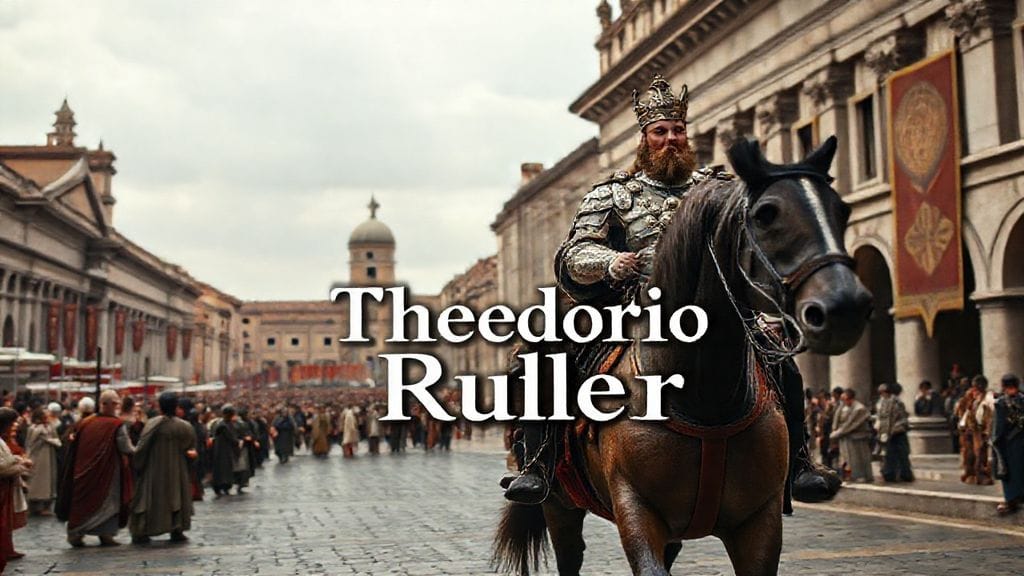
The salt air of the Adriatic brushed softly against the crumbling walls of Ravenna on that early March day in 493 AD. It was a city both ancient and battered, once thriving as the Western Roman Empire’s capital, now a fragile jewel caught between the old world and a turbulent new order. Fog clung to the canals and narrow streets as the towering figure of a foreign army approached—a force unlike any seen in Italy for decades. Theodoric the Great, leader of the Ostrogoths, was about to enter Ravenna, not as a conqueror, but as a ruler whose ambitions melded barbarian vigor with Roman grandeur.
For the people of Ravenna, the arrival of Theodoric marked the denouement of a long and violent saga. The collapse of imperial power had plunged the city into uncertainty, and Theodoric’s triumph was at once an end and a beginning—a promise of order, but also a profound transformation. The silence before his entry was thick with anticipation and unease. Would this warrior-king be a ruthless conqueror, or the architect of a new Roman dawn?
2. The Fall of the Western Roman Empire: A Prelude to Change
To grasp the significance of Theodoric’s entry into Ravenna, one must turn back the pages to the twilight of Roman power in the West. The fifth century was a tempest decade, marked by invasions, plundering, and political fragmentation. Theodoric’s Venice-bound approach hinted at the end of an era that had begun with Augustus two centuries earlier.
By 476 AD, the last Roman emperor, Romulus Augustulus, was deposed by the Germanic warlord Odoacer, symbolizing Rome’s political collapse in the West. Yet, Odoacer’s reign was unstable, and Italy became a prize for competing barbarian chieftains. Theodoric, leading the Ostrogoths, was at once a participant in this chaos and a peculiar candidate for renewal. His alliance with the Eastern Roman Emperor Zeno was both pragmatic and fraught with tension, underscoring the political complexity of the period.
3. Who Was Theodoric? Origins of a Barbarian King
Theodoric was no ordinary chieftain; born around 454 AD, he was a man shaped by Rome and the Gothic tradition alike. Raised partly as a hostage in Constantinople, he learned the art of war and diplomacy in the imperial courts, gaining fluency in Latin, Greek, and Gothic customs. This uncommon education enabled him to envision a synthesis of Gothic strength and Roman civilization.
Unlike earlier barbarian leaders boxed into opposition with the Roman world, Theodoric imagined a reconciled Italy ruled by an Ostrogothic elite yet engaged with Roman law and society. His lineage traced back to the Amali dynasty, a royal Gothic bloodline steeped in the martial myths of the north, yet he carried the mark of a Romanized future on his shoulders.
4. Theodoric’s Path to Power: From Ostrogothic Chieftain to Roman Ally
Theodoric’s rise was neither linear nor solely martial. His early years were marked by triumphs and setbacks—among them battles against the Eastern Roman Empire and Gothic factions. Yet his fortunes shifted dramatically when Emperor Zeno commissioned him to overthrow Odoacer, whose defiance in Italy threatened the fragile eastern-western balance.
This imperial endorsement was crucial. Theodoric led his people into Italy in 488 AD, initiating a power contest that culminated years later in his decisive campaign for Ravenna—the jewel of Italian administration and culture. Far from being a mere invader, Theodoric presented himself as a restorer of order sanctioned by Rome itself.
5. The Siege and Entry: Theodoric Takes Ravenna
Ravenna, surrounded by labyrinthine marshes and canals, was a fortress difficult to conquer. Odoacer had withdrawn there, confident in its defensibility. Theodoric’s siege began in earnest in 490 AD. For over three years, the city’s fate hung in balance. The Ostrogothic army camped relentlessly; the city inside suffered scarcity and fatigue.
But Theodoric combined martial patience with political acumen, winning over disaffected nobles and even promising clemency to the city’s inhabitants. On March 5, 493, after a carefully negotiated surrender, Theodoric entered Ravenna. His triumph was not marked by destruction but by a solemn procession—an act designed to signify legitimate succession, not brutal conquest.
6. The Symbolism of Ravenna: Capital of a Shifting Empire
Entering Ravenna was more than asserting dominion over a city; it was about capturing the very symbols of power in Italy. Ravenna, with its basilicas resplendent in mosaics of gold and glass, represented the continuity of Roman imperial authority, Christian faith, and the cultural legacy of a fragmented empire.
By taking Ravenna, Theodoric claimed more than a seat of government—he assumed the mantle of leadership in a fragile post-Roman world, aspiring to balance Gothic prowess with the preservation of Roman traditions.
7. Negotiating Legitimacy: Theodoric and the Roman Senate
Upon his entry, Theodoric was cautious not to alienate the Roman Senate—still a body of significant influence despite waning power. His reign began with gestures aimed at reconciliation: restoring senatorial privileges, preserving Roman laws, and respecting senatorial authority.
The Senate, wary but hopeful, saw in Theodoric a ruler capable of protecting Rome’s interests without uprooting its centuries-old institutions. Theodoric’s diplomacy thus blended respect for Roman customs with Gothic rule—a delicate dance of power, tradition, and innovation.
8. A New Rule in a Fragile City: Early Challenges
Theodoric’s initial period in Ravenna was marked by challenges that tested his vision. First, he confronted suspicions from Roman citizens and Gothic warriors alike, who viewed his policies as either too lenient or too Roman.
Then there were practical concerns: re-establishing administrative order, securing grain supplies, and defending the city against external threats such as the Franks and Vandals. Behind Theodoric’s calm façade lay constant negotiation between disparate interests and fragile alliances.
9. Theodoric’s Vision: Unity Between Goths and Romans
Unlike other barbarian rulers who ruled by iron domination, Theodoric sought a fusion of identities. His policy was clear: Goths and Romans were to coexist under a single polity, maintaining their customs yet sharing a stable government.
Legal pluralism characterized his reign—Romans followed Roman law, Goths their customs—yet Theodoric personally defended the unified peace of the realm. This approach positioned him as a unique bridge between antiquity and the emerging medieval order.
10. Religious Tensions: Arians and Catholics Under One Roof
One of the most profound challenges was religious division. Theodoric himself was an Arian Christian, a branch considered heretical by the Roman Catholic Church which still held sway in Ravenna.
Despite doctrinal differences, Theodoric exercised remarkable tolerance, protecting Catholic clergy and allowing freedom of worship. This pragmatic religious policy was vital to maintaining peace, though tensions simmered beneath the surface, occasionally erupting in conflicts that tested his authority.
11. Administration and Governance: Blending Gothic Strength and Roman Tradition
Theodoric’s governance style was both authoritarian and inclusive. He kept Roman bureaucrats in office, ensuring continuity in tax collection, legal administration, and city planning, while placing key military commands with trusted Gothic leaders.
This hybrid administration preserved the efficiency of Roman statecraft yet integrated Gothic influence, ensuring loyalty from diverse constituencies. Theodoric's government became a model for post-Roman kingdoms that would later emerge in Western Europe.
12. Ravenna’s Architectural Flourish: Politics in Stone and Mosaic
Under Theodoric, Ravenna witnessed a remarkable architectural and artistic revival. The city’s famed mosaics and basilicas, such as Sant’Apollinare Nuovo, became vehicles for political messaging, blending Gothic symbols with Christian iconography and imperial references.
Rich in gold tesserae and vivid images, these artworks projected Theodoric’s role as a divinely sanctioned ruler bridging Roman heritage and Gothic roots. Each mosaic was a testament to his ambition—not just as a warrior but as a patron of culture.
13. Theodoric’s Military Reforms and Defensive Strategies
Maintaining control over Italy required constant vigilance. Theodoric reorganized the Ostrogothic army with Roman tactics and Gothic valor, creating a disciplined force capable of defending the realm against Lombards, Byzantines, and other threats.
His network of fortified towns, enhanced roadways, and intelligence networks ensured that Ravenna and Italy remained relatively secure during his reign—a critical factor in the stability he managed to impose over two decades.
14. Cultural Patronage: Theodoric as a Patron of Arts and Letters
Beyond politics and war, Theodoric fostered a vibrant cultural scene. He welcomed scholars, poets, and clerics, supporting Latin literature and philosophical discourse. His court in Ravenna became a center of learning and artistic production in a Europe often described as dark and fragmented.
Through manuscripts, inscriptions, and art, Theodoric helped preserve the intellectual heritage of Rome, positioning himself as more than a mere barbarian king—he was a custodian of civilization.
15. Relations with the Eastern Roman Empire: A Delicate Balance
Though nominally a vassal of Emperor Zeno in Constantinople, Theodoric’s relationship with the Eastern Roman Empire was complex and often tense. His authority in Italy was a constant reminder of the East’s indirect control, yet Theodoric wielded true autonomous power.
Diplomatic correspondence, marriage alliances, and occasional military posturing exemplified this uneasy coexistence. Theodoric had to navigate between asserting independence and acknowledging imperial legitimacy—a tightrope act that shaped his rule.
16. Economic Revival: Trade, Agriculture, and Stability
Theodoric understood that political power had to rest on economic foundations. He revitalized agriculture by restoring irrigation and land tenure systems, encouraged trade in Adriatic ports, and stabilized the currency.
Ravenna benefited as a commercial hub, bridging northern Europe and the Mediterranean. The stability brought by Theodoric’s reign laid the groundwork for economic recovery after decades of warfare and disruption.
17. Legacy of Theodoric’s Reign: Long Shadows over Italy
Theodoric’s death in 526 AD marked the end of an era, but his legacy endured. For a quarter-century, he had brought relative peace to Italy after decades of turmoil, preserved Roman institutions, and forged a new kind of kingdom blending barbarian and classical worlds.
Later rulers would imitate his model, and modern historians often see in Theodoric the archetype of the "Roman Barbarian" who helped transmit the legacy of Rome into the medieval age.
18. Theodoric’s Death and the Fate of Ravenna
After Theodoric’s passing, Ravenna and Italy plunged once again into instability. Succession disputes, Byzantine ambitions, and renewed invasions chipped away at his achievements.
By the middle of the 6th century, the Eastern Roman Empire reconquered Italy in the Gothic Wars, ending Ostrogothic rule. Yet Ravenna remained a cultural and political symbol, its mosaics and churches silent witnesses to Theodoric’s reign.
19. Historical Perspectives: How Chroniclers Remember Theodoric
Medieval chroniclers and later Renaissance humanists viewed Theodoric through different lenses: some praised him as a wise ruler who preserved peace, others saw him as a barbarian usurper.
The Gothic historian Jordanes, who arguably wrote with Theodoric’s consent, crafted a narrative of a heroic king uniting Goths and Romans. This portrayal influenced generations and helped define the mythos of the early medieval West.
20. Modern Reflections: Ravenna’s Past in Contemporary Italy
Today, visitors wandering Ravenna’s labyrinthine streets can still feel the echoes of Theodoric’s reign in its mosaics, basilicas, and city walls. Italy looks back on this era as a bridge from antiquity to the medieval order.
Theodoric’s story resonates as a tale of cultural fusion, political pragmatism, and the enduring quest for identity—an enduring reminder that history is never simply about conquests but about building worlds anew amid chaos.
Conclusion
Theodoric’s entry into Ravenna was more than the arrival of a foreign king; it was the moment a fractured Italy glimpsed order created from upheaval—a story of diplomacy, cultural synthesis, and political innovation. His reign remains a vivid chapter in the mosaic of European history, illuminating the nuanced transitions from empire to kingdom, barbarism to civilization.
In Theodoric, we meet a ruler who defied the conventions of his age, blending warrior ethos with statesmanship and respect for a Roman past he never fully abandoned. His legacy invites us to reflect on the resilience of human societies amid crisis, the power of cultural hybridity, and the eternal search for legitimacy in leadership.
FAQs
Q1: Why was Theodoric’s entry into Ravenna significant?
A1: It marked the establishment of Ostrogothic rule in Italy, signalling a shift from Roman imperial domination to a new regime blending Gothic leadership with Roman traditions.
Q2: How did Theodoric maintain peace between Goths and Romans?
A2: Through policies promoting legal pluralism, religious tolerance, and respect for Roman institutions, he fostered coexistence despite cultural and religious differences.
Q3: What role did religion play during Theodoric’s reign?
A3: Theodoric was an Arian Christian ruling largely Catholic populations, yet he practiced religious tolerance to maintain social harmony, though tensions remained.
Q4: How did Theodoric’s relationship with the Eastern Roman Empire evolve?
A4: Though theoretically a vassal, he operated with considerable independence, balancing diplomacy and power without fully submitting to Constantinople.
Q5: What architectural achievements are associated with Theodoric’s reign in Ravenna?
A5: His era saw a flourish of mosaics and basilica constructions that combined Gothic and Roman styles, some of which survive as UNESCO World Heritage sites today.
Q6: What happened to Ravenna and Italy after Theodoric’s death?
A6: The Ostrogothic kingdom declined, eventually falling to the Eastern Roman Empire during the Gothic Wars, leading to renewed conflict but also preservation of cultural heritage.
Q7: How do historians view Theodoric today?
A7: He is often seen as a pivotal figure who bridged late antiquity and the early medieval world, embodying the complexities of identity and power in a fractured post-Roman Europe.
Q8: Why is Theodoric considered a model of Roman-barbarian kingship?
A8: Because he combined the martial traditions of the Goths with Roman administrative practices and cultural patronage, creating a hybrid rule respected by diverse populations.

