Table of Contents
- The Tumultuous Twilight of the Vandal Kingdom
- Carthage in the Midst of Turmoil
- Huneric: The Controversial King Emerges
- Seeds of Religious and Political Conflict
- The Civil War Ignited: Fractures Within the Vandal Realm
- The Role of the Catholic and Arian Communities
- The Battle for Carthage: A City Divided
- Huneric’s Ascendancy: From Prince to Sovereign
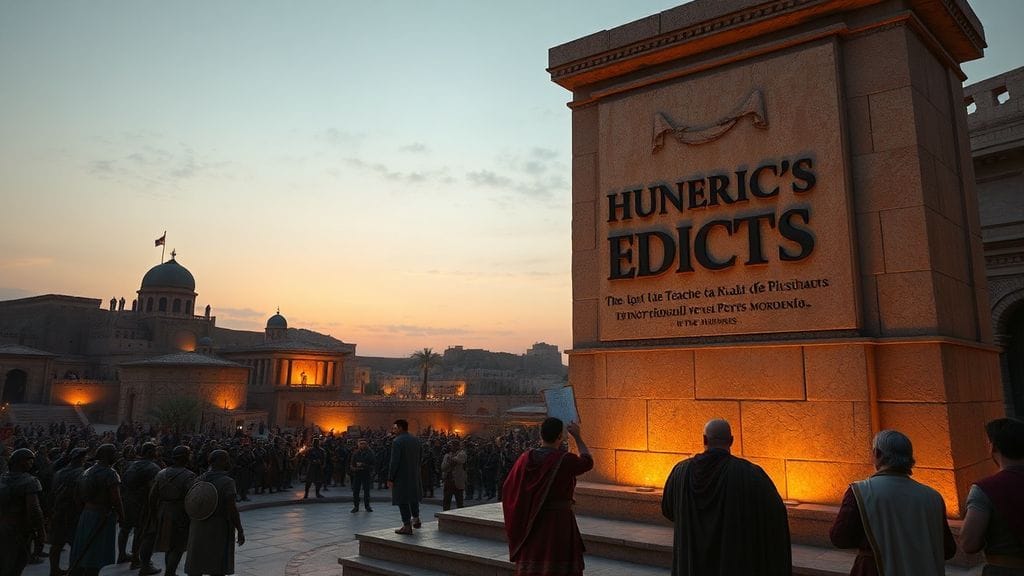
- The Edicts of 484: Instruments of Control and Suppression
- A Religious Purge Under the Guise of Legislation
- The Fate of the Catholic Clergy and Nobility
- Resistance and Repression: The End of the Civil War
- The Wider Mediterranean Reaction to Vandal Turmoil
- Huneric’s Reign: Consolidation Amidst Discord
- The Human Cost: Lives, Exile, and the Vanishing of a Kingdom
- Legacy of the Huneric Edicts in North African History
- The Collapse of the Vandal Kingdom: Prelude to Byzantine Reconquest
- Historiographical Debates: Understanding the Civil War’s Impact
- Archaeological Remnants: Traces of Conflict in Carthage
- Final Reflections on a Kingdom’s Last Stand
The Tumultuous Twilight of the Vandal Kingdom
In the heat-drenched avenues of 5th-century Carthage, shadowed by palm trees swaying under a merciless African sun, a kingdom teetered on the edge of implosion. The once-mighty Vandal Kingdom, seated on the ruins of Roman Africa, was unraveling from within. There was no sudden explosion of violence but a slow-burning conflagration of religious strife, political intrigue, and familial betrayals that crescendoed into full-blown civil war. This was the world into which Huneric stepped in 484, a ruler whose edicts would shape not only the fate of Carthage but the history of North Africa itself.
The year 484 marked the culmination of a painted drama of religious rivalry and fratricidal conflict. At stake was not only power over a kingdom snagged between the waning Roman Empire and the encroaching Byzantine forces but also the very soul of a society divided between Arianism and Catholicism. The civil war within the Vandal Kingdom was more than a mere political struggle—it was an existential crisis that resonated through every street, church, and family. When Huneric issued his infamous edicts, it was the decisive final act in this tragic saga.
Carthage in the Midst of Turmoil
Carthage, the jewel of Roman Africa, had become the capital of the Vandal Kingdom after the tribe’s dramatic crossing of the Mediterranean in 429 under King Genseric. Once a prosperous hub of commerce, learning, and Christianity, Carthage by the mid-5th century was a city riven by tension. The Vandals, adherents of Arian Christianity—a doctrine deemed heretical by the Roman Catholic Church—ruled over a majority Catholic population with a wary eye.
Carthage was not only the stage for political disputes but a spiritual battlefield where faith intertwined with identity and authority. The city’s landmarks, from the basilicas to the provincial administration buildings, stood witness to the deepening chasm between rulers and ruled. One sensed the pressure mounting like the oppressive heat before a desert storm: an unseen force ready to burst forth in chaos.
Huneric: The Controversial King Emerges
Huneric, the eldest son of Genseric, was a figure carved from complexity and contradiction. Known for his rigid commitment to Arianism and his ruthless political calculus, Huneric’s character was both admired and feared. His ascent to the throne followed years of internal strife within the Vandal royal family, as he navigated the treacherous waters of succession amid competing factions.
Though his reign would be marked by harsh policies and religious persecutions, Huneric was also a king driven by a vision—to solidify and expand Vandal power in a region increasingly unstable. His edicts, issued in 484, were his tools for imposing order, but in doing so, they ignited further suppression and fractures within his kingdom.
Seeds of Religious and Political Conflict
The underlying causes of the civil war that would convulse the Vandal Kingdom were steeped in religious intolerance and political rivalry. The Vandals’ adherence to Arian Christianity clashed with the overwhelmingly Catholic populace. This religious divide was deeply politicized, as many Catholic nobles and clergy refused to accept Vandal rule that marginalized their beliefs.
Meanwhile, tensions festered within the Vandal aristocracy and military. Façades of unified leadership cracked under the strain of competing ambitions, differing religious convictions, and external pressures from Roman and Byzantine entities eager to reclaim African territories. It was an unstable crucible in which political power and faith intertwined explosively.
The Civil War Ignited: Fractures Within the Vandal Realm
The civil war itself was not a single battle but a protracted struggle that unfolded over several years. Poisoned by rival claims to the throne, disputes over religious policy, and shifting alliances, the conflict tore through the kingdom’s fabric. Vandal nobles aligned themselves with either the strict Arian Huneric faction or more conciliatory representatives of Catholicism.
These internal divisions resulted in armed clashes, sieges, and purges. It was a battle that extended beyond the palace halls to encompass city streets and rural estates. The balance of power tilted precariously for years, leaving Carthage vulnerable and the kingdom’s future uncertain.
The Role of the Catholic and Arian Communities
Religion was not merely a backdrop to the civil war—it was its epicenter. The Catholic clergy, revered by the majority of Carthage’s inhabitants, found themselves targeted by Vandal authorities who favored Arianism. The political exploitation of these religious differences deepened mistrust, fostering an environment where brother could turn against brother.
The Catholic communities, despite persecution, became pockets of resistance and solidarity. Their bishops, such as the influential Primasius of Hadrumetum, attempted to maintain spiritual leadership while navigating dangerous political waters. For the Vandals, subjugating or converting the Catholic population was as critical as securing military dominance.
The Battle for Carthage: A City Divided
Carthage was the jewel contested in the civil war—its symbolic and strategic importance immense. Streets filled with whispers of treachery, and alleys bore silent witness to clandestine gatherings. The city’s noble families split along religious lines, creating a microcosm of the wider conflict.
Fierce skirmishes erupted within the city’s walls as factions battled for control over government buildings and religious sites. Yet it was a war fought as much by ideology and subversion as by sword and shield. The scars left upon Carthage were not only physical but psychological, permeating the collective memory of its people.
Huneric’s Ascendancy: From Prince to Sovereign
In 477, after years of turmoil, Huneric solidified his position as king. His reign promised stability, but it came at a heavy cost. Determined to stamp out Catholic resistance and enforce Arian orthodoxy, Huneric adopted measures that would culminate in the harsh edicts of 484.
His leadership style was autocratic and punitive. Huneric’s vision for the kingdom was relentless—no dissent would be tolerated. This period witnessed intensified persecution of Catholics, including imprisonment, torture, and exile. Huneric’s policies were both a cause and consequence of the civil war’s brutal logic.
The Edicts of 484: Instruments of Control and Suppression
The edicts Huneric promulgated in 484 were his most notorious legacy—legal instruments designed to cement his authority and suppress opposition. These laws targeted Catholics through restrictions on worship, property confiscations, and bans on clerical activities.
The edicts represented an explicit strategy of religious and political control. They codified persecution and sought to eliminate the Catholic Church’s influence. For many, these laws signaled an official declaration of war against dissent and a turning point in the kingdom’s fractious history.
A Religious Purge Under the Guise of Legislation
Beyond mere political maneuvering, the 484 edicts initiated a systematic purge cloaked as legal governance. Catholic bishops were exiled or imprisoned, churches closed or destroyed, and ordinary believers subjected to harassment and violence.
This ruthless campaign devastated the Catholic community’s structure and morale. Huneric’s regime portrayed these actions as a necessary defense of the kingdom’s unity and faith, yet they also alienated many subjects and further destabilized the social fabric.
The Fate of the Catholic Clergy and Nobility
The Catholic elite suffered immensely under the edicts. Many bishops, including the resilient Bishop Eugenius of Carthage, faced harsh punishments. Nobles who resisted the king’s policies were stripped of titles, lands, or worse.
This purging of leaders decapitated Catholic resistance but also created martyrs whose legacy inspired enduring opposition. The clergy’s suffering was chronicled by contemporaries and echoed through subsequent historical narratives, underscoring the human cost of Huneric’s reign.
Resistance and Repression: The End of the Civil War
By the mid-480s, the civil war neared its conclusion, but not through reconciliation. Huneric’s relentless repression quelled armed opposition and divided factions. The kingdom endured a grim peace enforced by fear rather than harmony.
Yet beneath the surface, resistance simmered—in secret gatherings, coded prayers, and whispered hopes of liberation. While the civil war formally ended, the wounds of conflict and religious hatred would persist, setting the stage for future upheaval.
The Wider Mediterranean Reaction to Vandal Turmoil
The Vandal civil war and Huneric’s policies did not go unnoticed beyond Africa’s shores. The declining Western Roman Empire and the Eastern Roman (Byzantine) Empire keenly observed these developments.
Some saw an opportunity to reclaim lost territories while others lamented the Kingdom’s descent into violence. Diplomatically, Huneric’s actions isolated the Vandals, eroding alliances and exposing the kingdom to external threats that would soon culminate in the Byzantine reconquest.
Huneric’s Reign: Consolidation Amidst Discord
Despite the controversies, Huneric managed to maintain a semblance of centralized authority until his death in 484. His reign was a paradox of consolidation and chaos—he unified the kingdom under his despotism but fractured its spirit irrevocably.
The edicts, though effective in suppressing dissent temporarily, alienated large swaths of the population and weakened internal cohesion. Huneric’s legacy is thus one of harsh order achieved through brutal means—a reign marked both by strength and tragedy.
The Human Cost: Lives, Exile, and the Vanishing of a Kingdom
Behind the political dramas lay countless personal tragedies. Families torn apart by religious hostility, individuals exiled into exile and despair, and entire communities marginalized. The civil war and ensuing persecutions deeply scarred African society.
Population displacement, the destruction of religious institutions, and loss of cultural continuity marked this era. The echoes of these human costs resonated for decades, complicating historical recovery and memory.
Legacy of the Huneric Edicts in North African History
The edicts of 484 became a symbol of intolerance and oppression in North African historical memory. For Catholic communities, they represented martyrdom and endurance. For historians, they highlight the complexities of rule in post-Roman Africa.
Their influence persists in debates over religious coexistence, power, and identity. Huneric's policies offer a stark illustration of how doctrinal rigidity can exacerbate political fragility.
The Collapse of the Vandal Kingdom: Prelude to Byzantine Reconquest
The internal divisions crystallized during the civil war weakened the Vandals irreparably. Just decades after Huneric’s reign, the Byzantine Empire launched the decisive campaign to reclaim North Africa under General Belisarius in 533.
The civil war and edicts had drained the kingdom’s resilience. Huneric’s harsh policies, though temporarily successful, hastened the Vandals’ demise and changed the geopolitical map of the Maghreb.
Historiographical Debates: Understanding the Civil War’s Impact
Modern historians grapple with interpreting the civil war’s causes and significance. Was it a purely religious conflict masked by political rivalry, or vice versa? How did Huneric’s edicts shape the kingdom’s fate?
Conflicting sources and biases, from pro-Catholic chroniclers to Byzantine accounts, complicate the narrative. Yet this scholarly debate enriches our understanding of the event's enduring complexity.
Archaeological Remnants: Traces of Conflict in Carthage
Archaeology offers glimpses into this turbulent era. Excavations reveal damaged religious structures, layers of destruction, and inscriptions hinting at religious tensions.
Such finds provide tangible connections to the civil war and enrich textual records. The ruins of Carthage serve as silent witnesses to a kingdom’s final, fiery descent into internal strife.
Final Reflections on a Kingdom’s Last Stand
The civil war within the Vandal Kingdom and the edicts of Huneric stand as poignant reminders of the fragility of power and faith. In the sun-soaked ruins of Carthage, one hears echoes of a society torn apart by intolerance and ambition.
Huneric’s legacy is not merely one of cruelty but also of the tragic complexity of governance in times of transition and upheaval. The story of 484 is a mirror of human struggles that resonate still—between belief and power, unity and division, life and death.
Conclusion
The end of the civil war in the Vandal Kingdom, marked by Huneric’s edicts in 484, encapsulates a dramatic, heartrending chapter in North African history. It was a time when faith became a weapon, and political ambition a blade slicing through society’s heart. Huneric’s reign illustrated the perils of intolerance and the cost of harsh rule, revealing both the precariousness of power and the resilience of human hope.
This saga of conflict, repression, and survival did not merely close a civil war—it set in motion forces that would reshape the Mediterranean world. Carthage, once a beacon of prosperity and culture, suffered under strict edicts that sought to extinguish dissent but ultimately illuminated the complexities of empire and identity. As we reflect upon this period, we are reminded that history’s lessons lie not just in dates and decrees, but in the lived realities of those caught in its relentless currents.
FAQs
1. What sparked the civil war within the Vandal Kingdom?
The civil war was primarily triggered by religious tensions between the Arian Vandal rulers and the Catholic majority, compounded by political rivalries within the Vandal aristocracy and challenges over succession.
2. Who was Huneric and why is he significant?
Huneric was the Vandal king who ruled from 477 to 484. His reign is significant due to the harsh edicts he issued against Catholics in 484, which brought the civil war to an end but deepened religious persecution.
3. What were the main provisions of the 484 edicts?
The edicts strictly curtailed Catholic worship, confiscated property, banned clerical activities, exiled bishops, and legalized persecution of Catholics, aiming to enforce Arian dominance.
4. How did the civil war affect Carthage and its inhabitants?
Carthage became deeply divided along religious lines, experiencing skirmishes, repression, and social fragmentation. Many inhabitants suffered exile, imprisonment, or loss of property.
5. What role did the civil war play in the eventual collapse of the Vandal Kingdom?
The internal conflict weakened the kingdom’s unity and military strength, paving the way for the Byzantine reconquest of North Africa in the 6th century.
6. How have historians interpreted Huneric’s edicts and the civil war?
Interpretations vary, with debates focusing on the interplay of religious and political factors. Some view Huneric as a tyrant driven by fanaticism, others as a pragmatic ruler confronting a fragile kingdom.
7. Are there archaeological traces of the civil war in Carthage?
Yes, excavations have uncovered damaged churches, inscriptions, and signs of destruction attributed to this period, offering material evidence of the turmoil.
8. What lessons does the Vandal Kingdom’s civil war offer for understanding religious conflict in history?
It highlights how religious intolerance intertwined with political ambitions can fracture societies, with long-lasting impacts on social cohesion and state stability.

