Table of Contents
- A Journey to the Edge of Empire: The Priscus Embassy Sets Forth
- The Historical Crossroads of 449 CE: Rome, Byzantium, and the Huns
- Who Was Priscus? A Scholar Amidst Empires
- The Huns in Pannonia: A People Perceived as Shadows from the Steppes
- The Long Road to the Tisza River: Geography and Peril
- The Arrival at Attila’s Court: First Impressions and Formalities
- Attila the Scourge of God: Myth vs. Reality in the Royal Audience
- Voices in the Court: Diplomacy, Ceremony, and Hidden Motives
- The Banquets of the Huns: Feasting as Power and Display
- A Captive's Tale: Priscus Meets the Defector Roman
- The Political Chessboard: Huns and Romans in Shifting Alliances
- Cultural Juxtapositions: Civilization and Nomadic Freedom
- The Role of Oratory and Storytelling in the Hunnic Court
- The Embassy’s Message: Negotiations Beyond Words
- What Priscus Did Not Say: Reading Between the Lines
- The Legacy of Priscus’s Account in Historical Memory
- The Impact of the Embassy on Later Diplomatic Exchanges
- The Lasting Image of Attila in Western Imagination
- Pannonia and the Foreshadowing of an Empire’s Fall
- Conclusion: A Moment Frozen on the Edge of Two Worlds
- FAQs: Key Questions on the Priscus Embassy and the Huns
- External Resource: The Wikipedia Entry on Priscus’s Embassy
- Internal Link: Explore More at History Sphere
1. A Journey to the Edge of Empire: The Priscus Embassy Sets Forth
It was the dawn of an uncertain age—when the Rust-colored horizons of Pannonia stretched beneath restless skies. In the heart of this churning world, a Roman envoy named Priscus led a mission destined to bridge the insurmountable divide between the empire of Rome and the enigmatic realm of the Huns. Imagine the trepidation, the awe, the clash of civilizations palpable in every footstep toward the Misleadingly placid banks of the Tisza River.
At the crux of the fifth century, the world was rearranging itself. The great Roman Empire, though still grand, felt faint cracks beneath its marble surface. Beyond its frontiers, fierce nomadic peoples stirred, with the Huns as their fiery spearhead. Priscus’s embassy was more than a diplomatic mission; it was an encounter between two worlds—one ancient and settled, the other bold, mobile, and fiercely independent.
This was no ordinary journey. Priscus later recounted vivid encounters, unexpected gestures, and a royal court unlike any other—within which Attila the Hun held sway. His narrative offers the rare window into a world often obscured by fear and myth. We step into a time when history was not yet written by the victors but spoke through the uneasy voices of diplomacy, war, and fragile peace.
2. The Historical Crossroads of 449 CE: Rome, Byzantium, and the Huns
The year 449 CE sat at a pivotal moment bristling with tension. The Western Roman Empire was gasping under internal decay and external pressures. Although technically split from the Eastern Roman or Byzantine Empire for over a century, the two halves still navigated shared fate like uneasy siblings.
On the northern frontier lay the Huns, a confederation of tribes whose sudden incursions had terrified European realms. Their movements were swift, unpredictable, and striking. The Huns challenged not only military borders but also ideas of governance, power, and civilization itself.
Byzantium, sitting proudly on its ancient capital Constantinople, tried to manage this threat not just by force but through diplomacy. The imperial court sent envoys, like Priscus, to parley with Attila, hoping to negotiate terms and buy peace—or at the very least, time.
Thus, the embassy took shape in a delicate balance of fear and respect, understanding and suspicion. Priscus was to tread carefully in this uncertain theater, where words could spark war or forge fleeting alliances.
3. Who Was Priscus? A Scholar Amidst Empires
Priscus of Panium, a Greek rhetorician and diplomat, was no mere courier of messages. Born in the East, schooled in rhetoric and history, he carried with him a yearning to understand as much as to negotiate. His writings betray a critical mind and a keen eye for detail, combined with a surprising empathy for those he met.
Unlike many Roman historians, Priscus did not reduce the Huns to barbarous caricatures. Instead, his accounts reveal a complex society with rules, customs, and personalities worth studying. His position as an intellectual and official allowed him to gaze intently beyond the frontier’s fearsome reputation.
We owe much of what we know about Attila and the Hunnic court to Priscus’s narrative, which survived as fragments quoted by later historians. It’s through his voice that the Huns emerge as more than a faceless enemy—complex human beings with their own codes and dignity.
4. The Huns in Pannonia: A People Perceived as Shadows from the Steppes
The Huns had swept across the Eurasian Steppe, a swift and fearsome horde whose origins remain partially mysterious. By 449, they controlled vast stretches of Pannonia—a fertile region straddling present-day Hungary, Austria, and neighboring countries.
To the Romans, the Huns were the “other”: wild, uncivilized, seemingly beyond reason. Their nomadic lifestyle clashed vividly with the imperial order. Yet to those who lived alongside or under Hunnic rule, the situation was more nuanced—a negotiated reality balancing submission, tribute, and coexistence.
Their mastery of mounted warfare and horsemanship was legendary, a terrifying advantage during raids and battles. But beneath the veneer of warlike prowess, the Huns maintained a court with rituals, hierarchy, and political savvy that Priscus would soon see firsthand.
5. The Long Road to the Tisza River: Geography and Peril
The Tisza River, flowing serenely through Pannonia’s lush plains, marked the frontline where empires and peoples intersected. For Priscus and his delegation, the journey was arduous—resisting not just the elements and distance, but the psychological weight of confronting the unknown.
Ancient roads gave way to wilderness, fortified camps blended into forested hills, and wary scouts shadowed their movements. Every mile brought them closer to a precarious meeting—one balancing hope and menace beneath diplomatic facades.
Crossing the river itself was symbolic, a passage from the known to an alien world where ancient Roman conventions scarcely applied. As the river’s waters rippled against their boats, the embassy entered a threshold where customs would be challenged and perceptions upended.
6. The Arrival at Attila’s Court: First Impressions and Formalities
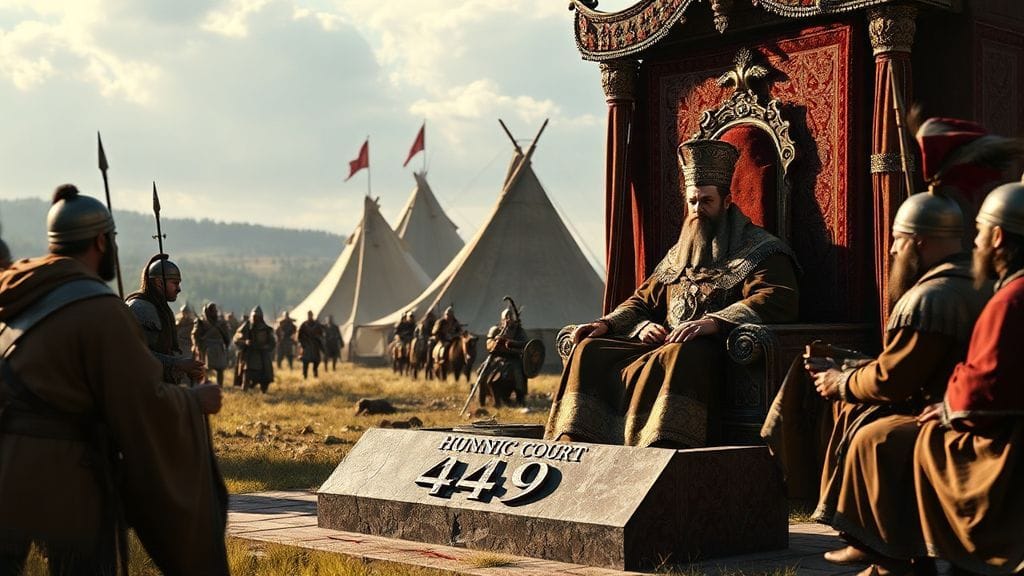
Priscus’s narrative captures the surreal atmosphere upon arriving at the Hunnic court. The camp was vast, a sprawling maze of tents and yurts, emperor’s pavilion towering in the midst. Guards, horsemen, and nobles moved in a ritual choreography designed to impress and intimidate.
The reception was calculated and theatrical. Attila’s envoys and attendants performed careful dances of politeness, while underlying every gesture was the unspoken contest for respect. Priscus felt the weight of history pressing down—a small Roman party within the folds of a powerful “barbarian” empire.
The Roman customs of ceremony were met with Hunnic traditions blending showmanship and brutal practicality. Each speech, each gift exchanged, was part of a wider game—one where survival depended on reading between the words and gauging the mood.
7. Attila the Scourge of God: Myth vs. Reality in the Royal Audience
Attila’s legend loomed large, but Priscus provides a remarkable humanization that breaks through myth. He described Attila as neither a monstrous tyrant nor a mere savage; rather, a shrewd leader, physically commanding yet capable of strategic thought and political calculation.
Priscus observed the king’s calm demeanor amid the ceremonial bustle, how he sifted through words with deliberation and how he demanded respect from both his subjects and foreign emissaries.
This encounter paints Attila not just as a warlord but as a ruler aware of his limitations and aspirations. His court was a stage on which he projected power, but also a workshop where alliances were crafted and foes measured.
8. Voices in the Court: Diplomacy, Ceremony, and Hidden Motives
The embassy witnessed a court alive with conversations layered in subtlety and intrigue. Attendants whispered counsel, envoys exchanged coded signals, and every festival echoed with political meaning.
Diplomacy here was a dance with danger—the lines between ally and enemy blurred constantly. Priscus noted speeches filled with veiled threats, offers masked as friendship, and the palpable tension beneath festive banquets.
To outsiders, these interactions might have seemed chaotic or brutal, but to the Huns, they were expressions of a society thriving in survival. Words were weapons just as potent as swords, and silence itself could be scathing.
9. The Banquets of the Huns: Feasting as Power and Display
One of Priscus’s most evocative passages describes the feasts held in the royal tent. These banquets were performances of hierarchy and ideology, mixing raw meat, fermented mare’s milk, and exotic delicacies.
Guests were fed lavishly or sparingly according to rank and favor, and the physical closeness of eating together reinforced bonds—or revealed fractures. The Huns’ hospitality was double-edged: generosity marked strength, while stinginess hinted at suspicion.
Priscus was struck by the absence of Roman-style table manners but the presence of ritual and formality all the same. This was an unfamiliar, vibrant culture—but one where power was palpably on the plate.
10. A Captive's Tale: Priscus Meets the Defector Roman
In a rare encounter, Priscus spoke with a Roman captive who had escaped to the Huns. This man’s story was a lens into the complexities of identity and allegiance on the borders of empire.
Far from simply being prisoners, some defectors found in Hunnic society a freedom or status unattainable under Roman rule. His accounts challenged simplistic notions of civilization, revealing a multifaceted world where loyalty was negotiated daily.
This conversation offered Priscus—and through him, history—a provocative insight: empire was not absolute, and the ‘barbarians’ offered alternative paths to power and survival.
11. The Political Chessboard: Huns and Romans in Shifting Alliances
Behind every feast, every speech, lay the calculation of politics. The Huns were not isolated marauders; they were players in a complex game involving Romans, Goths, and other barbarian groups.
Their relationship with Rome was volatile—a mixture of war, tribute, and uneasy peace. Attila’s ambitions extended beyond raiding; he sought legitimacy and influence within the Roman world itself.
Priscus’s embassy glimpsed this fluidity—where yesterday’s enemy could be tomorrow’s ally, and where diplomacy was inseparable from power struggles.
12. Cultural Juxtapositions: Civilization and Nomadic Freedom
The embassy revealed stark contrasts and unexpected parallels between Roman and Hunnic worlds. Where Rome prized permanent cities, codified law, and bureaucratic order, the Huns valued mobility, loyalty to the leader, and warrior prowess.
Yet both had hierarchical structures, ceremonies, and sophisticated communication forms. Priscus’s observations challenge the simplistic dichotomy of ‘civilized’ vs. ‘barbarian,’ inviting a deeper appreciation of cultural diversity.
In this meeting, we see the collision and conversation of two distinct visions of society—each convinced of its rightness, each shaped by the demands of survival.
13. The Role of Oratory and Storytelling in the Hunnic Court
Despite the Huns’ reputation as fierce warriors, their court valued words and stories. Priscus noted eloquent speeches and mythic narratives shaping group identity and political authority.
Oratory was a tool of persuasion and cohesion, a means to instill loyalty and justify actions. Storytelling linked past glories with present ambitions, weaving a fabric of shared meaning.
This dimension of Hunnic culture reminds us that all societies, even those perceived as “barbaric,” engage deeply with language as a form of power.
14. The Embassy’s Message: Negotiations Beyond Words
Priscus’s mission carried delicate messages, but much of its success depended on unspoken signals—gestures, gifts, presence. The encounter was as much about displaying strength and respect as about explicit discourse.
Through subtle courtesies and performances, the embassy sought to secure peace, or at least delay conflict. The success was partial but invaluable, buying time and information at a moment of great uncertainty.
We see diplomacy not as mere talk but as an embodied art, layered and fraught with risk.
15. What Priscus Did Not Say: Reading Between the Lines
While detailed, Priscus’s account leaves gaps—silences that hint at greater tensions or realities unspoken. What fears, compromises, or frustrations lay beneath measured words?
Historians speculate about the pressures on Priscus, his need to protect imperial interests while acknowledging the humanity before him. His narrative strikes a balance between admiration and caution.
These unspoken elements remind us that history is often a story crafted through fragments, shaped by perspective and politics.
16. The Legacy of Priscus’s Account in Historical Memory
Priscus’s writings became one of the few surviving eyewitness accounts of Attila and the Huns, influencing generations of historians and artists.
His portrayal complicated simple demonization, offering a nuanced portrait that has inspired reassessment. The embassy emerges as a key episode illuminating the twilight of antiquity and the dawn of a new era.
Through his legacy, the names Attila and the Huns gained depth beyond caricature, entering a more human historical imagination.
17. The Impact of the Embassy on Later Diplomatic Exchanges
The embassy set a precedent for future contacts between Rome and nomadic powers. Its lessons—on language, ceremony, and the limits of negotiation—echoed through later centuries.
Underlining both possibilities and dangers, it shaped how diplomacy addressed “barbarian” neighbors. Priscus’s visit became a touchstone for understanding cross-cultural negotiation in times of collapse and transformation.
18. The Lasting Image of Attila in Western Imagination
Despite rational accounts, Attila remained a symbol—first of existential threat, then of complex leadership. Medieval and modern portrayals often oscillate between tyrant and tragic hero.
Priscus’s neutral tone contrasts sharply with later legend, a reminder of history’s malleability and the power of narrative to shape identity.
Attila’s image lives on as an enduring figure who marks the boundary between classical antiquity and the medieval world.
19. Pannonia and the Foreshadowing of an Empire’s Fall
The very landscape of Pannonia, contested and divided, reflected larger transformations—a frontier where Rome’s decline and the rise of new powers accelerated.
Priscus’s embassy occurred in this liminal zone, where old worlds dissolved and new ones were forged with fire and diplomacy.
History felt the tremors here; within a generation, the Western Roman Empire would collapse, and kingdoms of barbarian origin would shape Europe.
20. Conclusion: A Moment Frozen on the Edge of Two Worlds
Priscus’s embassy to Attila’s court was more than a diplomatic errand; it was a crossing point—between civilizations, epochs, and myths.
Through his eyes, we glimpse not just the Huns but the fragile beauty of human connection amid suspicion and conflict. His narrative challenges us to rethink “barbarism” and “civilization” as fluid, contested concepts.
This encounter, on the Tisza’s banks, remains a powerful testament to the complexities of cultural encounter and the fragile threads holding empires together.
Conclusion
The embassy of Priscus to Attila’s Hunnic court in 449 CE stands as a singular episode in the twilight of classical antiquity. Through its prism, we capture not only the clash between two formidable powers but the compelling humanity beneath the veneer of war and myth. Priscus’s narrative invites us to see Attila—not as a mere scourge but as a multifaceted leader commanding a vibrant, if fearsome, society. The journey itself echoes the fragility of diplomacy on the borders of empire, where fragile peace and raw conflict coexisted in uneasy dance.
This meeting on the plains of Pannonia was a moment suspended in time—where cultures collided, perceptions evolved, and history pivoted towards transformation. It reminds us that across time, the encounters between peoples are never simply political but profoundly human stories of adaptation, misunderstanding, and a shared world precariously balanced between order and chaos.
FAQs
Q1: Why was Priscus sent to Attila’s court in 449?
A1: Priscus was sent as an envoy to negotiate peace and understand Hunnic intentions, at a time when the Roman Empire faced increasing pressure and sought to manage the Hunnic threat through diplomacy.
Q2: What made Priscus’s account of the Huns unique among ancient sources?
A2: Unlike many contemporaries who depicted the Huns solely as barbaric foes, Priscus offered a nuanced, detailed, and empathetic portrayal of Hunnic society, culture, and leadership.
Q3: How did Attila present himself during the embassy?
A3: Attila was portrayed as a commanding and shrewd leader—firm but capable of dialogue—contrasting with the exaggerated image of a savage tyrant that often prevailed.
Q4: What insights did Priscus’s encounter reveal about Hunnic culture?
A4: The embassy highlighted Hunnic values of mobility, loyalty, ritual, and a sophisticated court culture with its own traditions of oratory and ceremony.
Q5: How did the embassy affect relations between the Huns and the Roman Empire?
A5: While it did not secure lasting peace, the embassy helped temporarily ease tensions, provided critical intelligence, and set a precedent for future diplomatic engagement.
Q6: What is the historical significance of the Tisza River region?
A6: Pannonia, around the Tisza River, was a strategic frontier where the Roman Empire confronted barbarian powers, symbolizing the shifting boundaries and transformations of late antiquity.
Q7: Why does Priscus’s account still matter today?
A7: It offers a rare eyewitness perspective on a pivotal historical figure and event, challenging stereotypes and enriching understanding of cultural encounters in history.
Q8: How did later histories and legends interpret Attila’s image?
A8: Later narratives often exaggerated Attila as a ruthless “Scourge of God,” but Priscus’s account provides a more balanced portrait, reminding us of the complexities behind legend.

