Table of Contents
- Dawn of a New Era: The Anglo-Saxon Settlement in 5th Century Britain
- Britannia at the Crossroads: Rome’s Withdrawal and Its Aftermath
- The Vanishing Roman World: Socio-Political Vacuum and Fragile Stability
- Who Were the Anglo-Saxons? Origins Beyond the Channel
- First Footsteps on British Shores: Initial Settler Waves
- Kent: A Foothold of Power and Early Kingdom Formation
- The Thames Valley: Strategic Heartland and Cultural Confluence
- Clash and Coexistence: Native Britons and Anglo-Saxon Arrivals
- Settler Societies: Tribal Structures and Emerging Hierarchies
- Material Culture: Archaeology Reveals Daily Life and Beliefs
- The Language and Legend: Old English Roots Take Hold
- Christianity’s Challenge and Adoption: From Pagan to Faith
- Economic Transformations: Agriculture, Trade, and Networks
- The Rise of Kings and Kingdoms: Governance Amidst Chaos
- Myth-Making and Identity: How the Anglo-Saxons Defined “Briton”
- Long Shadows: The Expansion’s Impact on Medieval Britain
- Archaeological Discoveries Today: Unearthing Forgotten Worlds
- Considering the Evidence: Debates Among Historians and Archaeologists
- The Anglo-Saxon Legacy in Modern Britain: Language, Law, and Culture
- Lessons from the 5th Century: Migration, Conflict, and Adaptation
Dawn of a New Era: The Anglo-Saxon Settlement in 5th Century Britain
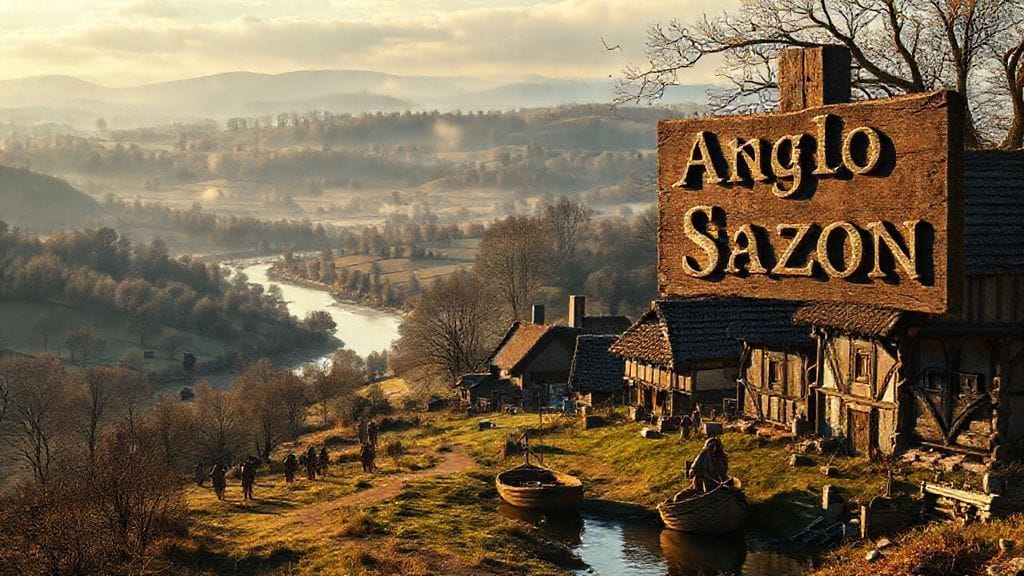
Picture a coastline veiled in mist. The waters of the North Sea ripple gently against the shores of ancient Britain as small wooden ships, their sails taut with the ocean wind, approach the land with a purpose both fateful and fraught. It is the early 5th century, a world transformed — or perhaps left bereft — after the departure of Roman legions. Into this liminal space step the Anglo-Saxons, whose arrival will alter the very fabric of Britain. This is not just the story of migration; it is the genesis of a new society, the planting of cultural seeds whose roots continue to grow in modern Britain.
The tension hung in the air—between the familiarity of the fading Roman order and the ominous unknown represented by the newcomers. It was a time marked by upheaval, resilience, and transformation. What happened next was nothing less than the forging of a nation from the shards of Empire and the waves of migration. Let us trace the footsteps of those early settlers who left behind their homelands for the promise and peril of Britons’ shores.
Britannia at the Crossroads: Rome’s Withdrawal and Its Aftermath
In the early 5th century, the age-old protector, the Roman Empire, abandoned Britain. This strategic withdrawal left a power vacuum like an echo in misty hills and empty forts. Roman Britain had long been a province thriving under imperial governance — roads to connect, cities to oversee, law and order enforced by legions and governors. But by 410 AD, those legions were recalled to defend the Empire’s crumbling heartlands against increasing threats on the continent.
The consequences were immediate and profound. With no Rome to call upon, local Romano-British leaders were left to their own devices — amidst growing raids from Picts and Scots from the north, and mercenaries pressing on the frontiers. The heart of Britain dissolved from imperial cohesion to a motley confederation of tribal and local powers struggling for survival. The story of the Anglo-Saxon settlement begins squarely in this moment of uncertainty and opportunity.
The Vanishing Roman World: Socio-Political Vacuum and Fragile Stability
Imagine a land where bustling towns and grand villas gradually fade into abandoned ruins. Roman roads still crisscross the landscape, but the once mighty administration has withered. Coinage, literacy, and complex governance dwindle. What remains is a patchwork of communities: Romano-British chieftains trying to maintain order, rural farmers eking out uncertain lives, and warriors vigilant against external threats.
The stability of this world was fragile. The economy contracted, trade with the continent diminished, and population movements created localized shifts. This socio-political void opened the door wider for new groups who sought to stake their claim — the insidious and ambitious Anglo-Saxons.
Who Were the Anglo-Saxons? Origins Beyond the Channel
To understand the settlement, one must cross the waters of the North Sea and the English Channel. The Anglo-Saxons were not a monolithic tribe but a composite of diverse Germanic peoples: Angles, Saxons, Jutes, and Frisians. Their homelands stretched across northern Germany, parts of Denmark, and the coastal Netherlands — lands both familiar and harsh, shaped by the ebb and flow of the tides and the pulse of forested plains.
Driven by pressures ranging from population growth, internal conflicts, and the allure of new opportunities, these groups embarked on migrations. Their naval prowess, though primitive by later standards, was sufficient to navigate the channel crossings and seek new lands. Unlike the Romans, their focus was not governance and administration but settlement and survival.
First Footsteps on British Shores: Initial Settler Waves
The arrival of these peoples was not a sudden invasion but a gradual influx of settlers, raiders, and opportunists. Coastal regions such as Kent — directly accessible from Jutish homelands — were among the earliest points of contact. Archaeological findings, including cemeteries and settlements, show that by the mid-5th century, these newcomers established footholds on traditionally Roman-British territory.
At first, interactions ranged from violent confrontations to uneasy coexistence and exchange. The tales of early battles have been immortalized in chronicles and sagas—like the legendary figures of Hengist and Horsa, whose very names evoke both myth and history. These stories illustrate a process of conquest and accommodation, with shifting alliances and conflicts marking the decades that followed.
Kent: A Foothold of Power and Early Kingdom Formation
Kent emerges as a particularly significant theater in this drama. Its fertile lands and proximity to continental Europe made it not only a destination but a launching ground for the consolidation of Anglo-Saxon presence. The early kingdom of Kent would become a beacon for understanding how migrating tribes transitioned into political entities capable of ruling.
The archaeological record reveals a landscape dotted with burial mounds, weaponry, jewelry, and housing structures typical of Germanic culture. The political structure was nascent — a blend of kinship ties, warrior elites, and emerging royalty. Kent’s rulers would, in time, embrace Christianity, setting them apart and beginning a process of cultural synthesis that would shape later England.
The Thames Valley: Strategic Heartland and Cultural Confluence
If Kent was a gateway, the Thames Valley quickly became the artery through which Anglo-Saxon expansion flowed inward. Controlling this vital river corridor meant controlling trade routes, fertile farming grounds, and communication lines. The settlements expanded along both banks, evidence of a growing and dynamic society.
Importantly, this was also a zone of intense intercultural contact. The Romano-British populations here did not disappear overnight. Instead, they often coexisted, resisted, or assimilated. Artifacts exhibit a fusion of material cultures, valorizing practices from both the continental settlers and indigenous Britons.
Clash and Coexistence: Native Britons and Anglo-Saxon Arrivals
The narrative of the Anglo-Saxon settlement is often distilled into a story of conquest — but the reality was far more complex. For many Britons, the newcomers represented threats to ancestral lands and traditions; for others, possible allies or even integrators.
Historical sources, such as the early medieval writings of Gildas and later Bede, capture in varying degrees the tensions and transformations. Some clans fled into the mountains of Wales and Cornwall, while others adapted, intermarried, and exchanged knowledge. The social upheaval included violent struggles but also a gradual reshaping of identity on both sides.
Settler Societies: Tribal Structures and Emerging Hierarchies
The Anglo-Saxon settlers brought with them social structures rooted in kinship and tribal grouping. Village units called “tun” and larger territories governed by chieftains evolved into more formalized political units — the kingdoms like Kent, Essex, and Sussex.
Power was often personalized around warrior elites supported by retinues and fostered by mutual loyalty bonds. Law codes began to develop, initially oral, later written, marking the gradual emergence of governance. The famous “witan” councils and early kings reflected these evolving institutions.
Material Culture: Archaeology Reveals Daily Life and Beliefs
Beyond political history, archaeology provides a vivid window into the daily lives of these early Anglo-Saxons. Excavations have revealed richly furnished graves, simple hearth-huts, iron tools, and handmade pottery—the tangible legacy of ordinary lives.
One striking aspect is the use of grave goods: weapons for men, jewelry for women, indicative both of status and belief in an afterlife. The appearance of cremation and inhumation practices reflects shifting spiritual landscapes. The objects literally speak of a people negotiating old traditions and new realities.
The Language and Legend: Old English Roots Take Hold
With the arrival of these Germanic peoples came the seeds of what would become the English language. Old English was not a single dialect but a mosaic of linguistic influences from Angles, Saxons, and Jutes.
Oral tradition flourished, with poetry, maxims, and ancestral lore anchoring community memory. Legendary figures such as Beowulf, though set in earlier Scandinavian history, were woven into the Anglo-Saxon cultural fabric and later transmitted throughout Britain.
Christianity’s Challenge and Adoption: From Pagan to Faith
The early Anglo-Saxons were pagans, worshipping a pantheon of gods akin to Norse and Germanic deities. However, the proximity to Roman Christian Britain, and later missionary efforts such as those led by St. Augustine in 597 AD, began a slow process of conversion.
This religious transformation was neither quick nor uniform—it created tensions, syncretism, and political leverage. Adoption of Christianity would eventually become a powerful tool of legitimacy for Anglo-Saxon kings and a unifier of disparate tribes.
Economic Transformations: Agriculture, Trade, and Networks
The settlement period saw significant economic change. Anglo-Saxon settlers cultivated the land, introduced new farming techniques, and reoriented trade networks toward continental Europe.
The Thames Valley, in particular, prospered as a commercial hub, balancing subsistence farming with exchanges of goods such as salt, wool, and metalwork. This economic stability was critical for the rise of towns and royal centers in subsequent centuries.
The Rise of Kings and Kingdoms: Governance Amidst Chaos
By the late 5th and early 6th centuries, the landscape was dotted not just with scattered settlements but with nascent kingdoms. The concept of “bretwaldas” — overlord-kings — emerged, with some rulers like Æthelberht of Kent attaining supremacy.
This new political order required negotiation of power, diplomacy, and at times brutal warfare. The consolidation of rulers laid the groundwork for what would eventually become the Anglo-Saxon heptarchy: a mosaic of seven kingdoms vying for dominance.
Myth-Making and Identity: How the Anglo-Saxons Defined “Briton”
One of the most enduring legacies of this period is the redefinition of who counted as “Briton.” Anglo-Saxon identities were often constructed in opposition to the native Celtic populations, creating ethnic boundaries that would persist for centuries.
Myths, legends, and genealogies were created not just for entertainment but to foster group cohesion, legitimize rule, and justify conquest. This identity project contributed to later English nationalism and historical memory.
Long Shadows: The Expansion’s Impact on Medieval Britain
The Anglo-Saxon settlement was not an isolated episode but the foundation for the medieval history of England. It shaped language, law, culture, and social norms that endured well beyond the Norman Conquest.
Furthermore, it set patterns of settlement, agricultural use, and political control whose echoes are discernible in contemporary Britain’s geography and heritage.
Archaeological Discoveries Today: Unearthing Forgotten Worlds
Recent archaeological advances continue to reshape our understanding of the 5th century migration. From richly endowed graves discovered with advanced imaging technology to DNA studies, the picture is becoming more nuanced.
Sites in Kent and along the Thames Valley yield insights into the blending of populations, the timeline of settlement, and the survival of Romano-British culture alongside Anglo-Saxons.
Considering the Evidence: Debates Among Historians and Archaeologists
Scholars debate the scale and nature of the Anglo-Saxon settlement. Was it a violent conquest, peaceful infiltration, or a complex cultural transformation? Written sources — often penned centuries later — provide fragmentary and sometimes biased accounts.
Yet, by integrating archaeological data, linguistic studies, and comparative anthropology, historians aim to reconstruct a balanced narrative that honors the complexity of these early centuries.
The Anglo-Saxon Legacy in Modern Britain: Language, Law, and Culture
The echoes of the Anglo-Saxon expansion resonate in modern Britain’s language—English is a direct descendant—and in the legal foundations laid by early codes. The ideas of kingship, property rights, and community law trace back to this era.
Culturally, the blend of Germanic and Celtic influences created a unique identity that continues to inform British self-understanding today.
Lessons from the 5th Century: Migration, Conflict, and Adaptation
The story of the Anglo-Saxon settlement is, in many ways, timeless. It reveals how migration can lead to societal transformation, how conflict and coexistence intertwine, and how new identities are forged amid disruption.
In an age marked by global movement and cultural change, these lessons remain profoundly relevant—reminding us that history is a living dialogue between past and present.
Conclusion
The Anglo-Saxon expansion into 5th century Britain was not merely a series of events inscribed in ancient texts or buried beneath the soil; it was a crucible of cultural fusion and conflict, survival and innovation. Through the ebbing waves of migration, the dissolution of imperial power, and fierce confrontation with both landscape and people, a new society emerged—one that would sow the seeds of modern England.
What is astonishing is how this period, often overshadowed by the grandeur of Rome or the later Middle Ages, captures the elemental essence of history itself: human resilience in the face of uncertainty, the struggle for identity, and the power of transformation. The Anglo-Saxons, in their journeys and settlements, remind us that history is alive—shaping who we were, who we are, and who we might become.
FAQs
Q1: Why did the Anglo-Saxons migrate to Britain in the 5th century?
A1: Several factors prompted Anglo-Saxon migration, including population pressures, internal conflicts in their homelands, opportunities in the weakening Roman province, and invitations or mercenary engagements by local British leaders seeking defense.
Q2: How did the withdrawal of Roman forces affect Britain?
A2: The Roman military and administrative withdrawal left a power vacuum, leading to political fragmentation, economic decline, and vulnerability to raids by northern tribes, which facilitated the Anglo-Saxon settlement.
Q3: Were the Anglo-Saxons invaders or settlers?
A3: The Anglo-Saxon presence was a complex mixture of both invasion and settlement. Initial violent incursions gave way to permanent settlements, but coexistence and cultural assimilation also occurred.
Q4: What archaeological evidence supports Anglo-Saxon settlement in Kent and the Thames Valley?
A4: Excavations have uncovered cemeteries with characteristic grave goods, settlements showing Germanic architectural features, and artefacts indicating trade and cultural exchange.
Q5: How did Christianity influence Anglo-Saxon kingdoms?
A5: Christianity, introduced through missionary efforts like those of St. Augustine, gradually replaced pagan beliefs, helping unify kingdoms under shared faith and providing legitimacy to rulers.
Q6: What was the social structure of early Anglo-Saxon society?
A6: It was founded on kinship networks, tribal groups, warrior elites, and evolving monarchies supported by councils of nobles, eventually developing codified law systems.
Q7: How has the Anglo-Saxon legacy influenced modern Britain?
A7: The Anglo-Saxon period laid the foundation for the English language, legal traditions, cultural identity, and political institutions that still influence Britain today.
Q8: Do historians agree on the nature of the Anglo-Saxon settlement?
A8: Scholars remain divided, with interpretations ranging from mass displacement to peaceful integration. Ongoing research in archaeology and genetics continues to refine this picture.

