Table of Contents
- The Dawn of a New Era: Clovis’s Ascension in 481
- The Franks and the Legacy of Rome: A Shifting Landscape
- The Early Life of Clovis: From Youth to Leader
- The Political Fractures of Frankish Gaul in the Late 5th Century
- The Death of Childeric I and the Young King’s Burden
- Clovis’s Strategic Vision: Forging Unity Among the Franks
- The Battle for Tournai: A Crucible of Power
- The Role of the Roman Church and Christian Influence
- The Frankish Kingdom's Expansion: Allies and Adversaries
- The Salian Franks: Roots and Resilience
- Clovis’s Alliance with the Catholic Bishops
- The Frankish Code: Foundations of Law and Order
- Clash of Cultures: Roman, Germanic, and Christian Worlds
- The Shift from Tribal Kingship to Centralized Monarchy
- The Significance of Tournai: Political and Symbolic Capital
- Clovis and the Seeds of the Merovingian Dynasty
- Early Challenges: Rebellions and Regional Resistance
- The Impact on Later European History: A New Kingdom Emerges
- Clovis’s Legacy in French National Consciousness
- How Clovis’s Reign Prefigured Medieval Christendom
- The Frankish Chronicles: Chroniclers and Their Tales
- Political Intrigue and the Balance of Power Among the Nobles
- Myth, Legend, and the Historical Clovis
- Conclusion: The Rise of a King and the Birth of a Nation
- FAQs: Understanding Clovis’s Ascension and Its Impact
- External Resource
- Internal Link
1. The Dawn of a New Era: Clovis’s Ascension in 481
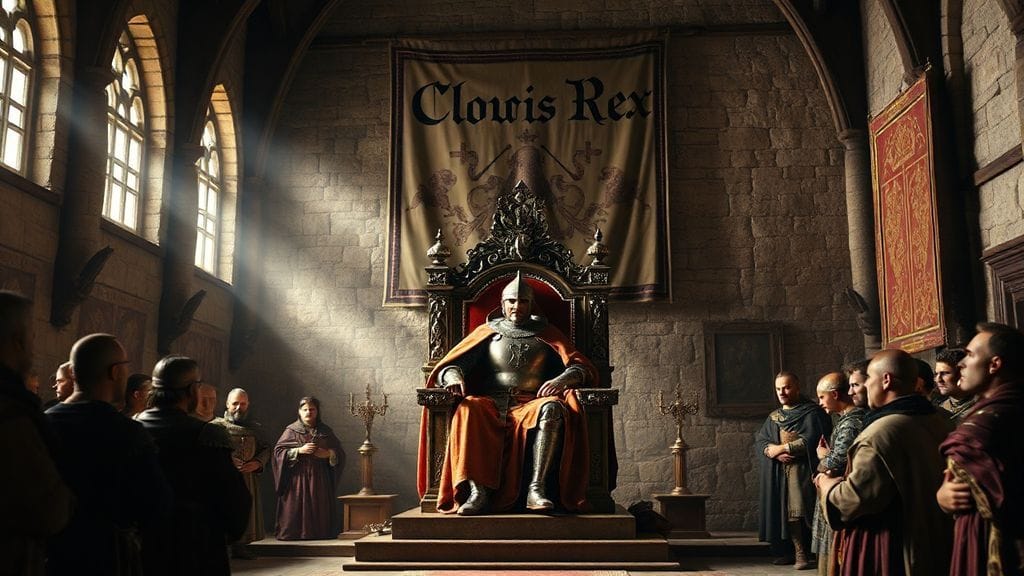
It was the year 481, and the twilight of the Western Roman Empire had left Gaul in a fragile state of flux. Amidst the echoes of crumbling imperial order, a young king named Clovis stood poised on the banks of the Scheldt, in the city of Tournai, ready to ascend the throne of the Salian Franks. The air was thick with anticipation and uncertainty. Europe was a patchwork, a mosaic of remnants—Roman senators clutching fading privileges, Visigoths entrenching in the south, Burgundians in the east, and the stirring forces of the Franks in the north.
Clovis was barely in his twenties, yet he carried the weight of destiny on his shoulders. His ascension was more than a mere succession; it was a beacon signaling the dawn of something radically new. The Frankish people, hitherto divided among various chieftains and clans, would soon be united under one ruler. This moment in Tournai was the fulcrum on which the future of Western Europe would pivot.
The crowd that gathered to witness the proclamation of Clovis’s kingship did not yet know that this youth would, within decades, command the allegiance of many tribes, carve out a powerful kingdom, and ultimately transform the religious and political landscape of a continent still healing from the fall of Rome. But for now, the cheers and the solemn rites echoed against the ancient stones, heralding the rise of a king who would leave an indelible mark on history.
2. The Franks and the Legacy of Rome: A Shifting Landscape
By the late 5th century, Gaul was a land of contrasts and contradictions. The Roman Empire, once the mighty orchestrator of civilization in the West, had dissolved, leaving behind infrastructures, languages, and institutions that persisted even as imperial authority slipped away. Local Roman aristocrats juggled survival in a world reordered by new power dynamics, and the various "barbarian" tribes, including the Franks, Visigoths, Burgundians, and others, established their own realms atop old foundations.
The Franks themselves were not newcomers but oscillating federates of the late empire. Their relationship with Rome had always been complex—sometimes allies, sometimes enemies. By 481, Frankish power had grown from being merely a border menace to a force capable of controlling substantive territories in northern Gaul. Still, power was fragmented among regional leaders, and the mingling of Roman-Gallo culture and Germanic tradition created a volatile social fabric.
Clovis inherited this legacy—a fractured, transitional world where old Roman law coexisted uneasily with Frankish customs. The question was whether he could marshal these forces into a unified kingdom capable of enduring beyond the chaos.
3. The Early Life of Clovis: From Youth to Leader
Little is known in absolute certainty about Clovis’s childhood, but the emerging picture of the young prince is of a boy raised in the martial and aristocratic traditions of the Salian Franks. As the son of Childeric I—a respected warrior-king with ties to Roman authority—Clovis grew up amidst the turbulent dynamics of tribal alliances, warfare, and diplomacy.
His upbringing prepared him not merely for battle but for leadership. Early anecdotes suggest a young man of considerable cunning and ambition, qualities that would soon be tested once he ascended to the throne. The turbulent times demanded more than courage; they required vision, adaptability, and political savvy.
When news arrived of his father’s death, Clovis was thrust into a crucible from which he would emerge not just as king, but as the architect of a kingdom.
4. The Political Fractures of Frankish Gaul in the Late 5th Century
The Frankish people were far from united. Rather, they were divided into various clans and leaders, often at odds or operating independently. This fragmented political reality was both a source of vulnerability and potential. Rival kings and chieftains jostled for influence, and external enemies exploited divisions.
In the south, the Visigoths had seized much of southwestern Gaul and parts of Hispania, carving their own kingdom. The Burgundians held the southeastern territories, while remnants of Roman governance clung to areas around cities like Arles and Aix. The challenge for Clovis was to navigate this fractured chessboard.
From the outset, Clovis understood that military conquest alone would not be enough; he needed alliances, strategic marriages, and perhaps most importantly, legitimacy in the eyes of his subjects and neighbors.
5. The Death of Childeric I and the Young King’s Burden
Childeric I’s death marked a turning point. The elder king had long maintained Frankish traditions while balancing relations with the fading Roman authorities. But as his body was laid to rest, Clovis ascended—not just as heir but as a ruler whose immediate decision would be survival or extinction.
The transition was anything but smooth. Rival clans eyed the throne, the Roman Gallo aristocracy watched suspiciously, and neighboring tribes plotted to exploit the moment. Clovis’s youth was simultaneously a symbol of renewal and a potential weakness.
Yet, the young new king chose decisiveness. He moved quickly to consolidate his position in Tournai, sending envoys, recruiting warriors, and strategizing alliances that would expand his influence.
6. Clovis’s Strategic Vision: Forging Unity Among the Franks
Clovis’s genius lay in his capacity to envision a unified Frankish realm not merely through brute force, but also political acumen. He began to absorb or neutralize rival chieftains, employing marriage alliances and diplomatic measures alongside military campaigns.
His goal was clear: to transform a fractious collection of tribes into a cohesive monarchy. This vision was revolutionary—moving away from the traditional loose tribal confederations toward a strong, centralized state.
His efforts to standardize Frankish law and customs would later be reflected in his famous Salic Law, signaling a new era of order and legitimate governance.
7. The Battle for Tournai: A Crucible of Power
Tournai, strategically perched on the Scheldt River, was much more than a city; it was the heartland of the Salian Franks. Its capture and defense were of immense symbolic and practical importance.
Clovis's ascent involved the consolidation of control over Tournai, securing loyalty from local nobles and ensuring the city’s architecture and fortifications could withstand external threat. The city would effectively become the capital of Frankish power under Clovis.
The battle for dominance was not only military but ideological—it was about the legitimacy of kingship, the unification of disparate tribes, and the future imprint of the Franks on Gaul.
8. The Role of the Roman Church and Christian Influence
The Roman Church still upheld significant influence in Gaul, even amid political instability. Clovis's relationship with Christianity was a slow transformation that would define his reign and the identity of the Frankish kingdom.
Though initially pagan, Clovis’s eventual conversion to Catholic Christianity (not Arianism, which was prevalent among many Germanic tribes) would secure him the support of the Gallo-Roman bishops and broaden his legitimacy.
This alliance between throne and altar laid the groundwork for the medieval conception of kingship—whereby the king was seen as God's representative on earth, a protector of the faith.
9. The Frankish Kingdom's Expansion: Allies and Adversaries
Following his ascension, Clovis embarked on military campaigns that expanded Frankish territory at the expense of neighboring tribes and rival kingdoms. His conquests against the Alemanni and other tribes not only expanded his domain but asserted Frankish dominance in northwest Europe.
However, this expansion was complex and fraught with constant military risk and shifting alliances. Clovis’s efforts to integrate conquered tribes into his kingdom were essential to consolidating his foothold.
His reputation as a warrior king was cemented during these campaigns, inspiring loyalty among his men and fear among his enemies.
10. The Salian Franks: Roots and Resilience
The Salians were a subgroup of the Franks, originally settled along the lower Rhine. Their customs, legal traditions, and martial culture shaped the nascent Frankish state.
Clovis’s identification with the Salians underscored his authority, but he also transcended tribalism by embracing other Frankish groups and even some Roman traditions.
Understanding the Salian roots explains not only Clovis’s initial power base but also the unique synthesis of Roman and Germanic elements in his kingdom’s identity.
11. Clovis’s Alliance with the Catholic Bishops
One of Clovis's most transformative decisions was to ally closely with Catholic bishops in Gaul. Unlike other Germanic rulers who adhered to Arian Christianity, Clovis’s conversion to Nicene Catholicism fostered unity with the Roman population and clergy.
The support of figures like Saint Remigius, who baptized Clovis in 496 (some fifteen years after his ascension), proved crucial in legitimizing his rule.
This alliance laid the foundations for the Frankish kingdom's role as a defender of orthodox Christianity, linking religious and royal authority in unprecedented ways.
12. The Frankish Code: Foundations of Law and Order
Under Clovis’s rule, the codification of laws began in earnest. The Salic Law, attributed to him or his successors, was a groundbreaking legal framework blending Roman legal principles with Germanic customs.
This law code governed issues ranging from inheritance to crime, providing a sense of justice and societal order necessary for a stable kingdom.
Clovis’s introduction of such legal codes marked a transition from arbitrary tribal rulership to institutional monarchy and foreshadowed medieval European legal traditions.
13. Clash of Cultures: Roman, Germanic, and Christian Worlds
Clovis's reign was a crucible where multiple cultures collided and merged. The Roman-Gallo world’s remnants lived alongside Germanic tribes who maintained their own customs and belief systems.
Christianity served both as a dividing and uniting force; Roman bishops sought to preserve their influence, while Germanic elites balanced pagan traditions and the growing Christian faith.
Clovis’s own kingdom symbolized the birth of medieval Europe—an amalgam of Roman administrative heritage, Germanic military culture, and Christian spiritual authority.
14. The Shift from Tribal Kingship to Centralized Monarchy
Before Clovis, leadership among the Franks was often decentralized—more a confederation of chieftains than a unified monstrous state. His reign marked the crucial transition towards a monarchy with centralized authority.
The consequences were profound: greater state cohesion, consistent laws, and a stronger, more capable military apparatus.
This model influenced not only the Franks but subsequent European monarchies, setting precedents for royal legitimacy and governance.
15. The Significance of Tournai: Political and Symbolic Capital
Tournai was not chosen at random. As a fortified city with Roman origins and strategic positioning, it was the natural seat of Clovis’s power.
Holding Tournai meant control over trade routes, military logistics, and a political center capable of projecting influence across northern Gaul.
The city’s identity became intertwined with the Frankish legacy, serving as a symbol of the emerging kingdom’s strength and resilience.
16. Clovis and the Seeds of the Merovingian Dynasty
Clovis’s reign was the foundation stone of what would become known as the Merovingian dynasty—named after his legendary ancestor Merovech.
By consolidating Frankish tribes and establishing a stable monarchy, Clovis ensured that his lineage would rule for centuries.
The Merovingians would leave a complex legacy of fragmented power and charismatic kingship but crucially laid the groundwork for medieval France’s development.
17. Early Challenges: Rebellions and Regional Resistance
Clovis’s rule was far from uncontested. Many local leaders resisted central control, and there were several rebellions and insurrections aimed at fracturing the nascent unity.
These challenges tested Clovis’s military skill and political dexterity.
Yet, each conflict resolved reinforced his authority and the idea of his kingship as paramount among the Frankish people.
18. The Impact on Later European History: A New Kingdom Emerges
The ascension of Clovis was not an isolated event—it reshaped the trajectory of European history.
His kingdom became the nucleus of what would later evolve into the kingdom of France.
Moreover, by choosing Catholicism over Arianism, Clovis aligned Western Europe’s religious future with Rome’s doctrinal majority, influencing medieval Christendom’s ideological landscape.
19. Clovis’s Legacy in French National Consciousness
Centuries later, Clovis was lionized as the first “King of the French,” a unifier and founder. French historiography, particularly from the medieval period onward, casts him as a pivotal figure in national identity.
His story is celebrated in chronicles, legends, and national mythologies as the crucible of French monarchy and Christian nationhood.
20. How Clovis’s Reign Prefigured Medieval Christendom
Clovis’s reign was the early blueprint of the sacred kingship that characterized medieval Europe. The fusion of temporal and spiritual authority set a model for subsequent monarchs and the Church alike.
By embodying both warrior and Christian king, Clovis became a prototype for the medieval ideal of rulership, bringing divine sanction to earthly power.
21. The Frankish Chronicles: Chroniclers and Their Tales
Our knowledge of Clovis comes from several early sources, notably Gregory of Tours and the “History of the Franks.”
These chronicles blend history with legend, reflecting contemporary perspectives and religious agendas.
They immortalize Clovis’s deeds, magnify his significance, and provide invaluable windows into his era’s worldview.
22. Political Intrigue and the Balance of Power Among the Nobles
Clovis did not rule alone. Powerful nobles, warrior elites, and bishops shaped the political arena.
Balancing their interests required skillful diplomacy and sometimes ruthless measures.
This landscape of intrigue defined the king’s day-to-day challenges and shaped the evolution of medieval governance.
23. Myth, Legend, and the Historical Clovis
Over time, Clovis’s historical figure became enveloped in myth. Tales of his baptism, conquests, and divine favor circulated widely.
Separating fact from legend remains a challenge for historians, but these stories underscore his cultural impact.
His image as a Christian warrior king endures as a potent symbol of early medieval Europe.
24. Conclusion: The Rise of a King and the Birth of a Nation
Clovis’s ascension in 481 at Tournai marked the beginning of the transformation from fragmented tribal society to a unified Frankish kingdom. His vision, courage, and political acumen catalyzed profound changes that shaped not only Gaul but the future of Europe.
The legacy of his reign extends far beyond military victories; it lies in the creation of new social orders, religious alliances, and legal foundations that underpinned medieval civilization.
In the shifting shadows of a collapsing empire, Clovis emerged—a beacon of unity, faith, and power—whose reign would resonate through the centuries.
FAQs
Q1: Why was Clovis’s ascension in Tournai in 481 so significant?
A1: Tournai was the political heart of the Salian Franks. Clovis’s rise here symbolized the unification of Frankish tribes and the emergence of a centralized monarchy that would become foundational to medieval Europe.
Q2: What role did religion play in Clovis’s reign?
A2: Although initially pagan, Clovis’s conversion to Catholic Christianity around 496 strategically aligned him with the Roman Church and Gallo-Roman population, enhancing his legitimacy and setting a precedent for Christian kingship.
Q3: How did Clovis consolidate power among the Frankish tribes?
A3: Through a mixture of military conquest, strategic marriages, alliances, and legal codification, Clovis united various Frankish groups under a single monarchy, moving beyond the typical tribal confederation.
Q4: What was the importance of the Salic Law?
A4: The Salic Law codified customary Frankish rules and introduced new legal standards. It was crucial for social order and governance, influencing medieval European legal traditions many centuries later.
Q5: How does Clovis’s reign connect to later French history?
A5: Clovis is often considered the founder of France’s monarchy; his dynasty, the Merovingians, ruled as precursors to medieval and modern France. His Christianization established France’s religious identity.
Q6: What sources inform us about Clovis’s life and reign?
A6: Primary sources include Gregory of Tours’ History of the Franks and various Frankish chronicles, which combine historical narrative with legend and religious interpretation.
Q7: How did Clovis’s kingdom differ from earlier Roman Gaul?
A7: Clovis’s kingdom was a fusion of Roman administrative legacy and Germanic tribal traditions, centralized under a Christian monarchy—distinct from the fragmented Roman provincial system that preceded it.
Q8: What challenges did Clovis face when ascending the throne?
A8: He encountered rival chieftains, regional rebellions, and the delicate balance of Frankish and Roman interests. His youth and the fragmented political landscape made his initial rule perilous.

