Table of Contents
- The Fall of Roman Gaul: A World in Transition
- Clovis: From Frankish Chieftain to King of Kings
- Syagrius: The Last Roman Warlord in Gaul
- The Political Landscape of Late 5th Century Gaul
- The Prelude to Battle: Tensions Rising at Soissons
- The Armies Assemble: Frankish Warbands vs Roman Remnants
- Clovis’s Strategy: Unity through Force and Faith
- The Battle of Soissons: Clash of Titans
- The Turning Tide: Key Moments on the Field
- Syagrius’s Defeat: The Last Stand of Roman Authority in Gaul
- Aftermath on the Battlefield: Blood and Power
- Clovis’s Consolidation of Power: From Warrior to King
- The Fall of Roman Civilization in Gaul: Cultural Shifts
- The Frankish Kingdom Emerges: Foundations of Medieval Europe
- Clovis’s Conversion: Religion as a Political Weapon
- The Legacy of Soissons: Myths, Memory, and Historical Debate
- Consequences for Gaul’s Roman Population
- The End of the Roman Western Empire: A New Order
- The Role of Soissons in the Rise of the Merovingian Dynasty
- From Battlefield to Ballad: Soissons in Art and Literature
- Clovis and the Church: The Making of a Christian Kingdom
- Political Ripples Beyond Gaul: Europe in Flux
- Lessons from Soissons: Power, Identity, and Change
- Conclusion: The Battle that Forged a Kingdom
- FAQs
- External Resource
- Internal Link
The Fall of Roman Gaul: A World in Transition
In the year 486, the fields around the city of Soissons bore silent witness to a clash that would irrevocably alter the fate of Western Europe. Beyond the muffled sounds of war cries and the clashing of steel, there stood an empire’s last gasp, a civilization struggling to hold on while a new force surged forward, ravenous and resolute. The Roman presence in Gaul—once the pinnacle of imperial grandeur and governance—had dwindled drastically, leaving a power vacuum that foreshadowed a sweeping change. It was here, on those uncertain plains, that Clovis, the ambitious Frankish warlord, met Syagrius, the self-styled “King of Romans,” in a battle that would seal the fate of Gaul and propel the Merovingian dynasty into the annals of history.
Clovis: From Frankish Chieftain to King of Kings
Clovis, a name that resonates through the ages, was far from the obscure leader of a mere tribal confederation. Born around 466 into the Salian Franks, his early years were marked by ambition and a thirst for dominance. Unlike many of his contemporaries who saw themselves purely as tribal warlords, Clovis harbored a vision: uniting the fractious Frankish tribes under one rule and extending his influence into the fading territories of the Western Roman Empire.
This introspective yet ruthless leader understood the power of both the sword and faith. His reign would later be distinguished by his conversion to Christianity, but in 486, Clovis was primarily a military tactician and shrewd politician, keenly aware that Gaul's future hinged on the consolidation of power—an enterprise that would begin at Soissons.
Syagrius: The Last Roman Warlord in Gaul
Opposing Clovis was Syagrius, the Roman general who controlled the remnants of Roman authority in northern Gaul. Often called the "King of Romans" by his contemporaries—a title carrying both irony and gravitas—Syagrius was the last vestige of Roman order in a land rapidly slipping away from imperial control.
His territory was a fragile holdout amid the rising tide of Germanic tribes. With the Western Roman Empire having officially fallen in 476, Syagrius’s rule was akin to a city standing alone on a cliff edge, clinging to ruins while new forces—barbarians in the Roman view—encroached ever closer. His defense of Roman rule was as much a fight for survival as it was for identity and legitimacy.
The Political Landscape of Late 5th Century Gaul
Gaul in the mid-5th century was far from the proud Roman province it had been centuries earlier. The collapse of central authority had created fragmented realms where Gothic, Frankish, and other Germanic tribes jockeyed for supremacy. The Roman Senate no longer wielded influence; the imperial army was a distant memory. Syagrius’s domain was essentially an island of Roman governance surrounded by hostile or opportunistic neighbors.
Meanwhile, Clovis’s Franks, though still considered barbarians by Roman standards, were becoming a cohesive and formidable force. Their loyalty to Clovis and their adoption of Roman military techniques made them increasingly dangerous. This collision course was inevitable, with Soissons as the stage set for history’s drama.
The Prelude to Battle: Tensions Rising at Soissons
Soissons, a Roman city with centuries of history, was the natural fulcrum for this impending conflict. It was strategically located and symbolic—an ancient stronghold that broadcaster the tension between fading Roman order and emerging Frankish dominance.
Both leaders understood the stakes. According to later chroniclers, messages between their camps were terse, and negotiations had failed. The moment of reckoning was at hand, as Clovis gathered his warriors, melding their ferocity with discipline, and Syagrius prepared his Roman legions in a final attempt to safeguard an empire that had long lost its center.
The Armies Assemble: Frankish Warbands vs Roman Remnants
Clovis’s forces were primarily composed of Frankish warriors, professional soldiers seasoned in the rough terrain and brutal skirmishes that defined the late Roman frontier. These men fought not just for pay, but for honor and loyalty to their king. Their reputation for harshness was tempered by strategic cunning.
On the other side, Syagrius commanded the remains of the Roman army in Gaul—veterans still trained in the legionary arts, but few in number and suffering from depleted resources. The psychological weight of defending a collapsing empire rested heavily on their shoulders.
The two forces were unusual in contrast: barbarian warbands against organized, if diminished, Roman legions. Yet, the nature of warfare in 486 was not simply about numbers or technology but about leadership, morale, and the ability to adapt.
Clovis’s Strategy: Unity through Force and Faith
Clovis understood more than anyone that defeating Syagrius was about more than battlefield victory—it was about demonstrating that Roman rule was over, and a new order was beginning. His approach was meticulous, combining surprise, tactical dexterity, and psychological warfare.
While historical records are sparse on the specifics, early medieval chroniclers emphasize Clovis’s ruthlessness and decisiveness. It is said that he sought to integrate Roman customs to stabilize governance, winning over Roman citizens with the promise of order under Frankish rule, while decisively crushing those who resisted.
The Battle of Soissons: Clash of Titans
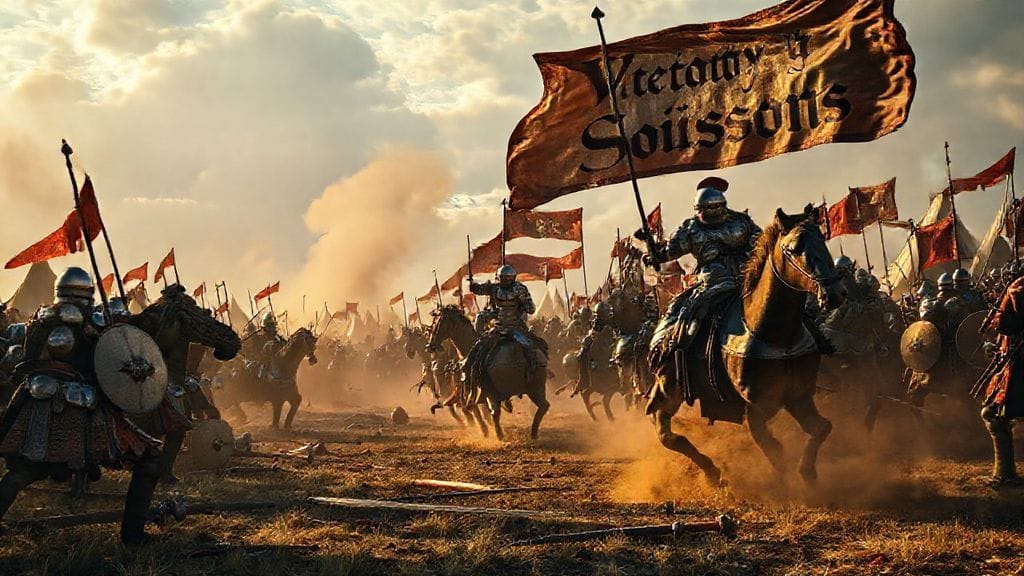
The battle itself, though not detailed in exhaustive contemporary accounts, was decisive. The Frankish warriors and Roman legions confronted each other with ferocity unmatched in a region long weary of war. Every inch of the battlefield was fought with desperation and determination.
Anecdotes passed down through the centuries depict Clovis rallying his men with fiery speeches, invoking their gods and promising glory. On the other side, Syagrius is portrayed as stoic, aware that he was perhaps the last representative of Rome. Their clash embodied not just a military struggle but a symbolic confrontation of civilizations.
The Turning Tide: Key Moments on the Field
What turned the tide in favor of Clovis? The ferocity of the Frankish assault, combined with superior morale and perhaps the tactical errors of Syagrius, sealed the fateful outcome. The Roman lines broke; their formations, once feared throughout Europe, were overwhelmed.
One telling detail relates to the capture and execution of Syagrius—betrayed and handed to Clovis by the Visigoths, his end was as ignoble as the fall of the empire he strove to preserve. The Roman dream in Gaul had died on that day.
Syagrius’s Defeat: The Last Stand of Roman Authority in Gaul
With Syagrius defeated and captured, Roman authority in northern Gaul effectively collapsed. No other general dared claim the mantle of Roman power in the region, leaving Clovis unchallenged. This defeat also signaled the end of Roman attempts to reclaim or restore their empire in the West.
From that moment, Gaul’s destiny lay in the hands of Germanic kings. Clovis’s victory was not merely territorial but ideological—a clear judgment that the Roman world had given way to a new order.
Aftermath on the Battlefield: Blood and Power
In the immediate aftermath, Clovis consolidated control over Soissons and the surrounding territories, welcoming Roman citizens into his new kingdom with promises of protection. However, the transition was not without bloodshed; resistance was met with harsh reprisals.
The battlefield at Soissons became a symbol of the violent yet transformative nature of this era. The price paid was immense, but it paved the way for the construction of the Frankish kingdom and later medieval Europe.
Clovis’s Consolidation of Power: From Warrior to King
Following the victory, Clovis embarked on a campaign of unification. Rather than simply subdue, he sought to integrate Roman administrative systems and gain the support of the local Gallo-Roman aristocracy.
It was this synthesis of Roman and Frankish elements that made his reign extraordinary. He moved from chieftain to king, laying foundations for the Merovingian dynasty, which would rule vast swaths of post-Roman Europe.
The Fall of Roman Civilization in Gaul: Cultural Shifts
The end of Roman rule heralded cultural and societal transformations. Roman roads and cities remained, but the governance structures shifted to Frankish hands. Latin persisted, blending with Germanic tongues. Roman law mingled with tribal customs, foreshadowing the medieval legal landscape.
This cultural churning was bittersweet: the grandeur of Rome faded, but new identities crystallized, shaping the future of France and Europe.
The Frankish Kingdom Emerges: Foundations of Medieval Europe
Clovis’s triumph at Soissons was a cornerstone for the Frankish kingdom. His successors expanded the realm, and the Frankish identity evolved from tribal origins into a medieval monarchy.
Eventually, this kingdom gave rise to figures like Charlemagne, who would restore imperial ideals on a Christian European stage. Soissons was thus not just a battle; it was the birth pang of what would become medieval Europe.
Clovis’s Conversion: Religion as a Political Weapon
An essential dimension of Clovis’s reign unfolded after Soissons: his conversion to Nicene Christianity. Legend tells how, after victory, he embraced the Christian God, aligning himself with the Roman Church, thus gaining the loyalty of Roman subjects and the ecclesiastical establishment.
This move transformed Clovis from a pagan warlord to a Christian monarch, creating a model that subsequent European rulers would follow.
The Legacy of Soissons: Myths, Memory, and Historical Debate
The battle’s memory is layered with myth and historical reconstruction. Medieval chroniclers often dramatized its events to highlight Clovis’s divine favor and destiny.
Modern historians debate the details but agree on its symbolic importance. Soissons stands as a narrative fulcrum—where the Roman past bowed to a new European future.
Consequences for Gaul’s Roman Population
For Roman Gauls, Soissons brought profound change. The aristocracy had to negotiate new status under Frankish rule; peasants faced altered social orders. While some continuity endured, the transformation was deep.
This demographic and cultural shift helped reshape Europe's ethnic and linguistic map.
The End of the Roman Western Empire: A New Order
Though the Western Roman Empire had formally ended in 476, Soissons was its symbolic final curtain in Gaul. The collapse of imperial authority was complete, displacing the old order.
What rose in its place was an intermingling of Roman legacy and Germanic power—a complicated and dynamic world.
The Role of Soissons in the Rise of the Merovingian Dynasty
The victory paved Clovis’s path to dominance over rival Frankish kings, eventually uniting most Frankish peoples under Merovingian rule.
This dynasty would steward the transformation from Roman provinces to medieval kingdoms.
From Battlefield to Ballad: Soissons in Art and Literature
The battle’s story has long inspired poets, artists, and chroniclers. It symbolizes transition, struggle, and the forging of nations.
From medieval chansons to modern histories, Soissons remains a compelling narrative of power and identity.
Clovis and the Church: The Making of a Christian Kingdom
The Church’s endorsement of Clovis after Soissons shaped the future European kingdom and Christianity’s role therein.
It established a precedent for kingship grounded in divine favor and church alliance.
Political Ripples Beyond Gaul: Europe in Flux
Clovis’s victory sent shockwaves beyond Gaul’s borders. Neighboring tribes and kingdoms recalibrated their strategies in response, marking a new phase in European geopolitics.
The battle was thus both a local event and a continental tremor.
Lessons from Soissons: Power, Identity, and Change
Soissons teaches us about the fragile nature of empires, the rise of new powers, and the complex interplay between culture, faith, and politics.
It illustrates how history's turning points often pivot on individual courage, vision, and chance.
Conclusion
The Battle of Soissons in 486 was far more than a military engagement; it was a decisive moment that closed the chapter on Roman Gaul and opened the door to the medieval world. Through the grit and grand strategy of a single man—Clovis—the forces of a fading empire were swept aside by a new kingdom that would shape Europe’s identity for centuries. It is incredible to consider how the blood-soaked fields near Soissons echoed with far-reaching consequences: political consolidation, religious transformation, cultural fusion, and the birth of a legacy that still resonates today.
Clovis’s triumph reminds us that history is not merely the story of states and battles, but of visions realized and identities forged—often amid chaos and conflict. The memory of Soissons invites us to reflect on the ceaseless tides of change, where endings are beginnings, and where power intertwines with faith and culture to make the world anew.
FAQs
1. Why was the Battle of Soissons in 486 so significant?
It marked the definitive end of Roman rule in northern Gaul and the rise of the Frankish kingdom, a cornerstone for medieval European history.
2. Who was Syagrius and why is he called the “King of Romans”?
Syagrius was the last Roman military leader in Gaul, holding onto remnants of imperial rule after the fall of the Western Roman Empire. His epithet highlights his role as a last symbolic guardian of Roman authority.
3. How did Clovis manage to unify the Frankish tribes?
Through military conquest, political alliance, and notably his conversion to Christianity, Clovis created a united Frankish kingdom that blended Roman and Germanic traditions.
4. What role did religion play in Clovis’s victory and reign?
Clovis’s conversion to Christianity after Soissons gained him the support of the Roman Church and Gallo-Roman elites, providing a powerful foundation for his kingdom.
5. What happened to the Roman population after the battle?
Many Gallo-Romans adapted to Frankish rule, with some elites integrating into the new order, while Roman culture and law gradually merged with Germanic elements.
6. How reliable are the historical sources on the Battle of Soissons?
Sources are limited and often written decades or centuries later, blending fact with legend. Modern historians use archaeology and critical analysis to reconstruct likely events.
7. Did the Battle of Soissons influence the broader downfall of the Western Roman Empire?
It postdated the official fall in 476 but affirmed the complete collapse of Roman power in Gaul, representing a critical moment in the empire’s fragmentation.
8. What legacy did the Merovingian dynasty leave following Clovis’s reign?
They laid political and cultural foundations for medieval Europe and helped stabilize territories that would later become modern France and beyond.

