Table of Contents
- The Turning Tide at Reims: A Cold Winter’s Day in 496
- The Merovingian King: Clovis Before the Baptism
- Gaul in Turmoil: Fragmented Realms and Clashing Faiths
- From Pagan Roots to Christian Conversion: The Ideological Crossroads
- The Role of Saint Remigius: Shepherd of Souls and Politics
- The Battle of Tolbiac: Divine Intervention or Strategic Triumph?
- The Moment of Decision: Clovis’ Baptism Ceremony in Reims
- The Symbolism of Water and Word: Rituals of Transformation
- Immediate Reverberations: The Frankish Nobility Reacts
- The Expansion of Christianity in the Frankish Kingdom
- Clovis’ Alliance with the Roman Church: A New Power Balance
- The Fall of the Last Roman Strongholds in Gaul
- Pagan Resistance and Religious Conflict in the Wake of Baptism
- The Impact on Neighboring Kingdoms and Tribes
- Clovis as the Founding Father of France: Myth and Reality
- The Merovingian Legacy: From Saints to Scepters
- Memory and Mythmaking: The Baptism in Medieval Chronicles
- The Baptism’s Archaeological and Historical Evidence
- Long Term Consequences: Christian Europe and the Frankish Realm
- A Turning Point in European Religious and Political History
On a cold December morning in the year 496, beneath the austere vaults of the cathedral city of Reims, the waters of baptism marked one of the most profound and transformative moments in early medieval Europe. The air was heavy with expectation, mingled uneasily with the chill of winter; courtiers, bishops, and warriors alike watched as the King of the Franks, Clovis, son of Childeric, approached the waters that promised not just spiritual salvation but a radical reshaping of his kingdom’s destiny. This ceremony—Clovis’ baptism—would not only reorder religious loyalties but would lay the groundwork for the future of a Christian Europe, an epochal rite upon whose waters the tides of Western history would forever turn.
The Turning Tide at Reims: A Cold Winter’s Day in 496
Reims, a city rich with Roman heritage and sacred Christian tradition, was the natural stage for this momentous event. The sun strove to break through the heavy grey clouds as ecclesiastical dignitaries in gleaming vestments assembled to witness the baptizing of a king who had spent much of his life as a fierce warrior. The Merovingian dynasty, new to the pages of history yet about to etch its name indelibly on the Frankish realm and beyond, stood on the cusp of an event that promised a seismic shift — from the older, pagan warrior codes toward a new order anchored in the Christian faith.
But such a shift was not inevitable. The Franks, a collection of Germanic tribes occupying a vast swathe of Roman Gaul, were a people of customs and belief systems that adhered closely to warrior deities and ancestral gods. Clovis himself had been a pagan ruler, celebrated for his military prowess and political cunning. The baptism was therefore more than a mere religious rite; it was a gamble—a deliberate embrace of a faith that could legitimize his rule far beyond the battlefield.
The Merovingian King: Clovis Before the Baptism
Born around 466, Clovis inherited a fractious realm from his father, Childeric I—a kingdom characterized by shifting alliances and endless skirmishes with neighboring tribes and Roman remnants. His early reign was marked by relentless campaigns to unify the Frankish people, battling both rival leaders and external enemies. What distinguished Clovis from many of his contemporaries was his burgeoning ambition to extend his domain and consolidate power through not only force but political astuteness.
Prior to baptism, Clovis was known for his pagan beliefs, worshipping the traditional gods of his people such as Wodan (Odin) and Tiwaz (Tyr), manifestations of war and law. Yet, his marriage to Clotilde, a Burgundian princess and devout Catholic, planted the seed of Christianity. Her influence was a persistent shadow amidst the tumult of Clovis’ conquests, a reminder of another path—one that would intertwine faith with power in unprecedented ways.
Gaul in Turmoil: Fragmented Realms and Clashing Faiths
By the late 5th century, Gaul was a mosaic of competing warlords and rapidly declining Roman authority. The Western Roman Empire had collapsed in 476, leaving a power vacuum filled by Germanic tribes—the Visigoths in the southwest, the Burgundians in the southeast, and the Franks in the north. Christianity itself was divided—Roman Catholicism was growing but still competed fiercely with lingering pagan traditions and Arian Christianity, favored by some Germanic elites.
Amidst these tensions, Gaul's peoples faced not only military confrontations but also cultural and religious revolutions. Converting the heart of the Frankish kingdom to Catholicism meant not only embracing a new God but also forging political alliances with the Latin clergy and remnants of Roman power. It was a coup both spiritual and strategic—a synthesis that would bring Rome’s legacy westward through Clovis.
From Pagan Roots to Christian Conversion: The Ideological Crossroads
Clovis’ conversion was not solely a spiritual awakening; it was a deliberate crossroads between old and new worlds. Paganism emphasized kinship ties, personal valor, and fate, while Christianity preached salvation, forgiveness, and a universal church under the Pope’s authority. For a rising king like Clovis, the benefits of the latter extended beyond doctrine—it provided an ideological framework to justify conquest, unite diverse peoples under a religious banner, and win the favor of the powerful Roman Catholic Church.
The Role of Saint Remigius: Shepherd of Souls and Politics
At the heart of the baptism was Saint Remigius (Remi), Bishop of Reims, a man whose quiet nobility belied a seasoned understanding of the political stakes at hand. Described by later chroniclers as gentle yet resolute, Remigius embodied the link between the fading Roman ecclesiastical order and the barbarian kingdoms ascending in its wake.
According to legend, Remigius foresaw Clovis’ future greatness and awaited the king’s conversion with steadfast patience. His participation in the ceremony was as much about ecclesiastical authority as about forging an alliance that would secure the Church’s influence throughout Gaul—and subsequently in all of Western Europe.
The Battle of Tolbiac: Divine Intervention or Strategic Triumph?
One catalyst often linked to the baptism is the Battle of Tolbiac (circa 496), where the Franks, under Clovis, fought the Alamanni, a Germanic tribe. The story passed down by Gregory of Tours tells of Clovis, desperate in battle, invoking the Christian God for help. He pledged to convert if victorious, and victory came.
Whether this was providence or realpolitik, it served a crucial propagandistic purpose. Clovis’ conversion was portrayed as a divine endorsement of his kingship, lending him unparalleled legitimacy in the eyes of his subjects and rivals alike. The narrative resonated deeply in a culture attuned to omens and divine favor.
The Moment of Decision: Clovis’ Baptism Ceremony in Reims
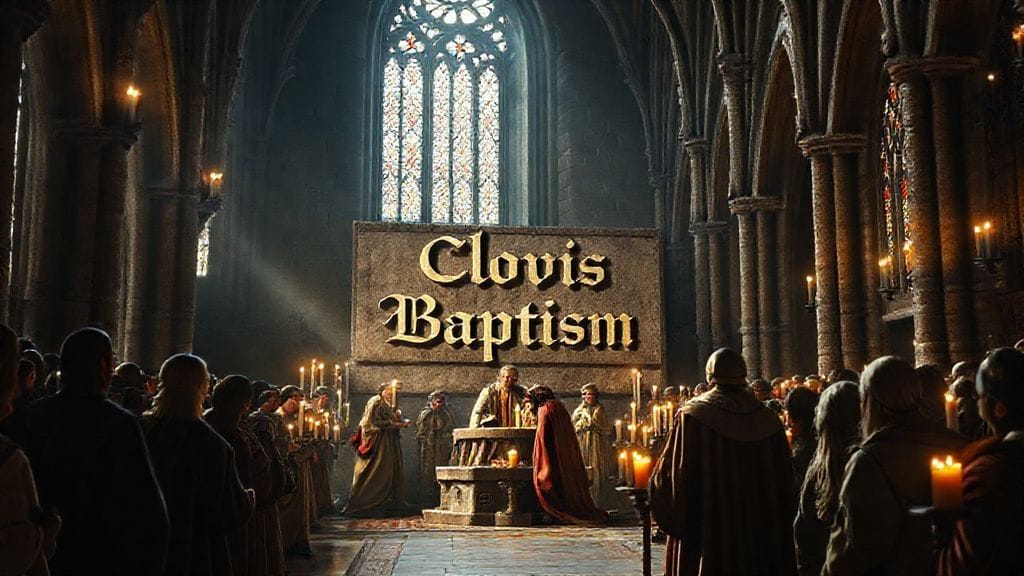
On December 25, 496, the symbolic heart of the ritual beat strongest. Clovis, emerging from the shadows of warlord paganism, was baptized by Remigius amid the chants of the clergy and the silent awe of attendants. The ceremony was solemn yet powerful—water poured thrice over his head, lips whispered ancient prayers, his body cloaked anew in the white garment of the baptized.
This act was more than personal purification; it was a coronation of a new political and religious era. Clovis was no longer just a warrior king; through baptism, he was Christ’s ally on earth, a ruler ordained to spread the faith and uphold God’s will.
The Symbolism of Water and Word: Rituals of Transformation
Baptism, in early Christianity, symbolized rebirth, the washing away of former sins and mistakes, a passage into a community bound by faith. For Clovis, this symbolic death and resurrection served to erase his pagan past and cast him as a new leader for a transformed people.
The rituals, replete with sacred readings and the imposition of the bishop’s hands, communicated a narrative of transcendence. It was a rite both seen and felt, its emotional and political impact resonating far beyond Reims.
Immediate Reverberations: The Frankish Nobility Reacts
Clovis’ conversion was not instantly embraced by all. Some Frankish nobles viewed it with suspicion or outright hostility, fearing the loss of traditional privileges and power structures tied to pagan customs.
Yet, Clovis was shrewd and persuasive. Gradually, aristocrats converted, finding in Christianity a unifying framework that transcended tribal rivalries. The endorsement of the Church also promised a network of allies and spiritual legitimacy that strengthened Clovis’ grip on his expanding realm.
The Expansion of Christianity in the Frankish Kingdom
Following the baptism, Christian missionaries gained unprecedented access throughout Frankish lands. Pagan temples were dismantled or repurposed, and churches rose in place. The Christian calendar, liturgy, and laws began to weave into daily life.
Clovis’ embrace of Catholicism opened the floodgates for religious transformation across Gaul, setting the stage for Christianity as the dominant faith in Western Europe.
Clovis’ Alliance with the Roman Church: A New Power Balance
This baptism forged a landmark alliance—Clovis the warrior king stood alongside the bishop, symbolizing the fusion of temporal and spiritual power. The papacy, though distant, would soon recognize the Frankish kingdom as a protector of Christendom.
This alliance redefined European politics; kingship no longer rested solely upon blood and muscle but drew authority from divine sanction and ecclesiastical endorsement.
The Fall of the Last Roman Strongholds in Gaul
With Clovis’ conversion and subsequent conquests, the last vestiges of Roman rule in Gaul faded away. Cities like Paris and Soissons became Frankish capitals, centers of administration and Christian culture.
The transfer of power was not seamless, but Clovis’ baptism symbolized the final passing of Rome’s legacy into new hands, a transition from antiquity to the Middle Ages.
Pagan Resistance and Religious Conflict in the Wake of Baptism
Conversion was neither universal nor peaceful. Pockets of pagan resistance persisted, religious practices clashed, and the transition at times sparked violent reprisals.
Yet, the Church’s growing influence, empowered by royal patronage, gradually quelled dissent. The narrative of a united Christian kingdom under Clovis took root in minds and memory.
The Impact on Neighboring Kingdoms and Tribes
Other Germanic rulers watched closely, some following Clovis’ lead, others maintaining Arian Christian or pagan beliefs. The baptism set a precedent—political legitimacy tied closely to Christian faith, a model soon emulated by rulers from the Visigoths to the Lombards.
This realignment shaped the religious map of Europe for centuries, laying the foundation for Christendom’s territorial and cultural coherence.
Clovis as the Founding Father of France: Myth and Reality
Later French monarchy and historians would exalt Clovis as France’s founder, the “father of kings,” a figure of immense symbolic power.
While historical reality is more complex—the unification was partial, fragile, and followed by further wars—the baptism at Reims anchors Clovis’ legacy as a mythic origin story, uniting nation, church, and crown.
The Merovingian Legacy: From Saints to Scepters
The Merovingian dynasty, born from Clovis’ bloodline, would rule for centuries, their authority intertwined irrevocably with Christian legitimacy.
Saintly cults, royal patronage of churches, and the fusion of sacred and secular power marked this era, setting early medieval traditions that shaped Western monarchy.
Memory and Mythmaking: The Baptism in Medieval Chronicles
Chronicles by Gregory of Tours and others preserved the baptism not just as history but as legend. Miracles, divine signs, and prophetic declarations surrounded the event.
These narratives underscored the divinely mandated nature of Clovis’ rule and justified the Frankish kingdom’s expansion as a sacred mission.
The Baptism’s Archaeological and Historical Evidence
Archaeologists have unearthed remnants of early Christian churches in Reims and elsewhere, traces of Merovingian burials and artifacts that corroborate the elite’s gradual Christianization.
While contemporary written records are scarce, interdisciplinary study paints a rich picture of a society in religious transition.
Long Term Consequences: Christian Europe and the Frankish Realm
Clovis’ baptism marks the dawn of medieval Christendom. It foreshadowed the rise of the Holy Roman Empire, the spread of the Catholic Church’s influence, and the shaping of European identity around faith and monarchy.
It formed a precedent for rulers wielding both spiritual and temporal power, deeply influencing the structure of Western civilization.
A Turning Point in European Religious and Political History
The baptism of Clovis was a hinge in history – a moment when faith and politics coalesced into a new order.
This convergence planted the seed for a Europe unified under the cross, forging not just a kingdom but a civilization’s soul destined to endure through centuries of upheaval and transformation.
Conclusion
The Christmas Day in 496 at Reims was more than a royal rite; it was a profound transformation on the stage of Europe. Clovis’ baptism embodied the convergence of personal fate and historical destiny, where the currents of faith lifted a warrior king into the role of Christ’s earthly champion and founder of a new order. Such moments remind us that history is not a mere sequence of dates and conquests but a tapestry woven from choices, beliefs, and the human longing for meaning and legitimacy.
Through water and word, tension and hope, Clovis stepped from pagan shadows into the light of Christianity, forever altering not just his kingdom but the soul of Western civilization. The baptism of Clovis remains a vivid testament to the power of faith as a driver of political revolution and cultural awakening, an event whose echoes resonate to this day in the fabric of Europe’s collective identity.
FAQs
Q1: Why did Clovis choose to convert to Christianity?
A: Clovis’ conversion was influenced by a combination of personal, political, and spiritual factors—including the influence of his Christian wife Clotilde, his desire for legitimacy, and the promise of uniting his people under a single religion.
Q2: How did Clovis’ baptism affect the balance of power in Gaul?
A: The baptism helped consolidate Frankish control, aligning Clovis with the Roman Catholic Church and granting him religious legitimacy, which allowed him to expand his realm at the expense of pagan and Arian rivals.
Q3: Who was Saint Remigius, and why was he important?
A: Saint Remigius was the Bishop of Reims who baptized Clovis. He played a crucial role as a religious and political figure connecting the Frankish king with the broader Christian world.
Q4: Did all Franks accept Christianity immediately after Clovis’ baptism?
A: No. Conversion was gradual and met with resistance from some nobles and pagan communities, but over time Christianity became dominant through royal patronage and missionary efforts.
Q5: What role did Clovis’ baptism play in European history?
A: It marked a foundational moment for medieval Christendom, setting a precedent for the fusion of church and state and influencing the political-religious landscape of Europe for centuries.
Q6: How is the baptism of Clovis remembered in French culture?
A: It is celebrated as the birth of the French nation and a symbol of unity, often mythologized as the foundation of the French monarchy and identity.
Q7: Is there archaeological evidence of Clovis’ baptism?
A: While direct evidence is limited, archaeological findings of early Christian sites in Reims and Merovingian artifacts support the historical narrative of gradual Christianization.
Q8: How did the baptism impact relations with other Germanic tribes?
A: It distinguished the Franks as Catholic Christians, setting them apart from Arian and pagan neighbors, affecting alliances and conflicts throughout the region.

