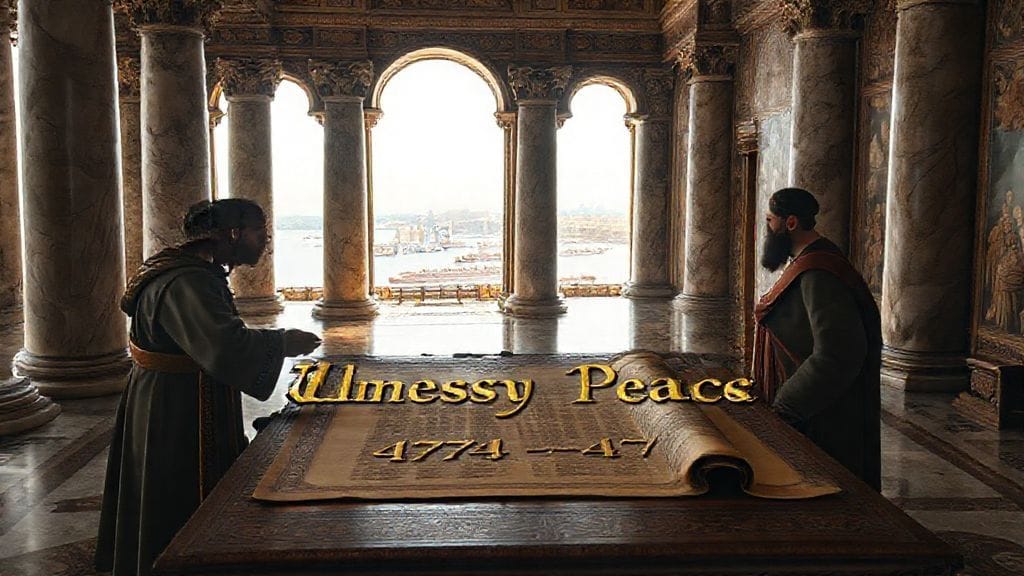
Table of Contents
- The Fragile Dawn: Constantinople and Carthage on the Brink
- The Shadow of the Vandals: A Mediterranean Powerhouse in Turmoil
- The Byzantine Empire’s Eastern Ambitions and Western Dilemmas
- The Vandal Kingdom: Origins, Power, and Decline
- Religious Fractures: Chalcedonian Christians and Arian Vandals
- The Prelude to Peace: Negotiations Amidst Unease
- Emperor Leo the Great and the Vandal King Huneric: Personalities in Play
- The Treaties of 474–477: Terms, Promises, and Ambiguities
- A Delicate Balance: Trade, Tribute, and Territorial Control
- The Role of Religion in Shaping Diplomatic Relations
- The Political Chessboard: Rome’s Legacy and New Powers
- Consequences of the Treaties: Stability or Inevitable Collapse?
- The Eyes of the Mediterranean: Reactions from Other Powers
- Cultural Exchanges: Art, Language, and Peoples between Empires
- The Legacy of the Treaties in Later Imperial Policies
- The End of the Vandal Kingdom and the Byzantine Reconquest
- The Human Dimension: Lives Changed by Peace and Conflict
- Economic Impacts: Trade Routes, Cities, and Wealth Distribution
- The Long Shadow of 474–477: How Uneasy Peace Shaped the Future
- Lessons from a Fragile Peace: Diplomacy in a Time of Crisis
1. The Fragile Dawn: Constantinople and Carthage on the Brink
The Mediterranean Sea shimmered under a late summer sun in the year 474, but beneath the tranquil waves, tensions rippled. On one shore, the imposing city of Constantinople, seat of the Byzantine Empire, was preparing for uncertain times; on the other, the bustling port of Carthage hummed with Vandal activity, a kingdom carved out violently from the remnants of Rome’s African provinces. An uneasy truce was in the air, yet neither empire trusted the other fully. The words exchanged between diplomats carried weighty promises but also hidden threats. This was the opening act of a series of treaties that would hold the promise of peace but harbor the seeds of future conflict.
Amidst grand palaces and war councils, Emperor Leo I faced the vexing task of managing an empire stretched thin—pressed between Persian ambitions in the east and Vandal piracy in the west. Meanwhile, the Vandal king Huneric, son and successor of the fierce Genseric, sought to stabilize his fragile kingdom, internally fractured by religious disputes and external pressure alike. Their fates were tied not by friendship but by necessity as they embarked on this diplomatic dance between 474 and 477.
The treaties that emerged were far from simple documents on parchment; they represented the broader struggle for control and survival in a changing Mediterranean world. These were agreements forged in the shadow of conquest and compromise, attempts to hold back the tide of warfare with fragile words.
2. The Shadow of the Vandals: A Mediterranean Powerhouse in Turmoil
To understand the treaties’ profound significance, one must first revisit the Vandals themselves. Once a fierce Germanic tribe migrating across Europe, the Vandals had decisively changed the Mediterranean tableau in 439 when Genseric captured Carthage. This conquest was a cultural and strategic blow to Rome, shifting naval power westward to Carthage and transforming it into a formidable maritime kingdom.
By the 470s, however, the Vandals faced internal divisions and external threats. Their religious identity as Arians set them against the largely Chalcedonian Christian populations they ruled, fostering discontent and rebellion. The kingdom was simultaneously a bastion of power and a powder keg, vulnerable beneath the surface pride of its conquests.
The Vandal fleet was notorious—disrupting trade routes and threatening Byzantine control. The Mediterranean, once a “Roman lake,” now witnessed the contest between an aging empire and a rugged successor kingdom determined to maintain its hold. Vandal raids into Sicily and Sardinia tested the limits of Byzantine endurance, forcing Constantinople to consider diplomatic solutions alongside military ones.
3. The Byzantine Empire’s Eastern Ambitions and Western Dilemmas
On the other side, Constantinople, the jewel of the East, wrestled with its own existential quandaries. The empire, heir of Rome, had survived centuries of upheaval but now faced rising pressures on multiple fronts. In the East, the Persian Sassanids demanded attention; in the West, the once-monolithic Roman territories had splintered into successor kingdoms, including the Vandals.
Emperor Leo I’s reign, beginning in 457, emphasized consolidation and stabilization. However, the western Mediterranean’s volatile nature forced him into reluctant diplomacy with the Vandals. While reconquest lingered as a distant hope, pragmatism demanded coexistence with Carthage, so the empire sought treaties that could secure maritime borders and safeguard crucial grain supplies from Africa.
The Byzantine strategy blended military posturing, religious influence, and diplomacy. Yet mistrust festered beneath every interaction with Vandal representatives, a legacy of past betrayals and recent skirmishes. Constantinople’s diplomats walked a precarious line between confrontation and conciliation.
4. The Vandal Kingdom: Origins, Power, and Decline
In tracking the Vandal Kingdom’s rise and subsequent weakening, the narrative unveils both strength and fragility. The tribe’s movement from central Europe to Spain and ultimately North Africa was marked by violence but also adaptability. By 474, the kingdom’s golden age had passed; internal religious strife—especially between the dominant Arian elite and the Catholic populations—eroded cohesion.
The death of Genseric in 477 left a leadership vacuum only partially filled by Huneric, whose reign was marked by repression of Catholic dissent, sparking fears of instability. At the same time, Vandal economic lifelines—centered on Carthage’s port and maritime commerce—required peace with Byzantium to protect trade routes, encouraging treaty-making despite underlying hostility.
This paradox—power undermined by internal division and external dependency—set the stage for the fragile agreements signed between 474 and 477.
5. Religious Fractures: Chalcedonian Christians and Arian Vandals
No account of Vandal-Byzantine relations overlooks religion’s pivotal role. The Vandals’ adherence to Arian Christianity, considered heretical by the Orthodox Byzantine Church, exacerbated tensions. In North Africa, the majority Chalcedonian population chafed under Arian rulers who intermittently persecuted Catholic bishops and communities.
Emperor Leo, a devout Chalcedonian, pressured Huneric to tolerate the Orthodox clergy as a condition of peace. Although Huneric initially promised leniency, he later resumed persecutions, deepening the religious divide and complicating diplomatic relations. The treaties attempted—largely unsuccessfully—to enshrine protections for Christians, illustrating how faith became both a tool and an obstacle in diplomacy.
Religious legitimacy went hand in hand with political power; Byzantium sought to present itself as the protector of true Christianity, while the Vandals struggled to maintain control over a fractious population divided by creed.
6. The Prelude to Peace: Negotiations Amidst Unease
By 474, exhaustion from decades of conflict encouraged the two powers to open negotiations. Envoys traveled across the Mediterranean, meeting in shadowed halls where cautious words masked deep suspicions. Byzantine historians recount tense moments—where promises made were quickly forgotten, and threats lingered behind diplomatic smiles.
The talks reflected broader realities: Constantinople’s desire for stability in the West and Carthage’s need for recognition and economic security. Both sides accepted compromises fraught with ambiguity, wary of appearing weak but recognizing that open warfare might benefit neither.
These preliminary exchanges laid the groundwork for a series of charters and agreements collectively known as the Vandal–Byzantine Treaties of 474–477—attempts to stave off violence while managing a complex reality that neither empire could fully control.
7. Emperor Leo the Great and the Vandal King Huneric: Personalities in Play
The diplomacy was personal as much as strategic. Emperor Leo I, known for his shrewd intellect and firm will, ruled from the majestic throne rooms of Constantinople with a vision of restoring imperial grandeur. His policies combined military reforms with subtle negotiations, grounded in a belief that the Christian empire must endure at all costs.
Huneric, in contrast, was a volatile and often ruthless monarch. Son of the legendary Genseric, he inherited a kingdom beset by challenges. Accounts depict him as distrustful, prone to violence, but also pragmatic enough to enter treaties when survival demanded.
Their interactions, though distant and conducted through emissaries, symbolized the broader struggle between an established empire clinging to Roman legacy and a newer kingdom forged by migration and conquest.
8. The Treaties of 474–477: Terms, Promises, and Ambiguities
Though no single cohesive treaty document survives intact, contemporary sources and fragments testify to agreements acknowledging borders, trade rights, and mutual non-aggression. The Vandals agreed to cease attacks on Byzantine ships in exchange for grain shipments and recognition of their control over North African provinces.
Additional clauses touched on religious freedoms, restoration of Catholic bishops, and prisoner exchanges. Yet the language was deliberately vague in areas vital for peace, such as territorial claims over islands like Sardinia and Sicily, reflecting mutual reluctance to concede anything vital.
This ambiguity ensured temporary calm but left underlying conflicts unresolved, sowing distrust that would later erupt.
9. A Delicate Balance: Trade, Tribute, and Territorial Control
The heart of the treaties lay in economic necessity. Africa’s fertile lands and Carthage’s strategic ports fueled both empires’ wealth. Byzantium depended on African grain to feed Constantinople’s growing population; the Vandals depended on trade and tribute to sustain their kingdom.
Maintaining safe maritime routes was paramount, prompting agreements to curb Vandal piracy temporarily. Tribute payments, formal or informal, became a method to buy peace, as did agreements on managing contested territories.
Yet, this balance was inherently unstable—dependent on mutual goodwill often absent in practice. Traders and sailors bore daily witness to this uneasy arrangement, facing dangers at sea even as treaties promised protection.
10. The Role of Religion in Shaping Diplomatic Relations
Religion intersected repeatedly with diplomacy during these years. Byzantium sought to assert itself as the champion of Chalcedonian Christianity, pressuring Vandals to allow religious freedom. However, Vandal rulers’ patronage of Arianism and persecution of Catholics undermined trust.
Church leaders acted as both spiritual guides and political actors, with bishops serving as emissaries and negotiators. The broader struggle for Christian orthodoxy influenced alliances and enmities, rendering the treaties more than secular accords—they were entwined with the battle over religious supremacy in the Mediterranean.
This intertwining reveals the complexity of late antique diplomacy, where faith and power forged inseparable bonds.
11. The Political Chessboard: Rome’s Legacy and New Powers
The treaties must be seen within the larger tableau of a Mediterranean transformed from Roman unity to a mosaic of competing states. The Vandals had taken the mantle of Roman rulers in Africa, challenging Byzantine claims. Meanwhile, the Western Roman Empire had fallen in 476, just as these treaties concluded, reshaping European politics irrevocably.
Other powers—like the Ostrogoths in Italy and Franks in Gaul—watched these developments with keen interest, each seeking advantage. The Byzantine Empire teetered between reconquest ambitions in the West and defense against Persian threats in the East, forcing diplomatic pragmatism with the Vandals.
This geopolitical context defined the constraints and opportunities of the treaties.
12. Consequences of the Treaties: Stability or Inevitable Collapse?
In the short term, the treaties brought a measure of respite. Trade resumed, rare diplomatic channels opened, and large-scale warfare temporarily abated. However, the underlying causes of conflict—religious hostility, territorial ambitions, fragile leadership—persisted.
Within a decade, the Vandal Kingdom would fall to Byzantine forces under Emperor Justinian, underscoring the fragility of the peace established. Thus, these treaties appear as both a pragmatic pause and a harbinger of the final shifts in Mediterranean power.
Historians debate whether the peace was genuine or merely a strategic lull before the storm, but its importance lies in its reflection of empire survival strategies in a fracturing world.
13. The Eyes of the Mediterranean: Reactions from Other Powers
The fragile Vandal-Byzantine peace did not unfold in isolation. Western kingdoms, the Papacy, and Eastern neighbors all monitored these developments, interpreting the treaties as signals of strength or weakness.
The Papacy, vested in the fate of North African Christians, pushed for greater protection of Catholic interests, often criticizing Byzantine concessions to the Vandals. Meanwhile, Gothic rulers in Italy contemplated whether the new balance presented opportunities to expand their influence.
These external reactions added layers of complexity, as diplomacy among Mediterranean states became a theater of competing ambitions beyond simple bilateral agreements.
14. Cultural Exchanges: Art, Language, and Peoples between Empires
Despite political tension, the treaties indirectly facilitated cultural contact. Merchants, diplomats, and clergy moving between Carthage and Constantinople carried stories, ideas, and artistic styles.
Latin and Greek mingled in port cities; traditional Roman customs persisted alongside Germanic and Byzantine influences. Religious art and architecture bore traces of shared and contested identities, making this era rich in cross-cultural synthesis.
These exchanges remind us that even amidst conflict, human connections transcend borders, shaping the Mediterranean’s diverse heritage.
15. The Legacy of the Treaties in Later Imperial Policies
The uneasy peace crafted between 474 and 477 informed Byzantine policy long after. Lessons learned about diplomacy, religious interplay, and regional power dynamics shaped Emperor Justinian’s later conquests and administrative reforms.
The recognition that military might alone could not guarantee lasting stability influenced a more nuanced approach combining force with negotiation and religious patronage.
Thus, the treaties serve as precursors to Byzantine strategies in reclaiming lost territories and managing diverse populations.
16. The End of the Vandal Kingdom and the Byzantine Reconquest
Less than a decade after the treaties, Emperor Justinian launched his campaign to retake North Africa. The Byzantine general Belisarius subdued Carthage in 533, ending Vandal rule and reintegrating the territory into the empire.
This decisive conquest rendered the prior treaties moot but confirmed their temporary role as an interlude—a breathing space before the resumption of open confrontation.
This victory restored a semblance of Roman order but also introduced new challenges of governance and cultural integration in a transformed landscape.
17. The Human Dimension: Lives Changed by Peace and Conflict
Beyond politics, the treaties affected millions who lived between Constantinople and Carthage. For traders, a lull in warfare meant safer passage; for peasants and urban dwellers, shifts in control could mean new rulers or renewed persecution.
Christian communities found moments of relief or fresh hardship depending on the fluctuating promises of religious tolerance. Families fractured by war sought stability, often caught between imperial ambitions.
This human perspective underscores the stakes behind diplomatic words and statecraft.
18. Economic Impacts: Trade Routes, Cities, and Wealth Distribution
The Mediterranean economy was delicately poised on the treaties' success. Safe sea lanes allowed grain shipments vital for Constantinople’s survival, while Carthage’s ports thrived on commerce.
Merchants navigated temporary peace to build wealth, but any breakdown threatened famine and economic collapse for both realms.
Thus, the treaties served as economic lifelines, even as their fragility mirrored the unpredictable tides of history.
19. The Long Shadow of 474–477: How Uneasy Peace Shaped the Future
Though ephemeral, the peace forged by the Vandal-Byzantine treaties cast a lasting shadow. They reveal the complexities of diplomacy in a transitional era—a world balancing the inheritance of Rome and the rise of medieval polities.
Their lessons resonate through history: genuine peace requires more than pacts; it demands trust, shared purpose, and sometimes, the courage to face hard truths.
These treaties stand as testament to human efforts to forge order amid chaos.
20. Lessons from a Fragile Peace: Diplomacy in a Time of Crisis
The Vandal–Byzantine Treaties of 474–477 teach enduring lessons about diplomacy’s challenge in divided worlds. They illustrate how survival often rests on imperfect compromises—between enemies, faiths, and ambitions.
Ultimately, they remind us that history’s great powers are constrained by internal pressures as much as external foes, and that peace is often a journey rather than a fixed destination.
These treaties, fragile and contested, hold echoes for every age where uneasy peace is the price of survival.
Conclusion
The years 474 to 477 mark a compelling chapter in Mediterranean history, where two empires—one established, the other ascendant—sought to navigate the treacherous waters between war and peace. The Vandal–Byzantine Treaties, born out of necessity and frailty, were much more than transient accords; they delineated the boundaries of power, faith, and survival in a world on the cusp of transformation.
Through these treaties, we glimpse the humanity behind empire: leaders grappling with impossible choices, faith communities striving for dignity, and ordinary people yearning for stability. The uneasy peace they carved was ephemeral, yet it illuminates the enduring dance of diplomacy—a fragile art balancing hope and suspicion, conflict and coexistence.
To ponder the legacy of these treaties is to reflect on the complex fabric of history, woven from moments of crisis, compromise, and courage. They remind us that peace—no matter how uneasy—is often the foundation upon which future generations build, learn, and dream.
FAQs
Q1: What were the main causes leading to the Vandal–Byzantine Treaties?
A1: Decades of intermittent warfare, religious tensions between Arian Vandals and Chalcedonian Byzantines, economic necessities like securing grain routes, and mutual exhaustion led to negotiations seeking to prevent further conflict.
Q2: Who were the key figures involved in the treaties?
A2: Emperor Leo I of Byzantium and King Huneric of the Vandals played central roles as leaders driving respective diplomatic efforts, embodying the complex interplay of politics and personality.
Q3: How did religion influence the peace negotiations?
A3: Religious differences exacerbated mistrust; Byzantium’s desire to protect Chalcedonian Christians clashed with Vandal Arian dominance, making religious freedom both a negotiation point and a persistent source of tension.
Q4: What were the economic stakes of these treaties?
A4: The treaties aimed to secure safe maritime trade routes, particularly for grain shipments vital to Constantinople, and maintain Carthage as a prosperous port city, thus underpinning both realms’ economies.
Q5: Did the treaties ensure lasting peace?
A5: No. While they temporarily reduced hostilities, underlying issues remained unresolved, and within a decade the Vandal Kingdom fell to Byzantine reconquest, illustrating the treaties’ limited durability.
Q6: How did other Mediterranean powers react to the treaties?
A6: The Papacy, Ostrogothic Kingdom, and various Western states closely watched, often interpreting the treaties as signs of relative strength or vulnerability, influencing their own regional strategies.
Q7: What cultural impacts arose from this uneasy peace?
A7: Despite conflict, the treaties facilitated some cultural and religious exchanges, blending Latin and Greek influences in art, language, and religious practice across Mediterranean port cities.
Q8: Why are these treaties important for understanding late antique diplomacy?
A8: They exemplify how diplomacy in a fragmented world requires balancing military power, religious authority, and economic interests—a delicate, often precarious, political art.

