Table of Contents
- The Death of Clovis: The King’s Final Breath and the Dawn of a New Era
- The Frankish Kingdom at the Crossroads: A Realm Poised for Change
- Clovis’ Legacy: From Pagan Chieftain to Christian Monarch
- The Tradition of Partible Inheritance: Medieval Roots of Division
- The Moment of Partition: Soissons Becomes the Center of Power
- The Heirs to the Throne: Who Were Clovis’ Sons?
- The Territories Carved: Neustria, Austrasia, Burgundy—A Fragmented Realm
- Political and Familial Rivalries: Brothers in Arms or Foes in Waiting?
- The Role of the Church: Religious Influence over a Fracturing Kingdom
- Governance Amidst Division: Local Powers and Royal Authority
- The Impact on the Frankish People: Daily Lives Caught in Transition
- External Threats: Bretons, Visigoths, and the Shifting Borders of Gaul
- Soissons as a Political Hub: Tradition, Power, and Symbolism
- The Seeds of the Merovingian Dynasty’s Future: Patterns of Power and Conflict
- The Aftermath: How the Partition Laid the Groundwork for Medieval France
- Cultural and Legal Ramifications of the Division
- The Partition’s Echoes in European History: Lessons in Unity and Fragmentation
- Anecdotes and Chronicles: Voices from the 6th Century Frontier
- Historiographical Perspectives: How Scholars Interpret the Partition
- The Lasting Memories of Clovis’ Heirs in Modern Imagination
1. The Death of Clovis: The King’s Final Breath and the Dawn of a New Era
The air hung heavy above the royal palace of Soissons in the winter of 511, a chill that seemed to seep not only into the stones but into the hearts of all who gathered within. Clovis, the legendary warrior-king who had forged a new Frankish realm from the mosaic of competing tribes and Roman ruins, lay on his deathbed. His breath, shallow and ragged, betrayed the fierce spirit that had once roared across the battlefields of Gaul. Outside, courtiers whispered anxiously, aware that the moment spelled both an end and a beginning. When Clovis finally exhaled his last, he did more than meet death—he unraveled an empire, setting the stage for a fractured future.
The kingdom which Clovis had wrested from chaos now faced an uncertain fate. The Vulgar Latin of the Roman administration was fading; Frankish customs were asserting themselves, yet no single hand stood ready to grasp the reins with the iron will of their late king. This was the moment when the Frankish world would be cleaved into pieces—a schism that would echo through centuries.
2. The Frankish Kingdom at the Crossroads: A Realm Poised for Change
By the early 6th century, the Frankish kingdom had become the most potent power in Western Gaul. Clovis, having unified the Salian Franks and subdued rival tribes, had expanded his dominion vastly. Yet, beneath the surface of apparent unity lurked complex tensions. The Roman world’s collapse had not erased local identities; tribal loyalties, Roman traditions, and emerging Christian faiths intertwined uneasily. The death of Clovis, the kingdom’s founder and symbol, touched off debates on succession, stability, and governance.
The kingdom’s geographic sweep was impressive but precarious. Stretching from the North Sea to the Mediterranean’s shadow, it encompassed diverse peoples—Gallo-Romans, Franks, Burgundians, and more. Each region carried its distinct customs and expectations, a patchwork disguised beneath Clovis’ assertive dominance. Now, with his death at Soissons, that very patchwork threatened to unravel.
3. Clovis’ Legacy: From Pagan Chieftain to Christian Monarch
Clovis’ story was nothing short of legendary—a pagan warlord turned Christian king. His baptism, supposedly in 496, was not just a spiritual conversion but a political masterstroke that reshaped the Frankish identity and linked him irrevocably to the Roman Catholic Church. By aligning himself with the bishop of Rome, Clovis secured powerful allies, legitimized his rule, and set a precedent for Christian kingship in Western Europe.
This transformed legacy fed into the expectations placed upon his heirs. They inherited not just lands but a kingdom sanctified by divine right—a delicate inheritance fraught with the contrast between warrior customs and ecclesiastical authority.
4. The Tradition of Partible Inheritance: Medieval Roots of Division
Unlike the primogeniture succession that would dominate later European monarchies, Frankish law favored partible inheritance—the equal division of a father’s lands among all his sons. Rooted in Germanic tribal customs, this system was intended to maintain familial harmony and fairness. Yet, in practice, it often sowed discord and fragmentation.
The death of Clovis unleashed this custom’s full impact. His four surviving sons were each entitled to a share of the kingdom’s wealth and power. While this might seem equitable, it set the stage for rivalry, territorial ambitions, and eventual civil war—a recurring theme throughout medieval European succession struggles.
5. The Moment of Partition: Soissons Becomes the Center of Power
Soissons, a former Roman city and a symbolic heartbeat of Frankish power, became the focal point for the kingdom's division. Here, amidst the ruins of Roman basilicas and early Christian churches, the heirs of Clovis convened and divided the realm. The city’s imposing walls bore witness to a moment heavy with consequence: the transformation from a united kingdom under one figurehead to a collection of dynastic domains.
The choice of Soissons was no accident. It had been a royal seat since Clovis’ reign, representing continuity even in rupture. The act of partitioning the land within its walls echoed loudly—like a family quarrel played out on the continent’s grandest stage.
6. The Heirs to the Throne: Who Were Clovis’ Sons?
Clovis left behind four sons who would inherit the crown: Theuderic I, Chlodomer, Childebert I, and Chlothar I. Each possessed distinct ambitions and temperaments, carved by the crucible of conquest and faith.
- Theuderic I ruled in Metz and was known for his military expeditions against the Thuringians.
- Chlodomer, the eldest, controlled Orléans and was considered the most militant and ruthless among his siblings.
- Childebert I took Paris, later making the city a royal capital—laying the groundwork for its future centrality.
- Chlothar I, the youngest, received Soissons itself and would ultimately outlive and outmaneuver his brothers.
Their relationships oscillated between fragile alliances and open hostilities, marking the kingdom’s early years with uncertainty.
7. The Territories Carved: Neustria, Austrasia, Burgundy—A Fragmented Realm
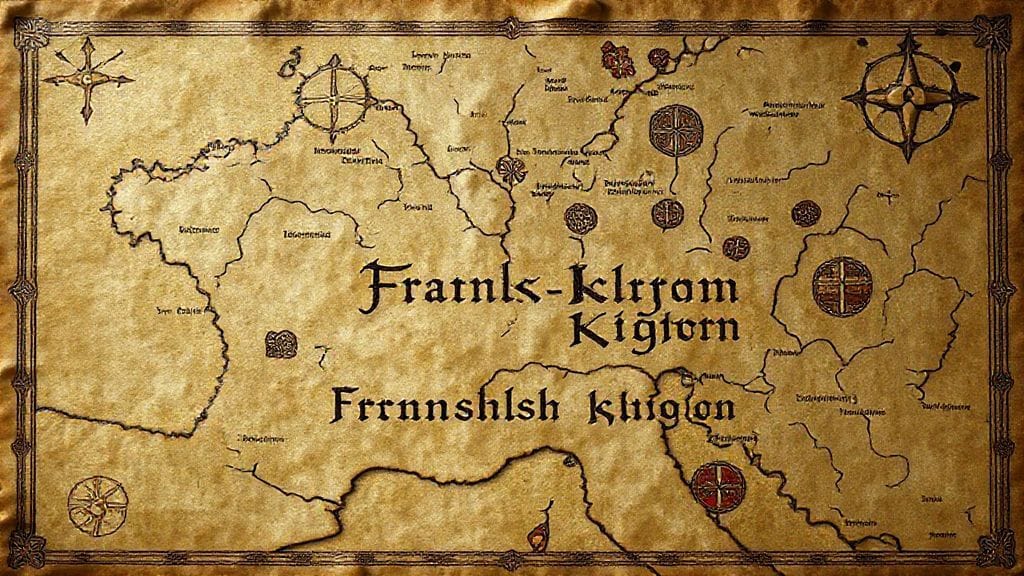
The kingdom was effectively carved into three major regions:
- Neustria, the western part, with Soissons at its heart, rich in Roman heritage and fertile lands.
- Austrasia, to the east and northeast, centered around Metz and characterized by its Frankish tribal roots and frontier position.
- Burgundy, encompassing lands around Orléans and further south, a region recently wrested from Visigothic and Roman influence.
This division was more than territorial; it represented varying identities and administrative legacies. The fragmentation sowed seeds of political fragmentation, but it also allowed local cultures to flourish in distinct ways.
8. Political and Familial Rivalries: Brothers in Arms or Foes in Waiting?
Though bound by blood, the four brothers were embroiled in a complex web of jealousy, ambition, and strategic calculation. Early cooperation gave way to rivalries that would stain the kingdom with blood. For example, Chlodomer’s aggressive campaigns against neighboring tribes raised both fear and suspicion among his siblings.
Episodes of intrigue included the ruthless elimination of potential rivals, the strategic use of marriage alliances, and shifting allegiances that made the Frankish court a hotbed of tension. The very system that had divided the kingdom to preserve peace paradoxically bred instability.
9. The Role of the Church: Religious Influence over a Fracturing Kingdom
The Church was not a mere spectator; it was a key actor in the unfolding drama. Clerics and bishops held immense moral and political authority, often mediating disputes and legitimizing rulers. Figures such as Bishop Remigius of Reims—who famously baptized Clovis—set precedents for ecclesiastical influence over secular matters.
The Christian faith also served as a unifying force, transcending tribal divides while reinforcing the notion of divine sanction. Yet, as the kingdom splintered, the Church’s role became more complex—sometimes a peacekeeper, sometimes a partisan actor in the politics of succession.
10. Governance Amidst Division: Local Powers and Royal Authority
Each king had to balance the demands of his local nobility, ecclesiastical figures, and emerging bureaucracies. The fragmentation of the kingdom did not mean total chaos; rather, it involved a delicate negotiation between central authority and regional powerholders.
The legal traditions—such as the Salic Law codified by Clovis—served as common ground, but local customs and provisional alliances often dictated day-to-day governance. This patchwork of power would characterize much of the early medieval period.
11. The Impact on the Frankish People: Daily Lives Caught in Transition
While dynasts argued over territory, everyday life for common Franks shifted subtly but surely. The integration of Roman administrative legacy, the spread of Christianity, and the imprint of Frankish tribal customs influenced laws, landownership, and social norms.
Villagers and townspeople experienced changes in tax obligations, military levies, and justice systems. The partition introduced uncertainty, but also opportunities as local leaders exercised increased autonomy within the divided realm.
12. External Threats: Bretons, Visigoths, and the Shifting Borders of Gaul
The partitioned Frankish kingdom faced external pressures from neighboring peoples. The Bretons in the West resisted Frankish overlordship, while the Visigoths retained strongholds in Septimania and southern Gaul.
These threats sometimes encouraged cooperation among brothers but also prompted military campaigns that further drained resources and stoked rivalries. The borderlands became zones of conflict and cultural exchange, shaping the kingdom’s political future.
13. Soissons as a Political Hub: Tradition, Power, and Symbolism
Though the kingdom was divided, Soissons remained a symbolic capital. Its legacy as an ancient Roman city endowed it with cultural prestige, and its strategic position in northern Gaul made it a focal point for royal power.
Festivals, royal courts, and ecclesiastical events held in Soissons reinforced its central role in the early Merovingian state. However, over time, other cities like Paris and Metz rose in prominence, reflecting shifting power dynamics.
14. The Seeds of the Merovingian Dynasty’s Future: Patterns of Power and Conflict
The partition among Clovis' heirs set the pattern for the Merovingian dynasty—a recurrent cycle of division, reunion, and fratricide. This dynamic would shape Frankish politics for over two centuries.
The struggle among brothers established a political culture where loyalty and betrayal danced precariously, influencing the evolution of monarchy, aristocracy, and religious institutions.
15. The Aftermath: How the Partition Laid the Groundwork for Medieval France
While the immediate consequence was fragmentation, the partition was far from the end of Frankish unity. Over time, the process of consolidation and reconquest gradually emerged. Kings like Clotaire I would reconquer lost territories, working toward reunification.
This cycle of division and reassembly laid the foundation for the future French kingdom. The cultural synthesis of Roman, Frankish, and Christian elements eventually gave rise to medieval French identity.
16. Cultural and Legal Ramifications of the Division
The division had profound effects on the development of law and culture. Salic Law was applied differently across regions, and local traditions influenced legal interpretations.
Culturally, the partition fostered regional identities—Neustria, Austrasia, and Burgundy would each contribute distinct customs, art, and political traditions that enriched the emerging medieval European tapestry.
17. The Partition’s Echoes in European History: Lessons in Unity and Fragmentation
The story of Clovis’ heirs serves as an early chapter in the broader European narrative of state formation. It highlights the tension inherent in medieval governance—between unity and division, personal ambition and dynastic legacy.
This episode resonates in later medieval partitions—as in the Carolingian Empire and beyond—emphasizing enduring questions about rulership, inheritance, and identity.
18. Anecdotes and Chronicles: Voices from the 6th Century Frontier
Chroniclers like Gregory of Tours provide vivid glimpses into this turbulent era. He recounts tales of royal feasts, violent betrayals, and saintly interventions, painting a picture both human and epic.
One tale tells of how Chlodomer’s wife, Princess Guntheuc, fled after his death, highlighting personal tragedies behind political machinations. Such stories remind us that behind the grand historical forces were real individuals with dreams, fears, and flaws.
19. Historiographical Perspectives: How Scholars Interpret the Partition
Historians have debated the partition’s meaning extensively. Some emphasize its destructive consequences, viewing it as the birth of feudal fragmentation. Others see it as a pragmatic adaptation to a complex realm.
Modern scholarship tends to view the division as a nuanced transformation rather than mere collapse, stressing continuities alongside change, and the ways in which the Merovingian kings negotiated new political realities.
20. The Lasting Memories of Clovis’ Heirs in Modern Imagination
Today, Clovis and his sons loom large in French national mythology. Their story is taught as the genesis of medieval France, a tale of heroism, faith, and familial drama.
Monuments, literature, and historiography continue to wrestle with these figures—casting them as both architects of unity and agents of division. The legacy of their partition remains a cautionary and inspiring chapter in European history.
Conclusion
The partitioning of the Frankish kingdom among Clovis’ heirs between 511 and 514 was a moment of profound transformation. It marked the death of a unifying figure and the birth of a divided but vibrant political landscape. This division was not simply a fracture of land but a complex negotiation of identities, loyalties, and power between brothers locked in a dance as old as monarchy itself.
Far from heralding decline, the partition laid the groundwork for the medieval order—where fragmented kingdoms would evolve into nations, and where the interplay of war, faith, and family would shape the course of Europe. It is an enduring reminder that history unfolds not only in moments of conquest but also in moments of division, where old worlds give way to the new in turbulent harmony.
The story of Clovis’ heirs is one of ambition and loss, faith and violence, unity and fragmentation—a narrative as human as it is monumental, reflecting the eternal challenge of building kingdoms from the unstable fabric of inheritance.
FAQs
Q1: Why did Clovis’ kingdom get divided after his death?
A: The division resulted from the Frankish tradition of partible inheritance, which dictated that a king's lands be equally divided among all his sons, rather than passing to a single heir.
Q2: How many sons did Clovis have, and who were they?
A: Clovis had four sons who inherited his kingdom: Theuderic I, Chlodomer, Childebert I, and Chlothar I, each receiving a distinct territory.
Q3: What role did Soissons play in the partition?
A: Soissons was the symbolic political center where the division was formalized. It was a former Roman city and a key royal seat under the Merovingians.
Q4: How did the Church influence the Frankish kingdom after Clovis’ death?
A: The Church was a powerful mediator and legitimizing force, supporting the kings’ Christian authority while sometimes involving itself in political disputes.
Q5: Did the partition lead immediately to conflict among Clovis’ sons?
A: While the brothers initially maintained uneasy cooperation, rivalries and military conflicts soon arose, driven by ambition and territorial interests.
Q6: What impact did the partition have on the Frankish people?
A: Daily life was affected through changes in governance, law, taxation, and military levies, with local authorities gaining greater importance during the division.
Q7: How is the partition connected to the later development of the French state?
A: The partition laid foundational dynamics of division and reunion that shaped the medieval French kingdom, influencing political culture and territorial identities.
Q8: Are there surviving contemporary accounts of this period?
A: Yes, chroniclers like Gregory of Tours provide rich narratives, blending historical facts with legend and personal stories from the era.

