Table of Contents
- The Dawn of Theological Turmoil: Setting the Scene in 6th-Century Gaul
- The Landscape of Christian Doctrine Before Orange
- Pelagianism and Semi-Pelagianism: Shadows over Grace
- The Rise of Augustine’s Theology: Controversy and Conviction
- Orange, 529: A Gathering with Monumental Stakes
- The Key Players: Bishops, Theologians, and Imperial Influences
- Opening the Council: Intentions and Atmosphere
- The Debate Unfolds: Flesh, Free Will, and Divine Grace
- Defining Grace: The Rejection of Pelagianism
- Semi-Pelagianism Under the Microscope: A Nuanced Condemnation
- The Council’s Canons: A Balance Between Divine Sovereignty and Human Agency
- Reception and Resistance: Immediate Reactions Across Gaul and Beyond
- The Role of Orange in Shaping Medieval Theology
- Long-Term Impact on Western Christianity and Ecclesiastical Politics
- Orange and the Seeds of Augustinian Orthodoxy
- Reflections on Grace: Philosophy, Hope, and Human Nature
- Orange’s Quiet Revolution: Between Heresy and Orthodoxy
- The Legacy in Modern Theology and Ecumenical Dialogues
- How the Council’s Decisions Echo Into Today’s Debates on Grace
- Remembering Orange: Pilgrimage, Scholarship, and Memory
- Conclusion: The Enduring Light of a Sixth-Century Gathering
- FAQs: Understanding the Council of Orange and Its Influence
- External Resource
- Internal Link
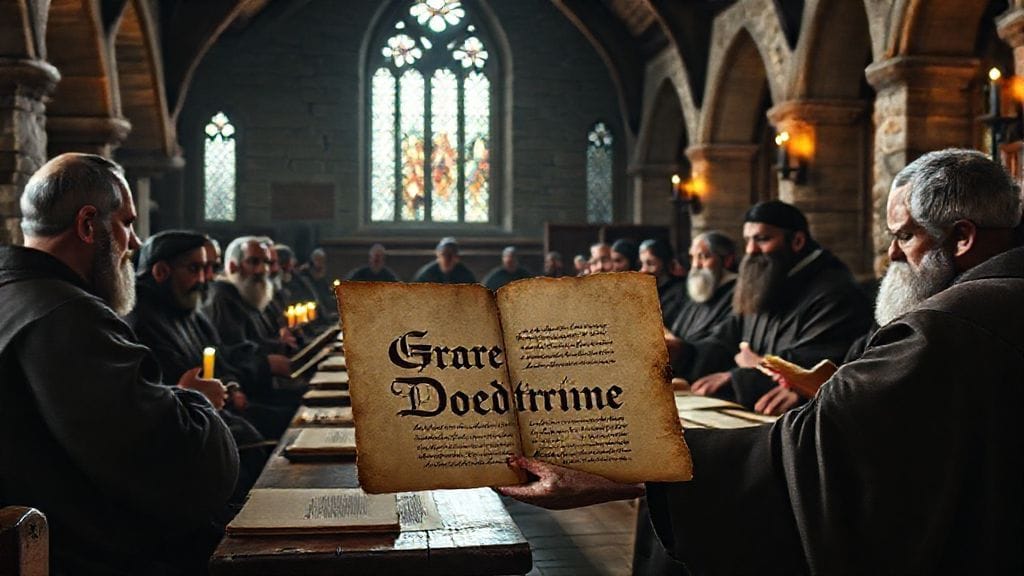
In the soft light of an early autumn in 529 AD, the ancient city of Orange, nestled in the rolling terrain of Roman Gaul, became the unlikely epicenter of a theological battle that had been simmering for centuries. As bishops and theologians gathered in the basilica, the air trembled with a tension not of swords or armies, but of ideas—ideas about the essence of God's grace and humanity's role in salvation.
This was no ordinary synod. It was the Second Council of Orange, convened in a world still raw from the fall of Rome and wrestling with the fragile threads of Christian orthodoxy. The city, known more for its Roman amphitheater than theological ferment, now found itself at the crossroads of a doctrine that would echo profoundly through the corridors of history.
The question on everyone’s lips was deceptively simple, yet profoundly complex: What is the nature of divine grace, and how does it relate to human free will? Could mankind choose God without His prior gift of grace? Was salvation the work of the Creator alone, or was human effort also indispensable?
As the council progressed, these issues were dissected with precision and passion. By the end, the Second Council of Orange would not only condemn certain heresies but also provide a carefully nuanced articulation of grace, marking a pivotal moment in the history of Christian theology.
1. The Dawn of Theological Turmoil: Setting the Scene in 6th-Century Gaul
The sixth century was a time of upheaval and transformation. The remnants of the Roman Empire in Gaul were contested and fragmented, and the Catholic Church had taken on a crucial role as both spiritual authority and political force. Christianity had long been the state religion, but theological disputes threatened its unity.
In these turbulent times, the debate over grace—the unmerited favor of God—had intensified, primarily in response to Pelagianism, a doctrine that challenged the necessity and efficacy of divine assistance in matters of salvation.
2. The Landscape of Christian Doctrine Before Orange
Christian theology had been evolving robustly since the early Church Fathers. Augustine of Hippo, whose writings dominated Western thought, had argued vehemently against Pelagius in the early 5th century. Yet, despite Augustine’s influence, his views had not been uncontroversial or universally accepted.
Various pockets of belief persisted. Among these, semi-Pelagianism sought a middle path that acknowledged grace but retained an essential role for human free will. This ambiguity created a fertile ground for contested definitions.
3. Pelagianism and Semi-Pelagianism: Shadows over Grace
Pelagianism, originating from the British monk Pelagius, asserted that human beings could initiate salvation through their own will, without the need for God’s grace. To many, this threatened the doctrine of original sin and the sovereignty of divine grace.
Semi-Pelagianism softened this stance, proposing a cooperative process where initial human assent to salvation triggered God’s grace. This nuance, however, failed to satisfy those who saw any human role in initiating salvation as a dangerous compromise.
4. The Rise of Augustine’s Theology: Controversy and Conviction
Augustine's writings, especially On Grace and Free Will, had become touchstones, emphasizing that grace must precede any human action toward God. He stressed humanity's fallen state and the impossibility of meriting salvation without divine intervention.
Yet his doctrines sparked debate: Was Augustine’s view too deterministic? Did it borderline on stripping humans of their freedom?
5. Orange, 529: A Gathering with Monumental Stakes
Against this backdrop, the Second Council of Orange was convened. Approximately 70 bishops from across Gaul attended, unified in their intent but divided in interpretation. No emperor presided, leaving the Council squarely in the ecclesiastical domain—yet the political implications lingered.
The city, Orange, was a symbolic choice—not a cultural capital, but a city whose Roman architecture mirrored the enduring heritage of law and order that the Council sought to impose on theology.
6. The Key Players: Bishops, Theologians, and Imperial Influences
Among the attendees, figures like Saint Caesarius of Arles played crucial roles, known for his disciplined approach to doctrine and pastoral care. Though no emperor dictated terms, the Merovingian kings watched closely, aware that religious doctrine shaped political legitimacy.
The council had to navigate less the demands of rulers than the undercurrents of local theological factions.
7. Opening the Council: Intentions and Atmosphere
The synod opened in a basilica that echoed with prayers, chants, and murmurs. The tone was somber yet charged. The presidents laid out the agenda: to clarify the Church’s stance on grace and free will, and to combat the lingering Pelagian and Semi-Pelagian heresies.
This was a moment of reckoning but also hope—a chance to bring clarity amidst centuries of confusion.
8. The Debate Unfolds: Flesh, Free Will, and Divine Grace
Discussions moved beyond abstractions; they tackled the human condition—the ‘flesh’ as described by Paul and Augustine—as inherently incapable of good without grace.
One bishop reflected, "If man is not first touched by grace, his will remains captive to sin." Others expressed concern about negating free will altogether.
9. Defining Grace: The Rejection of Pelagianism
The Council resolutely condemned Pelagianism, reaffirming Augustine’s doctrine. It was declared that the beginning of faith, repentance, and conversion is the grace of God, not a human act.
"Man receives from God the beginning of faith, and if he perseveres, it is by grace," ran one canonic decree, drawing a clear theological line.
10. Semi-Pelagianism Under the Microscope: A Nuanced Condemnation
Interestingly, the Council softened the severe tone toward Semi-Pelagianism, stopping short of an outright anathematization. Rather, it emphasized the necessity of prevenient grace—grace that precedes any human decision—thus carefully walking a theological tightrope.
This subtlety allowed the Council to quash heretical extremes while preserving a place for genuine human cooperation in salvation.
11. The Council’s Canons: A Balance Between Divine Sovereignty and Human Agency
The canons, sixteen in total, balanced Augustine’s emphasis on grace with an acknowledgment that human will must respond. The Council avoided fatalism, insisting that grace enables the will freely to cooperate.
This equilibrium would underpin much subsequent Christian doctrine.
12. Reception and Resistance: Immediate Reactions Across Gaul and Beyond
While the Council’s decrees were hailed by many bishops, resistance lingered. Some local churches hesitated to abandon the semi-Pelagian formulations they had relied on.
Nonetheless, the Council’s decisions gradually gained traction, especially as they were incorporated into later theological works.
13. The Role of Orange in Shaping Medieval Theology
In the centuries that followed, Orange became a reference point for discussions of grace. Medieval theologians cited its declarations to navigate controversies surrounding free will, predestination, and salvation.
It marked a clear endorsement of Augustine’s insights, yet tempered with pastoral sensitivity.
14. Long-Term Impact on Western Christianity and Ecclesiastical Politics
The Council’s balanced position helped avoid larger schisms. It influenced the Carolingians, the scholastics of the High Middle Ages, and even the Council of Trent, which centuries later reaffirmed Augustine's ideas on grace while confronting Protestant challenges.
Politically, it fortified the Church’s authority over doctrinal matters amid the fragmented post-Roman world.
15. Orange and the Seeds of Augustinian Orthodoxy
Orange’s theological clarifications planted the seeds for what would be called Augustinian orthodoxy in the West—an approach emphasizing grace and free will without capitulating to fatalism or Pelagian optimism.
This legacy resonates in the thought of later greats such as Thomas Aquinas and John Calvin, albeit in divergent interpretations.
16. Reflections on Grace: Philosophy, Hope, and Human Nature
Philosophically, the Council wrestled with eternal questions: Can humans transcend their fallen nature by their own strength? Is divine grace a gift freely given or a justice bestowed?
Orange’s nuanced conclusion offered hope: fallen humans are not alone but invited into a divine partnership.
17. Orange’s Quiet Revolution: Between Heresy and Orthodoxy
Though it lacked the fame of Nicaea or Chalcedon, Orange was a quiet revolution. It did not rewrite dogma but refined it, shaping understanding with subtlety and compassion.
Its legacy is a testament to the Church’s ability to negotiate doctrine amid diversity and dissent.
18. The Legacy in Modern Theology and Ecumenical Dialogues
Today, Orange remains a reference in discussions between Catholics and Protestants, especially in ecumenical contexts debating grace and free will.
It reminds modern believers that theological clarity need not come at the cost of human dignity or divine mystery.
19. How the Council’s Decisions Echo Into Today’s Debates on Grace
Issues raised at Orange persist: How much credit should humans receive in their salvation? What is the role of grace in moral and spiritual renewal?
These questions keep the Council’s words alive in academic debates, church dialogues, and even the spiritual lives of individuals.
20. Remembering Orange: Pilgrimage, Scholarship, and Memory
Though the city of Orange is better known today for Roman ruins, its theological heritage attracts scholars and the faithful alike.
Pilgrimages and symposia keep its memory alive, bridging past and present with a shared quest for understanding.
Conclusion
The Second Council of Orange was more than a meeting of minds in a humble Gallic city; it was a moment when the Church held a mirror to the mysteries of grace and human will, searching for truth amid ambiguity. Its legacy is a testament to the enduring struggle to reconcile divine sovereignty with human freedom, a struggle that pulses at the heart of Christian faith even today.
As we reflect on Orange, we glimpse the vibrant tension that fuels belief — the hope that though we are fallen, grace is near, ready to ignite the will, transform the heart, and chart the course of salvation.
FAQs
Q1: Why was the Second Council of Orange convened?
A1: To clarify the Church’s teachings on grace and free will, primarily to address the persistent heresies of Pelagianism and Semi-Pelagianism.
Q2: What is the difference between Pelagianism and Semi-Pelagianism?
A2: Pelagianism denies the necessity of divine grace for salvation, asserting humans can initiate faith by their own will. Semi-Pelagianism acknowledges grace but posits that initial human assent is necessary to receive it.
Q3: How did the Council of Orange view human free will?
A3: It affirmed that free will exists but is incapable of choosing good or salvation without grace. Grace initiates and enables the will to cooperate freely.
Q4: What lasting impact did the Council have on Christian doctrine?
A4: It helped define orthodox teachings on grace that influenced medieval theology, the Reformation, and Catholic doctrine up to the Council of Trent and beyond.
Q5: Were the Council's decisions universally accepted at the time?
A5: Acceptance was gradual; some regions resisted the rejection of semi-Pelagian views, but over time the Council's conclusions gained widespread ecclesiastical authority.
Q6: How is the Council of Orange relevant today?
A6: It informs ongoing theological discussions about the balance between divine grace and human responsibility, a debate present in ecumenical dialogues among Christian denominations.
Q7: Who was Saint Caesarius of Arles, and what was his role?
A7: A prominent bishop and theologian who helped lead the Council; his pastoral concerns influenced the Council’s balanced approach to grace and free will.
Q8: Where can I learn more about the Second Council of Orange?
A8: A detailed article on Wikipedia offers a comprehensive overview. See external resources below.

