Table of Contents
- The Dawn of a New Emperor: Justinian's Coronation in Constantinople
- The Eastern Roman Empire on the Brink of Transformation
- Justinian’s Early Life and Ambitions
- The Political Climate of Constantinople in 527
- The Ceremony That Sealed an Empire: April 1st, 527
- The Role of Empress Theodora and Imperial Court Intrigues
- The Legacy of Justinian’s Immediate Actions After His Coronation
- The Reign of Law: Codification and Legal Reforms
- Building an Empire: Architecture, Urban Planning, and the Hagia Sophia
- Military Campaigns to Reclaim the Lost Western Provinces
- Facing Religious Conflict and Religious Policies Under Justinian
- The Plague of Justinian: Catastrophe Amidst Glory
- The Byzantine Economy Under Justinian’s Rule
- The Impact of Justinian’s Reign on Neighboring Kingdoms and Peoples
- Stories from Constantinople’s Streets: The Lives of Commoners
- Theodora's Influence: From Actress to Empress
- The Fallouts and Failures: Revolts and Resistance
- Justinian’s Vision of a United Roman World
- How Justinian’s Reign Changed the Course of Eastern and Western History
- The Enduring Myth of Justinian in Later Generations
- The Archaeological Legacy: Uncovering Justinian’s Constantinople
- Conclusion: The Emperor Who Reimagined Rome
- FAQs About Justinian’s Ascension and Rule
- External Resource
- Internal Link
1. The Dawn of a New Emperor: Justinian's Coronation in Constantinople
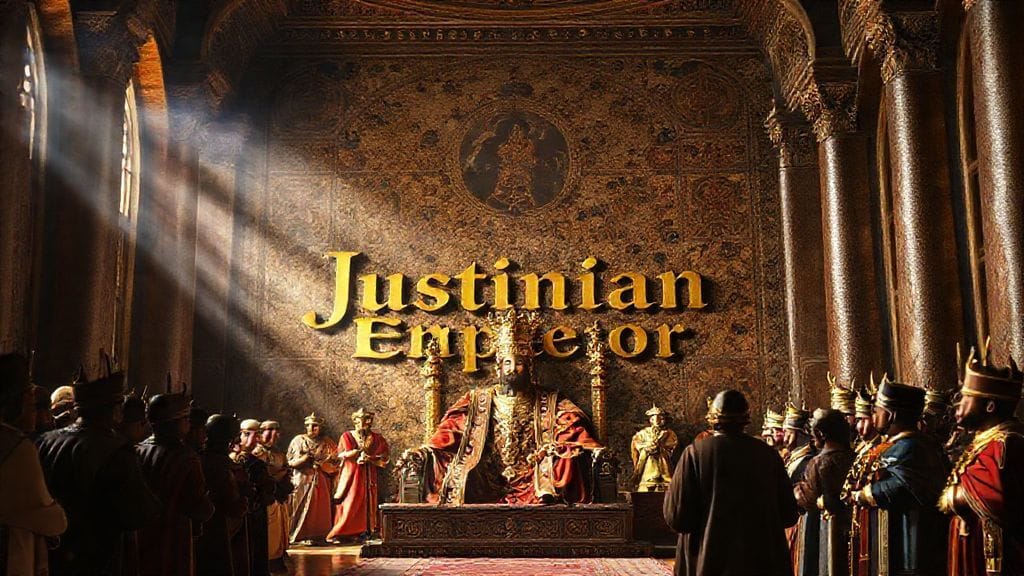
It was the morning of April 1, 527, and Constantinople was a city still shimmering with the fading light of dawn as citizens thronged the great basilicas and forums. The city, a jewel of empires, simmered with anticipation and unease. The old Emperor Justin I, worn out by age and the turmoil of previous decades, was dead. His nephew and heir, a man of towering ambition and intellect named Justinian, stood ready to take the imperial diadem. As the golden sun touched the domes of Hagia Sophia, the grand cathedral whispered its age-old prayers, not just to God, but to history itself—this day would mark a new chapter for the Eastern Roman Empire. The crown was laid on Justinian’s brow, a symbol not just of monarchy, but of rebirth, resilience, and an empire’s yearning for greatness.
2. The Eastern Roman Empire on the Brink of Transformation
In 527, the Eastern Roman Empire—known today as the Byzantine Empire—stood at a complex crossroads. The vast territories of the ancient Roman Empire had fractured, with the west lost to barbarian kingdoms and the east struggling to preserve Roman law, culture, and power in a world that was rapidly changing. The empire was a melting pot of Greek, Roman, Christian, and Persian influences. Constantinople itself was a city of contradictions—grand palaces and crowded slums, immense wealth and brutal poverty, rigid Orthodox Christianity and lingering pagan traditions. This was the world Justinian inherited: an empire on the edge, yet still potent, with a legacy to uphold and enemies to repel.
3. Justinian’s Early Life and Ambitions
Born around 482 in the small village of Tauresium, in the province of Dardania, Justinian was of humble origins. His name was originally Petrus Sabbatius before being adopted by his uncle Justin. Educated in Constantinople, he was a man of keen intellect, with a profound sense of discipline and an unyielding ambition that would define his reign. Unlike many of his predecessors, Justinian was not content to rule as a figurehead or a mere political actor; he sought to restore Roman greatness and bring order to a world of chaos. His vision extended beyond mere power: law, faith, warfare, and architecture were all tools for his imperial project.
4. The Political Climate of Constantinople in 527
At the time of Justinian’s accession, Constantinople was still healing from decades of political instability, religious conflicts, and external threats. The city was ruled by a bureaucracy that often acted for self-preservation rather than reform. The military was stretched thin and the frontier vulnerable to the Persians in the East and various tribes along the Danube. Additionally, the role of the senatorial aristocracy was shifting beneath the weight of imperial centralization. Emperors before Justinian had often been content with maintaining stability, but Justinian’s arrival announced an era of bold, sometimes brutal, reforms and campaigns.
5. The Ceremony That Sealed an Empire: April 1st, 527
The coronation of Justinian was both a religious and political spectacle designed to affirm the unity of body and soul of the empire under his rule. The ceremony took place in the Hagia Sophia, itself recently reconstructed and a shining example of imperial piety and power. Patriarch John the Cappadocian placed the crown on Justinian’s head, linking the imperial office to divine providence. The streets of Constantinople swelled with spectators—soldiers, merchants, common folk—all bearing witness to the dynasty’s continuity. Yet beneath the grandeur, whispers spread: What manner of ruler would Justinian be? The city braced itself as the new emperor stepped into the ancient footsteps of Caesar and Augustus.
6. The Role of Empress Theodora and Imperial Court Intrigues
Behind Justinian, stood Theodora, his wife and consort, whose influence was integral yet often undervalued by later chroniclers. From her origins in the theatrical world and the shadowy margins of society, Theodora rose to become one of the most powerful women in Byzantine history. She was not only a partner to Justinian but a political force in her own right, shaping policy and court dynamics. Court intrigue, religious factions, and bureaucratic factions vied for influence, but the imperial couple’s united front helped stabilize the regime and push through sweeping reforms.
7. The Legacy of Justinian’s Immediate Actions After His Coronation
Justinian wasted no time after his coronation. Within months, he began reorganizing the imperial administration, curbing corruption, and strengthening the military. His vision was clear: to restore the Roman Empire to its full territorial glory, to unify Christian doctrine, and to create a body of imperial law reflective of justice and order. Yet, these ambitions would soon reveal the tensions between idealism and reality, with successes mingling with costly wars and social upheavals.
8. The Reign of Law: Codification and Legal Reforms
If Justinian’s coronation was the symbolic heart of his reign, then his legal reforms formed its backbone. The Corpus Juris Civilis, or “Body of Civil Law,” was his monumental effort to codify and consolidate centuries of Roman legal principles and imperial edicts into a clear, systematic code. This codification not only streamlined governance but also reverberated through centuries of legal thought worldwide. Lawyers, judges, and scholars would study Justinian’s laws long after the empire itself had faded.
9. Building an Empire: Architecture, Urban Planning, and the Hagia Sophia
Justinian’s reign was marked not only by conquest and law but also by a grand architectural revival. The reconstruction of Hagia Sophia, following the destruction caused by rioting in 532, stands as perhaps the most famous testament to his vision. Designed by the architects Isidore of Miletus and Anthemius of Tralles, the cathedral’s soaring dome and intricate mosaics symbolized the glory of God and the emperor’s divine right to rule. Beyond churches, Justinian invested heavily in fortifications, aqueducts, and public buildings, transforming Constantinople into an unrivaled imperial capital.
10. Military Campaigns to Reclaim the Lost Western Provinces
Emboldened by his vision of Roman restoration, Justinian initiated savage and ambitious military campaigns to recapture the western provinces lost after the fall of Rome in 476. Under the command of generals like Belisarius and Narses, Byzantine forces reconquered parts of North Africa from the Vandals, reclaimed Italy from the Ostrogoths, and secured parts of Spain. These campaigns were brutal and expensive but temporarily restored the Mediterranean’s Roman unity, reviving imperial prestige.
11. Facing Religious Conflict and Religious Policies Under Justinian
Justinian’s rule coincided with intense religious tensions. His promotion of Orthodox Christianity and persecution of heretics, pagans, Monophysites, and Jews reflected his desire for a religiously unified empire. Yet these policies sowed discord, triggering revolts and unrest. The emperor’s role as both political and spiritual guardian enforced a complex intertwining of church and state rarely seen before or after his epoch.
12. The Plague of Justinian: Catastrophe Amidst Glory
Just as Justinian sought to forge a new empire, calamity struck: the Plague of Justinian, beginning in 541, ravaged Constantinople and the empire’s heartlands. This pandemic decimated populations, sapping the army and economy. Justinian himself fell ill but survived. The plague reminded all that even the might of an emperor was vulnerable, and it forever changed the demographic and economic landscape of the Mediterranean world.
13. The Byzantine Economy Under Justinian’s Rule
The costs of Justinian’s military and building campaigns were immense and placed enormous strain on the imperial economy. Taxation increased dramatically, often provoking resentment and popular unrest. Yet the empire’s trade networks, agricultural productivity, and control of vital routes helped sustain the state. Justinian’s era was a paradox of grand vision and tight resources, revealing the intricate balancing act of Byzantine economics.
14. The Impact of Justinian’s Reign on Neighboring Kingdoms and Peoples
Justinian’s ambitions did not unfold in isolation. His campaigns and policies shaped the Mediterranean world and the borderlands from Persia to the Slavs. The wars with the Sassanid Empire, diplomatic maneuvering with the barbarian kingdoms, and interactions with rising Muslim powers generated ripple effects far beyond Constantinople. His reign redefined power structures and cultural exchanges across continents.
15. Stories from Constantinople’s Streets: The Lives of Commoners
Beneath the imperial palaces and monumental architecture was the daily life of Constantinople’s millions—merchants hawking wares, artisans crafting icons, beggars seeking alms, and soldiers patrolling dusty streets. For them, Justinian’s coronation was both a spectacle and a source of hope or fear, depending on one’s social standing. Periodic riots, notably the Nika Revolt of 532, showed the precariousness of peace in a city where imperial grandeur coexisted with harsh realities.
16. Theodora's Influence: From Actress to Empress
Theodora’s story is extraordinary—a former actress and courtesan who rose to be empress and co-ruler. Her intelligence, boldness, and political acumen shaped many of Justinian’s decisions, especially regarding women’s rights and social policies. Her influence extended into court politics and public policy, making her one of the most formidable figures behind the scenes of Justinian’s reign.
17. The Fallouts and Failures: Revolts and Resistance
Justinian’s grand vision was not without its costs. The immense taxation sparked revolts such as the Vandalic and Gothic resistance, alongside the devastating Nika Revolt within Constantinople. These upheavals exposed the limits of imperial power and the costs of reform. Yet Justinian’s ruthless suppression of dissent also secured his legacy as a determined and occasionally merciless ruler.
18. Justinian’s Vision of a United Roman World
At its core, Justinian’s reign was a quest to restore the Roman Empire’s unity—politically, religiously, and culturally. His military campaigns, legal codes, architectural projects, and religious policies were all threads woven into a grand tapestry of revival. Though imperfect and often fraught with conflict, Justinian’s vision left an indelible mark on history—one where Rome’s laws, faith, and power endured into a new age.
19. How Justinian’s Reign Changed the Course of Eastern and Western History
Justinian’s reign proved pivotal in preserving and transforming Roman legacies. His legal codification influenced European legal systems for centuries, while his architectural innovations inspired religious and civic buildings far beyond Byzantium. Though the empire’s western reconquests were fleeting, they rekindled connections across the Mediterranean and laid foundations for medieval identities. Eastern Orthodoxy and Byzantine political culture trace much of their heritage to Justinian’s time.
20. The Enduring Myth of Justinian in Later Generations
After his death in 565, Justinian became a legendary figure—idealized as a lawgiver, conqueror, and builder by some, and criticized as a tyrant and despot by others. His image was invoked by medieval rulers, Renaissance thinkers, and even modern scholars who saw in his life the complexities of power, reform, and empire. This myth-making process underscores how history remembers and reshapes its greatest and most controversial figures.
21. The Archaeological Legacy: Uncovering Justinian’s Constantinople
Modern archaeology has brought new light to Justinian’s Constantinople, unearthing mosaics, foundations of buildings, and artifacts that reveal the splendor and struggles of his reign. Excavations around the Hagia Sophia, the Great Palace, and city walls illustrate the physical and cultural transformation Justinian envisioned and partially realized during his rule.
22. Conclusion: The Emperor Who Reimagined Rome
Justinian’s coronation in April 527 was not merely a ceremony; it was the awakening of an imperial dream. A man from humble origins ascended to shape one of history’s most enduring empires, blending law, war, faith, and art in a quest for a unified Roman world. His achievements and failures remind us of the fragile grandeur of empires and the human ambitions that forge them. More than a ruler, Justinian was a symbol—a force that would define Byzantine civilization and echo through the corridors of history long after the gold of his crown had dimmed.
FAQs
1. Why was Justinian’s coronation significant for the Eastern Roman Empire?
Justinian’s coronation marked the beginning of an ambitious reign aimed at restoring Roman greatness through legal reform, military conquest, and religious unification. It symbolized continuity and renewal in a time of uncertainty.
2. Who was Theodora, and how did she influence Justinian’s rule?
Theodora, Justinian’s wife, was a former actress who became a powerful empress. She influenced many policies, especially regarding women’s rights, and played a crucial role during crises like the Nika Revolt.
3. What was the impact of the Corpus Juris Civilis?
This codification of Roman law streamlined and preserved legal principles that influenced European legal systems for centuries, becoming a foundational text for civil law traditions worldwide.
4. How successful were Justinian’s military campaigns to reclaim Western Roman territories?
His generals achieved significant military victories, reconquering parts of North Africa, Italy, and Spain. However, these gains were costly and temporary, as the empire eventually lost these territories again.
5. What role did religion play during Justinian’s reign?
Justinian sought religious unity, promoting Orthodox Christianity and suppressing heretical movements. This policy stirred religious tensions but shaped Byzantine identity deeply.
6. How did the Plague of Justinian affect the empire?
The plague drastically reduced the population, weakened the military, and destabilized the economy, impacting the empire’s ability to sustain Justinian’s expansive projects and warfare.
7. In what ways did Justinian’s reign influence later history?
His legal reforms, architectural achievements, and vision of the Roman Empire left a lasting legacy on European law, Orthodox Christianity, and imperial ideology.
8. How is Justinian remembered today?
Justinian remains a controversial figure remembered both as a visionary ruler who shaped Byzantine civilization and a harsh autocrat whose ambitions often exacted a high human toll.

