Table of Contents
- The Siege of Ravenna: A Pivotal Moment in the Gothic War
- Ravenna under Ostrogothic Rule: A City Poised Between Empires
- Belisarius: The Brilliant Strategist of Byzantium
- The Political Chessboard: Byzantium vs Ostrogoths
- Background to the Siege: The Gothic War’s Early Campaigns
- The Road to Ravenna: Belisarius’ March through Italy
- The Strategic Importance of Ravenna in the 6th Century
- The Clash of Titans: Belisarius Confronts Witigis
- Siege Warfare in Late Antiquity: Technologies and Tactics
- The Fall of Ravenna: The Day the Walls Came Down
- The Capture of Witigis: The Last King of the Ostrogoths Captive
- Psychological Warfare and Diplomacy in the Siege
- Aftermath in Ravenna: From Gothic Capital to Byzantine Stronghold
- The Impact of the Capture on the Gothic War’s Course
- Economic and Cultural Consequences for Ravenna and Italy
- Belisarius’ Legacy and His Place in Military History
- The Fall of Ravenna in the Eyes of Contemporary Chroniclers
- The Broader Byzantine Ambitions in the West
- Ravenna’s Transformation under Byzantine Rule
- The Gothic War’s Shadow on Italian Identity
- Memory and Myth: Belisarius in Later Literature and Art
- Conclusion: The Siege That Reshaped a Continent
- FAQs about Belisarius and the Capture of Ravenna
- External Resource
- Internal Link
1. The Siege of Ravenna: A Pivotal Moment in the Gothic War
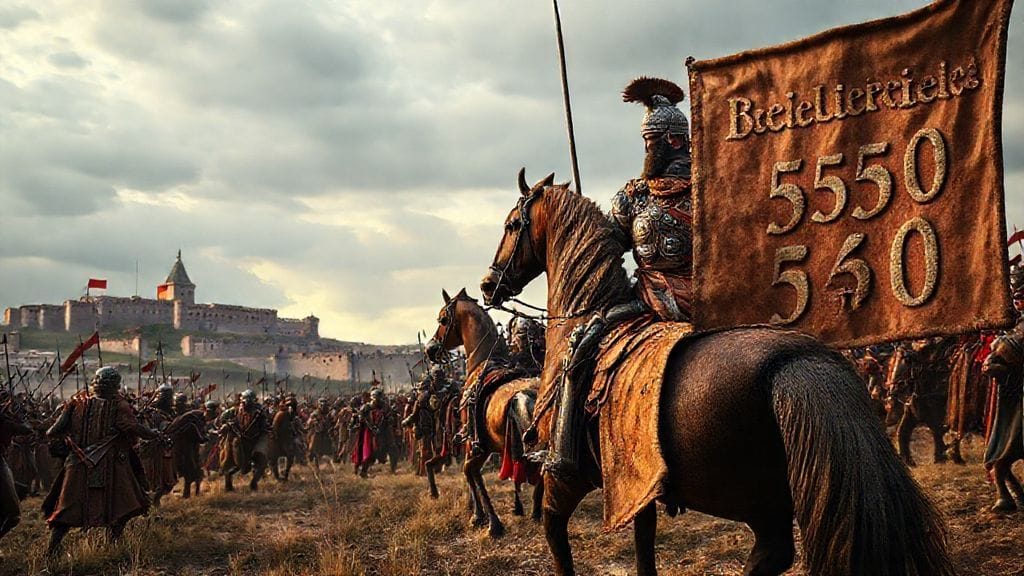
The air hung heavy with smoke and tension as the Byzantine banners fluttered under a bleak, ancient sky. The scent of salt and decay lingered over the lagoon city of Ravenna, whose towering walls had resisted countless attacks since the Roman Republic. But in 540 AD, after months of encirclement and attrition, the stalwart defenders found themselves cornered by one man’s genius—Belisarius, the last hope of the Eastern Roman Empire.
This was no ordinary battle for a city; it was a clash of civilizations, the Byzantine heart beating against the remnants of the Gothic kingdom that once dominated Italy. The capture of Ravenna did not simply mark a military victory; it was a transformative event that altered the political and cultural fabric of the Italian peninsula for centuries to come.
2. Ravenna under Ostrogothic Rule: A City Poised Between Empires
In the early 6th century, Ravenna was more than a city—it was the capital of the Ostrogothic Kingdom and a potent symbol of Gothic authority in Italy. Situated on a marshy peninsula near the Adriatic Sea, its labyrinth of canals and formidable walls impressed both friend and foe alike. Since the fall of the Western Roman Empire, Ravenna had served as a bastion of imperial power, first for Rome and then for the Goths.
Under the reign of King Theodoric the Great, Ravenna flourished as a cultural melting pot where Roman and Gothic traditions entwined. But by 540, the glittering veneer had begun to tarnish. Internal dissensions, economic strain, and the relentless pressure of Byzantine campaigns had weakened Gothic control. The city's population was divided in loyalty — some held onto Gothic sovereignty, others favored a return to Roman rule under Justinian’s banner.
3. Belisarius: The Brilliant Strategist of Byzantium
Flavius Belisarius—names etched in military textbooks and epics—stood as Justinian’s most esteemed general. His rise from humble origins to supreme commander was matched only by his tactical brilliance and unshakeable loyalty to the empire. Known for combining audacity with cunning, Belisarius had earned victories across North Africa, the Persian frontier, and now, Italy.
By 540, Belisarius was no stranger to siege warfare and psychological tactics. His reputation as a commander who could turn the tide against numerically superior foes preceded him. Yet Ravenna, with its impregnable marshlands and loyal Gothic defenders under King Witigis, posed perhaps his greatest challenge.
4. The Political Chessboard: Byzantium vs Ostrogoths
The capture of Ravenna occurred against the backdrop of the Gothic War (535–554 AD), a brutal conflict set off by Emperor Justinian I’s ambition to reclaim the former Western Roman lands. The Ostrogoths had inherited Italy after the collapse of Roman power, but the Eastern Empire under Justinian sought restoration of imperial unity.
The war was fraught with shifting alliances, betrayals, and pitched battles stretching across Italy. Each side wielded propaganda and political intrigue as deftly as swords. For the Goths, Ravenna was not only a capital but the last bastion of hope; for Byzantium, it was a jewel whose capture would symbolize the triumph of a reunited empire and Justinian’s vision.
5. Background to the Siege: The Gothic War’s Early Campaigns
The Gothic War was ignited when Justinian dispatched Belisarius to Italy in 535 AD. Initial campaigns saw swift advances—Rome was briefly retaken, and large swaths of the peninsula fell to the Byzantines. However, the war soon deteriorated into a grueling struggle, with Gothic counterattacks reclaiming territory and laying siege to cities.
By 540, after almost five years of conflict, the war had drained both sides’ resources and morale. Belisarius had pushed the Ostrogoths into a defensive posture, gradually securing northern and central Italy. Ravenna remained the last unyielding fortress, stubbornly refusing to fall.
6. The Road to Ravenna: Belisarius’ March through Italy
Belisarius’ advance toward Ravenna was marked by careful strategy and relentless pressure. He navigated through treacherous terrain—swamps, dense forests, and hostile towns—maintaining supply lines and troop morale. His keen use of diplomacy softened some cities, while his tactical prowess ensured battlefield successes.
The approach to Ravenna was no mere military maneuver; it was a psychological siege that wore down defenders' resolve. Belisarius understood that to break Ravenna's grip on Italy, he had to isolate it completely—cutting off food, reinforcements, and communication with Gothic allies.
7. The Strategic Importance of Ravenna in the 6th Century
Ravenna’s unique position made it the lynchpin of power in Italy. Its harbor and network of canals allowed it to control trade and military movements along the Adriatic coast. Strong walls and the natural protection of marshlands rendered it almost impregnable, a fortress city designed to withstand prolonged siege.
Politically, control over Ravenna signified control over the remnants of the Roman administration on the peninsula. It was also a symbolic seat of legitimacy—whichever power held Ravenna could claim authority over Italy.
8. The Clash of Titans: Belisarius Confronts Witigis
Facing Belisarius was King Witigis, a shrewd and determined Gothic leader who had inherited a precarious reign following the death of Theodahad. Witigis was well aware that the fall of Ravenna would mean the end of Gothic dominion in Italy.
The clash between these two commanders transcended mere military confrontation; it was a battle of wills and ideologies. Witigis fortified the city with loyal troops, prepared for a siege that he hoped would stall or reverse the Byzantine advance.
9. Siege Warfare in Late Antiquity: Technologies and Tactics
The siege of Ravenna was as much a trial of engineering and patience as of brute force. Byzantine forces employed a variety of siege engines—ballistae, scorpions, and trebuchets—designed to batter walls and spread terror among defenders.
But beyond machines, psychological tactics—spying, bribery, misinformation—played a crucial role. Belisarius was famed for his ability to exploit weak spots not just in fortifications, but in human nature.
10. The Fall of Ravenna: The Day the Walls Came Down
After prolonged encirclement and dwindling supplies inside, morale among Ravenna’s defenders began to collapse. The Byzantines, relentless and ingenious, found a secret betrayal that opened gates to the city. According to chroniclers, internal dissent aided Belisarius—a faction within Ravenna secretly negotiated terms with him.
When the walls finally fell in late 540 AD, it was both a military stupor and a political earthquake. The city’s surrender signaled a turning point in the Gothic War, marking the effective end of Ostrogothic power.
11. The Capture of Witigis: The Last King of the Ostrogoths Captive
Following the fall, King Witigis was captured and brought before Belisarius. His fate was emblematic of the epoch—a proud monarch reduced to a prisoner of the empire he had fought to protect. While precise details remain vague, it’s believed Witigis was treated with imperial dignity before being exiled.
Witigis’s capture was more than the loss of a king—it was the collapse of an entire era of Gothic sovereignty in Italy.
12. Psychological Warfare and Diplomacy in the Siege
Belisarius’ victory at Ravenna was engineered through a blend of force, strategy, and human manipulation. Diplomacy saw him securing allies within the city, promising clemency and fairness, while exploiting divisions among Gothic factions.
This approach showcased Belisarius not only as a warrior but as a statesman skilled in the subtleties of siegecraft, where winning hearts was as important as winning battles.
13. Aftermath in Ravenna: From Gothic Capital to Byzantine Stronghold
With Ravenna under Byzantine control, the city transformed into the administrative and military hub of imperial power in Italy. Byzantine governors replaced Gothic officials, restoring Roman law and customs while integrating local populations into the Eastern Empire’s remit.
This shift heralded a renewal of imperial culture but also sowed seeds of local nationalism and resistance that would simmer for decades.
14. The Impact of the Capture on the Gothic War’s Course
The fall of Ravenna dramatically shifted the war in favor of Byzantium. With the Gothic capital taken, remaining Ostrogothic forces fragmented. Belisarius, however, was recalled by Justinian before he could complete reconquest, leaving the conflict to drag on under other commanders with mixed results.
Nonetheless, the capture marked the high-water mark of Byzantine ambitions in Italy—a symbolic restoration of the Roman world.
15. Economic and Cultural Consequences for Ravenna and Italy
Ravenna’s integration into the Byzantine domain revitalized its economy as trade routes reopened and administrative reforms infused new resources. Culturally, Byzantine artistry and architecture mingled with existing Roman and Gothic styles, producing remarkable mosaics and churches.
Yet, the heavy toll of war, population losses, and infrastructural damage challenged long-term recovery.
16. Belisarius’ Legacy and His Place in Military History
Belisarius’ capture of Ravenna cemented his place as one of history’s most brilliant generals. His blend of tactical innovation, leadership, and loyalty to empire extended the Byzantine footprint and became a benchmark for military excellence.
Historians often depict him as the last great Roman general—a symbol of continuity amid the transformation of Late Antiquity.
17. The Fall of Ravenna in the Eyes of Contemporary Chroniclers
Contemporary sources like Procopius provide a vivid yet complicated portrait of the siege. Procopius, who accompanied Belisarius, admired the general’s skill but did not shy away from depicting the chaos and suffering involved.
The fall of Ravenna was portrayed as both triumphant and tragic; a moment of glory shadowed by the widespread destruction intrinsic to war.
18. The Broader Byzantine Ambitions in the West
The capture of Ravenna was part of Justinian's grand "Restoration of the Roman Empire," a policy aimed at reuniting East and West. The city became a foothold for Byzantine influence, from which they could project power into the Italian peninsula and beyond.
These ambitions, however, stretched imperial resources and provoked new conflicts across Europe and the Mediterranean.
19. Ravenna’s Transformation under Byzantine Rule
Under Byzantine administration, Ravenna evolved into a hybrid city—retaining Roman administrative structures but infused with Eastern Orthodox Christian influence. The city’s art and architecture flourished, reflecting this synthesis, most famously in the mosaics of the Basilica of San Vitale.
At the same time, its military significance made it a constant target for new waves of barbarian and later Lombard invasions.
20. The Gothic War’s Shadow on Italian Identity
The protracted warfare and the oscillation between Gothic and Byzantine control played a profound role in shaping early medieval Italian identity. The war left scars on the landscape and psyche, catalyzing a regional consciousness marking the distance from old Roman unity.
The memory of Ravenna’s fall became part of Italy’s complex historical narrative of fragmentation and resilience.
21. Memory and Myth: Belisarius in Later Literature and Art
Belisarius’ name echoed through the centuries, magnified by legend. From Renaissance paintings to modern historical novels, he has been portrayed as a tragic hero, a model of loyalty, often depicted blind and begging in later folk tales—though such accounts are likely apocryphal.
These myths underscore how the capture of Ravenna transcended military history to enter the realm of cultural memory.
22. Conclusion: The Siege That Reshaped a Continent
The capture of Ravenna by Belisarius was a decisive moment that rewrote the Mediterranean’s political map. It was an event born of strategy, bravery, human complexity, and imperial ambition. But perhaps most importantly, it symbolized the tenuous hope of reuniting a fractured world and wrestling Rome’s legacy from time’s grasp.
The stones of Ravenna still whisper tales of glory and loss—of a siege that was much more than a battle, but a turning point in the story of Europe’s transformation.
Conclusion
The storming of Ravenna in 540 AD by Belisarius stands as a luminous chapter in the twilight of the ancient world. It was at once an act of conquest and a plea for continuity—the final chord in the grand symphony of the Roman legacy. Belisarius did not merely capture a city; he captured history itself, in all its turbulence, complexity, and human tragedy.
Through his eyes, we glimpse a world in transition, where empires clashed not only with swords but with ideas, where the old order faded but never fully vanished. The fall of Ravenna was a moment of both ending and beginning—a reminder that history’s greatest battles are often fought at the crossroads of culture and power, weaving destinies that resonate far beyond their time.
FAQs
Q1: Why was Ravenna so important for both the Ostrogoths and Byzantines?
A1: Ravenna was strategically located with strong natural and man-made defenses, acting as the Gothic capital and administrative center, symbolizing control over Italy. For Byzantines, capturing Ravenna was essential to asserting imperial authority and reuniting the Roman world.
Q2: Who was Belisarius and why was he successful in the siege?
A2: Belisarius was the leading Byzantine general under Justinian I, known for his strategic genius, ability to inspire troops, and use of combined military and diplomatic tactics, which allowed him to overcome the formidable defenses and internal fractures within Ravenna.
Q3: How did the siege of Ravenna affect the wider Gothic War?
A3: The city’s fall marked the collapse of Ostrogothic political power in Italy and a turning point that allowed Byzantium to control much of the peninsula, although the war itself continued for years due to subsequent conflicts and leadership changes.
Q4: What happened to King Witigis after the fall of Ravenna?
A4: Witigis was captured and reportedly treated with respect by Belisarius before his exile, symbolizing the end of Gothic kingship in Italy and the final defeat of the Ostrogothic kingdom.
Q5: Were there significant cultural changes in Ravenna after Byzantine takeover?
A5: Yes, Byzantine rule brought administrative reforms, Eastern Orthodox Christianity, and artistic influences, seen in the city’s famed mosaics, blending Roman and Byzantine cultures, though the city remained a contested military site.
Q6: How is Belisarius remembered in history and legend?
A6: Belisarius is lauded as one of antiquity’s greatest generals and a symbol of loyalty and brilliance. Over time, legends have sometimes obscured facts—portraying him as tragic or blind—highlighting his enduring place in cultural memory.
Q7: Did the capture of Ravenna ensure lasting Byzantine control over Italy?
A7: Although it provided a foothold, Byzantine control was contested by new invasions and internal strife. The Gothic War dragged on, and later Lombard conquests further fragmented the region.
Q8: What sources inform our knowledge about the siege?
A8: Most details come from Procopius, a contemporary historian and Belisarius’ secretary, whose works combine firsthand observation with literary drama, supplemented by archaeological findings and later chroniclers’ accounts.

